COMPUTER AIDED FORMULATION DEVELOPMENT
PRESENTED BY…..
MISS. NIKITA D. GIDDE
M. PHARM 1ST (SEM - II)
DEPARTMENT OF PHARMACEUTICS
CONTENT
• Concept of optimization.
• Optimization parameters.
• Factorial designs.
• Types of factorial designs.
• Optimization technology and Screening design.
• Ethics of computing in pharmaceutical research
• Ethical issues.
• Computer in market analysis.
CONCEPT OF OPTIMIZATION
• The term optimize is defined as to make, effective, or as functional as possible
• Traditionally, Optimization in Pharmaceuticals refer to changing one variable at a time, so
to obtain solution of a problematic formulation.
• Modern Pharmaceutical optimization involves systematic design of experimemts to
improve formulation irregularities.
• Optimization is used in pharmacy relative to formulation and processing.
CONT….
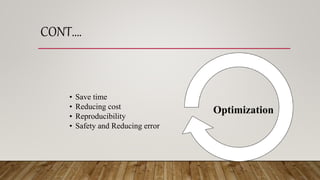
• Save time
• Reducing cost
• Reproducibility
• Safety and Reducing error
Optimization
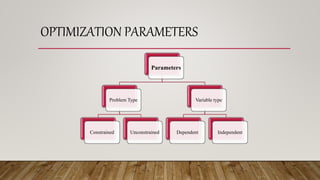
OPTIMIZATION PARAMETERS
Parameters
Problem Type
Constrained Unconstrained
Variable type
Dependent Independent
FACTORIAL DESIGN
• Factorial experiment is an experiment whose design consist of two or more factor each with different
possible valve or ā€œlevelā€.
• Technique introduced by ā€˜Fisher’ in 1926.
• Applied in optimization technique.
• Depends on independent variable for development of new formulation.
• Also depend on ā€œLevelā€ as well as ā€œCodingā€.
• Types of level: 1. Low
2. Intermediate
3. High
TYPES OF FACTORIAL DESIGN
• Factorial design divided into two types: 1. Full Factorial Design
2. Fractional Factorial Design
• Full Factorial Design :
A design in which every setting of every factor appears with setting of every other factors is full factorial design.
Types: 1.two levels Full FD
2.three levels Full FD
Full FD not applicable to factors more than 5.
• Fractional Factorial Design :
The number of experiments can be reduced systemically and resulting design is called as fractional factorial design.
Fractional factorial Design overcome on the limitation of Full factorial Design(applicable to factor more than 5)
OPTIMIZATION TECHNOLOGY AND SCREENING DESIGNS
• Types of Screening Designs…
1. Completely Randomized Designs
2. Randomized Block Designs
3. Factorial Designs
4. Response Surface Designs
5. Central Composite Designs
6. Box-Behnken Designs
7. Three Level Full Factorial Designs
COMPLETELY RANDOMIZED DESIGNS
• It compares the values of response variable based on different level of that primary factor.
• For ex , if there are 3 levels of the primary factor with each level to be run 2 times the
there are 6 factorial possible run sequences.
RANDOMIZED BLOCK DESIGNS
• For this there is one factor or variable that is of primary interest.
• To control non-significant factor , an important technique called blocking can be used to
reduce or eliminate the contribution of these factor to experimental error.
FACTORIAL DESIGNS
• These are the designs og choice for simultaneous determination of the effects of several factors and their
interactions
• Symbols to denote level are:
When both variable are in low concentration
 a – one low variable and second high variable
 b – one high variable and second low variable
 Ab – both variables are high
• Factorial designs are optimal to determined the :
 Effect of pressure and lubricant on the hardness of the tablet
 Effect of disintegrant and lubricant concentration on tablet dissolution.
• It is based in theory of probability and test of significance.
RESPONSE SURFACE DESIGNS
• These model has quadratic form.
• Designs for fitting these types of models are known as response surface designs.
• It defects and yield are the output and the goal is to minimize defects and maximize yield.
• Two most common designs generally used in this response surface modelling are:
I. Central Composite Design
II. Box – Behnken Design
CENTRAL COMPOSITE DESIGN
• This type contain an embedded factorial or fractional factorial design with center point
that is augmented with the group of ā€˜star points’.
• These always contains twice as many star point as there are factors in the design.
• The star points represent new extreme valve for each factor in the design.
• To picture central composite design, it must imagined that there are several factors that
can vary low and high valves .
BOX - BEHNKEN DESIGN
• In these design the treatment combinations are at the midpoints of edges of the process
space and at the center.
• These design are rotatable and require 3 levels of each factor.
• These design for three factor with circled point appearing at the origin and possibly
repeated for several runs. It’s alternative to CCD.
• The design should be sufficient to fit a quadratic model , that justify equation based on
square and products of factors.
THREE – LEVEL FULL FACTORIAL DESIGNS
• It is written as 3k factorial design.
• It means that k factors are considered each at 3 levels.
• These are usually referred to as low , intermediate and high valvues.
• These values are usually expressed as 0, 1and 2.
ETHICS OF COMPUTING IN PHARMACEUTICAL RESEARCH
Introduction :
• There is no doubt that computers , computing technology and the consequent information
systems have produced ethical challenges and conflicts.
• The challenges and conflicts have been presented not only to the practitioner facing new
problems but also to the professional philosopher dealing with computer use at a
conceptual level.
• Computer ethics are increasingly becoming important because of the rising number of
cyber crime issues, including software privacy, unauthorized access, pornography,
spamming, target marketing, and hacking .
ETHICAL ISSUES
• Privacy
• Liability
• Ownership
• Power
COMPUTER IN MARKET ANALYSIS
• Computerized marketing facilitates the collection and dissemination of curremt market
information.
• Most information used in the industry today is acquired through telephone conversations with
other traders.
• Computer aides marketing facilitates more efficient dissemination of current, accurate market
information.
• The result of this analysis were used with other information collected in the survey to draw
important conclusion about the potential to develop a computer aided marketing program.
Computer aided formulation development