GOVT. ENGINEERING
COLLEGE AJMER
Electronics &
Communication
EC-4
Submitted By Submitted To
Pushkar Singh
An Overview
Q-METER(RLC METER)
INTRODUCTION
 Q meter is design for measuring the Q factor of a coil
and for measuring inductance, capacitance and
resistance of an electric circuit at radio frequency. It is
also known as RLC meter.
 A direct-reading instrument which measures the Q of
an electric circuit at radio frequencies by determining
the ratio of inductance to resistance, and which has
also been developed to measure many other
quantities. Also known as quality-factor meter.
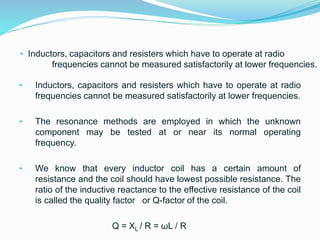
• Inductors, capacitors and resisters which have to operate at radio
frequencies cannot be measured satisfactorily at lower frequencies.
• Inductors, capacitors and resisters which have to operate at radio
frequencies cannot be measured satisfactorily at lower frequencies.
• The resonance methods are employed in which the unknown
component may be tested at or near its normal operating
frequency.
• We know that every inductor coil has a certain amount of
resistance and the coil should have lowest possible resistance. The
ratio of the inductive reactance to the effective resistance of the coil
is called the quality factor or Q-factor of the coil.
Q = XL / R = ωL / R
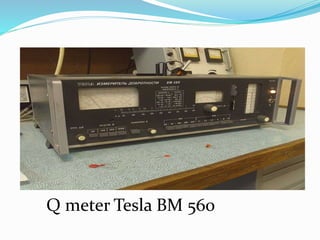
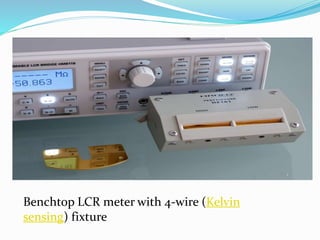
Q meter Tesla BM 560
Benchtop LCR meter with 4-wire (Kelvin
sensing) fixture
CONSTRUCTION
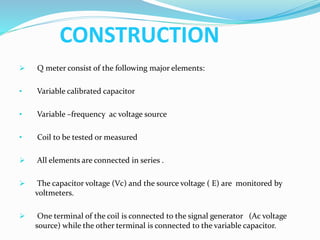
 Q meter consist of the following major elements:
• Variable calibrated capacitor
• Variable –frequency ac voltage source
• Coil to be tested or measured
 All elements are connected in series .
 The capacitor voltage (Vc) and the source voltage ( E) are monitored by
voltmeters.
 One terminal of the coil is connected to the signal generator (Ac voltage
source) while the other terminal is connected to the variable capacitor.
WORKING PRINCIPLE
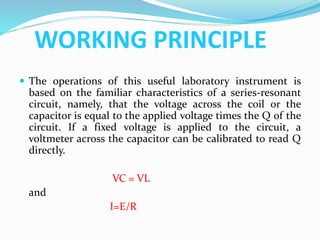
 The operations of this useful laboratory instrument is
based on the familiar characteristics of a series-resonant
circuit, namely, that the voltage across the coil or the
capacitor is equal to the applied voltage times the Q of the
circuit. If a fixed voltage is applied to the circuit, a
voltmeter across the capacitor can be calibrated to read Q
directly.
VC = VL
and
I=E/R
CIRCUIT DIAGRAM
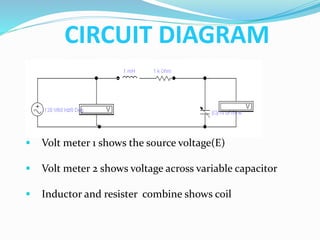
 Volt meter 1 shows the source voltage(E)
 Volt meter 2 shows voltage across variable capacitor
 Inductor and resister combine shows coil
OPERATION
• First of all The oscillator is set to the desired frequency
• Then the tuning Capacitor is adjusted for maximum
value under this condition and if the voltage is kept
constant the voltmeter connected across the capacitor
may be calibrated to read the value of Q directly.
• This measures value of Q in commonly regarded as the Q
of the coil under test.
• There is an error. The measured value of Q is the Q of the whole
circuit and not of the coil.
• Thus the measured value of Q is smaller than the true value.
• Coils of high resistance are being measured the difference between
the two value may be negligible but when measurements are done on
low resistance coils, the error caused on this account may be serious.
VC= VL and I = E/R
Q =ωL/R =1/ωCR
Q=VL/E =VC/E
APPLICATIONS OF A Q-METER
 The Q meter can be used for many purposes. As the
name implies, it can measure Q and is generally used
to check the Q factor of inductors.
 Unknown impedance can be measured using Q-meter,
either by series or shunt substitution method. IF the
impedance to be measured is small, the former is used
and if its large, the latter method is used
 Characteristic impedance of a transmission line can be
measured using series substitution method
• Measurement of quality factor involving comparison of
inductances and capacitances.
 Another use of the Q meter is to measure the value of
small capacitors.
The capacitor sample is resonated
with a selected inductor by adjusting the source
frequency and using the tuning capacitor set to a low
value on its calibrated scale.
THANK YOU

Q meter ppt

  • 1.
    GOVT. ENGINEERING COLLEGE AJMER Electronics& Communication EC-4 Submitted By Submitted To Pushkar Singh
  • 2.
  • 3.
    INTRODUCTION  Q meteris design for measuring the Q factor of a coil and for measuring inductance, capacitance and resistance of an electric circuit at radio frequency. It is also known as RLC meter.  A direct-reading instrument which measures the Q of an electric circuit at radio frequencies by determining the ratio of inductance to resistance, and which has also been developed to measure many other quantities. Also known as quality-factor meter.
  • 4.
    • Inductors, capacitorsand resisters which have to operate at radio frequencies cannot be measured satisfactorily at lower frequencies. • Inductors, capacitors and resisters which have to operate at radio frequencies cannot be measured satisfactorily at lower frequencies. • The resonance methods are employed in which the unknown component may be tested at or near its normal operating frequency. • We know that every inductor coil has a certain amount of resistance and the coil should have lowest possible resistance. The ratio of the inductive reactance to the effective resistance of the coil is called the quality factor or Q-factor of the coil. Q = XL / R = ωL / R
  • 5.
  • 6.
    Benchtop LCR meterwith 4-wire (Kelvin sensing) fixture
  • 7.
    CONSTRUCTION  Q meterconsist of the following major elements: • Variable calibrated capacitor • Variable –frequency ac voltage source • Coil to be tested or measured  All elements are connected in series .  The capacitor voltage (Vc) and the source voltage ( E) are monitored by voltmeters.  One terminal of the coil is connected to the signal generator (Ac voltage source) while the other terminal is connected to the variable capacitor.
  • 8.
    WORKING PRINCIPLE  Theoperations of this useful laboratory instrument is based on the familiar characteristics of a series-resonant circuit, namely, that the voltage across the coil or the capacitor is equal to the applied voltage times the Q of the circuit. If a fixed voltage is applied to the circuit, a voltmeter across the capacitor can be calibrated to read Q directly. VC = VL and I=E/R
  • 9.
    CIRCUIT DIAGRAM  Voltmeter 1 shows the source voltage(E)  Volt meter 2 shows voltage across variable capacitor  Inductor and resister combine shows coil
  • 10.
    OPERATION • First ofall The oscillator is set to the desired frequency • Then the tuning Capacitor is adjusted for maximum value under this condition and if the voltage is kept constant the voltmeter connected across the capacitor may be calibrated to read the value of Q directly. • This measures value of Q in commonly regarded as the Q of the coil under test.
  • 11.
    • There isan error. The measured value of Q is the Q of the whole circuit and not of the coil. • Thus the measured value of Q is smaller than the true value. • Coils of high resistance are being measured the difference between the two value may be negligible but when measurements are done on low resistance coils, the error caused on this account may be serious. VC= VL and I = E/R Q =ωL/R =1/ωCR Q=VL/E =VC/E
  • 12.
    APPLICATIONS OF AQ-METER  The Q meter can be used for many purposes. As the name implies, it can measure Q and is generally used to check the Q factor of inductors.  Unknown impedance can be measured using Q-meter, either by series or shunt substitution method. IF the impedance to be measured is small, the former is used and if its large, the latter method is used  Characteristic impedance of a transmission line can be measured using series substitution method
  • 13.
    • Measurement ofquality factor involving comparison of inductances and capacitances.  Another use of the Q meter is to measure the value of small capacitors. The capacitor sample is resonated with a selected inductor by adjusting the source frequency and using the tuning capacitor set to a low value on its calibrated scale.
  • 14.

Editor's Notes

  • #2 This template can be used as a starter file for presenting training materials in a group setting. Sections Right-click on a slide to add sections. Sections can help to organize your slides or facilitate collaboration between multiple authors. Notes Use the Notes section for delivery notes or to provide additional details for the audience. View these notes in Presentation View during your presentation. Keep in mind the font size (important for accessibility, visibility, videotaping, and online production) Coordinated colors Pay particular attention to the graphs, charts, and text boxes. Consider that attendees will print in black and white or grayscale. Run a test print to make sure your colors work when printed in pure black and white and grayscale. Graphics, tables, and graphs Keep it simple: If possible, use consistent, non-distracting styles and colors. Label all graphs and tables.
  • #4 Give a brief overview of the presentation. Describe the major focus of the presentation and why it is important. Introduce each of the major topics. To provide a road map for the audience, you can repeat this Overview slide throughout the presentation, highlighting the particular topic you will discuss next.
  • #15 Microsoft Confidential