Unit:03
Transducers
By
Prof.Mayur M.Sevak
Electronics and Communication Engg. Department
BVM Engineering College
Introduction
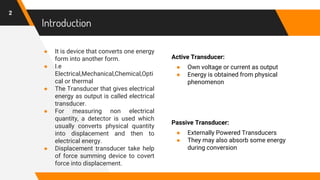
● It is device that converts one energy
form into another form.
● I.e
Electrical,Mechanical,Chemical,Opti
cal or thermal
● The Transducer that gives electrical
energy as output is called electrical
transducer.
● For measuring non electrical
quantity, a detector is used which
usually converts physical quantity
into displacement and then to
electrical energy.
● Displacement transducer take help
of force summing device to covert
force into displacement.
Active Transducer:
● Own voltage or current as output
● Energy is obtained from physical
phenomenon
Passive Transducer:
● Externally Powered Transducers
● They may also absorb some energy
during conversion
2
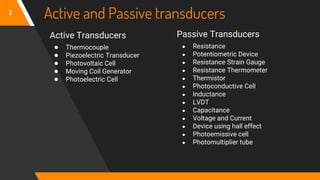
Active and Passive transducers
Passive Transducers
● Resistance
● Potentiometric Device
● Resistance Strain Gauge
● Resistance Thermometer
● Thermistor
● Photoconductive Cell
● Inductance
● LVDT
● Capacitance
● Voltage and Current
● Device using hall effect
● Photoemissive cell
● Photomultiplier tube
3
Active Transducers
● Thermocouple
● Piezoelectric Transducer
● Photovoltaic Cell
● Moving Coil Generator
● Photoelectric Cell
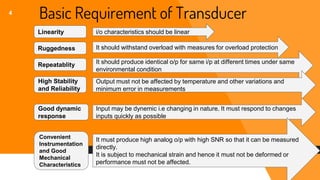
Basic Requirement of Transducer
4
Linearity i/o characteristics should be linear
Ruggedness It should withstand overload with measures for overload protection
Repeatablity It should produce identical o/p for same i/p at different times under same
environmental condition
High Stability
and Reliability
Output must not be affected by temperature and other variations and
minimum error in measurements
Good dynamic
response
Input may be dynemic i.e changing in nature. It must respond to changes
inputs quickly as possible
Convenient
Instrumentation
and Good
Mechanical
Characteristics
It must produce high analog o/p with high SNR so that it can be measured
directly.
It is subject to mechanical strain and hence it must not be deformed or
performance must not be affected.
“
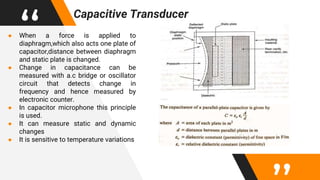
Capacitive Transducer
● When a force is applied to
diaphragm,which also acts one plate of
capacitor,distance between diaphragm
and static plate is changed.
● Change in capacitance can be
measured with a.c bridge or oscillator
circuit that detects change in
frequency and hence measured by
electronic counter.
● In capacitor microphone this principle
is used.
● It can measure static and dynamic
changes
● It is sensitive to temperature variations
Inductive Transducer
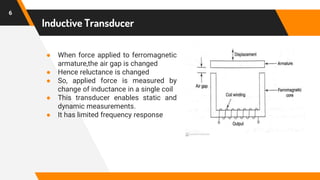
● When force applied to ferromagnetic
armature,the air gap is changed
● Hence reluctance is changed
● So, applied force is measured by
change of inductance in a single coil
● This transducer enables static and
dynamic measurements.
● It has limited frequency response
6
7
Linear Variable Differential Transformer
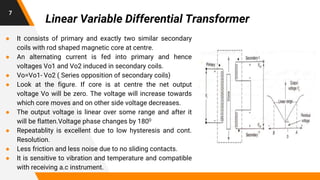
● It consists of primary and exactly two similar secondary
coils with rod shaped magnetic core at centre.
● An alternating current is fed into primary and hence
voltages Vo1 and Vo2 induced in secondary coils.
● Vo=Vo1- Vo2 ( Series opposition of secondary coils)
● Look at the figure. If core is at centre the net output
voltage Vo will be zero. The voltage will increase towards
which core moves and on other side voltage decreases.
● The output voltage is linear over some range and after it
will be flatten.Voltage phase changes by 1800
● Repeatablity is excellent due to low hysteresis and cont.
Resolution.
● Less friction and less noise due to no sliding contacts.
● It is sensitive to vibration and temperature and compatible
with receiving a.c instrument.
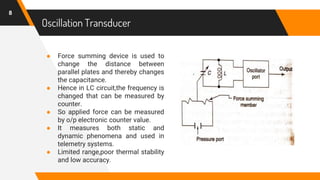
● Force summing device is used to
change the distance between
parallel plates and thereby changes
the capacitance.
● Hence in LC circuit,the frequency is
changed that can be measured by
counter.
● So applied force can be measured
by o/p electronic counter value.
● It measures both static and
dynamic phenomena and used in
telemetry systems.
● Limited range,poor thermal stability
and low accuracy.
Oscillation Transducer
8
Potentiometric Transducer
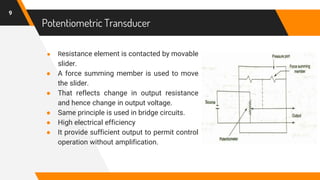
● Resistance element is contacted by movable
slider.
● A force summing member is used to move
the slider.
● That reflects change in output resistance
and hence change in output voltage.
● Same principle is used in bridge circuits.
● High electrical efficiency
● It provide sufficient output to permit control
operation without amplification.
9
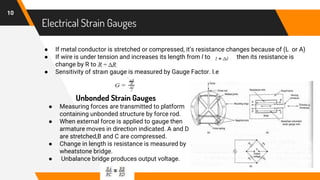
Electrical Strain Gauges
10
● If metal conductor is stretched or compressed, it’s resistance changes because of (L or A)
● If wire is under tension and increases its length from l to then its resistance is
change by R to
● Sensitivity of strain gauge is measured by Gauge Factor. I.e
Unbonded Strain Gauges
● Measuring forces are transmitted to platform
containing unbonded structure by force rod.
● When external force is applied to gauge then
armature moves in direction indicated. A and D
are stretched,B and C are compressed.
● Change in length is resistance is measured by
wheatstone bridge.
● Unbalance bridge produces output voltage.
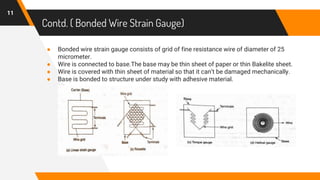
Contd. ( Bonded Wire Strain Gauge)
● Bonded wire strain gauge consists of grid of fine resistance wire of diameter of 25
micrometer.
● Wire is connected to base.The base may be thin sheet of paper or thin Bakelite sheet.
● Wire is covered with thin sheet of material so that it can’t be damaged mechanically.
● Base is bonded to structure under study with adhesive material.
11
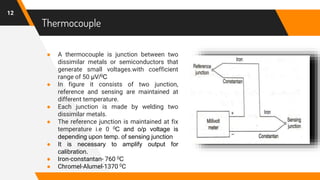
Thermocouple
● A thermocouple is junction between two
dissimilar metals or semiconductors that
generate small voltages.with coefficient
range of 50 µV/0C
● In figure it consists of two junction,
reference and sensing are maintained at
different temperature.
● Each junction is made by welding two
dissimilar metals.
● The reference junction is maintained at fix
temperature i.e 0 0C and o/p voltage is
depending upon temp. of sensing junction
● It is necessary to amplify output for
calibration.
● Iron-constantan- 760 0C
● Chromel-Alumel-1370 0C
12
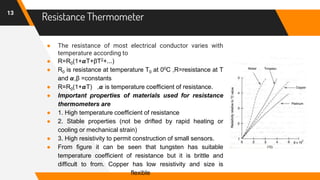
Resistance Thermometer
● The resistance of most electrical conductor varies with
temperature according to
● R=R0(1+𝞪T+βT2+...)
● R0 is resistance at temperature T0 at 00C ,R=resistance at T
and 𝞪,β =constants
● R=R0(1+𝞪T) ,𝞪 is temperature coefficient of resistance.
● Important properties of materials used for resistance
thermometers are
● 1. High temperature coefficient of resistance
● 2. Stable properties (not be drifted by rapid heating or
cooling or mechanical strain)
● 3. High resistivity to permit construction of small sensors.
● From figure it can be seen that tungsten has suitable
temperature coefficient of resistance but it is brittle and
difficult to from. Copper has low resistivity and size is
flexible
13
Contd.
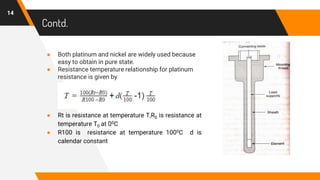
● Both platinum and nickel are widely used because
easy to obtain in pure state.
● Resistance temperature relationship for platinum
resistance is given by
● Rt is resistance at temperature T,R0 is resistance at
temperature T0 at 00C
● R100 is resistance at temperature 1000C d is
calendar constant
14
Thermistor
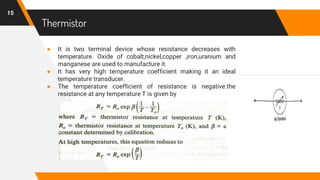
● It is two terminal device whose resistance decreases with
temperature. Oxide of cobalt,nickel,copper ,iron,uranium and
manganese are used to manufacture it.
● It has very high temperature coefficient making it an ideal
temperature transducer.
● The temperature coefficient of resistance is negative.the
resistance at any temperature T is given by
15
Contd.
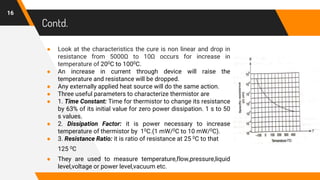
● Look at the characteristics the cure is non linear and drop in
resistance from 5000Ω to 10Ω occurs for increase in
temperature of 200C to 1000C.
● An increase in current through device will raise the
temperature and resistance will be dropped.
● Any externally applied heat source will do the same action.
● Three useful parameters to characterize thermistor are
● 1. Time Constant: Time for thermistor to change its resistance
by 63% of its initial value for zero power dissipation. 1 s to 50
s values.
● 2. Dissipation Factor: it is power necessary to increase
temperature of thermistor by 10C.(1 mW/0C to 10 mW/0C).
● 3. Resistance Ratio: it is ratio of resistance at 25 0C to that
125 0C
● They are used to measure temperature,flow,pressure,liquid
level,voltage or power level,vacuum etc.
16
Piezoelectric transducer
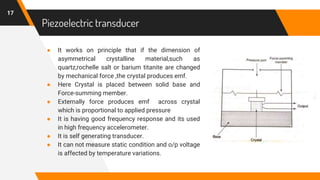
● It works on principle that if the dimension of
asymmetrical crystalline material,such as
quartz,rochelle salt or barium titanite are changed
by mechanical force ,the crystal produces emf.
● Here Crystal is placed between solid base and
Force-summing member.
● Externally force produces emf across crystal
which is proportional to applied pressure
● It is having good frequency response and its used
in high frequency accelerometer.
● It is self generating transducer.
● It can not measure static condition and o/p voltage
is affected by temperature variations.
17
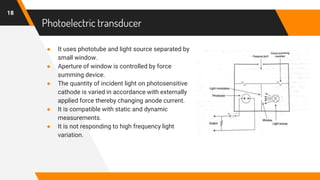
Photoelectric transducer
● It uses phototube and light source separated by
small window.
● Aperture of window is controlled by force
summing device.
● The quantity of incident light on photosensitive
cathode is varied in accordance with externally
applied force thereby changing anode current.
● It is compatible with static and dynamic
measurements.
● It is not responding to high frequency light
variation.
18
19
THANKS!
Any questions?

Transducers

  • 1.
    Unit:03 Transducers By Prof.Mayur M.Sevak Electronics andCommunication Engg. Department BVM Engineering College
  • 2.
    Introduction ● It isdevice that converts one energy form into another form. ● I.e Electrical,Mechanical,Chemical,Opti cal or thermal ● The Transducer that gives electrical energy as output is called electrical transducer. ● For measuring non electrical quantity, a detector is used which usually converts physical quantity into displacement and then to electrical energy. ● Displacement transducer take help of force summing device to covert force into displacement. Active Transducer: ● Own voltage or current as output ● Energy is obtained from physical phenomenon Passive Transducer: ● Externally Powered Transducers ● They may also absorb some energy during conversion 2
  • 3.
    Active and Passivetransducers Passive Transducers ● Resistance ● Potentiometric Device ● Resistance Strain Gauge ● Resistance Thermometer ● Thermistor ● Photoconductive Cell ● Inductance ● LVDT ● Capacitance ● Voltage and Current ● Device using hall effect ● Photoemissive cell ● Photomultiplier tube 3 Active Transducers ● Thermocouple ● Piezoelectric Transducer ● Photovoltaic Cell ● Moving Coil Generator ● Photoelectric Cell
  • 4.
    Basic Requirement ofTransducer 4 Linearity i/o characteristics should be linear Ruggedness It should withstand overload with measures for overload protection Repeatablity It should produce identical o/p for same i/p at different times under same environmental condition High Stability and Reliability Output must not be affected by temperature and other variations and minimum error in measurements Good dynamic response Input may be dynemic i.e changing in nature. It must respond to changes inputs quickly as possible Convenient Instrumentation and Good Mechanical Characteristics It must produce high analog o/p with high SNR so that it can be measured directly. It is subject to mechanical strain and hence it must not be deformed or performance must not be affected.
  • 5.
    “ Capacitive Transducer ● Whena force is applied to diaphragm,which also acts one plate of capacitor,distance between diaphragm and static plate is changed. ● Change in capacitance can be measured with a.c bridge or oscillator circuit that detects change in frequency and hence measured by electronic counter. ● In capacitor microphone this principle is used. ● It can measure static and dynamic changes ● It is sensitive to temperature variations
  • 6.
    Inductive Transducer ● Whenforce applied to ferromagnetic armature,the air gap is changed ● Hence reluctance is changed ● So, applied force is measured by change of inductance in a single coil ● This transducer enables static and dynamic measurements. ● It has limited frequency response 6
  • 7.
    7 Linear Variable DifferentialTransformer ● It consists of primary and exactly two similar secondary coils with rod shaped magnetic core at centre. ● An alternating current is fed into primary and hence voltages Vo1 and Vo2 induced in secondary coils. ● Vo=Vo1- Vo2 ( Series opposition of secondary coils) ● Look at the figure. If core is at centre the net output voltage Vo will be zero. The voltage will increase towards which core moves and on other side voltage decreases. ● The output voltage is linear over some range and after it will be flatten.Voltage phase changes by 1800 ● Repeatablity is excellent due to low hysteresis and cont. Resolution. ● Less friction and less noise due to no sliding contacts. ● It is sensitive to vibration and temperature and compatible with receiving a.c instrument.
  • 8.
    ● Force summingdevice is used to change the distance between parallel plates and thereby changes the capacitance. ● Hence in LC circuit,the frequency is changed that can be measured by counter. ● So applied force can be measured by o/p electronic counter value. ● It measures both static and dynamic phenomena and used in telemetry systems. ● Limited range,poor thermal stability and low accuracy. Oscillation Transducer 8
  • 9.
    Potentiometric Transducer ● Resistanceelement is contacted by movable slider. ● A force summing member is used to move the slider. ● That reflects change in output resistance and hence change in output voltage. ● Same principle is used in bridge circuits. ● High electrical efficiency ● It provide sufficient output to permit control operation without amplification. 9
  • 10.
    Electrical Strain Gauges 10 ●If metal conductor is stretched or compressed, it’s resistance changes because of (L or A) ● If wire is under tension and increases its length from l to then its resistance is change by R to ● Sensitivity of strain gauge is measured by Gauge Factor. I.e Unbonded Strain Gauges ● Measuring forces are transmitted to platform containing unbonded structure by force rod. ● When external force is applied to gauge then armature moves in direction indicated. A and D are stretched,B and C are compressed. ● Change in length is resistance is measured by wheatstone bridge. ● Unbalance bridge produces output voltage.
  • 11.
    Contd. ( BondedWire Strain Gauge) ● Bonded wire strain gauge consists of grid of fine resistance wire of diameter of 25 micrometer. ● Wire is connected to base.The base may be thin sheet of paper or thin Bakelite sheet. ● Wire is covered with thin sheet of material so that it can’t be damaged mechanically. ● Base is bonded to structure under study with adhesive material. 11
  • 12.
    Thermocouple ● A thermocoupleis junction between two dissimilar metals or semiconductors that generate small voltages.with coefficient range of 50 µV/0C ● In figure it consists of two junction, reference and sensing are maintained at different temperature. ● Each junction is made by welding two dissimilar metals. ● The reference junction is maintained at fix temperature i.e 0 0C and o/p voltage is depending upon temp. of sensing junction ● It is necessary to amplify output for calibration. ● Iron-constantan- 760 0C ● Chromel-Alumel-1370 0C 12
  • 13.
    Resistance Thermometer ● Theresistance of most electrical conductor varies with temperature according to ● R=R0(1+𝞪T+βT2+...) ● R0 is resistance at temperature T0 at 00C ,R=resistance at T and 𝞪,β =constants ● R=R0(1+𝞪T) ,𝞪 is temperature coefficient of resistance. ● Important properties of materials used for resistance thermometers are ● 1. High temperature coefficient of resistance ● 2. Stable properties (not be drifted by rapid heating or cooling or mechanical strain) ● 3. High resistivity to permit construction of small sensors. ● From figure it can be seen that tungsten has suitable temperature coefficient of resistance but it is brittle and difficult to from. Copper has low resistivity and size is flexible 13
  • 14.
    Contd. ● Both platinumand nickel are widely used because easy to obtain in pure state. ● Resistance temperature relationship for platinum resistance is given by ● Rt is resistance at temperature T,R0 is resistance at temperature T0 at 00C ● R100 is resistance at temperature 1000C d is calendar constant 14
  • 15.
    Thermistor ● It istwo terminal device whose resistance decreases with temperature. Oxide of cobalt,nickel,copper ,iron,uranium and manganese are used to manufacture it. ● It has very high temperature coefficient making it an ideal temperature transducer. ● The temperature coefficient of resistance is negative.the resistance at any temperature T is given by 15
  • 16.
    Contd. ● Look atthe characteristics the cure is non linear and drop in resistance from 5000Ω to 10Ω occurs for increase in temperature of 200C to 1000C. ● An increase in current through device will raise the temperature and resistance will be dropped. ● Any externally applied heat source will do the same action. ● Three useful parameters to characterize thermistor are ● 1. Time Constant: Time for thermistor to change its resistance by 63% of its initial value for zero power dissipation. 1 s to 50 s values. ● 2. Dissipation Factor: it is power necessary to increase temperature of thermistor by 10C.(1 mW/0C to 10 mW/0C). ● 3. Resistance Ratio: it is ratio of resistance at 25 0C to that 125 0C ● They are used to measure temperature,flow,pressure,liquid level,voltage or power level,vacuum etc. 16
  • 17.
    Piezoelectric transducer ● Itworks on principle that if the dimension of asymmetrical crystalline material,such as quartz,rochelle salt or barium titanite are changed by mechanical force ,the crystal produces emf. ● Here Crystal is placed between solid base and Force-summing member. ● Externally force produces emf across crystal which is proportional to applied pressure ● It is having good frequency response and its used in high frequency accelerometer. ● It is self generating transducer. ● It can not measure static condition and o/p voltage is affected by temperature variations. 17
  • 18.
    Photoelectric transducer ● Ituses phototube and light source separated by small window. ● Aperture of window is controlled by force summing device. ● The quantity of incident light on photosensitive cathode is varied in accordance with externally applied force thereby changing anode current. ● It is compatible with static and dynamic measurements. ● It is not responding to high frequency light variation. 18
  • 19.