Quality Matters @ BarryQuality Matters @ Barry
Inter-CollegiateInter-Collegiate
Quality AssuranceQuality Assurance
in Online Learningin Online Learning
Today’s Session…
• What is QM?
• Why QM @ Barry?
• Introduction and use of QM Rubric
• QM Process and Principles
• Participation in Quality Matters
Quality MattersQuality Matters is . . .is . . .
aa continuous improvement modelcontinuous improvement model
for assuring the qualityfor assuring the quality
of online courses through aof online courses through a
faculty review processfaculty review process..
~~ Fact Sheet ~Fact Sheet ~
Overview
QM Foundations
• Based in national standards of best
practice, the research literature, and
instructional design principles
• Designed to promote student learning
• Integral to continuous quality
improvement
• Part of an inter-institutional, faculty-
driven, collegial peer review process
For Our Purposes, Quality Is…
• More than average;
more than “good
enough”
• An attempt to capture
what’s expected in an
effective online
course at about an
85% level
• Based on research
and widely accepted
standards
85 %
Why QM @ Bucks?
• Accreditation
• Internal Assessments
• Faculty/Student Feedback
• Canvas
What’s in it for Faculty …
• Fresh eyes leads to course improvement
• Quality assurance
• Validates best practices in online learning
• Reduces redundant procedural questions
• More time on teaching
• Expands professional community
What’s in it for Students …
• Cleaner navigation & accessibility
• Faster start: reduced frustration
• Stronger engagement
• Course baseline standards
• Learning objectives & outcomes aligned
• Quality online learning experience
• Success!!
What’s in it for Institutions …
• Gain access to a sustainable, replicable,
scalable QA process
• Strengthens institution’s accreditation
package
• Positively impact articulation agreements
• Provide professional development
activities
• Improve student retention
The ToolsThe Tools
QM RubricQM Rubric
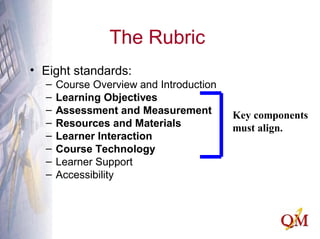
The Rubric
• Eight standards:
– Course Overview and Introduction
– Learning Objectives
– Assessment and Measurement
– Resources and Materials
– Learner Interaction
– Course Technology
– Learner Support
– Accessibility
Key components
must align.
QM Rubric Features
• Online Demo Rubric
• Annotations
• Our Examples
• Exemplary Course (?)
Peer Review Process
• Sometimes teaching an online course
can feel isolating.
• How do we know if our course is
effective?
• How do we make changes to our
course to make it even better for our
students?
• Sometimes we just need a fresh pair of
eyes.
Peer CoursePeer Course
ReviewReview
FeedbackFeedback
CourseCourse
Course Meets QualityCourse Meets Quality
ExpectationsExpectations
CourseCourse
RevisionRevision
Instructional Designers
Institutions
Faculty Course
Developers National Standards &
Research Literature
Rubric
Faculty Reviewers
Training
Quality Matters:Quality Matters:
Course PeerCourse Peer
Review ProcessReview Process
Rubric Scoring
Standards Points Relative Value
14 3 Essential
12 2 Very Important
14 1 Important
TOTALS
40 80
• Team of three (3) reviewers
• One score per standard based on majority
• Assigned point value; not sliding scale
To Meet Expectations…
A course must:
• Rate “Yes” on all 14 of the 3-point
“essential” standards.
• Earn minimum 68 out of 80 points
68/80 = 85%
The QM process is…
• Not about an individual instructor
–It’s about the course
• Not about faculty evaluation
–It’s about course quality
• Not about “winners” and “losers”
–It’s about continuous
improvement in a supportive
environment
Remember...
• Continuous quality improvement is
our goal.
• This is a learning process for us all.
• We’re “constructing” and helping to
determine what “quality matters.”
For more information:
Visit the website:
www.QualityMatters.org
Or contact:
Lyndon Godsall
Rhonda Hill
Thanks to YOU…
Quality Matters
…pass it on!

Q mat barry

  • 1.
    Quality Matters @BarryQuality Matters @ Barry Inter-CollegiateInter-Collegiate Quality AssuranceQuality Assurance in Online Learningin Online Learning
  • 2.
    Today’s Session… • Whatis QM? • Why QM @ Barry? • Introduction and use of QM Rubric • QM Process and Principles • Participation in Quality Matters
  • 3.
    Quality MattersQuality Mattersis . . .is . . . aa continuous improvement modelcontinuous improvement model for assuring the qualityfor assuring the quality of online courses through aof online courses through a faculty review processfaculty review process.. ~~ Fact Sheet ~Fact Sheet ~ Overview
  • 4.
    QM Foundations • Basedin national standards of best practice, the research literature, and instructional design principles • Designed to promote student learning • Integral to continuous quality improvement • Part of an inter-institutional, faculty- driven, collegial peer review process
  • 5.
    For Our Purposes,Quality Is… • More than average; more than “good enough” • An attempt to capture what’s expected in an effective online course at about an 85% level • Based on research and widely accepted standards 85 %
  • 6.
    Why QM @Bucks? • Accreditation • Internal Assessments • Faculty/Student Feedback • Canvas
  • 7.
    What’s in itfor Faculty … • Fresh eyes leads to course improvement • Quality assurance • Validates best practices in online learning • Reduces redundant procedural questions • More time on teaching • Expands professional community
  • 8.
    What’s in itfor Students … • Cleaner navigation & accessibility • Faster start: reduced frustration • Stronger engagement • Course baseline standards • Learning objectives & outcomes aligned • Quality online learning experience • Success!!
  • 9.
    What’s in itfor Institutions … • Gain access to a sustainable, replicable, scalable QA process • Strengthens institution’s accreditation package • Positively impact articulation agreements • Provide professional development activities • Improve student retention
  • 10.
    The ToolsThe Tools QMRubricQM Rubric
  • 11.
    The Rubric • Eightstandards: – Course Overview and Introduction – Learning Objectives – Assessment and Measurement – Resources and Materials – Learner Interaction – Course Technology – Learner Support – Accessibility Key components must align.
  • 12.
    QM Rubric Features •Online Demo Rubric • Annotations • Our Examples • Exemplary Course (?)
  • 13.
    Peer Review Process •Sometimes teaching an online course can feel isolating. • How do we know if our course is effective? • How do we make changes to our course to make it even better for our students? • Sometimes we just need a fresh pair of eyes.
  • 14.
    Peer CoursePeer Course ReviewReview FeedbackFeedback CourseCourse CourseMeets QualityCourse Meets Quality ExpectationsExpectations CourseCourse RevisionRevision Instructional Designers Institutions Faculty Course Developers National Standards & Research Literature Rubric Faculty Reviewers Training Quality Matters:Quality Matters: Course PeerCourse Peer Review ProcessReview Process
  • 15.
    Rubric Scoring Standards PointsRelative Value 14 3 Essential 12 2 Very Important 14 1 Important TOTALS 40 80 • Team of three (3) reviewers • One score per standard based on majority • Assigned point value; not sliding scale
  • 16.
    To Meet Expectations… Acourse must: • Rate “Yes” on all 14 of the 3-point “essential” standards. • Earn minimum 68 out of 80 points 68/80 = 85%
  • 17.
    The QM processis… • Not about an individual instructor –It’s about the course • Not about faculty evaluation –It’s about course quality • Not about “winners” and “losers” –It’s about continuous improvement in a supportive environment
  • 18.
    Remember... • Continuous qualityimprovement is our goal. • This is a learning process for us all. • We’re “constructing” and helping to determine what “quality matters.”
  • 19.
    For more information: Visitthe website: www.QualityMatters.org Or contact: Lyndon Godsall Rhonda Hill
  • 20.
    Thanks to YOU… QualityMatters …pass it on!

Editor's Notes

  • #7 Measurable assignments based on the core