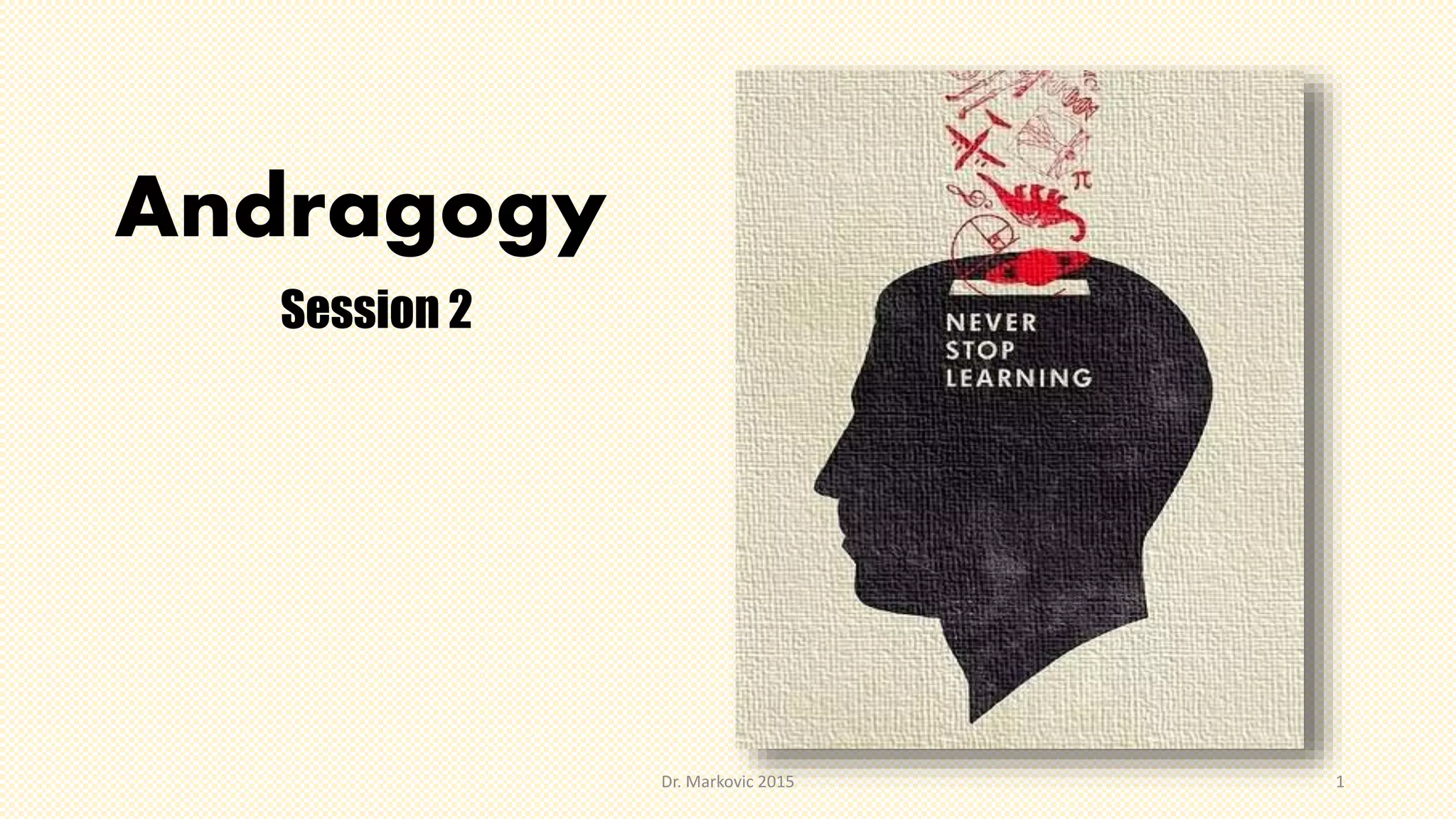
Andragogy
Session 2
1Dr. Markovic 2015
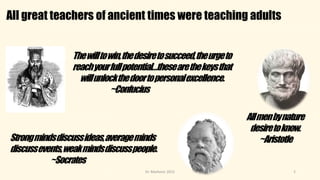
All great teachers of ancient times were teaching adults
2
Thewilltowin,thedesiretosucceed,theurgeto
reachyourfullpotential…thesearethekeysthat
willunlockthedoortopersonalexcellence.
~Confucius
Strongmindsdiscussideas,averageminds
discussevents,weakmindsdiscusspeople.
~Socrates
Allmenbynature
desiretoknow.
~Aristotle
Dr. Markovic 2015
Teaching in Ancient Times
• Learning was perceived as a process of mental inquiry, not passive
reception of transmitted content.
• Ancient techniques for engaging learners
• Chinese and Hebrews - case study method
• Greece - Socratic dialogue
• Rome - Confrontational methods
3Dr. Markovic 2015
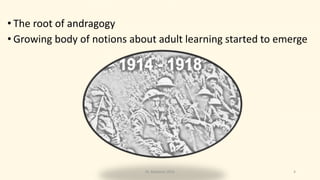
• The root of andragogy
• Growing body of notions about adult learning started to emerge
4Dr. Markovic 2015
1926 American Association of Adult Education
• Scientific stream of inquiry
• Discovering new knowledge through rigorous research
• Artistic stream of inquiry
• Discovering new knowledge through analysis of experience
• Concerned with how adults learn
• Lindeman laid the foundation for a systemic approach to
adult learning
• 6 key assumptions
5Dr. Markovic 2015
Lindeman’s Key Assumptions
1. Adults are motivated to learn as they experience needs and
interest that learning will satisfy
2. Adults’ orientation to learning is life-centered
3. Experience is the richest source for adult’s learning
4. Adults have a deep need to be self-directed
5. Individual differences among people increase with age
6Dr. Markovic 2015
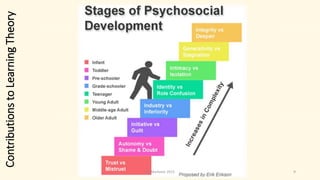
ContributionstoLearningTheory
Identified the effects of subconscious mind on behavior
Human motivation stems from relentless search for pleasure
7Dr. Markovic 2015
ContributionstoLearningTheory
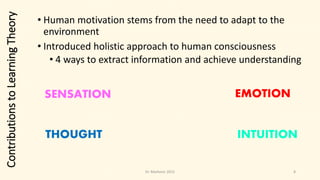
• Human motivation stems from the need to adapt to the
environment
• Introduced holistic approach to human consciousness
• 4 ways to extract information and achieve understanding
8
SENSATION
THOUGHT
EMOTION
INTUITION
Dr. Markovic 2015
ContributionstoLearningTheory
9Dr. Markovic 2015
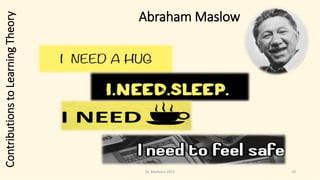
Abraham Maslow
10
ContributionstoLearningTheory
Dr. Markovic 2015
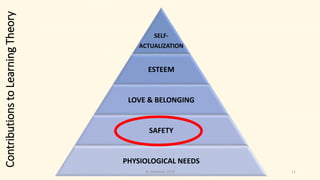
ContributionstoLearningTheory
11
SELF-
ACTUALIZATION
ESTEEM
LOVE & BELONGING
SAFETY
PHYSIOLOGICAL NEEDS
Dr. Markovic 2015
Conceptualized student-centered teaching
5 Basic hypothesis
12
ContributionstoLearningTheory
Dr. Markovic 2015
1. We cannot teach another person directly, we can only
facilitate their learning
• People respond to notions shaped by their experience and
perception
13
ContributionstoLearningTheory
Dr. Markovic 2015
2. A person learns significantly only those things which he
perceives as being involved in the maintenance of, or
enhancement of, the structure of self.
• Learning has to be relevant
14
ContributionstoLearningTheory
Dr. Markovic 2015
3. Experience which, if assimilated would involve a change in the
organization of self, tends to be resisted through denial or distortion of
symbolization.
4. The structure and organization of self appear to become more rigid
under threat and to relax its boundaries when completely free from
threat. Experience which is perceived as inconsistent with the self can
only be assimilated if the current organization of self is relaxed and
expanded to include it.
5. The educational situation that most effectively promotes significant
learning is one in which (a) threat to the self of the learner is reduced
to a minimum, and (b) differentiated perception of the field is
facilitated.
15
ContributionstoLearningTheory
Dr. Markovic 2015
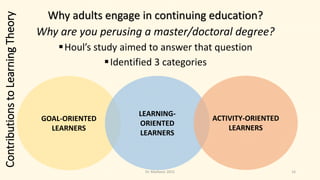
Why adults engage in continuing education?
Why are you perusing a master/doctoral degree?
Houl’s study aimed to answer that question
Identified 3 categories
16
GOAL-ORIENTED
LEARNERS
LEARNING-
ORIENTED
LEARNERS
ACTIVITY-ORIENTED
LEARNERS
ContributionstoLearningTheory
Dr. Markovic 2015
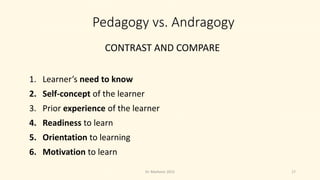
Pedagogy vs. Andragogy
CONTRAST AND COMPARE
1. Learner’s need to know
2. Self-concept of the learner
3. Prior experience of the learner
4. Readiness to learn
5. Orientation to learning
6. Motivation to learn
17Dr. Markovic 2015

Hrd 659 session 2 contributions to learning theory[1]

  • 1.
  • 2.
    All great teachersof ancient times were teaching adults 2 Thewilltowin,thedesiretosucceed,theurgeto reachyourfullpotential…thesearethekeysthat willunlockthedoortopersonalexcellence. ~Confucius Strongmindsdiscussideas,averageminds discussevents,weakmindsdiscusspeople. ~Socrates Allmenbynature desiretoknow. ~Aristotle Dr. Markovic 2015
  • 3.
    Teaching in AncientTimes • Learning was perceived as a process of mental inquiry, not passive reception of transmitted content. • Ancient techniques for engaging learners • Chinese and Hebrews - case study method • Greece - Socratic dialogue • Rome - Confrontational methods 3Dr. Markovic 2015
  • 4.
    • The rootof andragogy • Growing body of notions about adult learning started to emerge 4Dr. Markovic 2015
  • 5.
    1926 American Associationof Adult Education • Scientific stream of inquiry • Discovering new knowledge through rigorous research • Artistic stream of inquiry • Discovering new knowledge through analysis of experience • Concerned with how adults learn • Lindeman laid the foundation for a systemic approach to adult learning • 6 key assumptions 5Dr. Markovic 2015
  • 6.
    Lindeman’s Key Assumptions 1.Adults are motivated to learn as they experience needs and interest that learning will satisfy 2. Adults’ orientation to learning is life-centered 3. Experience is the richest source for adult’s learning 4. Adults have a deep need to be self-directed 5. Individual differences among people increase with age 6Dr. Markovic 2015
  • 7.
    ContributionstoLearningTheory Identified the effectsof subconscious mind on behavior Human motivation stems from relentless search for pleasure 7Dr. Markovic 2015
  • 8.
    ContributionstoLearningTheory • Human motivationstems from the need to adapt to the environment • Introduced holistic approach to human consciousness • 4 ways to extract information and achieve understanding 8 SENSATION THOUGHT EMOTION INTUITION Dr. Markovic 2015
  • 9.
  • 10.
  • 11.
  • 12.
    Conceptualized student-centered teaching 5Basic hypothesis 12 ContributionstoLearningTheory Dr. Markovic 2015
  • 13.
    1. We cannotteach another person directly, we can only facilitate their learning • People respond to notions shaped by their experience and perception 13 ContributionstoLearningTheory Dr. Markovic 2015
  • 14.
    2. A personlearns significantly only those things which he perceives as being involved in the maintenance of, or enhancement of, the structure of self. • Learning has to be relevant 14 ContributionstoLearningTheory Dr. Markovic 2015
  • 15.
    3. Experience which,if assimilated would involve a change in the organization of self, tends to be resisted through denial or distortion of symbolization. 4. The structure and organization of self appear to become more rigid under threat and to relax its boundaries when completely free from threat. Experience which is perceived as inconsistent with the self can only be assimilated if the current organization of self is relaxed and expanded to include it. 5. The educational situation that most effectively promotes significant learning is one in which (a) threat to the self of the learner is reduced to a minimum, and (b) differentiated perception of the field is facilitated. 15 ContributionstoLearningTheory Dr. Markovic 2015
  • 16.
    Why adults engagein continuing education? Why are you perusing a master/doctoral degree? Houl’s study aimed to answer that question Identified 3 categories 16 GOAL-ORIENTED LEARNERS LEARNING- ORIENTED LEARNERS ACTIVITY-ORIENTED LEARNERS ContributionstoLearningTheory Dr. Markovic 2015
  • 17.
    Pedagogy vs. Andragogy CONTRASTAND COMPARE 1. Learner’s need to know 2. Self-concept of the learner 3. Prior experience of the learner 4. Readiness to learn 5. Orientation to learning 6. Motivation to learn 17Dr. Markovic 2015