Center for Teaching and
Learning with Technology
Robert Alan Harris, Assistant Director
Center for Teaching & Learning with Technology
Welcome
Focus of the Presentation
1. What factors influenced our
decision to go with QM
2. Implementation Plan
3. Implementation Plans as an
Educational Experience
4. What’s Next
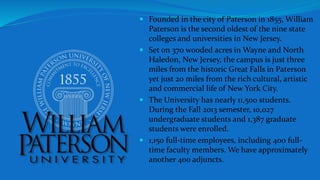
 Founded in the city of Paterson in 1855, William
Paterson is the second oldest of the nine state
colleges and universities in New Jersey.
 Set on 370 wooded acres in Wayne and North
Haledon, New Jersey, the campus is just three
miles from the historic Great Falls in Paterson
yet just 20 miles from the rich cultural, artistic
and commercial life of New York City.
 The University has nearly 11,500 students.
During the Fall 2013 semester, 10,027
undergraduate students and 1,387 graduate
students were enrolled.
 1,150 full-time employees, including 400 full-
time faculty members. We have approximately
another 400 adjuncts.
Research, Review and Experience
 Research has been refined over time and
 Features a comprehensive literature review
 Experience in the field distilled a thorough rubric
 Eight categories
 Forty Three specific elements ranked from essential to
important
 Subscription service : http://www.qualitymatters.org
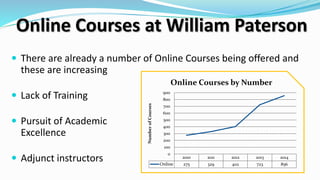
Online Courses at William Paterson
 There are already a number of Online Courses being offered and
these are increasing
 Lack of Training
 Pursuit of Academic
Excellence
 Adjunct instructors 2010 2011 2012 2013 2014
Online 275 329 402 723 856
0
100
200
300
400
500
600
700
800
900
NumberofCourses
Online Courses by Number
Specific Issues
 Limitations of Online Pedagogy Institute
 Good understanding of the design process
 Handy tools and online course templates available for
designing the course
 Quality assurance
What is Quality Matters?
 Quality Matters (QM) is a leader in quality assurance
for online education and has received national
recognition for its peer-based approach to
continuous improvement in online education and
student learning
 Faculty-centered, continuous improvement models for
assuring the quality of online courses through peer
review
 Professional development workshops and certification
courses for instructors and online learning professionals
 Rubrics for applying quality standards to course design
Features of Quality Matters
 A set of standards (rubric) for the design of online and
hybrid courses
 A peer review process (faculty to faculty) for reviewing
and improving online and hybrid courses
 A faculty support tool used by instructional development
staff
 A professional development opportunity
Current QM Applications
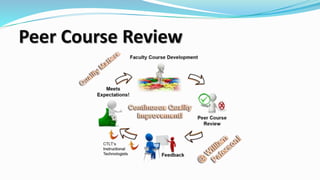
Peer Course Review
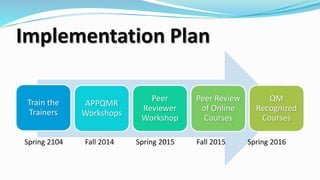
Implementation Plan
Train the
Trainers
APPQMR
Workshops
Peer
Reviewer
Workshop
Peer Review
of Online
Courses
QM
Recognized
Courses
Spring 2104 Fall 2014 Spring 2015 Fall 2015 Spring 2016
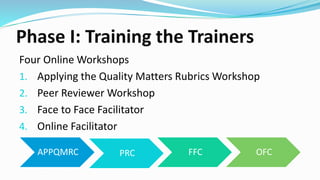
Phase I: Training the Trainers
Four Online Workshops
1. Applying the Quality Matters Rubrics Workshop
2. Peer Reviewer Workshop
3. Face to Face Facilitator
4. Online Facilitator
APPQMRC PRC FFC OFC
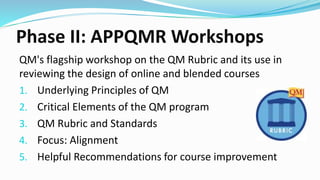
Phase II: APPQMR Workshops
QM's flagship workshop on the QM Rubric and its use in
reviewing the design of online and blended courses
1. Underlying Principles of QM
2. Critical Elements of the QM program
3. QM Rubric and Standards
4. Focus: Alignment
5. Helpful Recommendations for course improvement
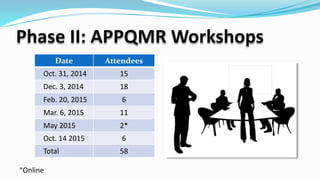
Phase II: APPQMR Workshops
Date Attendees
Oct. 31, 2014 15
Dec. 3, 2014 18
Feb. 20, 2015 6
Mar. 6, 2015 11
May 2015 2*
Oct. 14 2015 6
Total 58
*Online
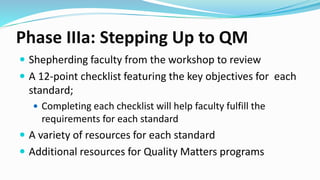
Phase IIIa: Stepping Up to QM
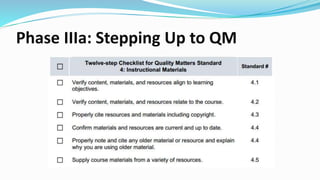
 Shepherding faculty from the workshop to review
 A 12-point checklist featuring the key objectives for each
standard;
 Completing each checklist will help faculty fulfill the
requirements for each standard
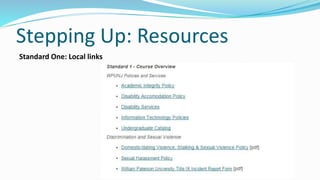
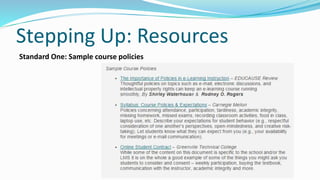
 A variety of resources for each standard
 Additional resources for Quality Matters programs
Phase IIIa: Stepping Up to QM
Stepping Up: Resources
Standard One: Local links
Stepping Up: Resources
Standard One: Sample course policies
Stepping Up: Resources
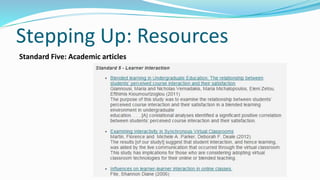
Standard Five: Academic articles
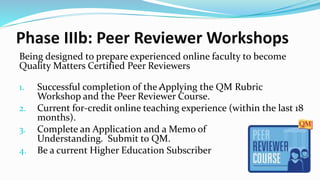
Phase IIIb: Peer Reviewer Workshops
Being designed to prepare experienced online faculty to become
Quality Matters Certified Peer Reviewers
1. Successful completion of the Applying the QM Rubric
Workshop and the Peer Reviewer Course.
2. Current for-credit online teaching experience (within the last 18
months).
3. Complete an Application and a Memo of
Understanding. Submit to QM.
4. Be a current Higher Education Subscriber
*
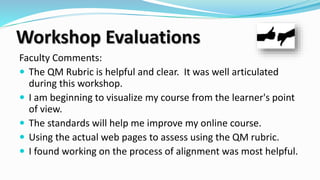
Workshop Evaluations
Faculty Comments:
 The QM Rubric is helpful and clear. It was well articulated
during this workshop.
 I am beginning to visualize my course from the learner's point
of view.
 The standards will help me improve my online course.
 Using the actual web pages to assess using the QM rubric.
 I found working on the process of alignment was most helpful.
Further Evaluations
What was the most surprising element you found in the QM
workshop?
 The most surprising part was that QM has affected all my courses,
not just online courses.
 How scripted the presentations are required to be.
 How appallingly bad some online courses are.
Official Reviews
 Our mistake was to emphasize official reviews
 Faculty seem daunted by the official review process
 Our strategy now is to ramp up to the official review by
starting out with personal reviews
None yet.
Baby steps . . .
Personal Reviews
Coming along!
 In the last month I’ve met with more than a dozen
faculty to introduce them to the personal review
 The next step is to schedule personal reviews
Peer Reviewer Workshops!!
Never happened.
 Reason is simple, a complete lack of interest.
 Faculty are more concerned with getting their own courses in
order than they are with helping others.
 We were ahead of ourselves; interest in peer reviewing should
happen when people have experienced a review themselves.
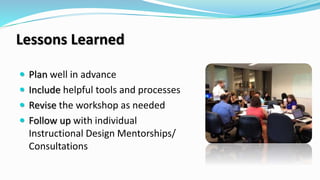
Lessons Learned
 Plan well in advance
 Include helpful tools and processes
 Revise the workshop as needed
 Follow up with individual
Instructional Design Mentorships/
Consultations
What’s Next
 Office consultations
• We can’t expect them to come to us
 Push self reviews as
• Help with a course, or
• Experience for an official review
 Improving your Online Course – State license?!
Any Questions?
Contact info:
Robert Alan Harris, MLS
William Paterson University
300 Pompton Rd, Wayne NJ
Office: Cheng Library 120h
Email: harrisr@wpunj.edu
Phone: 973 720.2451

Qualty matters @ William Paterson

  • 1.
    Center for Teachingand Learning with Technology Robert Alan Harris, Assistant Director Center for Teaching & Learning with Technology
  • 2.
  • 3.
    Focus of thePresentation 1. What factors influenced our decision to go with QM 2. Implementation Plan 3. Implementation Plans as an Educational Experience 4. What’s Next
  • 4.
     Founded inthe city of Paterson in 1855, William Paterson is the second oldest of the nine state colleges and universities in New Jersey.  Set on 370 wooded acres in Wayne and North Haledon, New Jersey, the campus is just three miles from the historic Great Falls in Paterson yet just 20 miles from the rich cultural, artistic and commercial life of New York City.  The University has nearly 11,500 students. During the Fall 2013 semester, 10,027 undergraduate students and 1,387 graduate students were enrolled.  1,150 full-time employees, including 400 full- time faculty members. We have approximately another 400 adjuncts.
  • 6.
    Research, Review andExperience  Research has been refined over time and  Features a comprehensive literature review  Experience in the field distilled a thorough rubric  Eight categories  Forty Three specific elements ranked from essential to important  Subscription service : http://www.qualitymatters.org
  • 7.
    Online Courses atWilliam Paterson  There are already a number of Online Courses being offered and these are increasing  Lack of Training  Pursuit of Academic Excellence  Adjunct instructors 2010 2011 2012 2013 2014 Online 275 329 402 723 856 0 100 200 300 400 500 600 700 800 900 NumberofCourses Online Courses by Number
  • 8.
    Specific Issues  Limitationsof Online Pedagogy Institute  Good understanding of the design process  Handy tools and online course templates available for designing the course  Quality assurance
  • 9.
    What is QualityMatters?  Quality Matters (QM) is a leader in quality assurance for online education and has received national recognition for its peer-based approach to continuous improvement in online education and student learning
  • 10.
     Faculty-centered, continuousimprovement models for assuring the quality of online courses through peer review  Professional development workshops and certification courses for instructors and online learning professionals  Rubrics for applying quality standards to course design Features of Quality Matters
  • 11.
     A setof standards (rubric) for the design of online and hybrid courses  A peer review process (faculty to faculty) for reviewing and improving online and hybrid courses  A faculty support tool used by instructional development staff  A professional development opportunity Current QM Applications
  • 12.
  • 14.
    Implementation Plan Train the Trainers APPQMR Workshops Peer Reviewer Workshop PeerReview of Online Courses QM Recognized Courses Spring 2104 Fall 2014 Spring 2015 Fall 2015 Spring 2016
  • 15.
    Phase I: Trainingthe Trainers Four Online Workshops 1. Applying the Quality Matters Rubrics Workshop 2. Peer Reviewer Workshop 3. Face to Face Facilitator 4. Online Facilitator APPQMRC PRC FFC OFC
  • 16.
    Phase II: APPQMRWorkshops QM's flagship workshop on the QM Rubric and its use in reviewing the design of online and blended courses 1. Underlying Principles of QM 2. Critical Elements of the QM program 3. QM Rubric and Standards 4. Focus: Alignment 5. Helpful Recommendations for course improvement
  • 17.
    Phase II: APPQMRWorkshops Date Attendees Oct. 31, 2014 15 Dec. 3, 2014 18 Feb. 20, 2015 6 Mar. 6, 2015 11 May 2015 2* Oct. 14 2015 6 Total 58 *Online
  • 18.
    Phase IIIa: SteppingUp to QM  Shepherding faculty from the workshop to review  A 12-point checklist featuring the key objectives for each standard;  Completing each checklist will help faculty fulfill the requirements for each standard  A variety of resources for each standard  Additional resources for Quality Matters programs
  • 19.
  • 20.
  • 21.
    Stepping Up: Resources StandardOne: Sample course policies
  • 22.
    Stepping Up: Resources StandardFive: Academic articles
  • 23.
    Phase IIIb: PeerReviewer Workshops Being designed to prepare experienced online faculty to become Quality Matters Certified Peer Reviewers 1. Successful completion of the Applying the QM Rubric Workshop and the Peer Reviewer Course. 2. Current for-credit online teaching experience (within the last 18 months). 3. Complete an Application and a Memo of Understanding. Submit to QM. 4. Be a current Higher Education Subscriber *
  • 25.
    Workshop Evaluations Faculty Comments: The QM Rubric is helpful and clear. It was well articulated during this workshop.  I am beginning to visualize my course from the learner's point of view.  The standards will help me improve my online course.  Using the actual web pages to assess using the QM rubric.  I found working on the process of alignment was most helpful.
  • 26.
    Further Evaluations What wasthe most surprising element you found in the QM workshop?  The most surprising part was that QM has affected all my courses, not just online courses.  How scripted the presentations are required to be.  How appallingly bad some online courses are.
  • 27.
    Official Reviews  Ourmistake was to emphasize official reviews  Faculty seem daunted by the official review process  Our strategy now is to ramp up to the official review by starting out with personal reviews None yet. Baby steps . . .
  • 28.
    Personal Reviews Coming along! In the last month I’ve met with more than a dozen faculty to introduce them to the personal review  The next step is to schedule personal reviews
  • 29.
    Peer Reviewer Workshops!! Neverhappened.  Reason is simple, a complete lack of interest.  Faculty are more concerned with getting their own courses in order than they are with helping others.  We were ahead of ourselves; interest in peer reviewing should happen when people have experienced a review themselves.
  • 30.
    Lessons Learned  Planwell in advance  Include helpful tools and processes  Revise the workshop as needed  Follow up with individual Instructional Design Mentorships/ Consultations
  • 31.
    What’s Next  Officeconsultations • We can’t expect them to come to us  Push self reviews as • Help with a course, or • Experience for an official review  Improving your Online Course – State license?!
  • 32.
    Any Questions? Contact info: RobertAlan Harris, MLS William Paterson University 300 Pompton Rd, Wayne NJ Office: Cheng Library 120h Email: harrisr@wpunj.edu Phone: 973 720.2451