The Professional Behaviours 
Framework 
it’s role in Leadership 
and 
our experience at the RVC
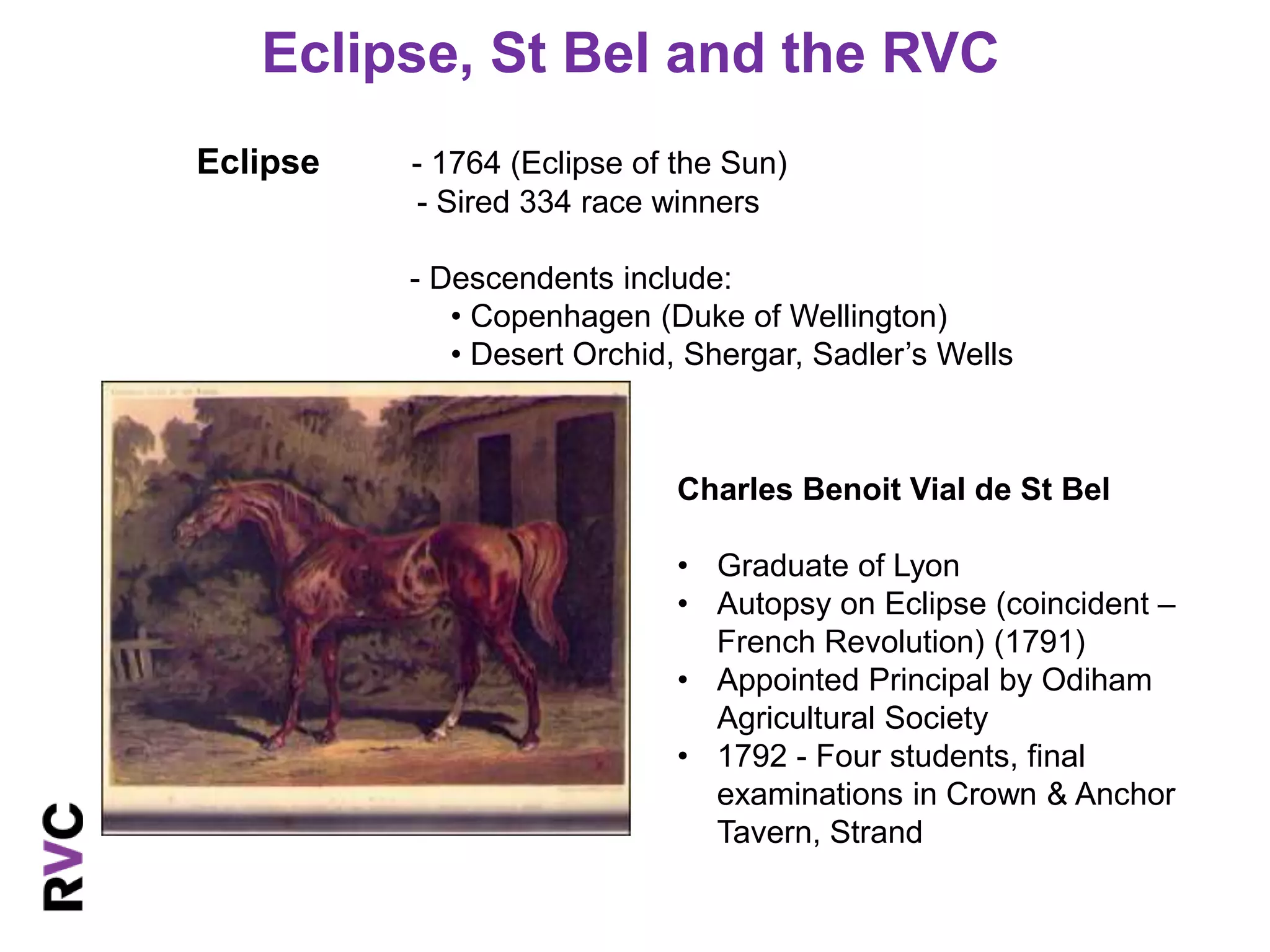
Eclipse, St Bel and the RVC 
Eclipse - 1764 (Eclipse of the Sun) 
- Sired 334 race winners 
- Descendents include: 
• Copenhagen (Duke of Wellington) 
• Desert Orchid, Shergar, Sadler’s Wells 
Charles Benoit Vial de St Bel 
• Graduate of Lyon 
• Autopsy on Eclipse (coincident – 
French Revolution) (1791) 
• Appointed Principal by Odiham 
Agricultural Society 
• 1792 - Four students, final 
examinations in Crown & Anchor 
Tavern, Strand
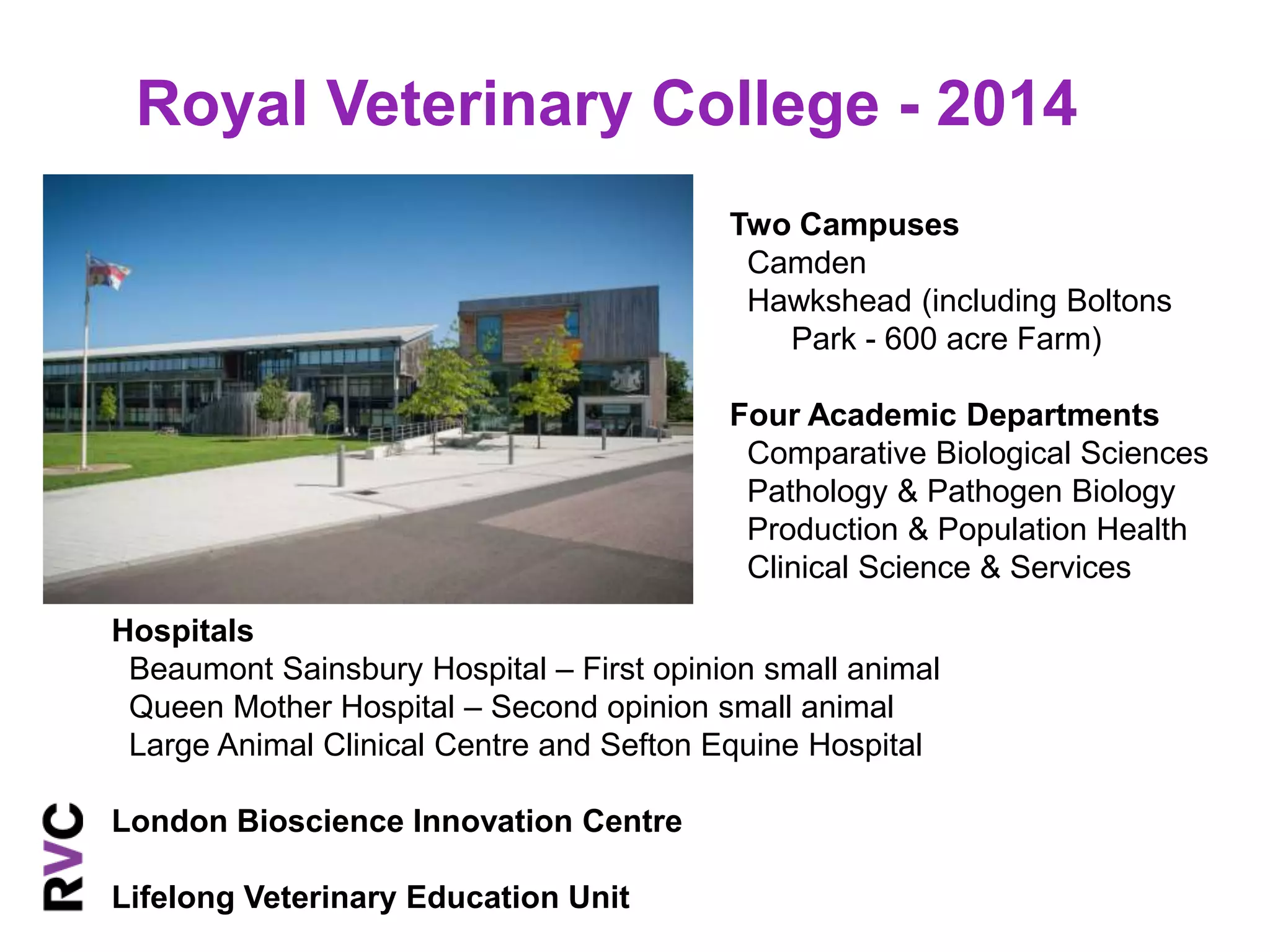
Royal Veterinary College - 2014 
Two Campuses 
Camden 
Hawkshead (including Boltons 
Park - 600 acre Farm) 
Four Academic Departments 
Comparative Biological Sciences 
Pathology & Pathogen Biology 
Production & Population Health 
Clinical Science & Services 
Hospitals 
Beaumont Sainsbury Hospital – First opinion small animal 
Queen Mother Hospital – Second opinion small animal 
Large Animal Clinical Centre and Sefton Equine Hospital 
London Bioscience Innovation Centre 
Lifelong Veterinary Education Unit
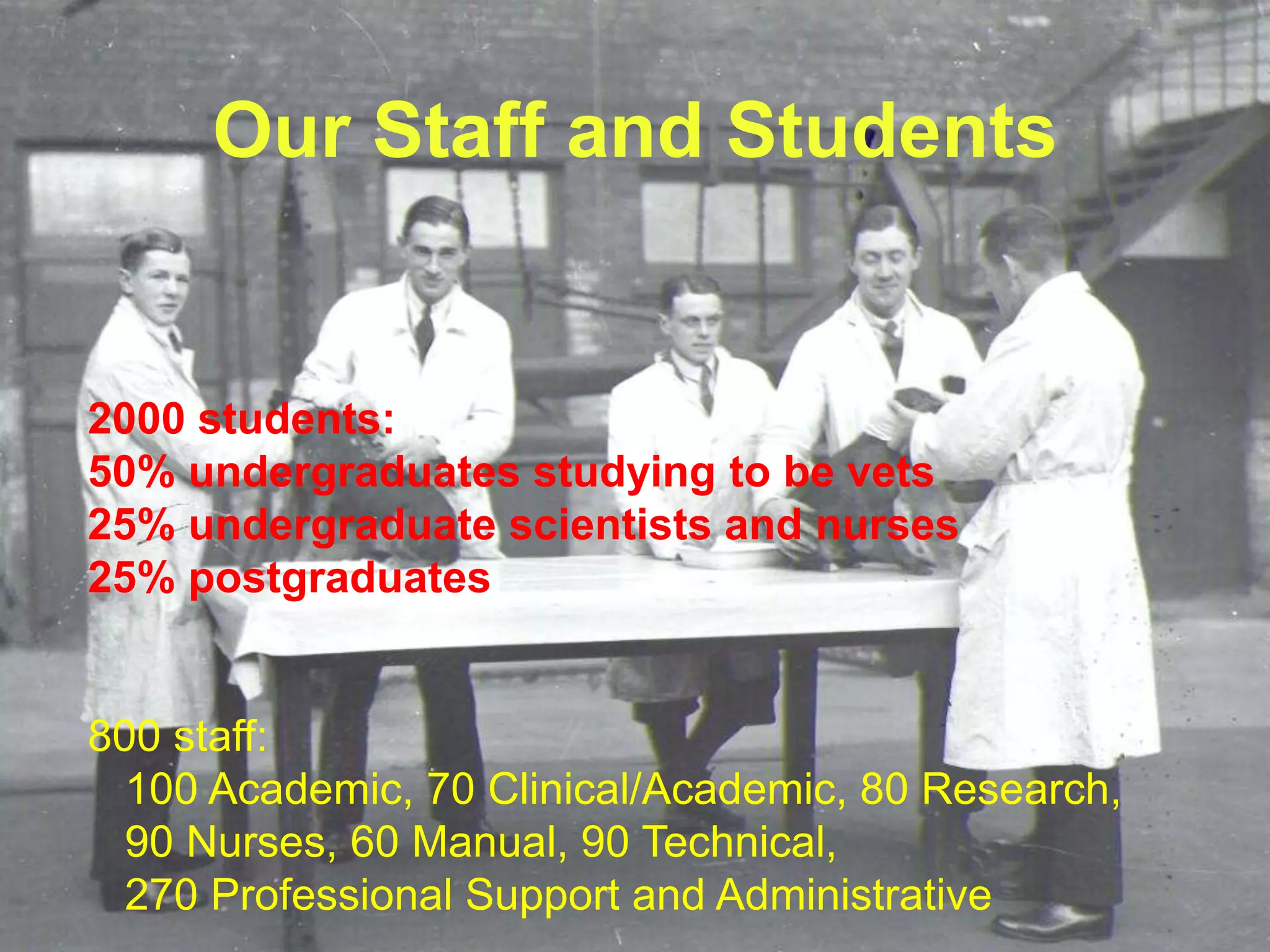
Our Staff and Students 
2000 students: 
50% undergraduates studying to be vets 
25% undergraduate scientists and nurses 
25% postgraduates 
800 staff: 
100 Academic, 70 Clinical/Academic, 80 Research, 
90 Nurses, 60 Manual, 90 Technical, 
270 Professional Support and Administrative
Starting to think about things…… 
In Pairs: 
For 2 minutes 
Count up how many organisational scandals you 
can think of since 2008: Banks, MPs 
expenses……….(very small RVC prize for highest 
number). 
For 10 minutes discuss: 
Where are the checks and balances in your 
University to stop such a thing happening, who are 
the people; how is it done?
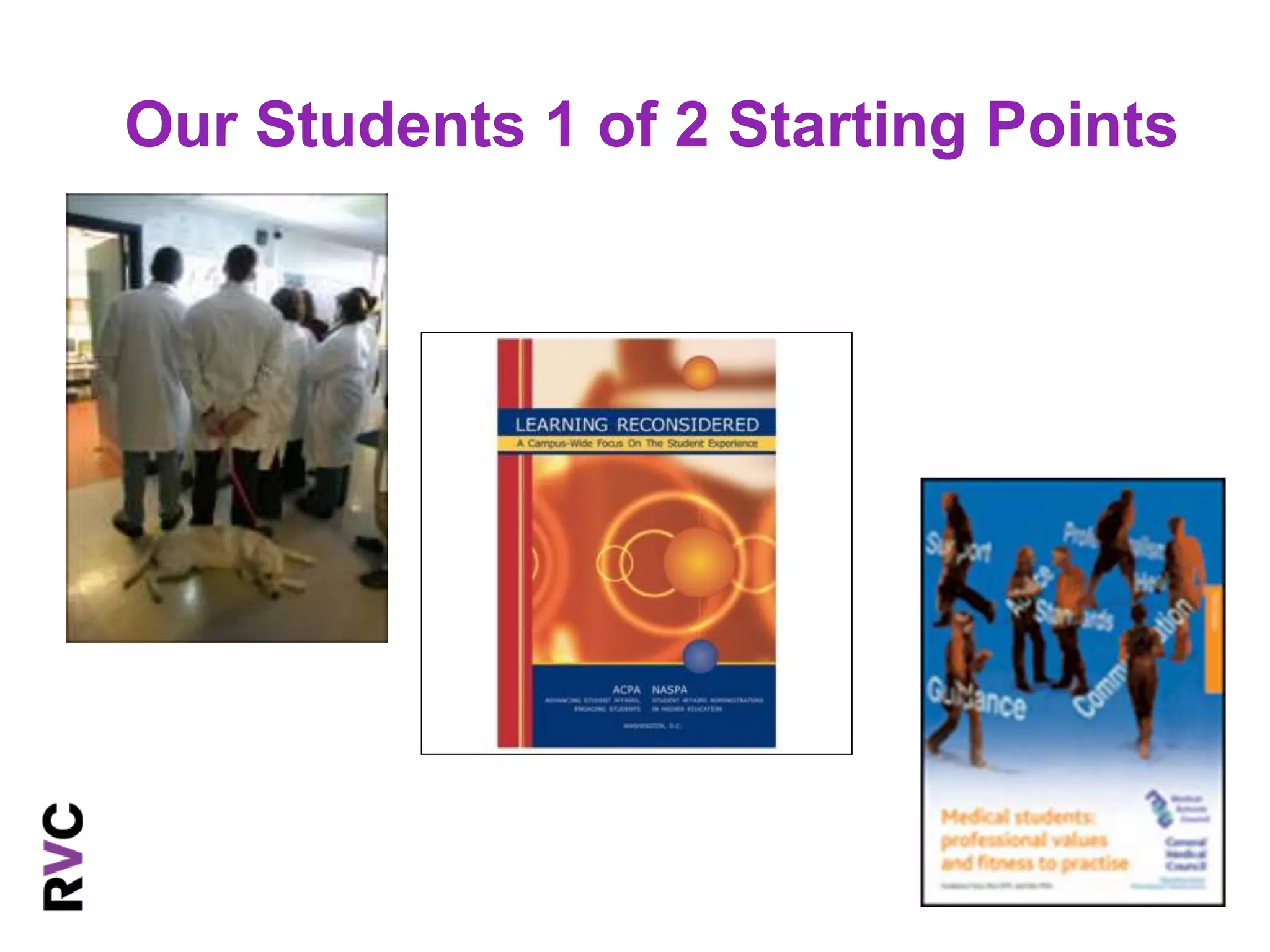
Our Students 1 of 2 Starting Points
Society Within a University 
Role models matter to students – that’s us 
Hidden curriculum 
What goes around comes around
Where Using Behaviours Comes In 
So it would be useful in the Society context of 
University life – staff and students. 
Equally critical right now though is the fact that 
for many people working in HE, this is the 
most significant period of change they have 
experienced in the course of their careers.
Some of the risks and threats 
Nationally we face: 
Market Challenges and the need to secure additional 
funding sources = ‘Agility Agenda’ 
Data as a Driver and its threats (Gibbs 2013) 
Procedures lagging behind technology 
Pace of IT change (www.raceagainstthemachine.com)
Threats and Tricky Situations 
In groups of 4 
• Choose a threat or a tricky situation in your 
organisation or a previous organisation 
• How was it handled? 
• What values were displayed? 
• Who was involved? 
We’re hoping you found it was lots of different 
people
People are Important 
Towards a ‘Psychological Contract’ 
The success of any institution depends on the 
knowledge, skills, and motivation of its people 
Knowledge and skills are easy to measure 
Motivation is the challenge
A Changing World 
In a changing environment the only thing you KNOW 
is wrong is NOT to change 
“The stupidest thing is to keep on doing the same 
thing, expecting a different result” * 
“It’s not the strongest that survive, nor the cleverest. 
It’s the most flexible” ** 
The challenge is deciding which changes to make 
* Albert Einstein ** Charles Darwin
So……………. 
It is how our teams are that matters. We need resilient, 
creative, thinking teams that deal with a rapidly changing 
environment 
We want students and staff to be part of the same team 
ONE Vet College. We have one Charter for both. 
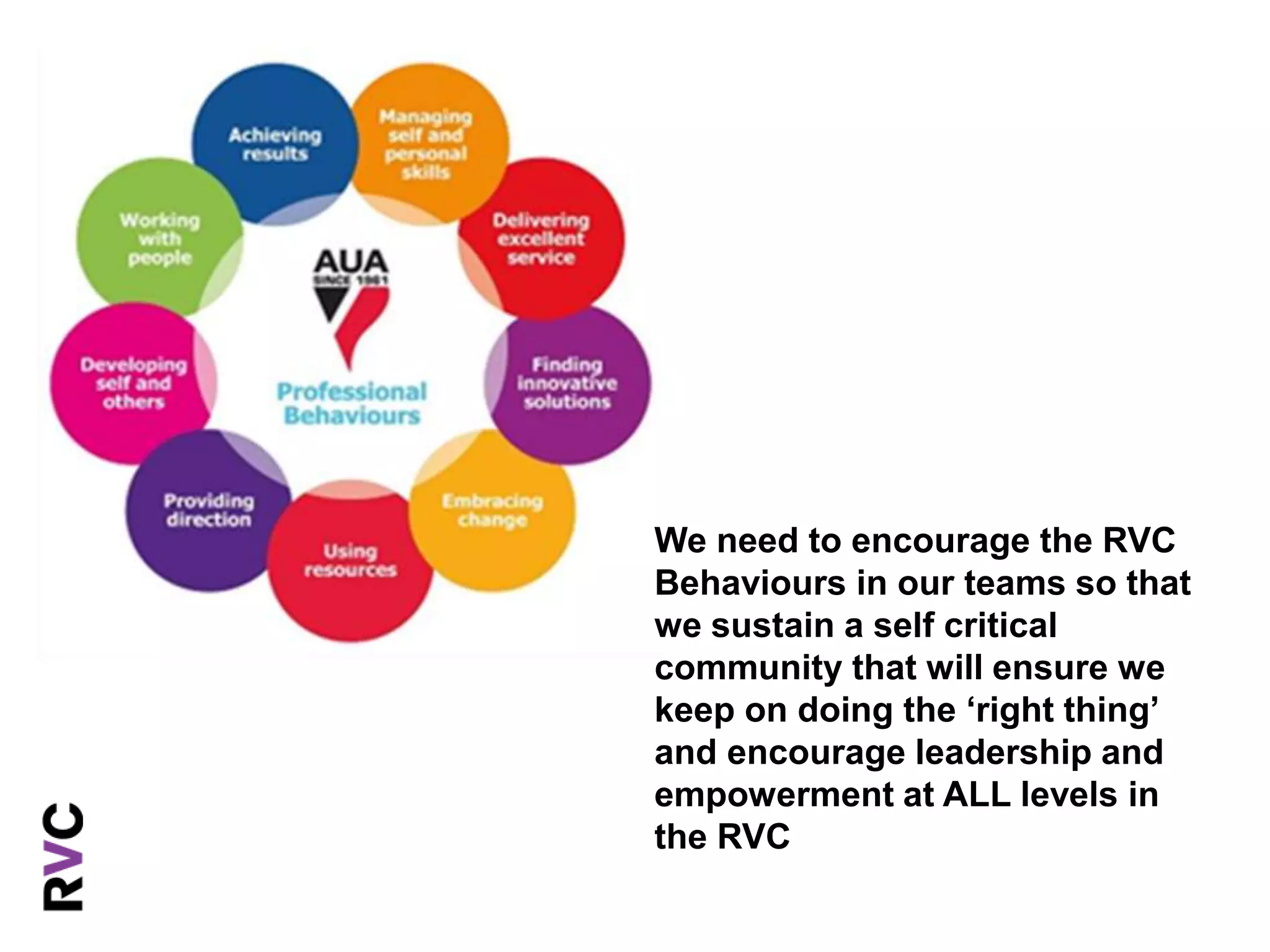
We need the AUA PBF - translated into RVC Behaviours! 
Behaviours and Values together will help us in this era of 
conflicting pressures. We still need to find the ‘right thing’ to 
do. We need to maintain our personal consciousness of 
both – to be mindful as an organisation and as individuals
We need to encourage the RVC 
Behaviours in our teams so that 
we sustain a self critical 
community that will ensure we 
keep on doing the ‘right thing’ 
and encourage leadership and 
empowerment at ALL levels in 
the RVC
From Potential to First Steps - Staff 
Used in appraisal 
• Pilot in 2012 
• Planned to implement across the College in 2013 
However, now embedded in ……………. 
Professional Services Probation 
Academic Career Progression 
and 
Potential to be used in managing employee relations 
It demands reflection – and that’s hard
Characteristics of Leadership 
• Proactive vs Reactive 
• Flexible/Adaptable 
• Good Communication 
• Enthusiastic 
• Open-minded 
• Resourceful 
• Open to change 
• Interested in Feedback 
• Evaluative – through Reflection? 
• Organised 
• Consistent 
• Uses Initiative 
• Takes responsibility - ownership of problems 
• Honest 
• Inspiring
What is Leadership 
How can it be defined? 
In groups: 
• Define/describe the core criteria of leadership 
• Is this what you see in your organisation? 
• At what point in the hierarchy does leadership ‘kick in’? 
• Do people in your Institution merge leadership and management into 
one? 
• How do your leaders enable their staff to protect and promote the 
University? 
• Are they different?
Promoting Reflection: 
Key to the Future 
Skills & knowledge = what 
Motivation = how 
Key to motivation is reflection 
Not just on what you do but where and why you do it 
You can reflect on your own performance and hopefully 
improve it 
But you can also reflect on ………. 
- the organisation you work for AND 
- how it goes about it’s business AND 
- what is your contribution and responsibility to the whole
About the Royal Veterinary College 
Our Vision 
To be the place of recommendation for education, 
clinical care, expert opinion and employment in 
veterinary medicine and science 
Our Mission 
To provide visionary leadership and excellence in 
veterinary science through innovative scholarship 
and pioneering clinical activity
Your thoughts??????

Development Conference 2014, The Professional Behaviours Framework,Ian Darker and Julie Clark

  • 1.
    The Professional Behaviours Framework it’s role in Leadership and our experience at the RVC
  • 2.
    Eclipse, St Beland the RVC Eclipse - 1764 (Eclipse of the Sun) - Sired 334 race winners - Descendents include: • Copenhagen (Duke of Wellington) • Desert Orchid, Shergar, Sadler’s Wells Charles Benoit Vial de St Bel • Graduate of Lyon • Autopsy on Eclipse (coincident – French Revolution) (1791) • Appointed Principal by Odiham Agricultural Society • 1792 - Four students, final examinations in Crown & Anchor Tavern, Strand
  • 3.
    Royal Veterinary College- 2014 Two Campuses Camden Hawkshead (including Boltons Park - 600 acre Farm) Four Academic Departments Comparative Biological Sciences Pathology & Pathogen Biology Production & Population Health Clinical Science & Services Hospitals Beaumont Sainsbury Hospital – First opinion small animal Queen Mother Hospital – Second opinion small animal Large Animal Clinical Centre and Sefton Equine Hospital London Bioscience Innovation Centre Lifelong Veterinary Education Unit
  • 4.
    Our Staff andStudents 2000 students: 50% undergraduates studying to be vets 25% undergraduate scientists and nurses 25% postgraduates 800 staff: 100 Academic, 70 Clinical/Academic, 80 Research, 90 Nurses, 60 Manual, 90 Technical, 270 Professional Support and Administrative
  • 5.
    Starting to thinkabout things…… In Pairs: For 2 minutes Count up how many organisational scandals you can think of since 2008: Banks, MPs expenses……….(very small RVC prize for highest number). For 10 minutes discuss: Where are the checks and balances in your University to stop such a thing happening, who are the people; how is it done?
  • 6.
    Our Students 1of 2 Starting Points
  • 7.
    Society Within aUniversity Role models matter to students – that’s us Hidden curriculum What goes around comes around
  • 8.
    Where Using BehavioursComes In So it would be useful in the Society context of University life – staff and students. Equally critical right now though is the fact that for many people working in HE, this is the most significant period of change they have experienced in the course of their careers.
  • 9.
    Some of therisks and threats Nationally we face: Market Challenges and the need to secure additional funding sources = ‘Agility Agenda’ Data as a Driver and its threats (Gibbs 2013) Procedures lagging behind technology Pace of IT change (www.raceagainstthemachine.com)
  • 10.
    Threats and TrickySituations In groups of 4 • Choose a threat or a tricky situation in your organisation or a previous organisation • How was it handled? • What values were displayed? • Who was involved? We’re hoping you found it was lots of different people
  • 11.
    People are Important Towards a ‘Psychological Contract’ The success of any institution depends on the knowledge, skills, and motivation of its people Knowledge and skills are easy to measure Motivation is the challenge
  • 12.
    A Changing World In a changing environment the only thing you KNOW is wrong is NOT to change “The stupidest thing is to keep on doing the same thing, expecting a different result” * “It’s not the strongest that survive, nor the cleverest. It’s the most flexible” ** The challenge is deciding which changes to make * Albert Einstein ** Charles Darwin
  • 13.
    So……………. It ishow our teams are that matters. We need resilient, creative, thinking teams that deal with a rapidly changing environment We want students and staff to be part of the same team ONE Vet College. We have one Charter for both. We need the AUA PBF - translated into RVC Behaviours! Behaviours and Values together will help us in this era of conflicting pressures. We still need to find the ‘right thing’ to do. We need to maintain our personal consciousness of both – to be mindful as an organisation and as individuals
  • 14.
    We need toencourage the RVC Behaviours in our teams so that we sustain a self critical community that will ensure we keep on doing the ‘right thing’ and encourage leadership and empowerment at ALL levels in the RVC
  • 15.
    From Potential toFirst Steps - Staff Used in appraisal • Pilot in 2012 • Planned to implement across the College in 2013 However, now embedded in ……………. Professional Services Probation Academic Career Progression and Potential to be used in managing employee relations It demands reflection – and that’s hard
  • 16.
    Characteristics of Leadership • Proactive vs Reactive • Flexible/Adaptable • Good Communication • Enthusiastic • Open-minded • Resourceful • Open to change • Interested in Feedback • Evaluative – through Reflection? • Organised • Consistent • Uses Initiative • Takes responsibility - ownership of problems • Honest • Inspiring
  • 17.
    What is Leadership How can it be defined? In groups: • Define/describe the core criteria of leadership • Is this what you see in your organisation? • At what point in the hierarchy does leadership ‘kick in’? • Do people in your Institution merge leadership and management into one? • How do your leaders enable their staff to protect and promote the University? • Are they different?
  • 18.
    Promoting Reflection: Keyto the Future Skills & knowledge = what Motivation = how Key to motivation is reflection Not just on what you do but where and why you do it You can reflect on your own performance and hopefully improve it But you can also reflect on ………. - the organisation you work for AND - how it goes about it’s business AND - what is your contribution and responsibility to the whole
  • 19.
    About the RoyalVeterinary College Our Vision To be the place of recommendation for education, clinical care, expert opinion and employment in veterinary medicine and science Our Mission To provide visionary leadership and excellence in veterinary science through innovative scholarship and pioneering clinical activity
  • 20.

Editor's Notes

  • #5 Up to 3 minutes at end of this slide
  • #6 Minute 23
  • #8 Expectations, Values, Behaviours – all critical
  • #9 Such change means that people need to be skilled up and geared up to deal with it – to ‘ride’ it and manage it rather than let it control them totally This is not traditional skills development and it applies at all levels in an organisation People need to be equipped
  • #10  30 mins up to here
  • #11  45minutes at end of this 15minute exercise. If you don’t use AUA CPDF at your institution – Could it be of benefit? If you do use it – is it delivering what you want it to deliver? Could you make changes/tweaks? Is more training required? Where is reflection in this piece?
  • #14  Over to Ian here At the RVC – with these challenges - we need strong, consistent Behaviours across the College, embedded Values and Empowered individuals at whatever ‘level’ they are in the institution. We need to have a common understanding of how we need to be and to act We need a common language to communicate regarding behaviours We need people to be the best that they can be – to reach their potential We need to all be responsible The ‘Institutional Conscience’
  • #16  55 minutes at end of this slide By embedding it provides clarity and consistency about what is required by each person Also reflection helps with development but this can be hard and we are considering what we need to do to help people to be able to ‘reflect’ Reflection can be difficult but it needs to become a habit and we need to set aside time to do it to get the best value from it
  • #17 LEADERSHIP involves VISION, COMMUNICATION AND JUDGEMENT On the slide are some of the characteristics of leadership which we are trying to encourage They are characteristics which could be demonstrated by anyone at any level of an organisation Empowerment is key The AUA PDF has been the starting point and we have built on this Interestingly, the AUA CPDF/RVC Behaviours and ‘Characteristics of Leadership’ are congruent and map onto each other THERE IS A LINK
  • #18 15 minues for this should be at 75 mins at the end of it. As a side note, when we were tailoring the AUA PDF for RVC use the focus groups after great discussion decided that the different elements of the behaviours applied to people at all levels so that everyone took responsibility at their appropriate level or took initiative or tried to manage costs etc. This was felt quite profoundly. Provision of opportunities to enable everyone to be the best that they can be to reach their potential. Olympics – gamesmakers demonstrated leadership but did not necessarily have great authority BUT were empowered and engaged
  • #19  Should be 80 minutes at end of this slide. So, by embedding the Behaviours into our processes we are hoping to effect Culture Change and to encourage Leadership at all levels To prepare us for the challenges that lie ahead.
  • #20 Where are we? On the way – we have a shared enterprise with support throughout the College Direction of travel is right Everyone is involved – ACADEMICS / NON-ACADEMICS / STUDENTS It is a TEAM thing – a ONE VET COLLEGE – COLLEGIATE ENTERPRISE