Design a 200 Watt, 150 Vrms PWM Bipolar Inverter


                   1
                       sub_zeerow@yahoo.com 2shafida_78@yahoo.com.my
                          3
                              acanthusz@yahoo.com 4hafzam@yahoo.com


Abstract-This paper is concentrate on design procedure which including design
requirement, calculation respect to design, circuit building and simulation result. The
simulation in this assiment by using MULTISIM software and it is base on components
that availale in market.


                                      I.    INTRODUCTION


Power inverters are circuits used to convert Direct Current (DC) to Alternating current (AC).
The input of the inverter may come from a DC source or from rectified AC input. There are
two main categories for switch mode voltage source inverters: square wave and pulse width
modulated (PWM). Square wave inverters are the simplest to implement. The simplicity of
the square wave inverter comes along with the disadvantage of harmonics close to the
fundamental frequency. PWM inverters function by comparing a sinusoidal control signal at
the desired output frequency with a triangular carrier signal at switching the frequency. The
harmonics of PWM inverters are located at multiples of the carrier signal frequency which is
typically in the kHz range. This simply means the output waveform of PWM appears more
sinusoidal than a square wave inverter. Also, higher frequency harmonics are easier to filter
than harmonics near the fundamental frequency.


The requirement of this asignment is to design full-bridge inverter that can produce an ac
output voltage of 150 Vrms with frequency of 50 Hz.     The output power is 200 Watt. The
modulation index (mi) is 1.0 and the frequency of the carrier is 5 kHz. The PWM modulation
type is the bipolar based PWM. This paper highlight:
      The design of bipolar PWM
      The THD voltage before filtering
      The low-pass filter design


       1
II.     METHODOLOGY


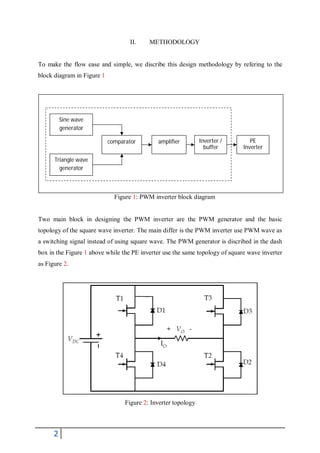
To make the flow ease and simple, we discribe this design methodology by refering to the
block diagram in Figure 1


          Sine wave
          generator

                            comparator        amplifier         Inverter /       PE
                                                                  buffer      Inverter

      Triangle wave
        generator


                              Figure 1: PWM inverter block diagram


Two main block in designing the PWM inverter are the PWM generator and the basic
topology of the square wave inverter. The main differ is the PWM inverter use PWM wave as
a switching signal instead of using square wave. The PWM generator is discribed in the dash
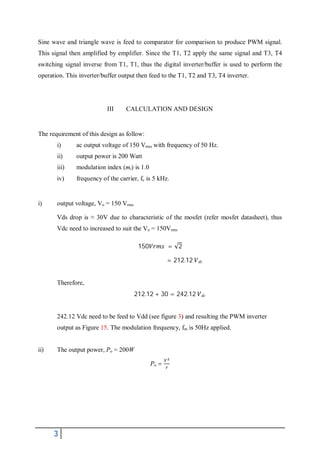
box in the Figure 1 above while the PE inverter use the same topology of square wave inverter
as Figure 2.


                                  Figure 2: Inverter topology


      2
Sine wave and triangle wave is feed to comparator for comparison to produce PWM signal.
This signal then amplified by emplifier. Since the T1, T2 apply the same signal and T3, T4
switching signal inverse from T1, T1, thus the digital inverter/buffer is used to perform the
operation. This inverter/buffer output then feed to the T1, T2 and T3, T4 inverter.


                           III     CALCULATION AND DESIGN


The requirement of this design as follow:
       i)      ac output voltage of 150 Vrms with frequency of 50 Hz.
       ii)     output power is 200 Watt
       iii)    modulation index (mi) is 1.0
       iv)     frequency of the carrier, fc is 5 kHz.


i)     output voltage, Vo = 150 Vrms

       Vds drop is ≈ 30V due to characteristic of the mosfet (refer mosfet datasheet), thus
       Vdc need to increased to suit the Vo = 150Vrms

                                        150          = √2

                                                     = 212.12   dc


       Therefore,
                                       212.12 + 30 = 242.12      dc


       242.12 Vdc need to be feed to Vdd (see figure 3) and resulting the PWM inverter
       output as Figure 15. The modulation frequency, fm is 50Hz applied.


ii)    The output power, Po = 200W

                                              Po =


      3
Since Vo = 212.12, thus
                                                  212.12
                                          200 =

                                              = 225


iii)   modulation index (mi) is 1.0
       Vmodulation, Vm = 10 Vpic and
       Vcarrier Vc = 10 Vpic
                                              mi =

                                              mi = 1


All the calculated value then applied to the circuit below by using MultiSim software. The
mosfet type 2SK2978 was selected which has the characteristic as in mosfet datasheet. (see
mosfet datasheet attached)


                               Figure 3: PWM inverter (full circuit)


       4
V1 = Vin when mi = 1


Calculation for THDV

                                                  
                                    Vout (t )  Vn sin( nwt )
                                                 n 1

                                             T
                                         2
                                 Vnk        V (t ) sin( nwt ) d ( wt )
                                         0


Performing the integration


                             2Vdc
                    Vnk          Cosnk  Cosnk  1  2Cosn(k  k )
                              


                                                                          ,
                                mf =     =
                                                                              ,

                                   =      = 100


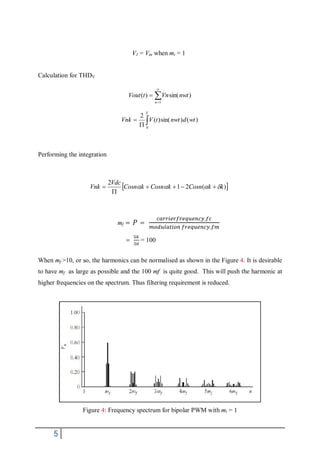
When mf >10, or so, the harmonics can be normalised as shown in the Figure 4. It is desirable
to have mf as large as possible and the 100 mf is quite good. This will push the harmonic at
higher frequencies on the spectrum. Thus filtering requirement is reduced.


                 Figure 4: Frequency spectrum for bipolar PWM with mi = 1


      5
Each courier frequency spectrum. The harmonic amplitudes are a function of mi=1


                            THDv=               −1


                                           150
                                  =                      −1
                                        0.6 212.12

                            THDv  62%


Although the voltage THD improvement is not significant, but the current THD will improve
greatly because the load normally has some current filtering effect.


By additional of filter; the largest harmonic (see Figure 4) can be eliminated. A simple
method reducing inverter output harmonic uses the LC low-pass passive filters. Second order
filter is represented by LC circuit, where the inductor is shunt with the Equations below
express LC filter transfer function as derived from voltage-divider rule (Anca, 2009)


Use of LC-filter lowers cost and losses of the inverter system. Equation below is for filter
inductance. The maximum ripple current was chosen to be 5%-20% (typical value of
maximum ripple current is 20% of rated current (Wang, 2003)).


Filter capacitance is determinable by the reactive power absorbed in the filter capacitor;
Equation below defines it. being the reactive power factor, its value was selected to be less
than 5%(Wang, 2003).


      6
Equation below defines the resonance frequency of the LC filter circuit (Khaled, 2007):


Since the MultiSim cannot provide the current waveform, thus the value of LC cant be
calculated properly and the THDi correction cannot be obtained.


                   IV         SIMULATION RESULT AND DISCUSSION


                                  Figure 5: PWM generator


The PWM signal is produced by comparing sine wave and triangle wave (5 Hz and 5 kHz as
required in this design). This can be done by using LM311H comparator (refer Figure 6).


      7
Figure 6: Comparator input with natural sampling (m=1, fc = 5kHz, fm = 50Hz)


                           Figure 7: Virtual Comparator output


Since the Comparator LM311H output change between 12V and 30V (refer Figure 8 and
LM311H datasheet), we need to change the Vmin from 12V to 0V, thus the higher value then
12V need as a comparison value.


                          Figure 8: Comparator LM311H output


     8
20V has been selected for this design feed to the 741 op-amp VS+ input (refer Figure 5) and
the ap-amp output generated as Figure 9 (also refer 741 op-amp datasheet).


                                Figure 9: 741 Op-amp output


Since the switching freq for Q1, Q3 is the same and Q2, Q4 is inverse from Q1, Q3, thus we
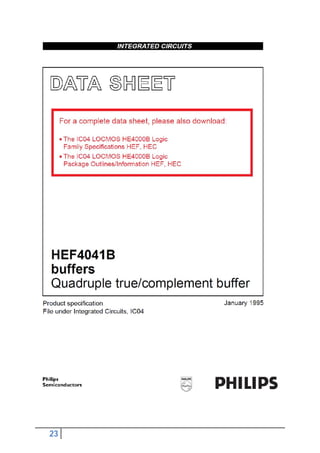
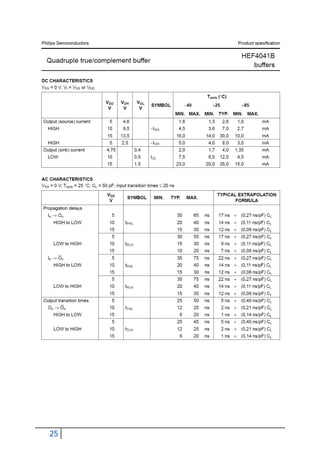
use the inverter/buffer ic 4041BP to perform and the resulting output (switching signal) as
Figure 10 and Figure 11.


       Figure 10: Digital 4041BP inverter/buffer output – switching signal Q1 and Q2


      9
Figure 11: Digital 4041BP inverter/buffer output – switching signal Q3 and Q4


This PWM signal then feed to the inverter at point IO1 and IO2 as Figure 12.


                                  Figure 12: PWM inverter


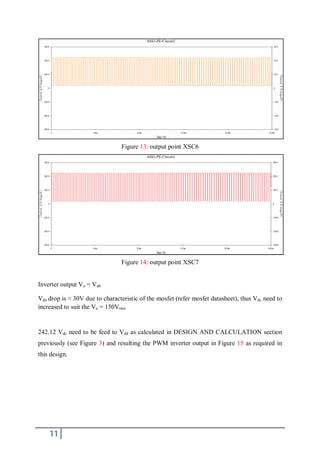
The PWM inverter output is produced as Figure 13, Figure 14 and Figure 15; each taken from
different point (XSC6, XSC 7 and XSC8).


    10
Figure 13: output point XSC6


                                Figure 14: output point XSC7


Inverter output Vo = Vab

Vds drop is ≈ 30V due to characteristic of the mosfet (refer mosfet datasheet), thus Vdc need to
increased to suit the Vo = 150Vrms


242.12 Vdc need to be feed to Vdd as calculated in DESIGN AND CALCULATION section
previously (see Figure 3) and resulting the PWM inverter output in Figure 15 as required in
this design.


    11
Figure 15: PWM inverter output point XSC8


Since the MultiSim software cannot generate the current waveform, thus the current
waveform was obtained by theoretically and the output should be as Figure below (blue line).


                    Figure 16: PWM inverter voltage and current output


                                  V       CONCLUSION

After flow through all the process, its can be conclude that designing the PWM converter was
not easy as square wave converter. Instead of square wave switching signal, we need to
generate PWM signal. PWM switching signal can be genarate by comparing sinewave and
trianglewave via comparator. In this design, natural sampling was used. One major limitation
with natural sampling PWM is the difficulty of its implementation in a digital modulation
system, because the intersection between the reference waveform and the triangular waveform
is defined by a transcendental equation and is complex to calculate. An analogue circuit

    12
possesses the advantages of a low cost with a fast dynamic response, but suffers from a
complex circuitry to generate complex PWM, limited function ability and difficulty to
perform in circuit modifications (Mekhlief , 1999). To overcome this limitation the modern
popular alternative is to implement the modulation system using a regular sampling PWM
strategy. This technique was introduced to provide a more flexible way of designing the
system. The system offers simple circuitry, software control and flexibility in adaptation to
various applications. The two most common regular sampling techniques are regular
symmetrical and asymmetrical sampling (Ledwich, 1991).


Simulation with an actual components parameter usually will cause waveform deviation
comparing to the ideal parameter. Thus the modification from the original topology is
necessary. The operation and characteristic of the ideal and the actual components parameter
need to understand. Waveform deviation that we obtained from LM311H comparator output
from the actual signal that we want push us to feed the signal via 741 op-amp to obtained the
right signal. Since the switching signal for Q1, Q2 and Q3, Q4 inverse each other, it is
necassary to feed this output signal of 741 op-amp through the digital inverter/buffer 4041BP.
In this simulation we took the sinewave and the squarewave direct from the signal generator
provided by MultiSim but for the real design, the both signal should be obtained by a circuit
design or generated by special components that available in market such as crystal oscillator
to generate sinewane and 555 timer circuit with some additional circuit to generate
trianglewave which not discuss in this paper.


On the fullwave inverter side is just the same as original squarewave inverter topology. The
chalenging on this side is to find the write mosfet that available is MultiSim software and
finally the n-channel mosfet by Hitachi 2SK2978 was selected. Since we use the MultiSim
software text book edition, even its provide the actual component parameter but not all of the
component available is the sistem. For cormesial circuit design, it is necessary to buy the
expensive solfware (e.g. professional edition) that provide more actual components parameter.


    13
REFERENCE


[1]    Daniel W. Hart, Introduction to Power Electronics, Prentice Hall International Inc,
       2003.


[2]    Robert W. Erickson, “DC-DC Power Converters”, Department of Electrical and
       Computer Engineering, University of Colorado


[3]    Rashid, M.H., Power Electronics, Circuits, Devices and Applications, Pearson/Prentice
       Hall, 2004


[4]    Mohan, Undeland & Robbins, Power Electronics – Converters, Applications and
       Design, 2nd edition, John Wiley & Sons, 2003.


[5]    Datasheet download at www.ic-on-line.net


      14
ATTACHMENT


15
16
17
18
19
20
21
22
23
24
25
26
27
28

pwm inverter

  • 1.
    Design a 200Watt, 150 Vrms PWM Bipolar Inverter 1 sub_zeerow@yahoo.com 2shafida_78@yahoo.com.my 3 acanthusz@yahoo.com 4hafzam@yahoo.com Abstract-This paper is concentrate on design procedure which including design requirement, calculation respect to design, circuit building and simulation result. The simulation in this assiment by using MULTISIM software and it is base on components that availale in market. I. INTRODUCTION Power inverters are circuits used to convert Direct Current (DC) to Alternating current (AC). The input of the inverter may come from a DC source or from rectified AC input. There are two main categories for switch mode voltage source inverters: square wave and pulse width modulated (PWM). Square wave inverters are the simplest to implement. The simplicity of the square wave inverter comes along with the disadvantage of harmonics close to the fundamental frequency. PWM inverters function by comparing a sinusoidal control signal at the desired output frequency with a triangular carrier signal at switching the frequency. The harmonics of PWM inverters are located at multiples of the carrier signal frequency which is typically in the kHz range. This simply means the output waveform of PWM appears more sinusoidal than a square wave inverter. Also, higher frequency harmonics are easier to filter than harmonics near the fundamental frequency. The requirement of this asignment is to design full-bridge inverter that can produce an ac output voltage of 150 Vrms with frequency of 50 Hz. The output power is 200 Watt. The modulation index (mi) is 1.0 and the frequency of the carrier is 5 kHz. The PWM modulation type is the bipolar based PWM. This paper highlight:  The design of bipolar PWM  The THD voltage before filtering  The low-pass filter design 1
  • 2.
    II. METHODOLOGY To make the flow ease and simple, we discribe this design methodology by refering to the block diagram in Figure 1 Sine wave generator comparator amplifier Inverter / PE buffer Inverter Triangle wave generator Figure 1: PWM inverter block diagram Two main block in designing the PWM inverter are the PWM generator and the basic topology of the square wave inverter. The main differ is the PWM inverter use PWM wave as a switching signal instead of using square wave. The PWM generator is discribed in the dash box in the Figure 1 above while the PE inverter use the same topology of square wave inverter as Figure 2. Figure 2: Inverter topology 2
  • 3.
    Sine wave andtriangle wave is feed to comparator for comparison to produce PWM signal. This signal then amplified by emplifier. Since the T1, T2 apply the same signal and T3, T4 switching signal inverse from T1, T1, thus the digital inverter/buffer is used to perform the operation. This inverter/buffer output then feed to the T1, T2 and T3, T4 inverter. III CALCULATION AND DESIGN The requirement of this design as follow: i) ac output voltage of 150 Vrms with frequency of 50 Hz. ii) output power is 200 Watt iii) modulation index (mi) is 1.0 iv) frequency of the carrier, fc is 5 kHz. i) output voltage, Vo = 150 Vrms Vds drop is ≈ 30V due to characteristic of the mosfet (refer mosfet datasheet), thus Vdc need to increased to suit the Vo = 150Vrms 150 = √2 = 212.12 dc Therefore, 212.12 + 30 = 242.12 dc 242.12 Vdc need to be feed to Vdd (see figure 3) and resulting the PWM inverter output as Figure 15. The modulation frequency, fm is 50Hz applied. ii) The output power, Po = 200W Po = 3
  • 4.
    Since Vo =212.12, thus 212.12 200 = = 225 iii) modulation index (mi) is 1.0 Vmodulation, Vm = 10 Vpic and Vcarrier Vc = 10 Vpic mi = mi = 1 All the calculated value then applied to the circuit below by using MultiSim software. The mosfet type 2SK2978 was selected which has the characteristic as in mosfet datasheet. (see mosfet datasheet attached) Figure 3: PWM inverter (full circuit) 4
  • 5.
    V1 = Vinwhen mi = 1 Calculation for THDV  Vout (t )  Vn sin( nwt ) n 1 T 2 Vnk  V (t ) sin( nwt ) d ( wt ) 0 Performing the integration 2Vdc Vnk  Cosnk  Cosnk  1  2Cosn(k  k )  , mf = = , = = 100 When mf >10, or so, the harmonics can be normalised as shown in the Figure 4. It is desirable to have mf as large as possible and the 100 mf is quite good. This will push the harmonic at higher frequencies on the spectrum. Thus filtering requirement is reduced. Figure 4: Frequency spectrum for bipolar PWM with mi = 1 5
  • 6.
    Each courier frequencyspectrum. The harmonic amplitudes are a function of mi=1 THDv= −1 150 = −1 0.6 212.12 THDv  62% Although the voltage THD improvement is not significant, but the current THD will improve greatly because the load normally has some current filtering effect. By additional of filter; the largest harmonic (see Figure 4) can be eliminated. A simple method reducing inverter output harmonic uses the LC low-pass passive filters. Second order filter is represented by LC circuit, where the inductor is shunt with the Equations below express LC filter transfer function as derived from voltage-divider rule (Anca, 2009) Use of LC-filter lowers cost and losses of the inverter system. Equation below is for filter inductance. The maximum ripple current was chosen to be 5%-20% (typical value of maximum ripple current is 20% of rated current (Wang, 2003)). Filter capacitance is determinable by the reactive power absorbed in the filter capacitor; Equation below defines it. being the reactive power factor, its value was selected to be less than 5%(Wang, 2003). 6
  • 7.
    Equation below definesthe resonance frequency of the LC filter circuit (Khaled, 2007): Since the MultiSim cannot provide the current waveform, thus the value of LC cant be calculated properly and the THDi correction cannot be obtained. IV SIMULATION RESULT AND DISCUSSION Figure 5: PWM generator The PWM signal is produced by comparing sine wave and triangle wave (5 Hz and 5 kHz as required in this design). This can be done by using LM311H comparator (refer Figure 6). 7
  • 8.
    Figure 6: Comparatorinput with natural sampling (m=1, fc = 5kHz, fm = 50Hz) Figure 7: Virtual Comparator output Since the Comparator LM311H output change between 12V and 30V (refer Figure 8 and LM311H datasheet), we need to change the Vmin from 12V to 0V, thus the higher value then 12V need as a comparison value. Figure 8: Comparator LM311H output 8
  • 9.
    20V has beenselected for this design feed to the 741 op-amp VS+ input (refer Figure 5) and the ap-amp output generated as Figure 9 (also refer 741 op-amp datasheet). Figure 9: 741 Op-amp output Since the switching freq for Q1, Q3 is the same and Q2, Q4 is inverse from Q1, Q3, thus we use the inverter/buffer ic 4041BP to perform and the resulting output (switching signal) as Figure 10 and Figure 11. Figure 10: Digital 4041BP inverter/buffer output – switching signal Q1 and Q2 9
  • 10.
    Figure 11: Digital4041BP inverter/buffer output – switching signal Q3 and Q4 This PWM signal then feed to the inverter at point IO1 and IO2 as Figure 12. Figure 12: PWM inverter The PWM inverter output is produced as Figure 13, Figure 14 and Figure 15; each taken from different point (XSC6, XSC 7 and XSC8). 10
  • 11.
    Figure 13: outputpoint XSC6 Figure 14: output point XSC7 Inverter output Vo = Vab Vds drop is ≈ 30V due to characteristic of the mosfet (refer mosfet datasheet), thus Vdc need to increased to suit the Vo = 150Vrms 242.12 Vdc need to be feed to Vdd as calculated in DESIGN AND CALCULATION section previously (see Figure 3) and resulting the PWM inverter output in Figure 15 as required in this design. 11
  • 12.
    Figure 15: PWMinverter output point XSC8 Since the MultiSim software cannot generate the current waveform, thus the current waveform was obtained by theoretically and the output should be as Figure below (blue line). Figure 16: PWM inverter voltage and current output V CONCLUSION After flow through all the process, its can be conclude that designing the PWM converter was not easy as square wave converter. Instead of square wave switching signal, we need to generate PWM signal. PWM switching signal can be genarate by comparing sinewave and trianglewave via comparator. In this design, natural sampling was used. One major limitation with natural sampling PWM is the difficulty of its implementation in a digital modulation system, because the intersection between the reference waveform and the triangular waveform is defined by a transcendental equation and is complex to calculate. An analogue circuit 12
  • 13.
    possesses the advantagesof a low cost with a fast dynamic response, but suffers from a complex circuitry to generate complex PWM, limited function ability and difficulty to perform in circuit modifications (Mekhlief , 1999). To overcome this limitation the modern popular alternative is to implement the modulation system using a regular sampling PWM strategy. This technique was introduced to provide a more flexible way of designing the system. The system offers simple circuitry, software control and flexibility in adaptation to various applications. The two most common regular sampling techniques are regular symmetrical and asymmetrical sampling (Ledwich, 1991). Simulation with an actual components parameter usually will cause waveform deviation comparing to the ideal parameter. Thus the modification from the original topology is necessary. The operation and characteristic of the ideal and the actual components parameter need to understand. Waveform deviation that we obtained from LM311H comparator output from the actual signal that we want push us to feed the signal via 741 op-amp to obtained the right signal. Since the switching signal for Q1, Q2 and Q3, Q4 inverse each other, it is necassary to feed this output signal of 741 op-amp through the digital inverter/buffer 4041BP. In this simulation we took the sinewave and the squarewave direct from the signal generator provided by MultiSim but for the real design, the both signal should be obtained by a circuit design or generated by special components that available in market such as crystal oscillator to generate sinewane and 555 timer circuit with some additional circuit to generate trianglewave which not discuss in this paper. On the fullwave inverter side is just the same as original squarewave inverter topology. The chalenging on this side is to find the write mosfet that available is MultiSim software and finally the n-channel mosfet by Hitachi 2SK2978 was selected. Since we use the MultiSim software text book edition, even its provide the actual component parameter but not all of the component available is the sistem. For cormesial circuit design, it is necessary to buy the expensive solfware (e.g. professional edition) that provide more actual components parameter. 13
  • 14.
    REFERENCE [1] Daniel W. Hart, Introduction to Power Electronics, Prentice Hall International Inc, 2003. [2] Robert W. Erickson, “DC-DC Power Converters”, Department of Electrical and Computer Engineering, University of Colorado [3] Rashid, M.H., Power Electronics, Circuits, Devices and Applications, Pearson/Prentice Hall, 2004 [4] Mohan, Undeland & Robbins, Power Electronics – Converters, Applications and Design, 2nd edition, John Wiley & Sons, 2003. [5] Datasheet download at www.ic-on-line.net 14
  • 15.
  • 16.
  • 17.
  • 18.
  • 19.
  • 20.
  • 21.
  • 22.
  • 23.
  • 24.
  • 25.
  • 26.
  • 27.
  • 28.