PRESENTATION
ON
DISLOCATION,
SPRAIN, STRAIN AND
CONTUSION
PRESENTED BY,
MONAMI GHOSH
ROLL NO-28
B.SC NURSING
SEMESTER III
SHOVA RANI NURSING COLLEGE
LEARNING OBJECTIVES
• Introduction
• Related Anatomy And Physiology
• Dislocation
 Definition
 Types
 Etiology
 Risk factors
 Clinical Features
 Diagnostic Studies
 Complications
• Sprain
 Definition
 Types
 Etiology
 Risk factors
 Pathophysiology
 Clinical Features
 Diagnostic Studies
 Complications
LEARNING OBJECTIVES
• Strain
 Definition
 Types
 Etiology
 Risk factors
 Pathophysiology
 Clinical Features
 Diagnostic Studies
 Complications
• Contusion
 Definition
 Types
 Etiology
 Risk factors
 Clinical Features
 Diagnostic Studies
 Complications
LEARNING OBJECTIVES
• Management
 Medical management
Pharmacological Management
Non-Pharmacological Management
 Surgical Management
• Nursing Management
 Nursing Diagnosis
 Goal
 Intervention
 Expected Outcome
• Summary
• Conclusion
Introduction
RELATED
ANATOMY
AND
PHYSIOLOGY
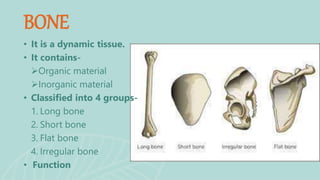
• It is a dynamic tissue.
• It contains-
Organic material
Inorganic material
• Classified into 4 groups-
1. Long bone
2. Short bone
3. Flat bone
4. Irregular bone
• Function
BONE
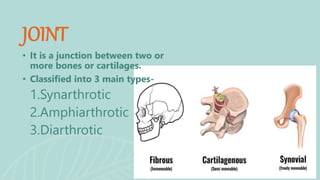
• It is a junction between two or
more bones or cartilages.
• Classified into 3 main types-
1.Synarthrotic
2.Amphiarthrotic
3.Diarthrotic
JOINT
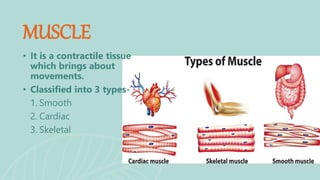
• It is a contractile tissue
which brings about
movements.
• Classified into 3 types-
1. Smooth
2. Cardiac
3. Skeletal
MUSCLE
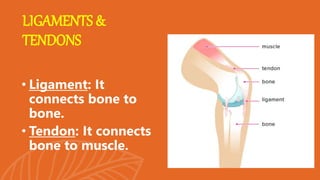
• Ligament: It
connects bone to
bone.
• Tendon: It connects
bone to muscle.
LIGAMENTS &
TENDONS
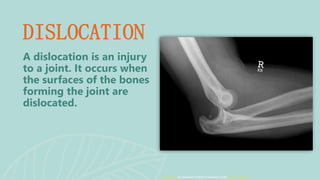
DISLOCATION
A dislocation is an injury
to a joint. It occurs when
the surfaces of the bones
forming the joint are
dislocated.
DISLOCATION
This Photo by Unknown Author is licensed under CC BY-SA-NC
1.Congenital Dislocation
2.Traumatic Dislocation
3.Pathological Dislocation
4.Paralytic Dislocation
TYPES
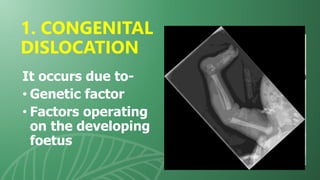
It occurs due to-
• Genetic factor
• Factors operating
on the developing
foetus
1. CONGENITAL
DISLOCATION
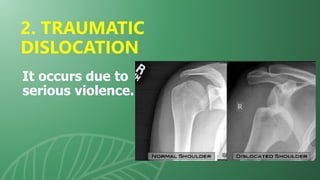
It occurs due to
serious violence.
2. TRAUMATIC
DISLOCATION
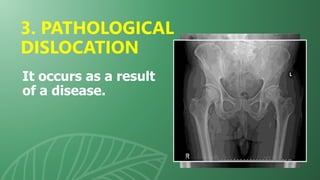
It occurs as a result
of a disease.
3. PATHOLOGICAL
DISLOCATION
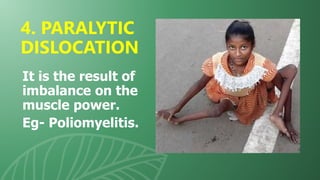
It is the result of
imbalance on the
muscle power.
Eg- Poliomyelitis.
4. PARALYTIC
DISLOCATION
• Falls
• Harsh hit
• Pulling with force
• Accidents
ETIOLOGY
• Age
• Accidents
• Sports Participation
• Heredity
RISK FACTORS
• Intense pain
• Deformity
• Change in the length of the
extremity
• Loss of normal movement
CLINICAL FEATURES
• Patient’s history
• Physical examination
• X-Ray
DIAGNOSTIC STUDIES
• Traumatic arthrotomy
• Fractures within the
joints
• Avascular Necrosis
• Arthritis
• Nerve and blood vessels
damage
COMPLICATIONS
SPRAIN
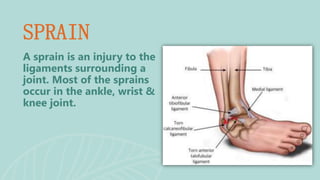
A sprain is an injury to the
ligaments surrounding a
joint. Most of the sprains
occur in the ankle, wrist &
knee joint.
SPRAIN
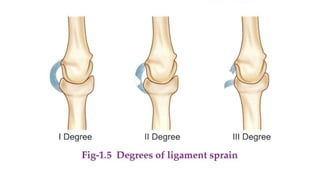
1. First Degree Sprain
2. Second Degree Sprain
3. Third Degree Sprain
DEGREE
• Twisting of joint
• Fall
• Sports injury
• Over stretching
• Getting hit by force
ETIOLOGY
• Sports participation
• Age
• Height
• Weight
RISK FACTORS
PATHOPHYSIOLOGY
Due to etiological factor,
the tensile force exerted on a muscle
Excessive stretching of the muscle fibre & a
tear close to the muscle-tendon junction
• Joint pain or muscle pain
• Swelling
• Joint stiffness
• Discoloration of the skin
• Decrease muscle strength
• Muscle cramp or spasm
CLINICAL FEATURES
• Patient’s history
• Physical examination
• X-Ray
• MRI
DIAGNOSTIC STUDIES
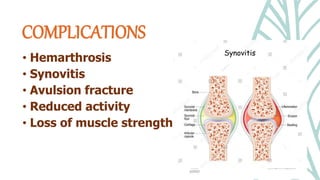
• Hemarthrosis
• Synovitis
• Avulsion fracture
• Reduced activity
• Loss of muscle strength
COMPLICATIONS
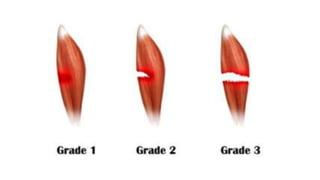
STRAIN
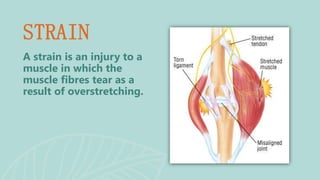
A strain is an injury to a
muscle in which the
muscle fibres tear as a
result of overstretching.
STRAIN
1. First Degree Strain
2. Second Degree Strain
3. Third Degree Strain
DEGREE
• Sports injury
• Poor posture
• Fatigue
• Not warming up before physical activity
• Poor flexibility
• Heavy lifting
ETIOLOGY
• Sports participation
• Age
• Heavy lifting
• Falls
RISK FACTORS
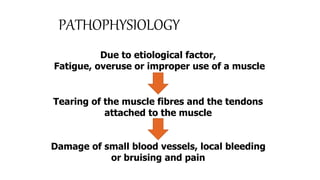
PATHOPHYSIOLOGY
Due to etiological factor,
Fatigue, overuse or improper use of a muscle
Tearing of the muscle fibres and the tendons
attached to the muscle
Damage of small blood vessels, local bleeding
or bruising and pain
• Swelling, bruising or redness
• Pain
• Tenderness
• Muscle stiffness
• Muscle spasm
CLINICAL FEATURES
• Patient’s history
• Physical examination
• X-Ray
• MRI
DIAGNOSTIC STUDIES
• Hemarthrosis
• Synovitis
• Avulsion fracture
• Deep vein Thrombosis
• Reduced activity
• Loss of muscle strength
COMPLICATIONs
CONTUSION
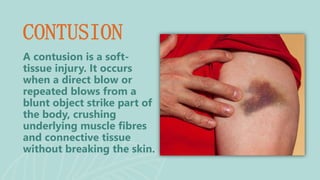
A contusion is a soft-
tissue injury. It occurs
when a direct blow or
repeated blows from a
blunt object strike part of
the body, crushing
underlying muscle fibres
and connective tissue
without breaking the skin.
CONTUSION
1. Subcutaneous contusion
2. Intramascular contusion
3. Periosteal contusion
TYPES
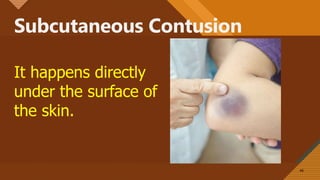
Subcutaneous Contusion
46
It happens directly
under the surface of
the skin.
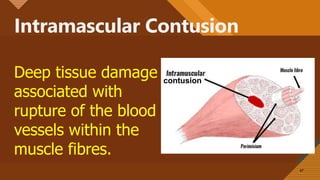
Intramascular Contusion
47
Deep tissue damage
associated with
rupture of the blood
vessels within the
muscle fibres.
contusion
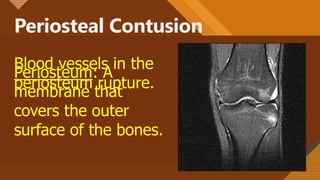
Periosteal Contusion
48
Periosteum: A
membrane that
covers the outer
surface of the bones.
Blood vessels in the
periosteum rupture.
• Direct or repeated blows to a muscle
• Sports injury
• Arthritis
• Falls
• Accidents
• Anticoagulant and antiplatelet medications
ETIOLOGY
• Age: >50
• Anticoagulant and antiplatelet drugs
• Vitamin K deficiency
• Liver disease
RISK FACTORS
• Tenderness
• Swelling
• Limited ROM
• Bluish discoloration
CLINICAL FEATURES
• Patient’s history
• Physical examination
• X-Ray
• CT Scan
• MRI
DIAGNOSTIC STUDIES
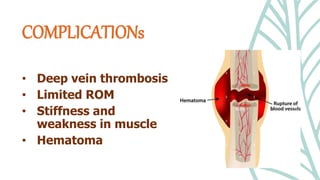
• Deep vein thrombosis
• Limited ROM
• Stiffness and
weakness in muscle
• Hematoma
COMPLICATIONs
MANAGEMENT
1.PHARMACOLOGICAL MANAGEMENT
• NSAIDs
• Mild analgesics
• Corticosteroid injections
A. MEDICAL MANAGEMENT
2. NON-PHARMACOLOGICAL MANAGEMENT
• First Aid
• Lifestyle modification
• Nutritional therapy
A. MEDICAL MANAGEMENT
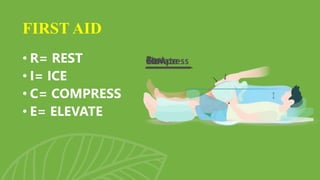
• R= REST
• I= ICE
• C= COMPRESS
• E= ELEVATE
FIRST AID
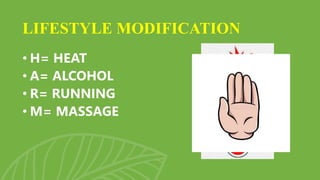
• H= HEAT
• A= ALCOHOL
• R= RUNNING
• M= MASSAGE
LIFESTYLE MODIFICATION
• Vitamins
• Calcium
• Protein
• Magnesium
• zinc
NUTRITIONAL THERAPY
• Arthroscopy
• Ligament reconstruction surgery
• A bankart shoulder repair surgery
B. SURGICAL MANAGEMENT
NURSING
MANAGEMENT
• NURSING DIAGNOSIS
•Acute pain related to soft tissue
injury possibly evidenced by
verbalized reports of pain, pain
scale score.
• GOAL
• INTERVENTIONS
• EXPECTED OUTCOMES
• NURSING DIAGNOSIS
Acute pain related to soft tissue
injury possibly evidenced by
verbalized reports of pain, pain
scale score.
• GOAL
• INTERVENTIONS
• EXPECTED OUTCOMES
• NURSING DIAGNOSIS
•Acute pain related to soft tissue
injury possibly evidenced by
verbalized reports of pain, pain
scale score.
• GOAL
• INTERVENTIONS
• EXPECTED OUTCOMES
• NURSING DIAGNOSIS
Impaired physical mobility related
to decrease muscle strength or
control possibly evidenced by
limited range of motion, slowed
movement.
• GOAL
• INTERVENTIONS
• EXPECTED OUTCOMES
• NURSING DIAGNOSIS
•Acute pain related to soft tissue
injury possibly evidenced by
verbalized reports of pain, pain
scale score.
• GOAL
• INTERVENTIONS
• EXPECTED OUTCOMES
• NURSING DIAGNOSIS
Impaired tissue integrity related to
surgical repair possibly evidenced
by destroyed/ damaged tissue
• GOAL
• INTERVENTIONS
• EXPECTED OUTCOMES
SUMMARY
CONCLUSION
Dislocation,sprain,strain and contusion.pptx

Dislocation,sprain,strain and contusion.pptx

  • 1.
    PRESENTATION ON DISLOCATION, SPRAIN, STRAIN AND CONTUSION PRESENTEDBY, MONAMI GHOSH ROLL NO-28 B.SC NURSING SEMESTER III SHOVA RANI NURSING COLLEGE
  • 2.
    LEARNING OBJECTIVES • Introduction •Related Anatomy And Physiology • Dislocation  Definition  Types  Etiology  Risk factors  Clinical Features  Diagnostic Studies  Complications • Sprain  Definition  Types  Etiology  Risk factors  Pathophysiology  Clinical Features  Diagnostic Studies  Complications
  • 3.
    LEARNING OBJECTIVES • Strain Definition  Types  Etiology  Risk factors  Pathophysiology  Clinical Features  Diagnostic Studies  Complications • Contusion  Definition  Types  Etiology  Risk factors  Clinical Features  Diagnostic Studies  Complications
  • 4.
    LEARNING OBJECTIVES • Management Medical management Pharmacological Management Non-Pharmacological Management  Surgical Management • Nursing Management  Nursing Diagnosis  Goal  Intervention  Expected Outcome • Summary • Conclusion
  • 5.
  • 6.
  • 7.
    • It isa dynamic tissue. • It contains- Organic material Inorganic material • Classified into 4 groups- 1. Long bone 2. Short bone 3. Flat bone 4. Irregular bone • Function BONE
  • 8.
    • It isa junction between two or more bones or cartilages. • Classified into 3 main types- 1.Synarthrotic 2.Amphiarthrotic 3.Diarthrotic JOINT
  • 9.
    • It isa contractile tissue which brings about movements. • Classified into 3 types- 1. Smooth 2. Cardiac 3. Skeletal MUSCLE
  • 10.
    • Ligament: It connectsbone to bone. • Tendon: It connects bone to muscle. LIGAMENTS & TENDONS
  • 11.
  • 12.
    A dislocation isan injury to a joint. It occurs when the surfaces of the bones forming the joint are dislocated. DISLOCATION This Photo by Unknown Author is licensed under CC BY-SA-NC
  • 13.
    1.Congenital Dislocation 2.Traumatic Dislocation 3.PathologicalDislocation 4.Paralytic Dislocation TYPES
  • 14.
    It occurs dueto- • Genetic factor • Factors operating on the developing foetus 1. CONGENITAL DISLOCATION
  • 15.
    It occurs dueto serious violence. 2. TRAUMATIC DISLOCATION
  • 16.
    It occurs asa result of a disease. 3. PATHOLOGICAL DISLOCATION
  • 17.
    It is theresult of imbalance on the muscle power. Eg- Poliomyelitis. 4. PARALYTIC DISLOCATION
  • 18.
    • Falls • Harshhit • Pulling with force • Accidents ETIOLOGY
  • 19.
    • Age • Accidents •Sports Participation • Heredity RISK FACTORS
  • 20.
    • Intense pain •Deformity • Change in the length of the extremity • Loss of normal movement CLINICAL FEATURES
  • 21.
    • Patient’s history •Physical examination • X-Ray DIAGNOSTIC STUDIES
  • 22.
    • Traumatic arthrotomy •Fractures within the joints • Avascular Necrosis • Arthritis • Nerve and blood vessels damage COMPLICATIONS
  • 23.
  • 24.
    A sprain isan injury to the ligaments surrounding a joint. Most of the sprains occur in the ankle, wrist & knee joint. SPRAIN
  • 25.
    1. First DegreeSprain 2. Second Degree Sprain 3. Third Degree Sprain DEGREE
  • 27.
    • Twisting ofjoint • Fall • Sports injury • Over stretching • Getting hit by force ETIOLOGY
  • 28.
    • Sports participation •Age • Height • Weight RISK FACTORS
  • 29.
    PATHOPHYSIOLOGY Due to etiologicalfactor, the tensile force exerted on a muscle Excessive stretching of the muscle fibre & a tear close to the muscle-tendon junction
  • 30.
    • Joint painor muscle pain • Swelling • Joint stiffness • Discoloration of the skin • Decrease muscle strength • Muscle cramp or spasm CLINICAL FEATURES
  • 31.
    • Patient’s history •Physical examination • X-Ray • MRI DIAGNOSTIC STUDIES
  • 32.
    • Hemarthrosis • Synovitis •Avulsion fracture • Reduced activity • Loss of muscle strength COMPLICATIONS
  • 33.
  • 34.
    A strain isan injury to a muscle in which the muscle fibres tear as a result of overstretching. STRAIN
  • 35.
    1. First DegreeStrain 2. Second Degree Strain 3. Third Degree Strain DEGREE
  • 37.
    • Sports injury •Poor posture • Fatigue • Not warming up before physical activity • Poor flexibility • Heavy lifting ETIOLOGY
  • 38.
    • Sports participation •Age • Heavy lifting • Falls RISK FACTORS
  • 39.
    PATHOPHYSIOLOGY Due to etiologicalfactor, Fatigue, overuse or improper use of a muscle Tearing of the muscle fibres and the tendons attached to the muscle Damage of small blood vessels, local bleeding or bruising and pain
  • 40.
    • Swelling, bruisingor redness • Pain • Tenderness • Muscle stiffness • Muscle spasm CLINICAL FEATURES
  • 41.
    • Patient’s history •Physical examination • X-Ray • MRI DIAGNOSTIC STUDIES
  • 42.
    • Hemarthrosis • Synovitis •Avulsion fracture • Deep vein Thrombosis • Reduced activity • Loss of muscle strength COMPLICATIONs
  • 43.
  • 44.
    A contusion isa soft- tissue injury. It occurs when a direct blow or repeated blows from a blunt object strike part of the body, crushing underlying muscle fibres and connective tissue without breaking the skin. CONTUSION
  • 45.
    1. Subcutaneous contusion 2.Intramascular contusion 3. Periosteal contusion TYPES
  • 46.
    Subcutaneous Contusion 46 It happensdirectly under the surface of the skin.
  • 47.
    Intramascular Contusion 47 Deep tissuedamage associated with rupture of the blood vessels within the muscle fibres. contusion
  • 48.
    Periosteal Contusion 48 Periosteum: A membranethat covers the outer surface of the bones. Blood vessels in the periosteum rupture.
  • 49.
    • Direct orrepeated blows to a muscle • Sports injury • Arthritis • Falls • Accidents • Anticoagulant and antiplatelet medications ETIOLOGY
  • 50.
    • Age: >50 •Anticoagulant and antiplatelet drugs • Vitamin K deficiency • Liver disease RISK FACTORS
  • 51.
    • Tenderness • Swelling •Limited ROM • Bluish discoloration CLINICAL FEATURES
  • 52.
    • Patient’s history •Physical examination • X-Ray • CT Scan • MRI DIAGNOSTIC STUDIES
  • 53.
    • Deep veinthrombosis • Limited ROM • Stiffness and weakness in muscle • Hematoma COMPLICATIONs
  • 54.
  • 55.
    1.PHARMACOLOGICAL MANAGEMENT • NSAIDs •Mild analgesics • Corticosteroid injections A. MEDICAL MANAGEMENT
  • 56.
    2. NON-PHARMACOLOGICAL MANAGEMENT •First Aid • Lifestyle modification • Nutritional therapy A. MEDICAL MANAGEMENT
  • 57.
    • R= REST •I= ICE • C= COMPRESS • E= ELEVATE FIRST AID
  • 58.
    • H= HEAT •A= ALCOHOL • R= RUNNING • M= MASSAGE LIFESTYLE MODIFICATION
  • 59.
    • Vitamins • Calcium •Protein • Magnesium • zinc NUTRITIONAL THERAPY
  • 60.
    • Arthroscopy • Ligamentreconstruction surgery • A bankart shoulder repair surgery B. SURGICAL MANAGEMENT
  • 61.
  • 62.
    • NURSING DIAGNOSIS •Acutepain related to soft tissue injury possibly evidenced by verbalized reports of pain, pain scale score. • GOAL • INTERVENTIONS • EXPECTED OUTCOMES • NURSING DIAGNOSIS Acute pain related to soft tissue injury possibly evidenced by verbalized reports of pain, pain scale score. • GOAL • INTERVENTIONS • EXPECTED OUTCOMES
  • 63.
    • NURSING DIAGNOSIS •Acutepain related to soft tissue injury possibly evidenced by verbalized reports of pain, pain scale score. • GOAL • INTERVENTIONS • EXPECTED OUTCOMES • NURSING DIAGNOSIS Impaired physical mobility related to decrease muscle strength or control possibly evidenced by limited range of motion, slowed movement. • GOAL • INTERVENTIONS • EXPECTED OUTCOMES
  • 64.
    • NURSING DIAGNOSIS •Acutepain related to soft tissue injury possibly evidenced by verbalized reports of pain, pain scale score. • GOAL • INTERVENTIONS • EXPECTED OUTCOMES • NURSING DIAGNOSIS Impaired tissue integrity related to surgical repair possibly evidenced by destroyed/ damaged tissue • GOAL • INTERVENTIONS • EXPECTED OUTCOMES
  • 65.
  • 66.