DISPERSION SYSTEMS
COLLOIDS
PART 2
www.medacademy.org.in
2
www.medacademy.org.in
a) Electrical properties of interfaces.
b) The electrical double layer
a) Electrical properties of interfaces:
Most surfaces acquire a surface electric charge when brought into contact with an aqueous
medium, the principal charging mechanisms
being as follows:
1) Ion dissolution.
2) Ionization.
3) Ion adsorption.
ELECTRIC PROPERTIES:
3
www.medacademy.org.in
1) Ion dissolution:
The surface charge of colloidal particles is controlled by the charge of ion
present in excess in the medium.
Examples; 1) AgNo3 + NaI AgI +NaNo3
a) silver iodide in a solution with excess iodide Particles acquire - ve
b) Aluminium hydroxide in a solution with excess hydroxide
Potential determining ions: ions whose conc. determine the electric potential at the particle surface
(e.g. Ag+ , I -, H+, OH- )charge & vice versa. if excess Ag the charge will be +ve since the
concentration of Ag and I determine the electric potential particles acquire – ve charge & vice
versa.
ELECTRIC PROPERTIES
4
www.medacademy.org.in
2) Ionisation
Surface charge of a colloidal particle is controlled by the ionisation of surface groupings
Examples;
a) polystyrene latex has a carboxylic acid group at the surface, ionised to give negatively charged
particles.
b) acidic drugs such as ibuprofen & nalidixic acid acquire surface negative
charges.
c) Amino acids & proteins have carboxyl & amino groups whose ionisation depends on the pH as
follow;
3) Ion adsorption:
Surface charge of a colloidal particle is controlled by the unequal adsorption of oppositely charged
ions
Examples;
Surfaces of sol in water are more often –ve charged than +ve charged
Because cations are more hydrated than anions, cations reside in the bulk while less hydrated
anions adsorbed on the surface.
ELECTRIC PROPERTIES
5
www.medacademy.org.in
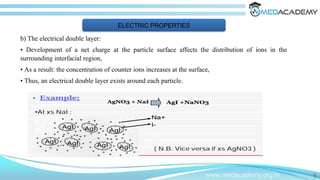
b) The electrical double layer:
• Development of a net charge at the particle surface affects the distribution of ions in the
surrounding interfacial region,
• As a result: the concentration of counter ions increases at the surface,
• Thus, an electrical double layer exists around each particle.
ELECTRIC PROPERTIES
6
www.medacademy.org.in
Silver iodide sols can be prepared by the reaction,
AgN03 + Nal---- Agl + NaN03
In the bulk of AgI particles 1: 1 ratio of Ag+ and I-
If the reaction is carried out with excess silver nitrate, there will be more Ag+ than I- ions in the
surface of the particles. The particles will thus be positively charged and the counterions
surrounding them will be N03-.
The combination of the positively charged surface and the atmosphere of counter ions surrounding
it is called the electric double layer.
If the reaction is carried out with an excess NaI, there will be more l- than Ag+ ions on the surface
of the particles
The particles will thus be negatively charged and the counter ions surrounding them will be Na+.
ELECTRIC PROPERTIES
7
www.medacademy.org.in
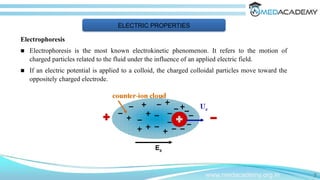
Electrophoresis
■ Electrophoresis is the most known electrokinetic phenomenon. It refers to the motion of
charged particles related to the fluid under the influence of an applied electric field.
■ If an electric potential is applied to a colloid, the charged colloidal particles move toward the
oppositely charged electrode.
ELECTRIC PROPERTIES
8
www.medacademy.org.in
1. Dispersion method (size decreasing)
a) Milling & grinding process:
b) Peptization:
Defined as a process of breaking aggregates/ secondary particles into particles of colloidal size.
Peptizing agent: a compound that promotes the dispersibility of solids without entering into
combination with them.
Ex: glycerin, sugar, lactose, citric acid.
PREPARATION METHODS
9
www.medacademy.org.in
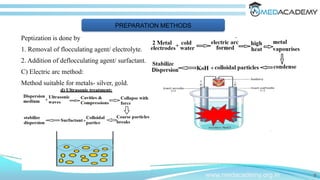
Peptization is done by
1. Removal of flocculating agent/ electrolyte.
2. Addition of deflocculating agent/ surfactant.
C) Electric arc method:
Method suitable for metals- silver, gold.
PREPARATION METHODS
10
www.medacademy.org.in
2. Condensation method (size increasing)
Particles of sub-colloidal range aggregate/condense to the colloidal range.
Principle:
In supersaturated solution, solute precipitates/ crystallises in 2 steps-
a. nucleation,
b. growth of nuclei
Nuclei is a cluster./ group of ions/ molecules.
A stable nucleus attracts ions/molecules on the surface, and size grows to the colloidal range.
a)Addition of non-solvent: Sulphur soluble in alcohol (solvent), insoluble in water (non-solvent)
b)Chemical methods:
Chemical reactions of inorganic substances in lyophobic sols form colloids.
1. Gold, silver, platinum-reduction
2. Sulphur-oxidation
3. Ferric oxide-hydrolysis
4. Arsenic oxide-double decomposition.
PREPARATION METHODS
• When a colloidal solution is prepared it often contains certain electrolytes which tend to destabilise it. The
following methods are used for purification:
1. Dialysis
2.Electrodialysis
3. Ultrafiltration
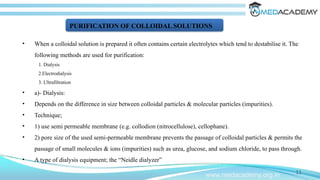
• a)- Dialysis:
• Depends on the difference in size between colloidal particles & molecular particles (impurities).
• Technique;
• 1) use semi permeable membrane (e.g. collodion (nitrocellulose), cellophane).
• 2) pore size of the used semi-permeable membrane prevents the passage of colloidal particles & permits the
passage of small molecules & ions (impurities) such as urea, glucose, and sodium chloride, to pass through.
• A type of dialysis equipment; the “Neidle dialyzer”
11
www.medacademy.org.in
PURIFICATION OF COLLOIDAL SOLUTIONS
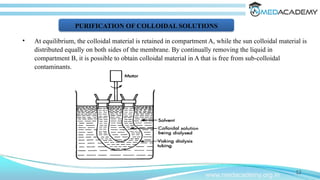
• At equilibrium, the colloidal material is retained in compartment A, while the sun colloidal material is
distributed equally on both sides of the membrane. By continually removing the liquid in
compartment B, it is possible to obtain colloidal material in A that is free from sub-colloidal
contaminants.
12
www.medacademy.org.in
PURIFICATION OF COLLOIDAL SOLUTIONS
Electrodialysis:
In the dialysis unit, the movement of ions across the membrane can be speeded up by applying an electric current through the
electrodes induced in the solution.
The most important use of dialysis is the purification of blood in artificial kidney machines.
The dialysis membrane allows small particles (ions) to pass through but the colloidal-size particles (haemoglobin) do not pass
through the membrane.
• Technique;
• An electric potential may be used to increase the rate of movement of ionic impurities through a dialyzing membrane and
so provide rapid
• purification.
• Electrodialysis is carried out in a three-compartment vessel with electrodes in the outer compartments containing water
and the sol in the centre
• compartment.
• A typical apparatus is shown in the figure.
• Application of electrical potential causes cations to migrate to the negative electrode compartment and anions to move to
the positive electrode compartment, in both of which running water ultimately removes the electrolyte.
13
www.medacademy.org.in
PURIFICATION OF COLLOIDAL SOLUTIONS
14
www.medacademy.org.in
PURIFICATION OF COLLOIDAL SOLUTIONS
c) Ultrafiltration:
• Technique;
Apply pressure (or suction) Solvent & small particles forced across a membrane while colloidal particles
are retained.
N.B.
• The membrane must be supported on a sintered glass plate to prevent rupture due to high pressure.
• Pore size of the membrane can be increased by soaking in a solvent that causes swelling
•e.g. cellophane swells in zinc chloride solution.
e.g. collodion (nitrocellulose) swells in alcohol.
15
www.medacademy.org.in
PURIFICATION OF COLLOIDAL SOLUTIONS
16
www.medacademy.org.in
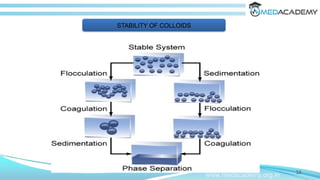
STABILITY OF COLLOIDS
■ Stabilisation serves to prevent colloids from aggregation.
■ The presence and magnitude, or absence of a charge on a colloidal particle is an important factor in the
stability of colloids.
■ Two main mechanisms for colloid stabilisation:
• 1-Steric stabilisation i.e. surrounding each particle with a protective solvent sheath which prevents
adherence due to Brownian movement
• 2-electrostatic stabilisation i.e. providing the particles with electric charge
A- Lyophobic sols:
− Unstable.
− The particles are stabilised only by the presence of electrical charges on their surfaces through the
addition of a small amount of electrolytes.
− The like charges produce repulsion which prevents coagulation of the particles and subsequent settling.
− Addition of electrolytes beyond necessary for maximum stability results in
17
www.medacademy.org.in
STABILITY OF COLLOIDS
− the accumulation of opposite ions
− and decrease zeta potential
− coagulation
− precipitation of colloids.
− Coagulation also results from the mixing of oppositely charged colloids.
• B- Lyophilic sols and association colloids:
− Stable
− Present as a true solution
− Addition of moderate amounts of electrolytes does not cause coagulation (opposite lyophobic)
• ** Salting out:
• Definition: agglomeration and precipitation of lyophilic colloids.
18
www.medacademy.org.in
STABILITY OF COLLOIDS
19
www.medacademy.org.in
STABILITY OF COLLOIDS
■ This is obtained by:
• 1- Addition of large amounts of electrolytes
− Anions arranged in a decreasing order of precipitating power: citrate > tartrate > sulphate > acetate >
chloride> nitrate > bromide > iodide
− The precipitation power is directly related to the hydration of the ion and its ability to separate water
molecules from colloidal particles
• 2- addition of less polar solvent
• - e.g. alcohol, acetone
− The addition of less polar solvent renders the solvent mixture unfavourable for the colloids
− Decreases solubility
20
www.medacademy.org.in
STABILITY OF COLLOIDS
1) Colloidal silver iodide, silver chloride & silver protein are effective germicides & not cause irritation as ionic silver salts.
2) Colloidal copper is used in cancer.
3) Colloidal gold is used as a diagnostic agent.
4) Colloidal mercury is used in syphilis.
5) Association colloids (SAA) are used to increase the solubility & stability of certain compounds in aqueous & oily
pharmaceutical preparations.
6) Efficiency of certain substances is increased when used in colloidal form due to the large surface area.
e.g. efficiency of kaolin in adsorbing toxins from GIT.
e.g. efficiency of aluminium hydroxide as an antacid.
7) Blood plasma substitutes such as dextran, PVP & gelatin are hydrophilic colloids used to restore or maintain blood volume.
8) Iron-dextran complex form non-ionic hydrophilic sols used for the treatment of anaemia.
21
www.medacademy.org.in
PHARMACEUTICALAPPLICATIONS OF COLLOIDS
Thank You
www.medacademy.org.in
“MAKING PROFESSIONALS, PROFESSIONALLY”

DISPERSED SYSTEM COLLOIDS 2.pptx

  • 1.
  • 2.
    2 www.medacademy.org.in a) Electrical propertiesof interfaces. b) The electrical double layer a) Electrical properties of interfaces: Most surfaces acquire a surface electric charge when brought into contact with an aqueous medium, the principal charging mechanisms being as follows: 1) Ion dissolution. 2) Ionization. 3) Ion adsorption. ELECTRIC PROPERTIES:
  • 3.
    3 www.medacademy.org.in 1) Ion dissolution: Thesurface charge of colloidal particles is controlled by the charge of ion present in excess in the medium. Examples; 1) AgNo3 + NaI AgI +NaNo3 a) silver iodide in a solution with excess iodide Particles acquire - ve b) Aluminium hydroxide in a solution with excess hydroxide Potential determining ions: ions whose conc. determine the electric potential at the particle surface (e.g. Ag+ , I -, H+, OH- )charge & vice versa. if excess Ag the charge will be +ve since the concentration of Ag and I determine the electric potential particles acquire – ve charge & vice versa. ELECTRIC PROPERTIES
  • 4.
    4 www.medacademy.org.in 2) Ionisation Surface chargeof a colloidal particle is controlled by the ionisation of surface groupings Examples; a) polystyrene latex has a carboxylic acid group at the surface, ionised to give negatively charged particles. b) acidic drugs such as ibuprofen & nalidixic acid acquire surface negative charges. c) Amino acids & proteins have carboxyl & amino groups whose ionisation depends on the pH as follow; 3) Ion adsorption: Surface charge of a colloidal particle is controlled by the unequal adsorption of oppositely charged ions Examples; Surfaces of sol in water are more often –ve charged than +ve charged Because cations are more hydrated than anions, cations reside in the bulk while less hydrated anions adsorbed on the surface. ELECTRIC PROPERTIES
  • 5.
    5 www.medacademy.org.in b) The electricaldouble layer: • Development of a net charge at the particle surface affects the distribution of ions in the surrounding interfacial region, • As a result: the concentration of counter ions increases at the surface, • Thus, an electrical double layer exists around each particle. ELECTRIC PROPERTIES
  • 6.
    6 www.medacademy.org.in Silver iodide solscan be prepared by the reaction, AgN03 + Nal---- Agl + NaN03 In the bulk of AgI particles 1: 1 ratio of Ag+ and I- If the reaction is carried out with excess silver nitrate, there will be more Ag+ than I- ions in the surface of the particles. The particles will thus be positively charged and the counterions surrounding them will be N03-. The combination of the positively charged surface and the atmosphere of counter ions surrounding it is called the electric double layer. If the reaction is carried out with an excess NaI, there will be more l- than Ag+ ions on the surface of the particles The particles will thus be negatively charged and the counter ions surrounding them will be Na+. ELECTRIC PROPERTIES
  • 7.
    7 www.medacademy.org.in Electrophoresis ■ Electrophoresis isthe most known electrokinetic phenomenon. It refers to the motion of charged particles related to the fluid under the influence of an applied electric field. ■ If an electric potential is applied to a colloid, the charged colloidal particles move toward the oppositely charged electrode. ELECTRIC PROPERTIES
  • 8.
    8 www.medacademy.org.in 1. Dispersion method(size decreasing) a) Milling & grinding process: b) Peptization: Defined as a process of breaking aggregates/ secondary particles into particles of colloidal size. Peptizing agent: a compound that promotes the dispersibility of solids without entering into combination with them. Ex: glycerin, sugar, lactose, citric acid. PREPARATION METHODS
  • 9.
    9 www.medacademy.org.in Peptization is doneby 1. Removal of flocculating agent/ electrolyte. 2. Addition of deflocculating agent/ surfactant. C) Electric arc method: Method suitable for metals- silver, gold. PREPARATION METHODS
  • 10.
    10 www.medacademy.org.in 2. Condensation method(size increasing) Particles of sub-colloidal range aggregate/condense to the colloidal range. Principle: In supersaturated solution, solute precipitates/ crystallises in 2 steps- a. nucleation, b. growth of nuclei Nuclei is a cluster./ group of ions/ molecules. A stable nucleus attracts ions/molecules on the surface, and size grows to the colloidal range. a)Addition of non-solvent: Sulphur soluble in alcohol (solvent), insoluble in water (non-solvent) b)Chemical methods: Chemical reactions of inorganic substances in lyophobic sols form colloids. 1. Gold, silver, platinum-reduction 2. Sulphur-oxidation 3. Ferric oxide-hydrolysis 4. Arsenic oxide-double decomposition. PREPARATION METHODS
  • 11.
    • When acolloidal solution is prepared it often contains certain electrolytes which tend to destabilise it. The following methods are used for purification: 1. Dialysis 2.Electrodialysis 3. Ultrafiltration • a)- Dialysis: • Depends on the difference in size between colloidal particles & molecular particles (impurities). • Technique; • 1) use semi permeable membrane (e.g. collodion (nitrocellulose), cellophane). • 2) pore size of the used semi-permeable membrane prevents the passage of colloidal particles & permits the passage of small molecules & ions (impurities) such as urea, glucose, and sodium chloride, to pass through. • A type of dialysis equipment; the “Neidle dialyzer” 11 www.medacademy.org.in PURIFICATION OF COLLOIDAL SOLUTIONS
  • 12.
    • At equilibrium,the colloidal material is retained in compartment A, while the sun colloidal material is distributed equally on both sides of the membrane. By continually removing the liquid in compartment B, it is possible to obtain colloidal material in A that is free from sub-colloidal contaminants. 12 www.medacademy.org.in PURIFICATION OF COLLOIDAL SOLUTIONS
  • 13.
    Electrodialysis: In the dialysisunit, the movement of ions across the membrane can be speeded up by applying an electric current through the electrodes induced in the solution. The most important use of dialysis is the purification of blood in artificial kidney machines. The dialysis membrane allows small particles (ions) to pass through but the colloidal-size particles (haemoglobin) do not pass through the membrane. • Technique; • An electric potential may be used to increase the rate of movement of ionic impurities through a dialyzing membrane and so provide rapid • purification. • Electrodialysis is carried out in a three-compartment vessel with electrodes in the outer compartments containing water and the sol in the centre • compartment. • A typical apparatus is shown in the figure. • Application of electrical potential causes cations to migrate to the negative electrode compartment and anions to move to the positive electrode compartment, in both of which running water ultimately removes the electrolyte. 13 www.medacademy.org.in PURIFICATION OF COLLOIDAL SOLUTIONS
  • 14.
  • 15.
    c) Ultrafiltration: • Technique; Applypressure (or suction) Solvent & small particles forced across a membrane while colloidal particles are retained. N.B. • The membrane must be supported on a sintered glass plate to prevent rupture due to high pressure. • Pore size of the membrane can be increased by soaking in a solvent that causes swelling •e.g. cellophane swells in zinc chloride solution. e.g. collodion (nitrocellulose) swells in alcohol. 15 www.medacademy.org.in PURIFICATION OF COLLOIDAL SOLUTIONS
  • 16.
  • 17.
    ■ Stabilisation servesto prevent colloids from aggregation. ■ The presence and magnitude, or absence of a charge on a colloidal particle is an important factor in the stability of colloids. ■ Two main mechanisms for colloid stabilisation: • 1-Steric stabilisation i.e. surrounding each particle with a protective solvent sheath which prevents adherence due to Brownian movement • 2-electrostatic stabilisation i.e. providing the particles with electric charge A- Lyophobic sols: − Unstable. − The particles are stabilised only by the presence of electrical charges on their surfaces through the addition of a small amount of electrolytes. − The like charges produce repulsion which prevents coagulation of the particles and subsequent settling. − Addition of electrolytes beyond necessary for maximum stability results in 17 www.medacademy.org.in STABILITY OF COLLOIDS
  • 18.
    − the accumulationof opposite ions − and decrease zeta potential − coagulation − precipitation of colloids. − Coagulation also results from the mixing of oppositely charged colloids. • B- Lyophilic sols and association colloids: − Stable − Present as a true solution − Addition of moderate amounts of electrolytes does not cause coagulation (opposite lyophobic) • ** Salting out: • Definition: agglomeration and precipitation of lyophilic colloids. 18 www.medacademy.org.in STABILITY OF COLLOIDS
  • 19.
  • 20.
    ■ This isobtained by: • 1- Addition of large amounts of electrolytes − Anions arranged in a decreasing order of precipitating power: citrate > tartrate > sulphate > acetate > chloride> nitrate > bromide > iodide − The precipitation power is directly related to the hydration of the ion and its ability to separate water molecules from colloidal particles • 2- addition of less polar solvent • - e.g. alcohol, acetone − The addition of less polar solvent renders the solvent mixture unfavourable for the colloids − Decreases solubility 20 www.medacademy.org.in STABILITY OF COLLOIDS
  • 21.
    1) Colloidal silveriodide, silver chloride & silver protein are effective germicides & not cause irritation as ionic silver salts. 2) Colloidal copper is used in cancer. 3) Colloidal gold is used as a diagnostic agent. 4) Colloidal mercury is used in syphilis. 5) Association colloids (SAA) are used to increase the solubility & stability of certain compounds in aqueous & oily pharmaceutical preparations. 6) Efficiency of certain substances is increased when used in colloidal form due to the large surface area. e.g. efficiency of kaolin in adsorbing toxins from GIT. e.g. efficiency of aluminium hydroxide as an antacid. 7) Blood plasma substitutes such as dextran, PVP & gelatin are hydrophilic colloids used to restore or maintain blood volume. 8) Iron-dextran complex form non-ionic hydrophilic sols used for the treatment of anaemia. 21 www.medacademy.org.in PHARMACEUTICALAPPLICATIONS OF COLLOIDS
  • 22.