CAVITATION,
NPSHR,
& NPSHA
Pump BasicsPump Basics
Cavitation?
Volute Wall
Minimum NPSHA must be > NPSHR
+ a safety factor
Higher than
Vaporization
Threshold, but
lower than
NPSHA
Higher pressure, but
still moving fast =
Kinetic energy
Moving slowly,
now highest
pressure
(Potential)
Sharp speed
increase due to
centrifugal force.
Slight pressure
increase. Bubbles
start to implode,
releasing
damaging energy
Vaporization
starts to occur
here
CAVITATION
• Occurs in the impeller and
chamber. Sounds like sand going
through the pump.
• Cause - Liquid vaporizes as it
enters the eyelet of the impeller if
the inlet pressure is too low.
These vapor bubbles collapse
(implode) under increased
pressure during their exit from the
impeller.
CAVITATION
• Damage Caused - The implosion
releases energy which erodes the
impeller and bearings, leading to
reduced efficiency and possible
pump failure.
• How to Avoid Cavitation - Ensure
that the NPSHA is greater than
the NPSHR! What does this
mean?
NPSH
• NPSH - Stands for Net Positive Suction Head.
It is the measure of the amount of energy at the
pump suction available to exert pressure on the
fluid (head is energy, measured in feet).
• Net = Result of adding some positives and
some negatives.
• Positive = + (always positive)
• Suction = The inlet of the pump
• Head = Energy in feet, absolute (Includes
atmospheric pressure)
+
NPSHR
• NPSHR - Stands for Net Positive Suction Head Required.
• Cavitation occurs when the Available Suction Head is less than
Required for a specific pump. When Suction Pressure is too
low, fluid vaporizes. The created bubbles collapse as they
encounter increased pressure while exiting the impeller,
resulting in Cavitation
NPSHR
• NPSHR Is Unique - The Net Positive Suction Head Required
is unique for each pump design. It is a function of the
geometric design and RPM.
• NPSHR is a Given! - Manufacturers provide graphs which
illustrate the NPSHR for each pump model at the full
spectrum of GPM range. As GPM increases, NPSHR
increases.
NPSHR Curve
• NPSHA - Net Positive Suction Head Available is unique for each specific
application and operating condition.
• NPSHA - Consists of 5 variables.
1. Gas Pressure - Atmospheric or closed system - (Positive, Pa)
2. Distance of the fluid source above (positive) or below (negative) the pump
suction inlet (He)
3. Suction plumbing friction loss (Negative, Hf)
4. Vapor Pressure (Liquid Temperature Sensitive) - (Negative, Pv)
5. Specific Gravity (S.G.)
• Positives prevent cavitation
• Negatives promote cavitation
NPSHA
• 1. Gas Pressure (Air, Vapor, etc.) acting on the fluid surface.
Its absolute pressure is always positive (although gauge
pressure may be negative).
– a. For an Open System, determine the atmospheric
pressure based on the elevation of the site above
seal level (e.g. 14.7psi at sea level multiplied by 2.31
to convert psi to feet of head = 33.4 feet). Consult
charts which supply this data.
– b. For a Closed System, gauge pressure, plus
atmospheric pressure based on the elevation above
sea level. Multiply by 2.31 to convert psi to feet of
head.
Elevation
Pressure
=
NPSHA
• 2. Distance of the liquid source
above or below the pump inlet,
measured in feet: can be positive
OR negative. Positive suction
head occurs when the top of the
water source is above the suction
Inlet of the pump. Negative
elevation refers to suction lift (like
from a pond, tank lower than the
pump, etc.)
+
-
NPSHA
• 3. Suction plumbing friction loss - It is
always Negative. It is the friction loss for
all components prior to the pump inlet.
As flow increases linearly, friction
increases exponentially. Friction loss is
calculated from friction charts for pipe,
fittings, valves, and other special fluid
carrying devices. The Grundfos
Engineering Catalog and the
Plumbing/Heating, Sump, Sewage &
Effluent Handbook include this
information.
Friction
FlowLinear
=
FrictionLoss
Exponential
Friction loss in
pipes
• 4. Vapor Pressure, at any given temperature is
always Negative. Vapor Pressure reduces the
positive effect of NPSH variable number 1, Gas
Pressure, by lowering the gas density as
temperature rises. “Vapor Pressure” sounds like
it should be “positive” but it is the result of
“vaporization” due to higher temperature.
Remember it as “Vaporizing” (Negating) the
Atmospheric Pressure effect.
Hot
Cold
Affect of
Temperature
On Inlet Pressure
NPSHA
NPSHA
• 5. Specific Gravity - If the specific gravity is < or > 1.0, the atmospheric
pressure - vapor pressure must be adjusted.
2.31 * (Pa – Pv)
Specific Gravity
NPSHA
NPSHA = 2.31 * (Pa – Pv) +/- He – Hf
Specific Gravity
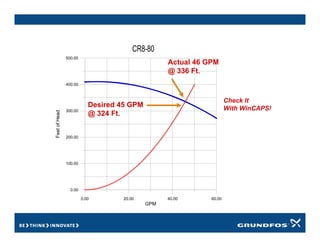
• A pump is required to produce 45 gpm at a TDH of 324 feet. The
pump is fed by a reservoir which is at an elevation of 20 feet above
the inlet of the pump. The system is located at an elevation of
2,000 feet above sea level. The water is 50 degrees F. The friction
loss in the plumbing leading from the tank to the pump inlet is
calculated at 3 feet of head.
NPSHR, NPSHA, & CAVITATION
An Example
0.00 20.00 40.00 60.00
GPM
0.00
100.00
200.00
300.00
400.00
500.00FeetofHead
CR8-80
Desired 45 GPM
@ 324 Ft.
Actual 46 GPM
@ 336 Ft.
Check It
With WinCAPS!
NPSHR Curve
Atmospheric Pressure Adjusted for Elevation
Properties of Water
• 1. Pump Size - 45 GPM at 324 feet of TDH. Select CR8-80.
• 2. NPSHR - At 45 GPM, the CR8 submittal data NPSH(R) Curve
indicates a minimum of 3.5 feet of NPSH is required to avoid
cavitation.
• 3. NPSHA
– 1. Gas Pressure (Open air or closed?) - In this case, an open system.
The elevation chart indicates an atmospheric pressure of + 13.7 psi at an
elevation of 2,000 feet.
– 2. Elevation from the pump inlet to the top of the feed water. Given = +
20 feet (since it was above the inlet).
CAVITATION, NPSHR, & NPSHA
An Example - The Answer
– 3. Friction loss - Given in this case, 3 feet of head. If not given, calculate
losses in the pipes, fittings, and valves from the feed source to the pump
inlet flange. Include losses in the tank discharge port. Friction charts are
available to calculate losses in pipes and fittings. Manufacturers can
supply friction loss values for special components.
– 4. Vapor Pressure - Reading from the “Properties of Water” chart, the
Vapor Pressure loss at 50 degrees F is 0.18 psia
– 5. Specific Gravity = 1.001 at 50 degrees F
– Total NPSHA = 2.31* (13.7psia - 0.18psia)/1.001 + 20 ft. - 3 ft. = +48.2 ft.
• NPSHR = 3.5 ft.
• NPSHA > NPSHR = A good application
• Approximately how long could the feed pipe be extended if the lost per 100 feet
of the 2” pipe was 3.9 feet? What could you do to increase the distance and
not cause cavitation?
CAVITATION, NPSHR, & NPSHA
An Example - The Answer
• NPSHA > NPSHR = OK
• NPSHA < NPSHR = CAVITATION
CAVITATION, NPSHR, & NPSHA
Summary

Basics cavitation

  • 1.
  • 2.
    Cavitation? Volute Wall Minimum NPSHAmust be > NPSHR + a safety factor Higher than Vaporization Threshold, but lower than NPSHA Higher pressure, but still moving fast = Kinetic energy Moving slowly, now highest pressure (Potential) Sharp speed increase due to centrifugal force. Slight pressure increase. Bubbles start to implode, releasing damaging energy Vaporization starts to occur here
  • 3.
    CAVITATION • Occurs inthe impeller and chamber. Sounds like sand going through the pump. • Cause - Liquid vaporizes as it enters the eyelet of the impeller if the inlet pressure is too low. These vapor bubbles collapse (implode) under increased pressure during their exit from the impeller.
  • 4.
    CAVITATION • Damage Caused- The implosion releases energy which erodes the impeller and bearings, leading to reduced efficiency and possible pump failure. • How to Avoid Cavitation - Ensure that the NPSHA is greater than the NPSHR! What does this mean?
  • 5.
    NPSH • NPSH -Stands for Net Positive Suction Head. It is the measure of the amount of energy at the pump suction available to exert pressure on the fluid (head is energy, measured in feet). • Net = Result of adding some positives and some negatives. • Positive = + (always positive) • Suction = The inlet of the pump • Head = Energy in feet, absolute (Includes atmospheric pressure) +
  • 6.
    NPSHR • NPSHR -Stands for Net Positive Suction Head Required. • Cavitation occurs when the Available Suction Head is less than Required for a specific pump. When Suction Pressure is too low, fluid vaporizes. The created bubbles collapse as they encounter increased pressure while exiting the impeller, resulting in Cavitation
  • 7.
    NPSHR • NPSHR IsUnique - The Net Positive Suction Head Required is unique for each pump design. It is a function of the geometric design and RPM. • NPSHR is a Given! - Manufacturers provide graphs which illustrate the NPSHR for each pump model at the full spectrum of GPM range. As GPM increases, NPSHR increases.
  • 8.
  • 9.
    • NPSHA -Net Positive Suction Head Available is unique for each specific application and operating condition. • NPSHA - Consists of 5 variables. 1. Gas Pressure - Atmospheric or closed system - (Positive, Pa) 2. Distance of the fluid source above (positive) or below (negative) the pump suction inlet (He) 3. Suction plumbing friction loss (Negative, Hf) 4. Vapor Pressure (Liquid Temperature Sensitive) - (Negative, Pv) 5. Specific Gravity (S.G.) • Positives prevent cavitation • Negatives promote cavitation NPSHA
  • 10.
    • 1. GasPressure (Air, Vapor, etc.) acting on the fluid surface. Its absolute pressure is always positive (although gauge pressure may be negative). – a. For an Open System, determine the atmospheric pressure based on the elevation of the site above seal level (e.g. 14.7psi at sea level multiplied by 2.31 to convert psi to feet of head = 33.4 feet). Consult charts which supply this data. – b. For a Closed System, gauge pressure, plus atmospheric pressure based on the elevation above sea level. Multiply by 2.31 to convert psi to feet of head. Elevation Pressure = NPSHA
  • 11.
    • 2. Distanceof the liquid source above or below the pump inlet, measured in feet: can be positive OR negative. Positive suction head occurs when the top of the water source is above the suction Inlet of the pump. Negative elevation refers to suction lift (like from a pond, tank lower than the pump, etc.) + - NPSHA
  • 12.
    • 3. Suctionplumbing friction loss - It is always Negative. It is the friction loss for all components prior to the pump inlet. As flow increases linearly, friction increases exponentially. Friction loss is calculated from friction charts for pipe, fittings, valves, and other special fluid carrying devices. The Grundfos Engineering Catalog and the Plumbing/Heating, Sump, Sewage & Effluent Handbook include this information. Friction FlowLinear = FrictionLoss Exponential Friction loss in pipes
  • 13.
    • 4. VaporPressure, at any given temperature is always Negative. Vapor Pressure reduces the positive effect of NPSH variable number 1, Gas Pressure, by lowering the gas density as temperature rises. “Vapor Pressure” sounds like it should be “positive” but it is the result of “vaporization” due to higher temperature. Remember it as “Vaporizing” (Negating) the Atmospheric Pressure effect. Hot Cold Affect of Temperature On Inlet Pressure NPSHA
  • 14.
    NPSHA • 5. SpecificGravity - If the specific gravity is < or > 1.0, the atmospheric pressure - vapor pressure must be adjusted. 2.31 * (Pa – Pv) Specific Gravity
  • 15.
    NPSHA NPSHA = 2.31* (Pa – Pv) +/- He – Hf Specific Gravity
  • 16.
    • A pumpis required to produce 45 gpm at a TDH of 324 feet. The pump is fed by a reservoir which is at an elevation of 20 feet above the inlet of the pump. The system is located at an elevation of 2,000 feet above sea level. The water is 50 degrees F. The friction loss in the plumbing leading from the tank to the pump inlet is calculated at 3 feet of head. NPSHR, NPSHA, & CAVITATION An Example
  • 17.
    0.00 20.00 40.0060.00 GPM 0.00 100.00 200.00 300.00 400.00 500.00FeetofHead CR8-80 Desired 45 GPM @ 324 Ft. Actual 46 GPM @ 336 Ft. Check It With WinCAPS!
  • 18.
  • 19.
  • 20.
  • 21.
    • 1. PumpSize - 45 GPM at 324 feet of TDH. Select CR8-80. • 2. NPSHR - At 45 GPM, the CR8 submittal data NPSH(R) Curve indicates a minimum of 3.5 feet of NPSH is required to avoid cavitation. • 3. NPSHA – 1. Gas Pressure (Open air or closed?) - In this case, an open system. The elevation chart indicates an atmospheric pressure of + 13.7 psi at an elevation of 2,000 feet. – 2. Elevation from the pump inlet to the top of the feed water. Given = + 20 feet (since it was above the inlet). CAVITATION, NPSHR, & NPSHA An Example - The Answer
  • 22.
    – 3. Frictionloss - Given in this case, 3 feet of head. If not given, calculate losses in the pipes, fittings, and valves from the feed source to the pump inlet flange. Include losses in the tank discharge port. Friction charts are available to calculate losses in pipes and fittings. Manufacturers can supply friction loss values for special components. – 4. Vapor Pressure - Reading from the “Properties of Water” chart, the Vapor Pressure loss at 50 degrees F is 0.18 psia – 5. Specific Gravity = 1.001 at 50 degrees F – Total NPSHA = 2.31* (13.7psia - 0.18psia)/1.001 + 20 ft. - 3 ft. = +48.2 ft. • NPSHR = 3.5 ft. • NPSHA > NPSHR = A good application • Approximately how long could the feed pipe be extended if the lost per 100 feet of the 2” pipe was 3.9 feet? What could you do to increase the distance and not cause cavitation? CAVITATION, NPSHR, & NPSHA An Example - The Answer
  • 23.
    • NPSHA >NPSHR = OK • NPSHA < NPSHR = CAVITATION CAVITATION, NPSHR, & NPSHA Summary