PULMONARY EMBOLISM
Dr.Partha Das
MEM,PGY2
Fortis Hospital, Kolkata
08/04/2016
STATISTICS (INDIAN SCENARIO)
• Overall, the annual incidence of PE
ranges between 23 and 69 cases per
100,000 population
• Responsible for up to 15% of all in-
hospital deaths
• Accounts for 20 to 30% of deaths a/w
pregnancy & delivery
• Average case fatality rate within 2 weeks
of Δ of ~ 11 %
• Roughly accounting for at least 100,000
deaths each year
Ref : indianheartjournal.com/ihj09/sep_oct_09/467-469.html
DEFINITION
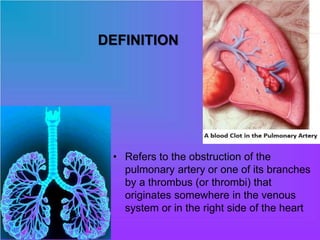
• Refers to the obstruction of the
pulmonary artery or one of its branches
by a thrombus (or thrombi) that
originates somewhere in the venous
system or in the right side of the heart
PATHOPHYSIOLOGY
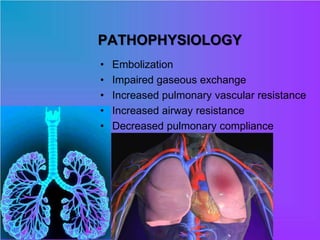
• Embolization
• Impaired gaseous exchange
• Increased pulmonary vascular resistance
• Increased airway resistance
• Decreased pulmonary compliance
Contd…
As pulmonary vascular resistance↑, RV
wall tension ↑ & causes further RV dilation
& dysfunction
↓
↑ RV wall tension also compresses the
RCA
↓
↓ subendocardial perfusion & limits
myocardial oxygen supply
↓
Provokes MI → eventually circulatory
collapse & death may ensue
Ref : Harrison’s Principles of Internal Medicine, 18th Ed
PREDISPOSING FACTORS
• Malignancy
• Prolonged bed rest
• Long-haul air travel
• Obesity
• COPD
• Systemic arterial HTN
• Smoking
• OCPs
• Pregnancy
• Surgery & trauma
• Post menopausal hormone replacement
• Thrombophilia, AF
HEREDITARY FACTORS
• Antithrombin III deficiency
• Protein C deficiency
• Protein S deficiency
• Factor V Leiden
• Plasminogen abnormality
• Fibrinogen abnormality
• Resistance to activated Protein C
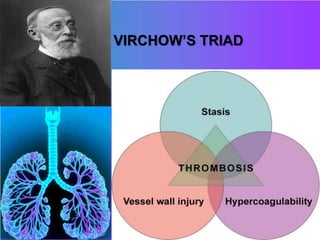
VIRCHOW’S TRIAD
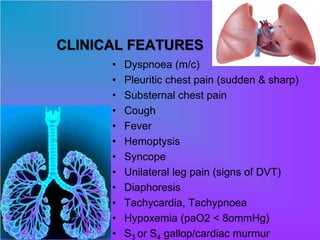
CLINICAL FEATURES
• Dyspnoea (m/c)
• Pleuritic chest pain (sudden & sharp)
• Substernal chest pain
• Cough
• Fever
• Hemoptysis
• Syncope
• Unilateral leg pain (signs of DVT)
• Diaphoresis
• Tachycardia, Tachypnoea
• Hypoxemia (paO2 < 8ommHg)
• S3 or S4 gallop/cardiac murmur
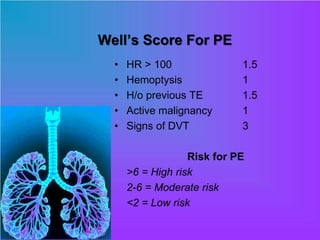
Well’s Score For PE
• HR > 100 1.5
• Hemoptysis 1
• H/o previous TE 1.5
• Active malignancy 1
• Signs of DVT 3
Risk for PE
>6 = High risk
2-6 = Moderate risk
<2 = Low risk
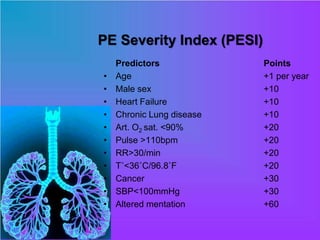
PE Severity Index (PESI)
Predictors Points
• Age +1 per year
• Male sex +10
• Heart Failure +10
• Chronic Lung disease +10
• Art. O2 sat. <90% +20
• Pulse >110bpm +20
• RR>30/min +20
• T˚<36˚C/96.8˚F +20
• Cancer +30
• SBP<100mmHg +30
• Altered mentation +60
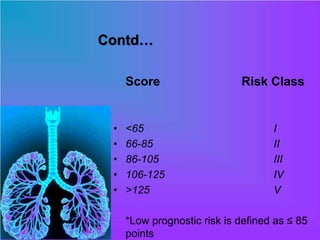
Contd…
Score Risk Class
• <65 I
• 66-85 II
• 86-105 III
• 106-125 IV
• >125 V
*Low prognostic risk is defined as ≤ 85
points
PE R/O Criteria (PERC)
• Age < 50 years
• HR < 100 bpm
• SpO2 >95% in R/A
• No Hemoptysis
• No exogenous Estrogen use
• No previous TE
• No trauma/Surgery requiring
hospitalization (in 4 weeks)
• No U/L leg swelling
DIAGNOSTIC FINDINGS
Chest X Ray
• Radiographic signs include:-
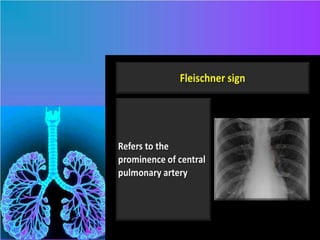
• Fleishner sign: enlarged pulmonary artery
(20%)
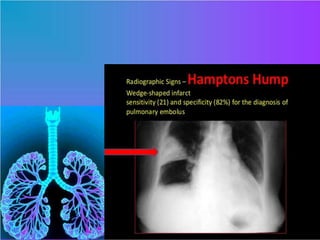
• Hampton hump: peripheral wedge of
airspace opacity and implies lung
infarction (20%)
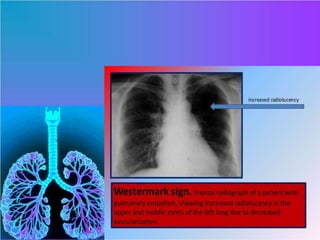
• Westermark's sign: regional oligaemia and
highest positive predictive value (10%)
• Pleural effusion (35%)
• Knuckle sign
Ref : http://radiopaedia.org/articles/pulmonary-embolism
Contd…
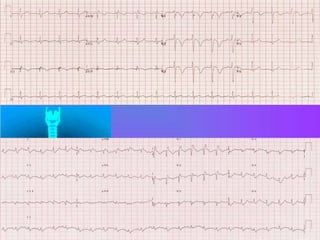
ECG
• Sinus tachycardia – m/c abnormality
• Complete or incomplete RBBB – a/w ↑
mortality
• RV strain pattern – T wave ↓ in the right
precordial leads (V1-4) ± the inferior leads
• Right axis deviation
• Right atrial enlargement (P pulmonale)
– peaked P wave in lead II > 2.5 mm in
height
• Atrial Tachyarrhythmias – AF, Flutter
• Non specific ST-segment & T wave
changes
Contd…
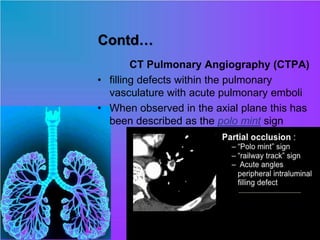
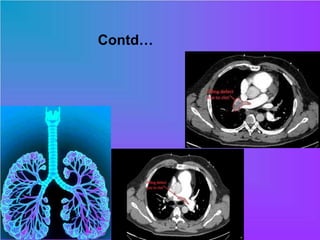
CT Pulmonary Angiography (CTPA)
• filling defects within the pulmonary
vasculature with acute pulmonary emboli
• When observed in the axial plane this has
been described as the polo mint sign
Contd…
Other Investigations :-
• ECHO - It helps to detect RV
enlargement & RWMA a/w PTE
(McConnell’s sign - hypokinesia of RV
free wall with normal motion of RV apex
is best known indirect sign of PE)
• ABG - ↓ PaO2
• D- Dimer assay
• NT Pro BNP
• V/Q Scan
• Venous USG & Impedence
Plethysmography
• Contrast enhanced Helical CT Lung
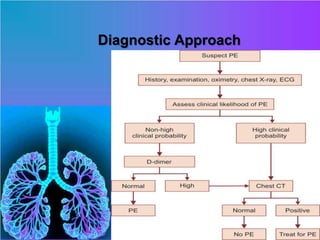
Diagnostic Approach
Management
• Provide O2 by cannula/mask/ventilator –
as indicated
• Elevate head-end of bed
• Elevate lower extremities if DVT is
present
• Morphine to manage pain & anxiety
(avoid in case of severe Hypotension)
• Inj. Heparin 10,000 U i/v bolus followed
by 5000 U i/v 6 hourly charged in 200 ml
N/S
• LMWH (Enoxaparin 1mg/kg BD s/c)
• Dopamine or Dobutamine infusion to treat
hypotension & shock
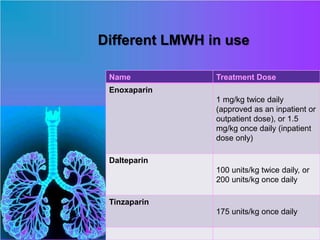
Different LMWH in use
Name Treatment Dose
Enoxaparin
1 mg/kg twice daily
(approved as an inpatient or
outpatient dose), or 1.5
mg/kg once daily (inpatient
dose only)
Dalteparin
100 units/kg twice daily, or
200 units/kg once daily
Tinzaparin
175 units/kg once daily
Pulmonary Embolectomy
• Emergency surgical removal of emboli
which are blocking blood circulation &
causing necrosis
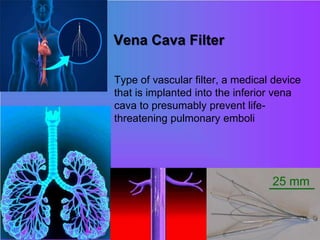
Vena Cava Filter
• Type of vascular filter, a medical device
that is implanted into the inferior vena
cava to presumably prevent life-
threatening pulmonary emboli
Prevention
• Leg exercises (Dorsiflexion of feet)
• Frequent position changes
• Ambulation
• Intermittent pneumatic leg
compression devices
• Anti embolism stockings
• Tab.Warfarin 5mg BD x 3-4 weeks &
then can be tapered to keep INR @
2.5-3
REFERENCES
• Tintinalli’s Emergency Medicine e-Book
6th Edition
• Harrison’s Principles of Internal
Medicine 18th Edition
• European Heart Journal, 2014
• Kapoor VK. Venous thromboembolism in
India. The National Medical Journal.
2010;23(4):193-95.
• European Heart Journal Advance
Access published August 29, 2014
• radiopaedia.org/articles/pulmonary-
embolism
Pulmonary embolism

Pulmonary embolism

  • 1.
  • 2.
    STATISTICS (INDIAN SCENARIO) •Overall, the annual incidence of PE ranges between 23 and 69 cases per 100,000 population • Responsible for up to 15% of all in- hospital deaths • Accounts for 20 to 30% of deaths a/w pregnancy & delivery • Average case fatality rate within 2 weeks of Δ of ~ 11 % • Roughly accounting for at least 100,000 deaths each year Ref : indianheartjournal.com/ihj09/sep_oct_09/467-469.html
  • 3.
    DEFINITION • Refers tothe obstruction of the pulmonary artery or one of its branches by a thrombus (or thrombi) that originates somewhere in the venous system or in the right side of the heart
  • 4.
    PATHOPHYSIOLOGY • Embolization • Impairedgaseous exchange • Increased pulmonary vascular resistance • Increased airway resistance • Decreased pulmonary compliance
  • 5.
    Contd… As pulmonary vascularresistance↑, RV wall tension ↑ & causes further RV dilation & dysfunction ↓ ↑ RV wall tension also compresses the RCA ↓ ↓ subendocardial perfusion & limits myocardial oxygen supply ↓ Provokes MI → eventually circulatory collapse & death may ensue Ref : Harrison’s Principles of Internal Medicine, 18th Ed
  • 6.
    PREDISPOSING FACTORS • Malignancy •Prolonged bed rest • Long-haul air travel • Obesity • COPD • Systemic arterial HTN • Smoking • OCPs • Pregnancy • Surgery & trauma • Post menopausal hormone replacement • Thrombophilia, AF
  • 7.
    HEREDITARY FACTORS • AntithrombinIII deficiency • Protein C deficiency • Protein S deficiency • Factor V Leiden • Plasminogen abnormality • Fibrinogen abnormality • Resistance to activated Protein C
  • 8.
  • 9.
    CLINICAL FEATURES • Dyspnoea(m/c) • Pleuritic chest pain (sudden & sharp) • Substernal chest pain • Cough • Fever • Hemoptysis • Syncope • Unilateral leg pain (signs of DVT) • Diaphoresis • Tachycardia, Tachypnoea • Hypoxemia (paO2 < 8ommHg) • S3 or S4 gallop/cardiac murmur
  • 10.
    Well’s Score ForPE • HR > 100 1.5 • Hemoptysis 1 • H/o previous TE 1.5 • Active malignancy 1 • Signs of DVT 3 Risk for PE >6 = High risk 2-6 = Moderate risk <2 = Low risk
  • 11.
    PE Severity Index(PESI) Predictors Points • Age +1 per year • Male sex +10 • Heart Failure +10 • Chronic Lung disease +10 • Art. O2 sat. <90% +20 • Pulse >110bpm +20 • RR>30/min +20 • T˚<36˚C/96.8˚F +20 • Cancer +30 • SBP<100mmHg +30 • Altered mentation +60
  • 12.
    Contd… Score Risk Class •<65 I • 66-85 II • 86-105 III • 106-125 IV • >125 V *Low prognostic risk is defined as ≤ 85 points
  • 13.
    PE R/O Criteria(PERC) • Age < 50 years • HR < 100 bpm • SpO2 >95% in R/A • No Hemoptysis • No exogenous Estrogen use • No previous TE • No trauma/Surgery requiring hospitalization (in 4 weeks) • No U/L leg swelling
  • 14.
    DIAGNOSTIC FINDINGS Chest XRay • Radiographic signs include:- • Fleishner sign: enlarged pulmonary artery (20%) • Hampton hump: peripheral wedge of airspace opacity and implies lung infarction (20%) • Westermark's sign: regional oligaemia and highest positive predictive value (10%) • Pleural effusion (35%) • Knuckle sign Ref : http://radiopaedia.org/articles/pulmonary-embolism
  • 18.
    Contd… ECG • Sinus tachycardia– m/c abnormality • Complete or incomplete RBBB – a/w ↑ mortality • RV strain pattern – T wave ↓ in the right precordial leads (V1-4) ± the inferior leads • Right axis deviation • Right atrial enlargement (P pulmonale) – peaked P wave in lead II > 2.5 mm in height • Atrial Tachyarrhythmias – AF, Flutter • Non specific ST-segment & T wave changes
  • 20.
    Contd… CT Pulmonary Angiography(CTPA) • filling defects within the pulmonary vasculature with acute pulmonary emboli • When observed in the axial plane this has been described as the polo mint sign
  • 21.
  • 22.
    Other Investigations :- •ECHO - It helps to detect RV enlargement & RWMA a/w PTE (McConnell’s sign - hypokinesia of RV free wall with normal motion of RV apex is best known indirect sign of PE) • ABG - ↓ PaO2 • D- Dimer assay • NT Pro BNP • V/Q Scan • Venous USG & Impedence Plethysmography • Contrast enhanced Helical CT Lung
  • 23.
  • 24.
    Management • Provide O2by cannula/mask/ventilator – as indicated • Elevate head-end of bed • Elevate lower extremities if DVT is present • Morphine to manage pain & anxiety (avoid in case of severe Hypotension) • Inj. Heparin 10,000 U i/v bolus followed by 5000 U i/v 6 hourly charged in 200 ml N/S • LMWH (Enoxaparin 1mg/kg BD s/c) • Dopamine or Dobutamine infusion to treat hypotension & shock
  • 25.
    Different LMWH inuse Name Treatment Dose Enoxaparin 1 mg/kg twice daily (approved as an inpatient or outpatient dose), or 1.5 mg/kg once daily (inpatient dose only) Dalteparin 100 units/kg twice daily, or 200 units/kg once daily Tinzaparin 175 units/kg once daily
  • 26.
    Pulmonary Embolectomy • Emergencysurgical removal of emboli which are blocking blood circulation & causing necrosis
  • 27.
    Vena Cava Filter •Type of vascular filter, a medical device that is implanted into the inferior vena cava to presumably prevent life- threatening pulmonary emboli
  • 28.
    Prevention • Leg exercises(Dorsiflexion of feet) • Frequent position changes • Ambulation • Intermittent pneumatic leg compression devices • Anti embolism stockings • Tab.Warfarin 5mg BD x 3-4 weeks & then can be tapered to keep INR @ 2.5-3
  • 29.
    REFERENCES • Tintinalli’s EmergencyMedicine e-Book 6th Edition • Harrison’s Principles of Internal Medicine 18th Edition • European Heart Journal, 2014 • Kapoor VK. Venous thromboembolism in India. The National Medical Journal. 2010;23(4):193-95. • European Heart Journal Advance Access published August 29, 2014 • radiopaedia.org/articles/pulmonary- embolism