

Introduction to Public
      Relations


       An overview
What is Public?
A public is any group that has an
actual or potential interest in or
   impact on a company’s or a
  person’s ability to achieve its
            objectives.


    What is Relations?
It is the result and outcome of
mutual understanding derived
  from the process of sharing
       common interests.
Defining the Publics
 The term public (active audience)
includes any group of people tied
together, however loosely, by
some common bond of interest or
concern and who have importance
on an organization.
What is Public Relations?


Public Relations (PR) involves a variety of
programs designed to promote or protect a
company’s image or a person’s or individual
products.
Defining Public Relations
Public relations, according to the Institute of Public
Relations (IPR), is about the reputation. The result
of what you do; what you say and what others say
about you.

The PR practice is defined as the discipline that
looks after reputation with the aim of earning
understanding and support, and influencing opinion
and behavior. It is planned and sustained effort to
establish and maintain good will and mutual
understanding between an organization and its
public – i.e., a company's staff, suppliers,
shareholders, customers, etc.
Origin of PR in the world

   PR found itself originating in the media &
    publicists who specialized in promoting
    circuses, theatrical performances, and
    other public spectacles.

   The First World War (1914-1918) also
    helped stimulate the development of
    public relations as a profession.
Origin of PR contd…


Many of the first PR professionals, including
Ivy Led better Lee, Edward Bernays, and
Carl Byoir, got their start with the
Committee for Public Information (also
known as the Creel Committee), which
organized publicity on behalf of U.S.
objectives during World War -I
Basic Functions of PR
   Press or Media Relations
   Product Publicity
   Corporate Communications
   Lobbying
   Counseling
   Crisis Management
Developing friendly media relations
    Critical appreciation of media requirements

    Understanding the role and responsibility of
     journalists

    Understand your organization, its policies,
     programs, and also the structure and
     functioning of a typical media organization
Product publicity

   Public relation officer utilizing their
    potential, he makes the product
    publicity and awareness a breeze,
    channeling all required information for a
    product to all possible media in a
    consistent and straightforward manner.
Corporate communication
     Creation of a state-of-the-art and
       precise corporate PR strategy is
        aimed at image lifting through
      analysis of possible events and
            trends, forecasting of their
      consequences, meeting with the
    executives of the organization and
           implementing the necessary
         strategies and programs, thus
              bringing benefits both this
        organization and the society at
             large. Eg. Filmfare awards.
Lobbying
   Lobbying (also Lobby) is a form of
    advocacy with the intention of influencing
    decisions made by legislators and officials in
    the government by individuals, other
    legislators or groups. A lobbyist is a person
    who tries to influence legislation on behalf of
    a special interest or a member of a lobby.
    Eg- Governments or the corporate world
    often define and regulate organized group
    lobbying that has become influential on
    policy. ….2G Scam
Counseling
    Counseling is a scientific process which is
    largely accepted by many of us. Whether its
    vocation guidance or coping with personal
    trauma counseling surely makes it easy for us to
    seek professional guidance. There are many
    subjects that require counseling. With changing
    times our lifestyle offers us so many advantages
    that make life easy but at the same time it is
    important to acknowledge the side effects of a
    routine fast paced life.
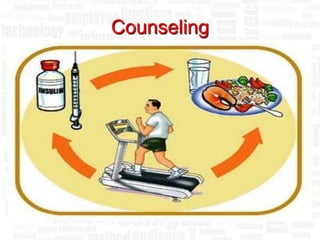
Counseling
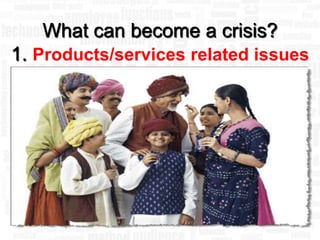
What can become a crisis?
1. Products/services related issues
What can become a crisis?
- Incidents at sites,

- Business strategies,
 E.g.- Anil- Mukesh Ambani business

  crisis.

- Actions of pressure groups
 E.g- Mr. Sharad Pawar agreed to released
  food grains to the BPL.
Crisis management

   Being a Public relations
    officer you must get ready to
    face various kinds of crisis.
    - Preparing for a crisis
    - Managing a crisis
    - Communicating in a crisis
What is crisis?
   Any event which can create opinion
    that :

   Products/services are harmful

   Plans/processes detrimental to
   investors, communities, employees,
    etc.
Specialty PR

   Foodservice PR
   Healthcare PR
   Technology PR
   Entertainment & Lifestyle PR
   Financial PR
Foodservice PR
   In its most basic form it can be split into two
    clear types - the profit and the cost sector.
    Profit operators meanwhile offer far greater
    potential gains to the manufacturer - pricing is
    flexible, important consumer insight key.
        Cost sector operators, such as education
    and healthcare caterers, do not derive
    substantial margins - the supply of meals is
    not the core function of their business, merely
    a necessity. Provision is dependent on contract
    and pricing controlled or fixed.
Healthcare PR
   Individuals that specialize in health care public
    relations are in charge of handling the internal and
    external communications for a health care facility.
    They interact with physicians, nurses, managers,
    administrators, and patients, and therefore must have
    excellent communication skills. Some of their
    responsibilities include writing for internal publications
    such as newsletters, handling calls from the media,
    as well as writing and creating various material that
    promote the services offered at that facility.
Healthcare PR
   Public relations specialists may also be called
    upon to prepare marketing plans that
    highlight various aspects of an organization.
    The most important function of this position
    is handling all communications with the
    public. They may organize events between
    the organization and the public, or they
    might prefer to correspond by publishing
    press releases. Public relations specialists
    must be highly organized and be prepared to
    deal with a variety of situations.
Technology PR
   Having clear messages and public
    relations programs in place that enable
    technologists, scientists and other
    experts to distinctly articulate their
    vision can not only help them become
    industry leaders and advance their
    technologies, but provides
    organizations with a voice in the
    marketplace of ideas, facts, and
    viewpoints to aid informed public
    debate.
Technology PR
Entertainment & Lifestyle PR
   This PR specializing in literary, lifestyle and
    entertainment communication services.
    The clients include celebrities from TV,
    film and music, authors and publishing
    houses, medical professionals, industry
    experts and various businesses. It works
    intimately with clients to provide strategic
    PR support that helps them achieve their
    goals, image building, elevate status and
    expose them in countless ways around the
    nation.
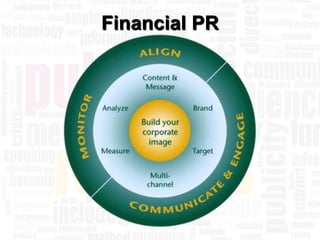
Financial PR
   This PR specializing in corporate
    disclosure responsibilities, stockholder
    relations, and relations with the
    professional investor community. Financial
    public relations is concerned not only with
    matters of corporate image, the
    cultivation of a favorable financial and
    investment environment but also with
    legal interpretation, devotion to Securities
    and Exchange Commission and other
    government regulations.
Financial PR
Media in India
   The 1990’s saw a new phase in the Indian
    economy.
   Liberalization, Globalization and
    Privatization saw the increase in the advent
    of the big companies/corporations entering
    the Indian market
   It saw a boom of various channels providing
    the mix of news and entertainment.
   Clients pay and sponsor programmes on the
    Television and weave in their brands into the
    programmes. For e.g.- A Nescafe mug on a
    early morning breakfast show on a news
    channel.
   E.g.- Media partner/ sponsored programme.
Public Relations Process
   Fact Finding and data gathering
    (Research)
   Planning and Programming (Follow
    the Principles of Management-
    Motivate to fans associations)
   Action, Relationship-building and
    communication
   Evaluation (measurement, response
    from the target)
Reaching the publics : Publicity
           Media
 Print Media
 Broadcasting Media

 Online Media

 Outdoor Media

 Traditional Media

But, one has to be aware of each
  media’s advantages and limitations…
PR Tools
   Press Release : A press release, news
    release, media release or press
    statement is a written or recorded
    communication directed at members of the
    news media for the purpose of announcing
    something claimed as having news value.
   The aim of which is to attract favorable
    media attention to public relations
    professional's client and/or provide publicity
    for products or events marketed by those
    clients. A press release provides reporters
    with the basics they need to develop a news
    story.
PR Tools
   Press releases can announce a range
    of news items such as: scheduled
    events, personal promotions, awards,
    new products and services, sales and
    other financial data, activities, etc.
    They are often used in generating a
    feature story or are sent for the
    purpose of announcing news
    conferences, upcoming events or
    change in corporation, etc.
PR Tools
   Press Invite : A news conference
    or press conference is a media
    event in which newsmakers invite
    journalists to hear them speak and
    most often ask questions. A joint
    press conference instead is held
    between two or more talking sides.
PR Tools
   Press Conference : An interview
    held for news reporters by a political
    figure, famous person or any
    companies, establishment or
    organizations, etc. Also called news
    conference. It can be done pre or
    post event.
PR Tools
   Press Briefing : The act or an
    instance of giving instructions or
    preparatory information to the Media.
    It’s a meeting at which such
    information is presented and the
    information trying to conveyed. Press
    Briefing generally given by the
    SPOKESPERSON or spokesman or
    spokeswoman with the help of their
    Public Relations Officer.
PR Tools
   Press tours :Organized by the
    organizations, firms, companies,
    Institutions, etc. to their establishments
    for the Media. These tours help you
    achieve your story goals while saving
    you time and money. They arrange
    interviews, tours, tasting and lunches
    with owners, winemakers, and cook
    through private, personally escorted
    media tours.
PR Tools
   Interviews : Reporters interviews to
    gather information and do research.
    Even if they report a story based on a
    written study or official documents,
    they need to conduct interviews to
    flesh out the facts, provide
    perspective, obtain quotes and add
    interest. In other cases, interviews
    alone comprise the entire premise for
    an article.
PR Tools
   Interviews : The media interview
    can take several formats. Many
    reporters prefer to interview a source
    in person whenever possible.
    Conversation generally flows more
    naturally in person, and a reporter
    can draw details from your
    surroundings using visual cues and
    other sensory information that they
    otherwise wouldn’t experience.
PR Tools
   White papers (This concept is popular in Foreign
    countries-Its nothing but a research based
    article) : A white paper (or "whitepaper") is an
    authoritative report or guide that often addresses
    issues and how to solve them. White papers are
    used to educate readers and help people make
    decisions. They are often used in politics,
    business and technical fields. In commercial use,
    the term has also come to refer to documents
    used by businesses as a marketing or sales tool.

                                                   39
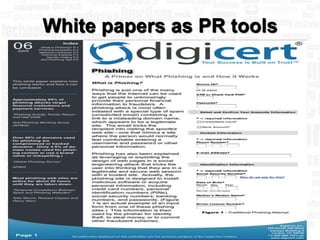
White papers as PR tools
PR Tools

   Category articles : By this tools PR
    Professionals does write-up on the
    category wise which is indirectly
    related with their products or
    services, etc. (For e.g.-Any
    Company, firms organization or
    establishment writes articles on the
    Aurveda- not on the direct product
    like Medimix soap, etc.)
PR Tools
   Events
   Speeches
   Road-shows
   Exhibitions
   Fairs
   Group meets
   Street plays, folk theatre, etc.
   House journals, Brochures, Annual Reports
   Photo Shoots
   Developing films & Literature
   Virtually accessing people through company
    websites, blogs, e-mails, etc.
PR Tools
   Direct mails
   Stickers, posters, labels to serve as
    reminders
   Racks or bins for display of products
   Identification on the pack
   Specialty gifts like calendars, diaries, pens,
    key chains, etc.
   Provision of any necessary leaflets,
    catalogues, etc. to assist customer’s
    decision to buy.

                                      43
Media Analysis and Evaluation
               (MAE)

   In a 1966 lecture at the Kaufman Art
    Gallery in New York City, Marshall
    McLuhan said, “The medium is the
    massage, not the message…. It really
    works us over; it really takes hold and
    massages the population in a savage
    way.”
MAE


Media evaluation and analysis is the
first key step of PR measurement. It
involves thorough research of media
coverage given to your client and its
impact on the publics thorough
various methods.
Why do MEA?

   Testing the affect of the message given to
    the public (Public Relations Campaigns)
   Finding out the image of the organisation
    in the eyes of the publics
   Status : Organisation vis-à-vis
    Competitors
   Media’s treatment to the Organisation
Media Content Analysis
   Byline
   Length
   Advertising value
   Impressions
   Editorial tone
   Headline
   News-release tracking
   Photographs
   Prominence
   Spokespersons (name included or not)
   Story subject
   Story summary
   Strategic messages
   Evaluation : After you have implemented the
    tactics, review the results of your project. Ask
    yourself these four questions:
    1. Did you meet your measurable objectives?
    2. Did the story placed in the media emphasize
    your key messages?
    3. Did the story appear in a Media your
    audience reads/watch/listen?
    4. Do your key target audiences have a better
    understanding of your company?
       After you have reviewed the results of your
    program, make adjustments to your
    strategy and objectives and continue
    implementing your revised strategy.
Books for reference:-
   Public Relations - The realities of PR by
    Newsom, Turk, Kruckleberg
   Principals of Public Relations-C. S. Rayudu & K.
    R. Balan
   Public Relations -Diwakar Sharma
   Public Relations Practices- Center & Jackson
   Effective Public Relations in Public and Private
    Sector by G. C. Banik .
   The Corporate Peacock-Rita Bhimani
   Public Relations for your business- Frank Jefkins.
   The Art of Public Relations by CEO of leading PR
    firms.
Thank You

Pr an overview 12.01.13 - garware

  • 1.
    Introduction to Public Relations An overview
  • 2.
    What is Public? Apublic is any group that has an actual or potential interest in or impact on a company’s or a person’s ability to achieve its objectives. What is Relations? It is the result and outcome of mutual understanding derived from the process of sharing common interests.
  • 3.
    Defining the Publics The term public (active audience) includes any group of people tied together, however loosely, by some common bond of interest or concern and who have importance on an organization.
  • 4.
    What is PublicRelations? Public Relations (PR) involves a variety of programs designed to promote or protect a company’s image or a person’s or individual products.
  • 5.
    Defining Public Relations Publicrelations, according to the Institute of Public Relations (IPR), is about the reputation. The result of what you do; what you say and what others say about you. The PR practice is defined as the discipline that looks after reputation with the aim of earning understanding and support, and influencing opinion and behavior. It is planned and sustained effort to establish and maintain good will and mutual understanding between an organization and its public – i.e., a company's staff, suppliers, shareholders, customers, etc.
  • 6.
    Origin of PRin the world  PR found itself originating in the media & publicists who specialized in promoting circuses, theatrical performances, and other public spectacles.  The First World War (1914-1918) also helped stimulate the development of public relations as a profession.
  • 7.
    Origin of PRcontd… Many of the first PR professionals, including Ivy Led better Lee, Edward Bernays, and Carl Byoir, got their start with the Committee for Public Information (also known as the Creel Committee), which organized publicity on behalf of U.S. objectives during World War -I
  • 8.
    Basic Functions ofPR  Press or Media Relations  Product Publicity  Corporate Communications  Lobbying  Counseling  Crisis Management
  • 9.
    Developing friendly mediarelations  Critical appreciation of media requirements  Understanding the role and responsibility of journalists  Understand your organization, its policies, programs, and also the structure and functioning of a typical media organization
  • 10.
    Product publicity  Public relation officer utilizing their potential, he makes the product publicity and awareness a breeze, channeling all required information for a product to all possible media in a consistent and straightforward manner.
  • 11.
    Corporate communication Creation of a state-of-the-art and precise corporate PR strategy is aimed at image lifting through analysis of possible events and trends, forecasting of their consequences, meeting with the executives of the organization and implementing the necessary strategies and programs, thus bringing benefits both this organization and the society at large. Eg. Filmfare awards.
  • 12.
    Lobbying  Lobbying (also Lobby) is a form of advocacy with the intention of influencing decisions made by legislators and officials in the government by individuals, other legislators or groups. A lobbyist is a person who tries to influence legislation on behalf of a special interest or a member of a lobby. Eg- Governments or the corporate world often define and regulate organized group lobbying that has become influential on policy. ….2G Scam
  • 13.
    Counseling  Counseling is a scientific process which is largely accepted by many of us. Whether its vocation guidance or coping with personal trauma counseling surely makes it easy for us to seek professional guidance. There are many subjects that require counseling. With changing times our lifestyle offers us so many advantages that make life easy but at the same time it is important to acknowledge the side effects of a routine fast paced life.
  • 14.
  • 15.
    What can becomea crisis? 1. Products/services related issues
  • 16.
    What can becomea crisis? - Incidents at sites, - Business strategies,  E.g.- Anil- Mukesh Ambani business crisis. - Actions of pressure groups  E.g- Mr. Sharad Pawar agreed to released food grains to the BPL.
  • 17.
    Crisis management  Being a Public relations officer you must get ready to face various kinds of crisis. - Preparing for a crisis - Managing a crisis - Communicating in a crisis
  • 18.
    What is crisis?  Any event which can create opinion that :  Products/services are harmful  Plans/processes detrimental to  investors, communities, employees, etc.
  • 19.
    Specialty PR  Foodservice PR  Healthcare PR  Technology PR  Entertainment & Lifestyle PR  Financial PR
  • 20.
    Foodservice PR  In its most basic form it can be split into two clear types - the profit and the cost sector. Profit operators meanwhile offer far greater potential gains to the manufacturer - pricing is flexible, important consumer insight key. Cost sector operators, such as education and healthcare caterers, do not derive substantial margins - the supply of meals is not the core function of their business, merely a necessity. Provision is dependent on contract and pricing controlled or fixed.
  • 21.
    Healthcare PR  Individuals that specialize in health care public relations are in charge of handling the internal and external communications for a health care facility. They interact with physicians, nurses, managers, administrators, and patients, and therefore must have excellent communication skills. Some of their responsibilities include writing for internal publications such as newsletters, handling calls from the media, as well as writing and creating various material that promote the services offered at that facility.
  • 22.
    Healthcare PR  Public relations specialists may also be called upon to prepare marketing plans that highlight various aspects of an organization. The most important function of this position is handling all communications with the public. They may organize events between the organization and the public, or they might prefer to correspond by publishing press releases. Public relations specialists must be highly organized and be prepared to deal with a variety of situations.
  • 23.
    Technology PR  Having clear messages and public relations programs in place that enable technologists, scientists and other experts to distinctly articulate their vision can not only help them become industry leaders and advance their technologies, but provides organizations with a voice in the marketplace of ideas, facts, and viewpoints to aid informed public debate.
  • 24.
  • 25.
    Entertainment & LifestylePR  This PR specializing in literary, lifestyle and entertainment communication services. The clients include celebrities from TV, film and music, authors and publishing houses, medical professionals, industry experts and various businesses. It works intimately with clients to provide strategic PR support that helps them achieve their goals, image building, elevate status and expose them in countless ways around the nation.
  • 26.
    Financial PR  This PR specializing in corporate disclosure responsibilities, stockholder relations, and relations with the professional investor community. Financial public relations is concerned not only with matters of corporate image, the cultivation of a favorable financial and investment environment but also with legal interpretation, devotion to Securities and Exchange Commission and other government regulations.
  • 27.
  • 28.
    Media in India  The 1990’s saw a new phase in the Indian economy.  Liberalization, Globalization and Privatization saw the increase in the advent of the big companies/corporations entering the Indian market  It saw a boom of various channels providing the mix of news and entertainment.  Clients pay and sponsor programmes on the Television and weave in their brands into the programmes. For e.g.- A Nescafe mug on a early morning breakfast show on a news channel.  E.g.- Media partner/ sponsored programme.
  • 29.
    Public Relations Process  Fact Finding and data gathering (Research)  Planning and Programming (Follow the Principles of Management- Motivate to fans associations)  Action, Relationship-building and communication  Evaluation (measurement, response from the target)
  • 30.
    Reaching the publics: Publicity Media  Print Media  Broadcasting Media  Online Media  Outdoor Media  Traditional Media But, one has to be aware of each media’s advantages and limitations…
  • 31.
    PR Tools  Press Release : A press release, news release, media release or press statement is a written or recorded communication directed at members of the news media for the purpose of announcing something claimed as having news value.  The aim of which is to attract favorable media attention to public relations professional's client and/or provide publicity for products or events marketed by those clients. A press release provides reporters with the basics they need to develop a news story.
  • 32.
    PR Tools  Press releases can announce a range of news items such as: scheduled events, personal promotions, awards, new products and services, sales and other financial data, activities, etc. They are often used in generating a feature story or are sent for the purpose of announcing news conferences, upcoming events or change in corporation, etc.
  • 33.
    PR Tools  Press Invite : A news conference or press conference is a media event in which newsmakers invite journalists to hear them speak and most often ask questions. A joint press conference instead is held between two or more talking sides.
  • 34.
    PR Tools  Press Conference : An interview held for news reporters by a political figure, famous person or any companies, establishment or organizations, etc. Also called news conference. It can be done pre or post event.
  • 35.
    PR Tools  Press Briefing : The act or an instance of giving instructions or preparatory information to the Media. It’s a meeting at which such information is presented and the information trying to conveyed. Press Briefing generally given by the SPOKESPERSON or spokesman or spokeswoman with the help of their Public Relations Officer.
  • 36.
    PR Tools  Press tours :Organized by the organizations, firms, companies, Institutions, etc. to their establishments for the Media. These tours help you achieve your story goals while saving you time and money. They arrange interviews, tours, tasting and lunches with owners, winemakers, and cook through private, personally escorted media tours.
  • 37.
    PR Tools  Interviews : Reporters interviews to gather information and do research. Even if they report a story based on a written study or official documents, they need to conduct interviews to flesh out the facts, provide perspective, obtain quotes and add interest. In other cases, interviews alone comprise the entire premise for an article.
  • 38.
    PR Tools  Interviews : The media interview can take several formats. Many reporters prefer to interview a source in person whenever possible. Conversation generally flows more naturally in person, and a reporter can draw details from your surroundings using visual cues and other sensory information that they otherwise wouldn’t experience.
  • 39.
    PR Tools  White papers (This concept is popular in Foreign countries-Its nothing but a research based article) : A white paper (or "whitepaper") is an authoritative report or guide that often addresses issues and how to solve them. White papers are used to educate readers and help people make decisions. They are often used in politics, business and technical fields. In commercial use, the term has also come to refer to documents used by businesses as a marketing or sales tool. 39
  • 40.
  • 41.
    PR Tools  Category articles : By this tools PR Professionals does write-up on the category wise which is indirectly related with their products or services, etc. (For e.g.-Any Company, firms organization or establishment writes articles on the Aurveda- not on the direct product like Medimix soap, etc.)
  • 42.
    PR Tools  Events  Speeches  Road-shows  Exhibitions  Fairs  Group meets  Street plays, folk theatre, etc.  House journals, Brochures, Annual Reports  Photo Shoots  Developing films & Literature  Virtually accessing people through company websites, blogs, e-mails, etc.
  • 43.
    PR Tools  Direct mails  Stickers, posters, labels to serve as reminders  Racks or bins for display of products  Identification on the pack  Specialty gifts like calendars, diaries, pens, key chains, etc.  Provision of any necessary leaflets, catalogues, etc. to assist customer’s decision to buy. 43
  • 44.
    Media Analysis andEvaluation (MAE)  In a 1966 lecture at the Kaufman Art Gallery in New York City, Marshall McLuhan said, “The medium is the massage, not the message…. It really works us over; it really takes hold and massages the population in a savage way.”
  • 45.
    MAE Media evaluation andanalysis is the first key step of PR measurement. It involves thorough research of media coverage given to your client and its impact on the publics thorough various methods.
  • 46.
    Why do MEA?  Testing the affect of the message given to the public (Public Relations Campaigns)  Finding out the image of the organisation in the eyes of the publics  Status : Organisation vis-à-vis Competitors  Media’s treatment to the Organisation
  • 47.
    Media Content Analysis  Byline  Length  Advertising value  Impressions  Editorial tone  Headline  News-release tracking  Photographs  Prominence  Spokespersons (name included or not)  Story subject  Story summary  Strategic messages
  • 48.
    Evaluation : After you have implemented the tactics, review the results of your project. Ask yourself these four questions: 1. Did you meet your measurable objectives? 2. Did the story placed in the media emphasize your key messages? 3. Did the story appear in a Media your audience reads/watch/listen? 4. Do your key target audiences have a better understanding of your company? After you have reviewed the results of your program, make adjustments to your strategy and objectives and continue implementing your revised strategy.
  • 49.
    Books for reference:-  Public Relations - The realities of PR by Newsom, Turk, Kruckleberg  Principals of Public Relations-C. S. Rayudu & K. R. Balan  Public Relations -Diwakar Sharma  Public Relations Practices- Center & Jackson  Effective Public Relations in Public and Private Sector by G. C. Banik .  The Corporate Peacock-Rita Bhimani  Public Relations for your business- Frank Jefkins.  The Art of Public Relations by CEO of leading PR firms.
  • 50.

Editor's Notes

  • #12 Cement co. organized meeting with civil engineer, contractors, construction workers, etc.Pharmaceuticals Co. organized meeting/seminar/workshop with the physician, pharmacist, etc.
  • #13 Eg- Many Co. becomes media partner, shareholder, etc.