Publics are
the interested audiences that are important in some way
to an organization including ,
current and potential customers,
current and potential employees and management,
investors, vendors and suppliers, media, government,
and opinion leaders.
They can be internal within an organization or external
from an organization
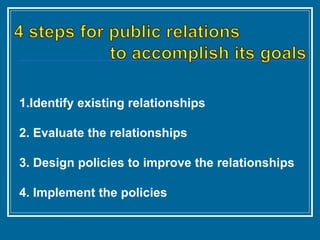
1.Identify existing relationships
2. Evaluate the relationships
3. Design policies to improve the relationships
4. Implement the policies
1.Identify existing relationships :-
In modern society institutions have many relationships
EX:
school
students
Neighborhood
community
faculty
staff
benefactors
2. Evaluate the relationships :-
The public relations practitioner studies these relationships
to determine How well they are working.
This evaluation is an ongoing process.
3. Design policies to improve the relationships :-
The job of public relations people is to recommend policies
to top Management to make these relationships work better,
not only for the organization but also For the partners in each relationship
1.External Relationships
2.Internal Relationships
3.Media Relationships
1.External Relationships:-
Public relations engage with groups and people
outside the organizations. These include customers,
dealers , suppliers , community leaders and
policymakers
2.Internal Relationships :-
Organizations need internal communication for optimal
relations among employees, managers, unions, shareholders and
other internal constituencies. In-house newsletters, magazines and
brochures are elements in internal public relationships
3.Media Relationships :-
For communication with large groups, organizations rely
largely on mass media. It is media relations people who respond to
news reporters queries, arrange news conferences, issue statements
to the news media and often serve as an organization’s spokespersons
Community Relations:-
Any organization must be seen as a
good community citizen and should have the goodwill of the
community in which it operates. An effective community
relations program will need to be continuing and
comprehensive.
Employee Relations :-
Maybe the most important resource that a
company has are its employees and the customer service they provide.
The functions of public relations in regards to the company’s employees
is the maintenance of employee goodwill. The image and reputation of a
company among its employees is also another responsibility of public
relations in its function of employee relations.
Product Public Relations :-
When new products are introduced to the
market the role that public relations plays is crucial for creating
awareness and differentiating the product in the public’s eyes from other
similar products. When existing products need a push public relations is
often called on the improve product visibility.
Financial Relations:-
This function involves communication with the
wide variety of individuals and groups that the company deals with in the
course of its operations. This includes the stockholders and investors but is
not limited to them.
Political and Government Relations :-
The wide range of activities that public relations
has to cover in the political arena includes influencing legislation that can
be hindrances to the proper operation of the company. Public relations in
politics may have to stage debates and seminars for government officials.
Crisis Communications:-
When anything untoward happens like
an accident in a production plant it is the job of
public relations to provide honest and accurate
information so that the uncertainty by the people
involved directly or indirectly can be assuaged.
Natural disasters, management wrongdoings,
bankruptcies and product failures are crises which
public relations must play a large part.
PUBLIC RELATION OFFICER
Public relations officers plan, develop, put into
place and evaluate information and
communication strategies that present an
organization to the public, clients and other
stakeholders. They also promote good information
flow within their organization.
Public relations officers may
perform the following tasks:
 monitor public opinion regarding an
organization or particular issues
 develop and implement communication
strategies for an organization and advise
management on communication issues and
strategies
 plan public relations programs, including
the preparation of cost budgets
 present arguments on behalf of an
organization to government, other
organizations and special interest groups
 respond to enquiries from the public, media
and other organizations
 arrange interviews with journalists, prepare
and distribute media releases, and liaise
with and make statements to the media
 write, edit and arrange production of
newsletters, in-house magazines,
pamphlets and brochures
 assist with preparing organizational
documents such as annual reports,
corporate profiles and submissions
 write speeches, prepare visual aids and
make public presentations
 oversee production of visual, audio and
electronic material, including managing
websites
 organize special events such as open days,
visits, exhibitions and functions
 conduct internal communication courses,
workshops and media training
 develop risk assessments and implement
crisis management plans to ensure an
organization's reputation is maintained
 plan, develop and manage brand identity
 organize and manage events, exhibitions,
conferences and product launches
 procure sponsorship deals.
Public relations

Public relations

  • 4.
    Publics are the interestedaudiences that are important in some way to an organization including , current and potential customers, current and potential employees and management, investors, vendors and suppliers, media, government, and opinion leaders. They can be internal within an organization or external from an organization
  • 5.
    1.Identify existing relationships 2.Evaluate the relationships 3. Design policies to improve the relationships 4. Implement the policies
  • 6.
    1.Identify existing relationships:- In modern society institutions have many relationships EX: school students Neighborhood community faculty staff benefactors
  • 7.
    2. Evaluate therelationships :- The public relations practitioner studies these relationships to determine How well they are working. This evaluation is an ongoing process. 3. Design policies to improve the relationships :- The job of public relations people is to recommend policies to top Management to make these relationships work better, not only for the organization but also For the partners in each relationship
  • 8.
  • 9.
    1.External Relationships:- Public relationsengage with groups and people outside the organizations. These include customers, dealers , suppliers , community leaders and policymakers
  • 10.
    2.Internal Relationships :- Organizationsneed internal communication for optimal relations among employees, managers, unions, shareholders and other internal constituencies. In-house newsletters, magazines and brochures are elements in internal public relationships 3.Media Relationships :- For communication with large groups, organizations rely largely on mass media. It is media relations people who respond to news reporters queries, arrange news conferences, issue statements to the news media and often serve as an organization’s spokespersons
  • 11.
    Community Relations:- Any organizationmust be seen as a good community citizen and should have the goodwill of the community in which it operates. An effective community relations program will need to be continuing and comprehensive.
  • 12.
    Employee Relations :- Maybethe most important resource that a company has are its employees and the customer service they provide. The functions of public relations in regards to the company’s employees is the maintenance of employee goodwill. The image and reputation of a company among its employees is also another responsibility of public relations in its function of employee relations. Product Public Relations :- When new products are introduced to the market the role that public relations plays is crucial for creating awareness and differentiating the product in the public’s eyes from other similar products. When existing products need a push public relations is often called on the improve product visibility.
  • 13.
    Financial Relations:- This functioninvolves communication with the wide variety of individuals and groups that the company deals with in the course of its operations. This includes the stockholders and investors but is not limited to them. Political and Government Relations :- The wide range of activities that public relations has to cover in the political arena includes influencing legislation that can be hindrances to the proper operation of the company. Public relations in politics may have to stage debates and seminars for government officials.
  • 14.
    Crisis Communications:- When anythinguntoward happens like an accident in a production plant it is the job of public relations to provide honest and accurate information so that the uncertainty by the people involved directly or indirectly can be assuaged. Natural disasters, management wrongdoings, bankruptcies and product failures are crises which public relations must play a large part.
  • 15.
    PUBLIC RELATION OFFICER Publicrelations officers plan, develop, put into place and evaluate information and communication strategies that present an organization to the public, clients and other stakeholders. They also promote good information flow within their organization.
  • 16.
    Public relations officersmay perform the following tasks:
  • 17.
     monitor publicopinion regarding an organization or particular issues  develop and implement communication strategies for an organization and advise management on communication issues and strategies  plan public relations programs, including the preparation of cost budgets
  • 18.
     present argumentson behalf of an organization to government, other organizations and special interest groups  respond to enquiries from the public, media and other organizations  arrange interviews with journalists, prepare and distribute media releases, and liaise with and make statements to the media
  • 19.
     write, editand arrange production of newsletters, in-house magazines, pamphlets and brochures  assist with preparing organizational documents such as annual reports, corporate profiles and submissions  write speeches, prepare visual aids and make public presentations
  • 20.
     oversee productionof visual, audio and electronic material, including managing websites  organize special events such as open days, visits, exhibitions and functions  conduct internal communication courses, workshops and media training  develop risk assessments and implement crisis management plans to ensure an organization's reputation is maintained
  • 21.
     plan, developand manage brand identity  organize and manage events, exhibitions, conferences and product launches  procure sponsorship deals.