HISTORY OF
PUBLIC RELATIONS
 The history of Public Relations begin as human
being lived in a society.
 People use public relations to solve crisis and
problems through two way communication.
 History also shows that almost all great leaders
are a good PR practitioners.
 As early as 1800 b.c. in Iraq, messages were crafted or
written on stones to educate farmers on agricultural
technique to encourage them to be involved in producing
food for the nation.
 In Yunan , good orators are made leaders. A lot of
politician try to get help from SUFI practitioners to
sharpen their communication skills.
 Romans and the Greeks are example of good orators
who uses rhetoric to persuade the followers. Example
Julius Ceasar and Aristotle.
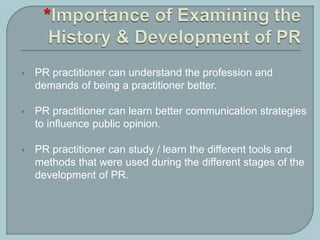
 PR practitioner can understand the profession and
demands of being a practitioner better.
 PR practitioner can learn better communication strategies
to influence public opinion.
 PR practitioner can study / learn the different tools and
methods that were used during the different stages of the
development of PR.
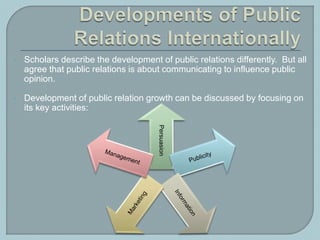
 Scholars describe the development of public relations differently. But all
agree that public relations is about communicating to influence public
opinion.
 Development of public relation growth can be discussed by focusing on
its key activities:
Persuasion
 In early years, using persuasive speech to spread
religion such as Islam and Christianity.
 The Greeks and Roman use public speech to win
support for their policies. Using rhetoric to persuade
others.
Persuasion
 American Public Relations use publicity and promotion
for commercial reason, fund raising or building
personalities.
 In the 1920’s, it was more incline toward promoting
products and raising money for charitable purpose.
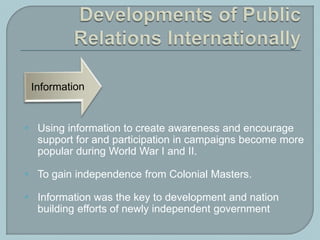
 Using information to create awareness and encourage
support for and participation in campaigns become more
popular during World War I and II.
 To gain independence from Colonial Masters.
 Information was the key to development and nation
building efforts of newly independent government
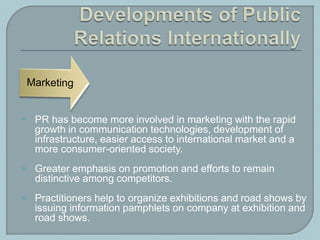
 PR has become more involved in marketing with the rapid
growth in communication technologies, development of
infrastructure, easier access to international market and a
more consumer-oriented society.
 Greater emphasis on promotion and efforts to remain
distinctive among competitors.
 Practitioners help to organize exhibitions and road shows by
issuing information pamphlets on company at exhibition and
road shows.
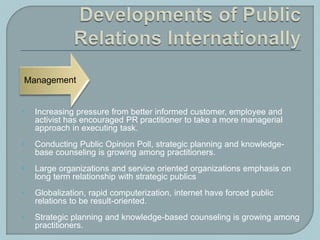
 Increasing pressure from better informed customer, employee and
activist has encouraged PR practitioner to take a more managerial
approach in executing task.
 Conducting Public Opinion Poll, strategic planning and knowledge-
base counseling is growing among practitioners.
 Large organizations and service oriented organizations emphasis on
long term relationship with strategic publics
 Globalization, rapid computerization, internet have forced public
relations to be result-oriented.
 Strategic planning and knowledge-based counseling is growing among
practitioners.
 According to Hamdan Adnan in his book “Prinsip
Perhubungan Awam” PR in Malaysia begin as early as the
era of the Malacca Rulers.
 The rulers will ask intellectuals to write or spread
information on their good deeds through ‘hikayat’ or
poems. One of the well known history books was written
by Tun Seri Lanang pertaining to Hikayat Raja-raja
Melayu.
 According to Hamdan, Hang Tuah and Bendahara Tun
Perak are an example of good PR practitioner who are
able to solve a lot of community problem and make
Malacca a well known port at that time.
 Early PR aimed at
 gaining independence,
 formalizing national status,
 promoting and maintaining unity among the different ethnic groups
 promoting government development plans and encouraging participation
in them.
 Most activities conducted through public campaign.
World War II until Independence
 1939 - Department of Information set up in Singapore to
inform development of the war.
 1946 – under Malayan Union, Department of Public
Relations was set up. Produce leaflets as well as radio
broadcast and face to face communication, through public
meeting to carry out the task. The primary role of this dept
were to:
 return confidence in British rule
 encourage the people to be self-sufficient in agricultural
produce due to the shortage of food
 counter communist threat &
 bring back peace to the nation
World War II until Independence
 1948 – the department was rename Department of
Information which is presently known as Ministry of
Information. Main task is to counter communist
propaganda during communist insurgency period.
 Early 1950’s – development of communication
infrastructure was accelerated. Broadcasting facilities
were expanded, cinema projectors and public address
system were double to improve communication to the
people.
Government Public Relations
Main functions of Malaysian government public relations
after independence:
1. To run nation building campaign.
2. To conduct press relations works to aid in government
effort to build democratic nation.
3. To disseminate information about government policies.
4. To promote acceptance of government policies.
5. To monitor feedback from general public on government
policies.
Government hired private consultancies to help with the
planning & strategy development segments of the
government campaign. This included campaign design,
media contacts & mgmt of special events.
Public Relation Consultancies
 Grew in 1960s with the growth of multi-national organization.
 The first known PR agencies is Eric White Associates started in
1965.
 Today there are about 40 local and foreign based PR agencies
in Malaysia.
 Most local agencies serve local businesses that cannot afford
international consultancies.
 Cater task such as media relations, event promotions and
product launches.
Corporate Public Relations Department
 Multinational companies set up their own in-house PR
departments.
 Corporate PR dept focus mainly on gaining acceptance of
their organization in their community in which they operate
and in assisting in increasing employee productivity.
 Corporate PR dept supported various government nation
building efforts especially in sports and education. They also
provide scholarships and donate to welfare projects.
 Set up in 1962 to give a further boost in the industry.
 Government information officers made up most of the
members.
 Aimed to upgrade public relations practice in Malaysia.
 Drew up code of ethnics based on British Institute of Public
Relation to self regulate the practice in the country. This
code is not subject to law.
 There are about 600 practitioners in the government and
private sector of whom about 500 are registered as
members of IPRM.
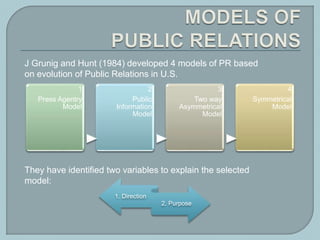
J Grunig and Hunt (1984) developed 4 models of PR based
on evolution of Public Relations in U.S.
They have identified two variables to explain the selected
model:
1
Press Agentry
Model
2
Public
Information
Model
3
Two way
Asymmetrical
Model
4
Symmetrical
Model
1. Direction
2. Purpose
 DIRECTION
• Use one way or two way communication
One way - Dissemination of Information
Two way – Exchange of Information
 PURPOSE
 Model uses “Asymmetrical” or “Symmetrical”
communication.
• Asymmetrical – communication emphasize on
changing the public not the organization.
• Symmetrical – to adjust the relationship between the
organization and the public.
 Aim to publicize the organization, its products and
services in any way possible.
 Involves one way communication dedicated to help the
organization control the public that affect it.
 Organization does not reveal complete information in an
attempt to control / dominate the environment.
 This Model is used to promote celebrities, products, sports
or organization’s leaders.
 Seeks to ‘disseminate’ information to the public as
truthfully and accurately as possible.
 Involves one-way communication through controlled
organization media and mass media.
 Not based on research and strategic planning.
 Promote the organization and tried to change the
behaviour of the publics but not the organization.
 Used by government agencies, non-profit organization
and association.
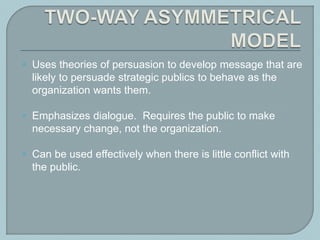
 Uses theories of persuasion to develop message that are
likely to persuade strategic publics to behave as the
organization wants them.
 Emphasizes dialogue. Requires the public to make
necessary change, not the organization.
 Can be used effectively when there is little conflict with
the public.
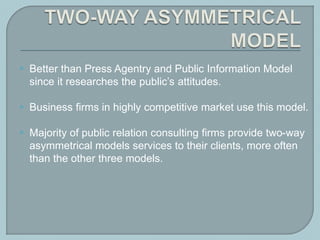
 Better than Press Agentry and Public Information Model
since it researches the public’s attitudes.
 Business firms in highly competitive market use this model.
 Majority of public relation consulting firms provide two-way
asymmetrical models services to their clients, more often
than the other three models.
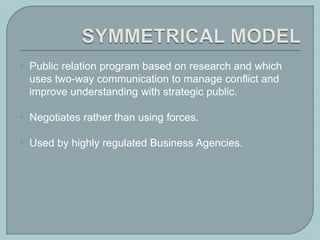
 Public relation program based on research and which
uses two-way communication to manage conflict and
improve understanding with strategic public.
 Negotiates rather than using forces.
 Used by highly regulated Business Agencies.
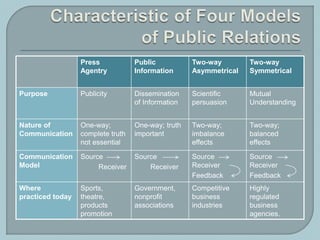
Press
Agentry
Public
Information
Two-way
Asymmetrical
Two-way
Symmetrical
Purpose Publicity Dissemination
of Information
Scientific
persuasion
Mutual
Understanding
Nature of
Communication
One-way;
complete truth
not essential
One-way; truth
important
Two-way;
imbalance
effects
Two-way;
balanced
effects
Communication
Model
Source
Receiver
Source
Receiver
Source
Receiver
Feedback
Source
Receiver
Feedback
Where
practiced today
Sports,
theatre,
products
promotion
Government,
nonprofit
associations
Competitive
business
industries
Highly
regulated
business
agencies.
Mixed – Motive Model (Murphy 1991)
 Middle ground between the two way asymmetrical and
symmetrical model.
 Organization and publics seek to negotiate outcome that
are most advantageous to both parties in the long term.
 Applies in excellent PR department as an extension of
symmetrical model.
 Persuade publics with the asymmetrical model and
negotiates with symmetrical model.
Personal Influence Model (Sriramesh 1992)
 Practitioners use interpersonal communication to build
personal and long term relationship with key individuals of
the organization’s strategic public like media, government,
political body or among activist group.
 Uses one-way communication and its purpose is
predominantly “synchronic” or asymmetrical.
 Use various techniques such as hospitality, giving gifts and
brokering of influence to build lasting friendship.

Chapter 2 PUBLIC RELATION

  • 1.
  • 2.
     The historyof Public Relations begin as human being lived in a society.  People use public relations to solve crisis and problems through two way communication.  History also shows that almost all great leaders are a good PR practitioners.
  • 3.
     As earlyas 1800 b.c. in Iraq, messages were crafted or written on stones to educate farmers on agricultural technique to encourage them to be involved in producing food for the nation.  In Yunan , good orators are made leaders. A lot of politician try to get help from SUFI practitioners to sharpen their communication skills.  Romans and the Greeks are example of good orators who uses rhetoric to persuade the followers. Example Julius Ceasar and Aristotle.
  • 4.
     PR practitionercan understand the profession and demands of being a practitioner better.  PR practitioner can learn better communication strategies to influence public opinion.  PR practitioner can study / learn the different tools and methods that were used during the different stages of the development of PR.
  • 5.
     Scholars describethe development of public relations differently. But all agree that public relations is about communicating to influence public opinion.  Development of public relation growth can be discussed by focusing on its key activities: Persuasion
  • 6.
     In earlyyears, using persuasive speech to spread religion such as Islam and Christianity.  The Greeks and Roman use public speech to win support for their policies. Using rhetoric to persuade others. Persuasion
  • 7.
     American PublicRelations use publicity and promotion for commercial reason, fund raising or building personalities.  In the 1920’s, it was more incline toward promoting products and raising money for charitable purpose.
  • 8.
     Using informationto create awareness and encourage support for and participation in campaigns become more popular during World War I and II.  To gain independence from Colonial Masters.  Information was the key to development and nation building efforts of newly independent government
  • 9.
     PR hasbecome more involved in marketing with the rapid growth in communication technologies, development of infrastructure, easier access to international market and a more consumer-oriented society.  Greater emphasis on promotion and efforts to remain distinctive among competitors.  Practitioners help to organize exhibitions and road shows by issuing information pamphlets on company at exhibition and road shows.
  • 10.
     Increasing pressurefrom better informed customer, employee and activist has encouraged PR practitioner to take a more managerial approach in executing task.  Conducting Public Opinion Poll, strategic planning and knowledge- base counseling is growing among practitioners.  Large organizations and service oriented organizations emphasis on long term relationship with strategic publics  Globalization, rapid computerization, internet have forced public relations to be result-oriented.  Strategic planning and knowledge-based counseling is growing among practitioners.
  • 11.
     According toHamdan Adnan in his book “Prinsip Perhubungan Awam” PR in Malaysia begin as early as the era of the Malacca Rulers.  The rulers will ask intellectuals to write or spread information on their good deeds through ‘hikayat’ or poems. One of the well known history books was written by Tun Seri Lanang pertaining to Hikayat Raja-raja Melayu.
  • 12.
     According toHamdan, Hang Tuah and Bendahara Tun Perak are an example of good PR practitioner who are able to solve a lot of community problem and make Malacca a well known port at that time.  Early PR aimed at  gaining independence,  formalizing national status,  promoting and maintaining unity among the different ethnic groups  promoting government development plans and encouraging participation in them.  Most activities conducted through public campaign.
  • 13.
    World War IIuntil Independence  1939 - Department of Information set up in Singapore to inform development of the war.  1946 – under Malayan Union, Department of Public Relations was set up. Produce leaflets as well as radio broadcast and face to face communication, through public meeting to carry out the task. The primary role of this dept were to:  return confidence in British rule  encourage the people to be self-sufficient in agricultural produce due to the shortage of food  counter communist threat &  bring back peace to the nation
  • 14.
    World War IIuntil Independence  1948 – the department was rename Department of Information which is presently known as Ministry of Information. Main task is to counter communist propaganda during communist insurgency period.  Early 1950’s – development of communication infrastructure was accelerated. Broadcasting facilities were expanded, cinema projectors and public address system were double to improve communication to the people.
  • 15.
    Government Public Relations Mainfunctions of Malaysian government public relations after independence: 1. To run nation building campaign. 2. To conduct press relations works to aid in government effort to build democratic nation. 3. To disseminate information about government policies. 4. To promote acceptance of government policies. 5. To monitor feedback from general public on government policies. Government hired private consultancies to help with the planning & strategy development segments of the government campaign. This included campaign design, media contacts & mgmt of special events.
  • 16.
    Public Relation Consultancies Grew in 1960s with the growth of multi-national organization.  The first known PR agencies is Eric White Associates started in 1965.  Today there are about 40 local and foreign based PR agencies in Malaysia.  Most local agencies serve local businesses that cannot afford international consultancies.  Cater task such as media relations, event promotions and product launches.
  • 17.
    Corporate Public RelationsDepartment  Multinational companies set up their own in-house PR departments.  Corporate PR dept focus mainly on gaining acceptance of their organization in their community in which they operate and in assisting in increasing employee productivity.  Corporate PR dept supported various government nation building efforts especially in sports and education. They also provide scholarships and donate to welfare projects.
  • 18.
     Set upin 1962 to give a further boost in the industry.  Government information officers made up most of the members.  Aimed to upgrade public relations practice in Malaysia.  Drew up code of ethnics based on British Institute of Public Relation to self regulate the practice in the country. This code is not subject to law.  There are about 600 practitioners in the government and private sector of whom about 500 are registered as members of IPRM.
  • 19.
    J Grunig andHunt (1984) developed 4 models of PR based on evolution of Public Relations in U.S. They have identified two variables to explain the selected model: 1 Press Agentry Model 2 Public Information Model 3 Two way Asymmetrical Model 4 Symmetrical Model 1. Direction 2. Purpose
  • 20.
     DIRECTION • Useone way or two way communication One way - Dissemination of Information Two way – Exchange of Information
  • 21.
     PURPOSE  Modeluses “Asymmetrical” or “Symmetrical” communication. • Asymmetrical – communication emphasize on changing the public not the organization. • Symmetrical – to adjust the relationship between the organization and the public.
  • 22.
     Aim topublicize the organization, its products and services in any way possible.  Involves one way communication dedicated to help the organization control the public that affect it.  Organization does not reveal complete information in an attempt to control / dominate the environment.  This Model is used to promote celebrities, products, sports or organization’s leaders.
  • 23.
     Seeks to‘disseminate’ information to the public as truthfully and accurately as possible.  Involves one-way communication through controlled organization media and mass media.  Not based on research and strategic planning.  Promote the organization and tried to change the behaviour of the publics but not the organization.  Used by government agencies, non-profit organization and association.
  • 24.
     Uses theoriesof persuasion to develop message that are likely to persuade strategic publics to behave as the organization wants them.  Emphasizes dialogue. Requires the public to make necessary change, not the organization.  Can be used effectively when there is little conflict with the public.
  • 25.
     Better thanPress Agentry and Public Information Model since it researches the public’s attitudes.  Business firms in highly competitive market use this model.  Majority of public relation consulting firms provide two-way asymmetrical models services to their clients, more often than the other three models.
  • 26.
     Public relationprogram based on research and which uses two-way communication to manage conflict and improve understanding with strategic public.  Negotiates rather than using forces.  Used by highly regulated Business Agencies.
  • 27.
    Press Agentry Public Information Two-way Asymmetrical Two-way Symmetrical Purpose Publicity Dissemination ofInformation Scientific persuasion Mutual Understanding Nature of Communication One-way; complete truth not essential One-way; truth important Two-way; imbalance effects Two-way; balanced effects Communication Model Source Receiver Source Receiver Source Receiver Feedback Source Receiver Feedback Where practiced today Sports, theatre, products promotion Government, nonprofit associations Competitive business industries Highly regulated business agencies.
  • 28.
    Mixed – MotiveModel (Murphy 1991)  Middle ground between the two way asymmetrical and symmetrical model.  Organization and publics seek to negotiate outcome that are most advantageous to both parties in the long term.  Applies in excellent PR department as an extension of symmetrical model.  Persuade publics with the asymmetrical model and negotiates with symmetrical model.
  • 29.
    Personal Influence Model(Sriramesh 1992)  Practitioners use interpersonal communication to build personal and long term relationship with key individuals of the organization’s strategic public like media, government, political body or among activist group.  Uses one-way communication and its purpose is predominantly “synchronic” or asymmetrical.  Use various techniques such as hospitality, giving gifts and brokering of influence to build lasting friendship.