

PA 763

Kristen O’Donovan & Shantanu Basu
          21st March 2007
The Policy Frameworks

Overview & Comparison

         PA 763

      Shantanu Basu
      21st March 2007
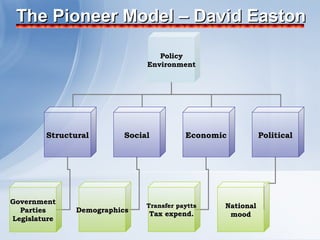
The Pioneer Model – David Easton

                                 Policy
                              Environment


        Structural       Social          Economic          Political


Government
                              Transfer paytts   National
  Parties     Demographics
                              Tax expend.        mood
Legislature
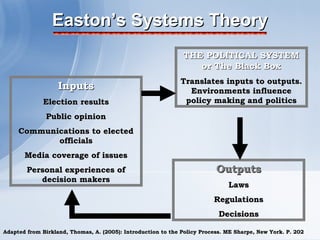
Easton’s Systems Theory
                                                              THE POLITICAL SYSTEM
                                                                 or The Black Box
                                                             Translates inputs to outputs.
                   Inputs                                      Environments influence
             Election results                                 policy making and politics

              Public opinion
     Communications to elected
            officials
       Media coverage of issues
        Personal experiences of                                           Outputs
           decision makers
                                                                              Laws
                                                                         Regulations
                                                                           Decisions

Adapted from Birkland, Thomas, A. (2005): Introduction to the Policy Process. ME Sharpe, New York. P. 202
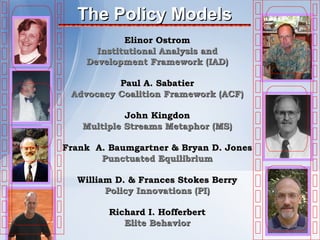
The Policy Models
            Elinor Ostrom
      Institutional Analysis and
    Development Framework (IAD)

          Paul A. Sabatier
 Advocacy Coalition Framework (ACF)

            John Kingdon
   Multiple Streams Metaphor (MS)

Frank A. Baumgartner & Bryan D. Jones
       Punctuated Equilibrium

  William D. & Frances Stokes Berry
        Policy Innovations (PI)

         Richard I. Hofferbert
            Elite Behavior
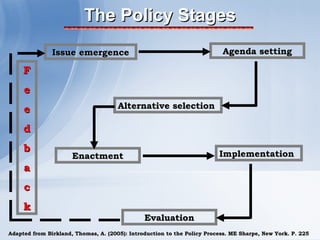
The Policy Stages
               Issue emergence                                            Agenda setting

     F
     e
     e                                Alternative selection

     d
     b                                                                   Implementation
                      Enactment
     a
     c
     k
                                               Evaluation
Adapted from Birkland, Thomas, A. (2005): Introduction to the Policy Process. ME Sharpe, New York. P. 225
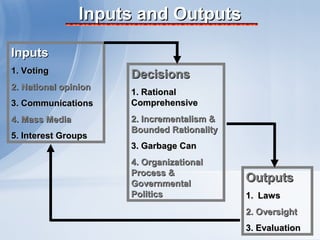
Inputs and Outputs

Inputs
1. Voting             Decisions
2. National opinion
                      1. Rational
3. Communications     Comprehensive
4. Mass Media         2. Incrementalism &
                      Bounded Rationality
5. Interest Groups
                      3. Garbage Can
                      4. Organizational
                      Process &
                      Governmental
                                            Outputs
                      Politics              1. Laws
                                            2. Oversight
                                            3. Evaluation
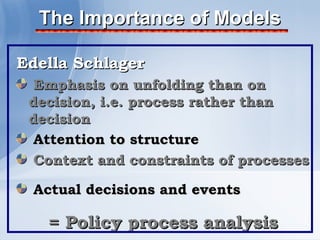
The Importance of Models

Edella Schlager
  Emphasis on unfolding than on
 decision, i.e. process rather than
 decision
  Attention to structure
  Context and constraints of processes

 Actual decisions and events

   = Policy process analysis
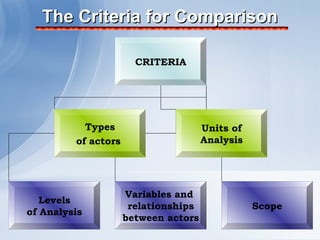
The Criteria for Comparison

                       CRITERIA


           Types                      Units of
         of actors                    Analysis


                     Variables and
   Levels
                      relationships              Scope
of Analysis
                     between actors
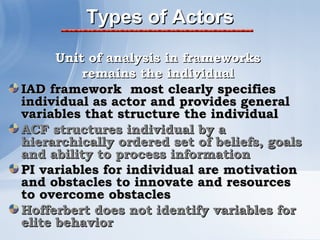
Types of Actors
      Unit of analysis in frameworks
          remains the individual
IAD framework most clearly specifies
individual as actor and provides general
variables that structure the individual
ACF structures individual by a
hierarchically ordered set of beliefs, goals
and ability to process information
PI variables for individual are motivation
and obstacles to innovate and resources
to overcome obstacles
Hofferbert does not identify variables for
elite behavior
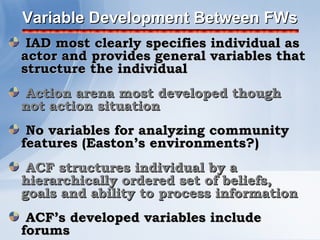
Variable Development Between FWs
 IAD most clearly specifies individual as
actor and provides general variables that
structure the individual
Action arena most developed though
not action situation
 No variables for analyzing community
features (Easton’s environments?)
 ACF structures individual by a
hierarchically ordered set of beliefs,
goals and ability to process information
 ACF’s developed variables include
forums
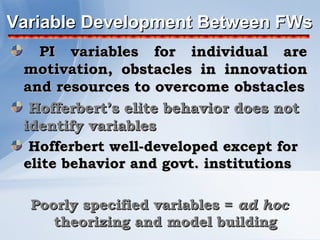
Variable Development Between FWs
    PI variables for individual are
 motivation, obstacles in innovation
 and resources to overcome obstacles
  Hofferbert’s elite behavior does not
 identify variables
  Hofferbert well-developed except for
 elite behavior and govt. institutions

  Poorly specified variables = ad hoc
     theorizing and model building
Units of Analysis

 IAD & Hofferbert FWs leave
unit of analysis choice to
analyst
 Both FWs are flexible
 ACF and PI specify units of
analysis
 But units are flexible for
application
Levels of Analysis
 Changing alignments of individual actors
 Graduating to collective-choice actions
 Only IAD FW pays explicit attention to
levels
 Other FWs pay implicit attention
 ACF & PI’s primary focus is on collective-
choice action only & individual by
implication
 Hofferbert by implication collective choice
for govt. institutions and elite behavior –
the rest is historical-geographic conditions
and socio-economic composition
Scope of Framework

 General variables and the relations between
them not developed for any policy stage
 IAD alone encompasses all stages primarily
due to attention to levels of action
 Interactive policy stage action situations
dovetail into collective-choice that, in turn,
fits into implementation with constant
feedback between levels that again, would
affect operational-level rules
 ACF focused on initiation, estimation and
selection, i.e. policymaking
 PI and Hofferbert relate primarily to policy
adoption or selection, i.e. policy adoption
THEORIES
Overview & Comparison
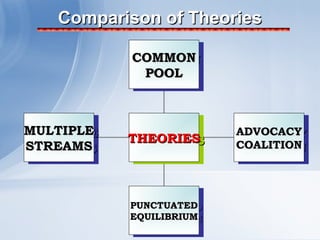
Comparison of Theories

           COMMON
           COMMON
            POOL
             POOL


MULTIPLE
MULTIPLE                  ADVOCACY
                           ADVOCACY
           THEORIES
           THEORIES       COALITION
STREAMS
 STREAMS                   COALITION


           PUNCTUATED
            PUNCTUATED
           EQUILIBRIUM
            EQUILIBRIUM
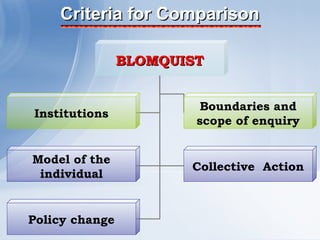
Criteria for Comparison

                BLOMQUIST


                         Boundaries and
Institutions
                        scope of enquiry


Model of the
                       Collective Action
 individual


Policy change
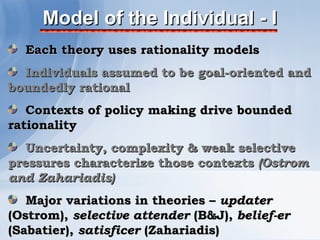
Model of the Individual - I
  Each theory uses rationality models
  Individuals assumed to be goal-oriented and
boundedly rational
   Contexts of policy making drive bounded
rationality
   Uncertainty, complexity & weak selective
pressures characterize those contexts (Ostrom
and Zahariadis)
   Major variations in theories – updater
(Ostrom), selective attender (B&J), belief-er
(Sabatier), satisficer (Zahariadis)
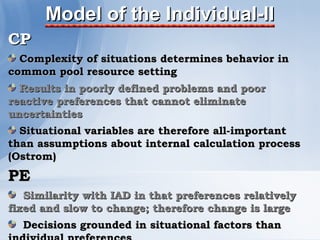
Model of the Individual-II
CP
  Complexity of situations determines behavior in
common pool resource setting
  Results in poorly defined problems and poor
reactive preferences that cannot eliminate
uncertainties
  Situational variables are therefore all-important
than assumptions about internal calculation process
(Ostrom)
PE
   Similarity with IAD in that preferences relatively
fixed and slow to change; therefore change is large
  Decisions grounded in situational factors than
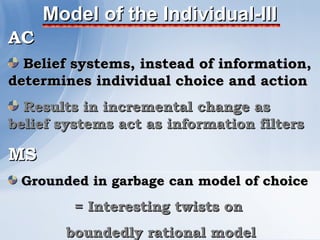
Model of the Individual-III
AC
  Belief systems, instead of information,
determines individual choice and action
  Results in incremental change as
belief systems act as information filters

MS
 Grounded in garbage can model of choice
         = Interesting twists on
        boundedly rational model
Collective Action -I
MS
  Least attention to collective
action
  Focus on policy entrepreneurs
and conditions for change
PE
  Policy makers plus collective action
make for change
  Emphasis on consequences of such
organization & activity, not modes of
organization
Collective Action -II
AC
  High degree of coordination not always present
  Outcome result of congruence of various common
interests rather than conscious coalition (Sabatier &
Jenkins-Smith)
 Empirical measures of action not developed – existing
measures not adequate
CP
  Supports collective action and inhibits free-riding
behavior
  Focuses on characteristics of physical world,
community and the rules-in-use to explain collective
action
Institutions - I
MS
  Focus on individual behavior
  Institutional implication indirect in policy entrepreneurs –
affects only political stream
  Needs more attention to institutions for greater structure and
consistency
  This is required to facilitate comparison across policy
communities

PE
  Structure sets policymaking context
  Multiple venues that influence decision-making
  Conceptualized as one whole institution – micro-level
processes and macro-level outcomes overlooked
  Identify rule configuration using IAD and replace venues with
changes in rules (Schlager)
Institutions - II
AC
  Emphasis on individuals in institutions
  Roles and structures of institutions need to be spelt
out – present framework only gross like PE
  Required to establish link between institutions and
belief systems of coalitions to assess relative influence
of individual actors
  Emphasis shift required to institutions
CP
  Emphasis on individuals using institutions
  Micro-level analysis creates individual rules
  Rules too many and configurations difficult to
determine
  Absence of any meta rules – good judgment only
possible for analyst
Policy Change
     AC, MS & PE : Major policy change
  No guarantee of policy change
  Ambiguity over what is major and minor policy
change
  Major change for one subsystem could be minor
for another – definition of subsystem loose
  How does the secondary core of a belief system
become the core of another – nested systems?
  Catalysts required for action
  Not possible to predict specific issues on which
there would be policy changes
       CP : Incremental policy change
  Substantial change to come thorough series of
incremental changes
Boundaries & Scope of Inquiry - I
MS
• Limited to explaining pre-decision processes in
policy making process
• Primary DVs are agenda-setting and specification of
policy alternatives
• Uses exogenous variables to explain DVs without
explaining the policy stream content and context –
Why do we see the types of policies or ideas that we
do in the policy stream?

PE
• Uses DV of agenda setting and explains by using IVs
such as interest group activity, mass mobilization,
media images, etc.
Boundaries & Scope of Inquiry - II

AC
• Focuses on both decision and pre-
decision
• Based primarily on case study and
difficult to generalize
• Sabatier & Jenkins Smith
approach using DVs as advocacy
coalitions and IVs of policy actors,
coordination, types and venues
Boundaries & Scope of Inquiry - III

CP
  Explains specific action situation with
reference to rules implemented
  DVs are outcomes of situation and IVs are
rules-in-use, resource, community and
individual characteristics
  CP can also explain origins of rules-in-use by
reversing IVs and DVs.
  IVs remain the same except for rules
(collective and constitutional choice) that
structure operational-level rulemaking
activities
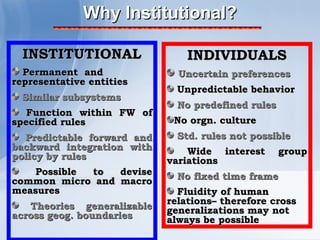
Why Institutional?

  INSTITUTIONAL                 INDIVIDUALS
  Permanent and               Uncertain preferences
representative entities
                              Unpredictable behavior
  Similar subsystems
                              No predefined rules
   Function within FW of
specified rules              No orgn. culture
  Predictable forward and     Std. rules not possible
backward integration with       Wide interest       group
policy by rules             variations
    Possible to  devise       No fixed time frame
common micro and macro
measures                      Fluidity of human
                            relations– therefore cross
   Theories generalizable   generalizations may not
across geog. boundaries     always be possible
Public policy analytical models

Public policy analytical models

  • 1.
    PA 763 Kristen O’Donovan& Shantanu Basu 21st March 2007
  • 2.
    The Policy Frameworks Overview& Comparison PA 763 Shantanu Basu 21st March 2007
  • 3.
    The Pioneer Model– David Easton Policy Environment Structural Social Economic Political Government Transfer paytts National Parties Demographics Tax expend. mood Legislature
  • 4.
    Easton’s Systems Theory THE POLITICAL SYSTEM or The Black Box Translates inputs to outputs. Inputs Environments influence Election results policy making and politics Public opinion Communications to elected officials Media coverage of issues Personal experiences of Outputs decision makers Laws Regulations Decisions Adapted from Birkland, Thomas, A. (2005): Introduction to the Policy Process. ME Sharpe, New York. P. 202
  • 5.
    The Policy Models Elinor Ostrom Institutional Analysis and Development Framework (IAD) Paul A. Sabatier Advocacy Coalition Framework (ACF) John Kingdon Multiple Streams Metaphor (MS) Frank A. Baumgartner & Bryan D. Jones Punctuated Equilibrium William D. & Frances Stokes Berry Policy Innovations (PI) Richard I. Hofferbert Elite Behavior
  • 6.
    The Policy Stages Issue emergence Agenda setting F e e Alternative selection d b Implementation Enactment a c k Evaluation Adapted from Birkland, Thomas, A. (2005): Introduction to the Policy Process. ME Sharpe, New York. P. 225
  • 7.
    Inputs and Outputs Inputs 1.Voting Decisions 2. National opinion 1. Rational 3. Communications Comprehensive 4. Mass Media 2. Incrementalism & Bounded Rationality 5. Interest Groups 3. Garbage Can 4. Organizational Process & Governmental Outputs Politics 1. Laws 2. Oversight 3. Evaluation
  • 8.
    The Importance ofModels Edella Schlager Emphasis on unfolding than on decision, i.e. process rather than decision Attention to structure Context and constraints of processes Actual decisions and events = Policy process analysis
  • 9.
    The Criteria forComparison CRITERIA Types Units of of actors Analysis Variables and Levels relationships Scope of Analysis between actors
  • 10.
    Types of Actors Unit of analysis in frameworks remains the individual IAD framework most clearly specifies individual as actor and provides general variables that structure the individual ACF structures individual by a hierarchically ordered set of beliefs, goals and ability to process information PI variables for individual are motivation and obstacles to innovate and resources to overcome obstacles Hofferbert does not identify variables for elite behavior
  • 11.
    Variable Development BetweenFWs IAD most clearly specifies individual as actor and provides general variables that structure the individual Action arena most developed though not action situation No variables for analyzing community features (Easton’s environments?) ACF structures individual by a hierarchically ordered set of beliefs, goals and ability to process information ACF’s developed variables include forums
  • 12.
    Variable Development BetweenFWs PI variables for individual are motivation, obstacles in innovation and resources to overcome obstacles Hofferbert’s elite behavior does not identify variables Hofferbert well-developed except for elite behavior and govt. institutions Poorly specified variables = ad hoc theorizing and model building
  • 13.
    Units of Analysis IAD & Hofferbert FWs leave unit of analysis choice to analyst Both FWs are flexible ACF and PI specify units of analysis But units are flexible for application
  • 14.
    Levels of Analysis Changing alignments of individual actors Graduating to collective-choice actions Only IAD FW pays explicit attention to levels Other FWs pay implicit attention ACF & PI’s primary focus is on collective- choice action only & individual by implication Hofferbert by implication collective choice for govt. institutions and elite behavior – the rest is historical-geographic conditions and socio-economic composition
  • 15.
    Scope of Framework General variables and the relations between them not developed for any policy stage IAD alone encompasses all stages primarily due to attention to levels of action Interactive policy stage action situations dovetail into collective-choice that, in turn, fits into implementation with constant feedback between levels that again, would affect operational-level rules ACF focused on initiation, estimation and selection, i.e. policymaking PI and Hofferbert relate primarily to policy adoption or selection, i.e. policy adoption
  • 16.
  • 17.
    Comparison of Theories COMMON COMMON POOL POOL MULTIPLE MULTIPLE ADVOCACY ADVOCACY THEORIES THEORIES COALITION STREAMS STREAMS COALITION PUNCTUATED PUNCTUATED EQUILIBRIUM EQUILIBRIUM
  • 18.
    Criteria for Comparison BLOMQUIST Boundaries and Institutions scope of enquiry Model of the Collective Action individual Policy change
  • 19.
    Model of theIndividual - I Each theory uses rationality models Individuals assumed to be goal-oriented and boundedly rational Contexts of policy making drive bounded rationality Uncertainty, complexity & weak selective pressures characterize those contexts (Ostrom and Zahariadis) Major variations in theories – updater (Ostrom), selective attender (B&J), belief-er (Sabatier), satisficer (Zahariadis)
  • 20.
    Model of theIndividual-II CP Complexity of situations determines behavior in common pool resource setting Results in poorly defined problems and poor reactive preferences that cannot eliminate uncertainties Situational variables are therefore all-important than assumptions about internal calculation process (Ostrom) PE Similarity with IAD in that preferences relatively fixed and slow to change; therefore change is large Decisions grounded in situational factors than
  • 21.
    Model of theIndividual-III AC Belief systems, instead of information, determines individual choice and action Results in incremental change as belief systems act as information filters MS Grounded in garbage can model of choice = Interesting twists on boundedly rational model
  • 22.
    Collective Action -I MS Least attention to collective action Focus on policy entrepreneurs and conditions for change PE Policy makers plus collective action make for change Emphasis on consequences of such organization & activity, not modes of organization
  • 23.
    Collective Action -II AC High degree of coordination not always present Outcome result of congruence of various common interests rather than conscious coalition (Sabatier & Jenkins-Smith) Empirical measures of action not developed – existing measures not adequate CP Supports collective action and inhibits free-riding behavior Focuses on characteristics of physical world, community and the rules-in-use to explain collective action
  • 24.
    Institutions - I MS Focus on individual behavior Institutional implication indirect in policy entrepreneurs – affects only political stream Needs more attention to institutions for greater structure and consistency This is required to facilitate comparison across policy communities PE Structure sets policymaking context Multiple venues that influence decision-making Conceptualized as one whole institution – micro-level processes and macro-level outcomes overlooked Identify rule configuration using IAD and replace venues with changes in rules (Schlager)
  • 25.
    Institutions - II AC Emphasis on individuals in institutions Roles and structures of institutions need to be spelt out – present framework only gross like PE Required to establish link between institutions and belief systems of coalitions to assess relative influence of individual actors Emphasis shift required to institutions CP Emphasis on individuals using institutions Micro-level analysis creates individual rules Rules too many and configurations difficult to determine Absence of any meta rules – good judgment only possible for analyst
  • 26.
    Policy Change AC, MS & PE : Major policy change No guarantee of policy change Ambiguity over what is major and minor policy change Major change for one subsystem could be minor for another – definition of subsystem loose How does the secondary core of a belief system become the core of another – nested systems? Catalysts required for action Not possible to predict specific issues on which there would be policy changes CP : Incremental policy change Substantial change to come thorough series of incremental changes
  • 27.
    Boundaries & Scopeof Inquiry - I MS • Limited to explaining pre-decision processes in policy making process • Primary DVs are agenda-setting and specification of policy alternatives • Uses exogenous variables to explain DVs without explaining the policy stream content and context – Why do we see the types of policies or ideas that we do in the policy stream? PE • Uses DV of agenda setting and explains by using IVs such as interest group activity, mass mobilization, media images, etc.
  • 28.
    Boundaries & Scopeof Inquiry - II AC • Focuses on both decision and pre- decision • Based primarily on case study and difficult to generalize • Sabatier & Jenkins Smith approach using DVs as advocacy coalitions and IVs of policy actors, coordination, types and venues
  • 29.
    Boundaries & Scopeof Inquiry - III CP Explains specific action situation with reference to rules implemented DVs are outcomes of situation and IVs are rules-in-use, resource, community and individual characteristics CP can also explain origins of rules-in-use by reversing IVs and DVs. IVs remain the same except for rules (collective and constitutional choice) that structure operational-level rulemaking activities
  • 30.
    Why Institutional? INSTITUTIONAL INDIVIDUALS Permanent and Uncertain preferences representative entities Unpredictable behavior Similar subsystems No predefined rules Function within FW of specified rules No orgn. culture Predictable forward and Std. rules not possible backward integration with Wide interest group policy by rules variations Possible to devise No fixed time frame common micro and macro measures Fluidity of human relations– therefore cross Theories generalizable generalizations may not across geog. boundaries always be possible