Policy Making
ā€¦ā€Processā€
Shahid Imran Khan
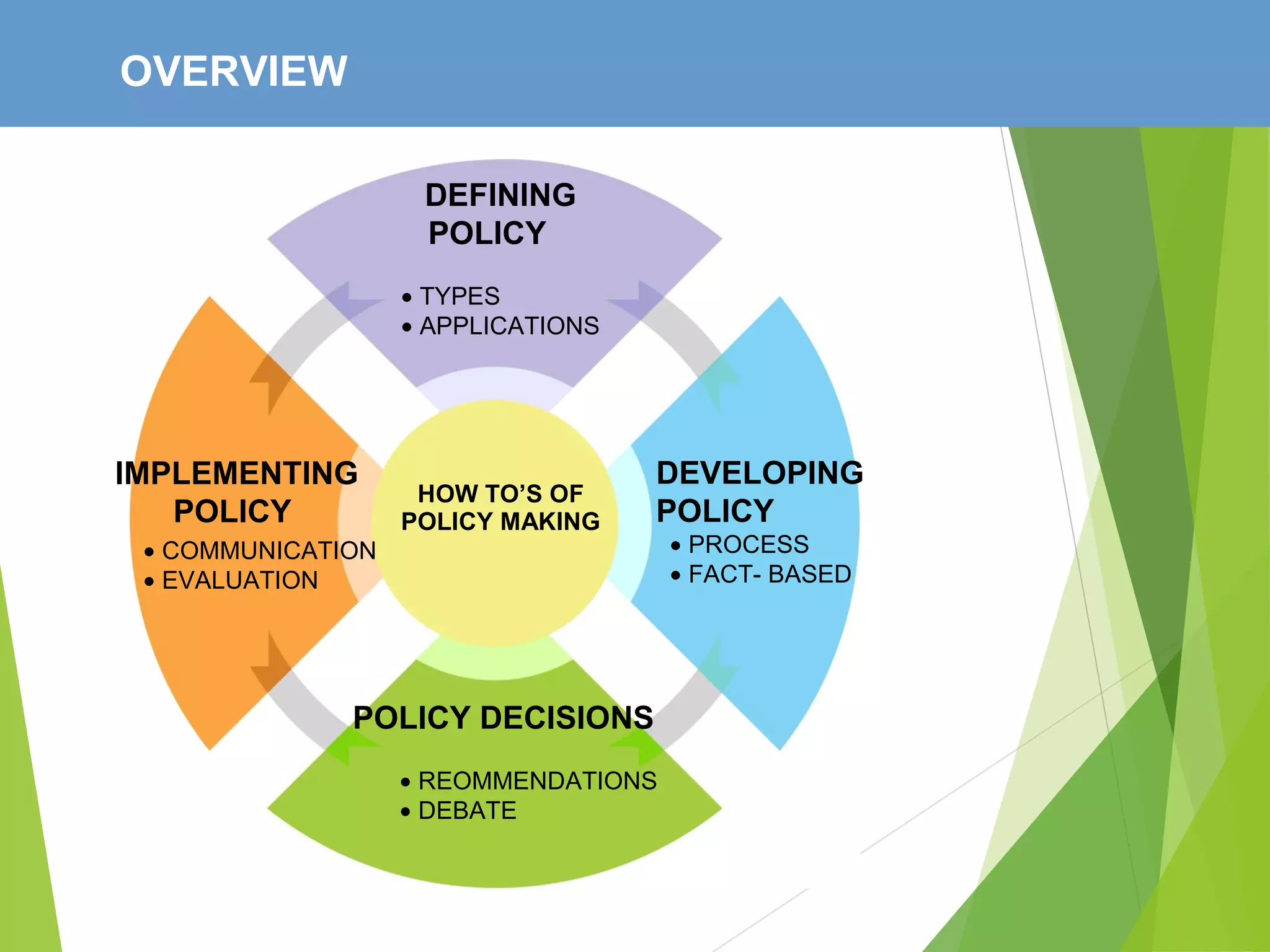
HOW TO’S OF
POLICY MAKING
OVERVIEW
DEFINING
POLICY
• TYPES
• APPLICATIONS
IMPLEMENTING
POLICY
• COMMUNICATION
• EVALUATION
DEVELOPING
POLICY
• PROCESS
• FACT- BASED
POLICY DECISIONS
• REOMMENDATIONS
• DEBATE
COMPETENCIES
• Understands legislative powers
• Communicates effectively
• Approaches problems creatively
• Assumes oversight role
Policy Defined
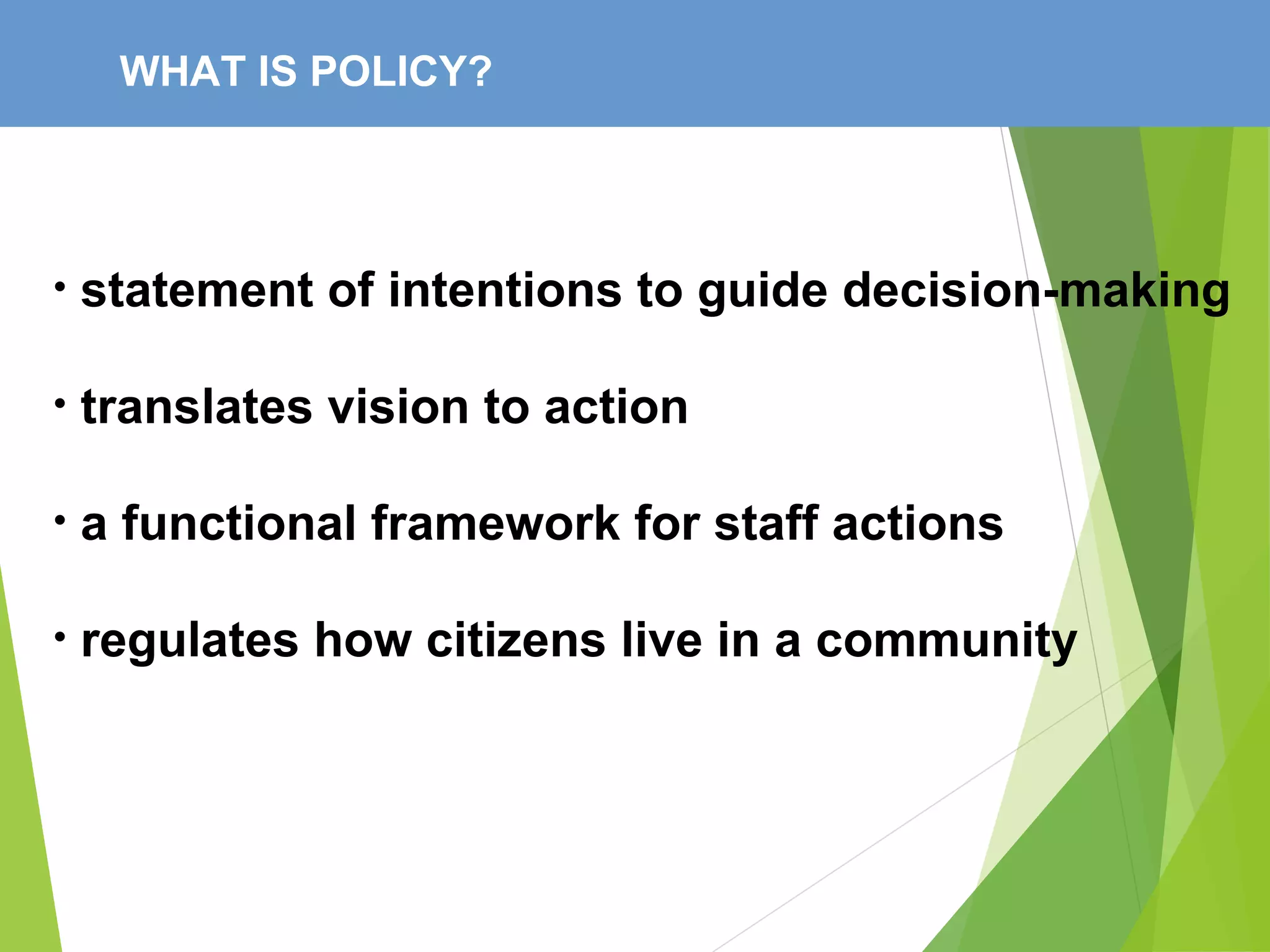
WHAT IS POLICY?
• statement of intentions to guide decision-making
• translates vision to action
• a functional framework for staff actions
• regulates how citizens live in a community
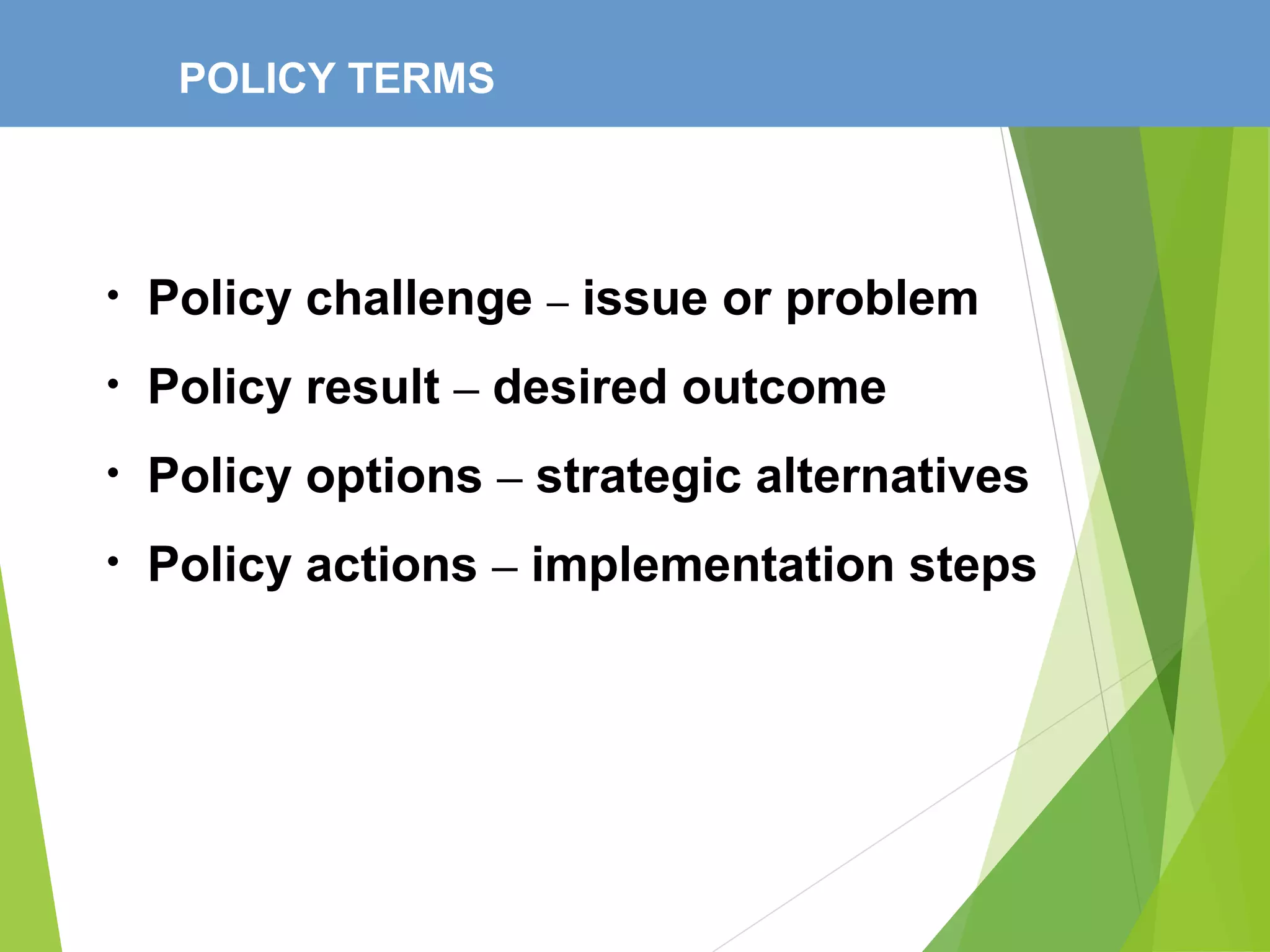
POLICY TERMS
• Policy challenge – issue or problem
• Policy result – desired outcome
• Policy options – strategic alternatives
• Policy actions – implementation steps
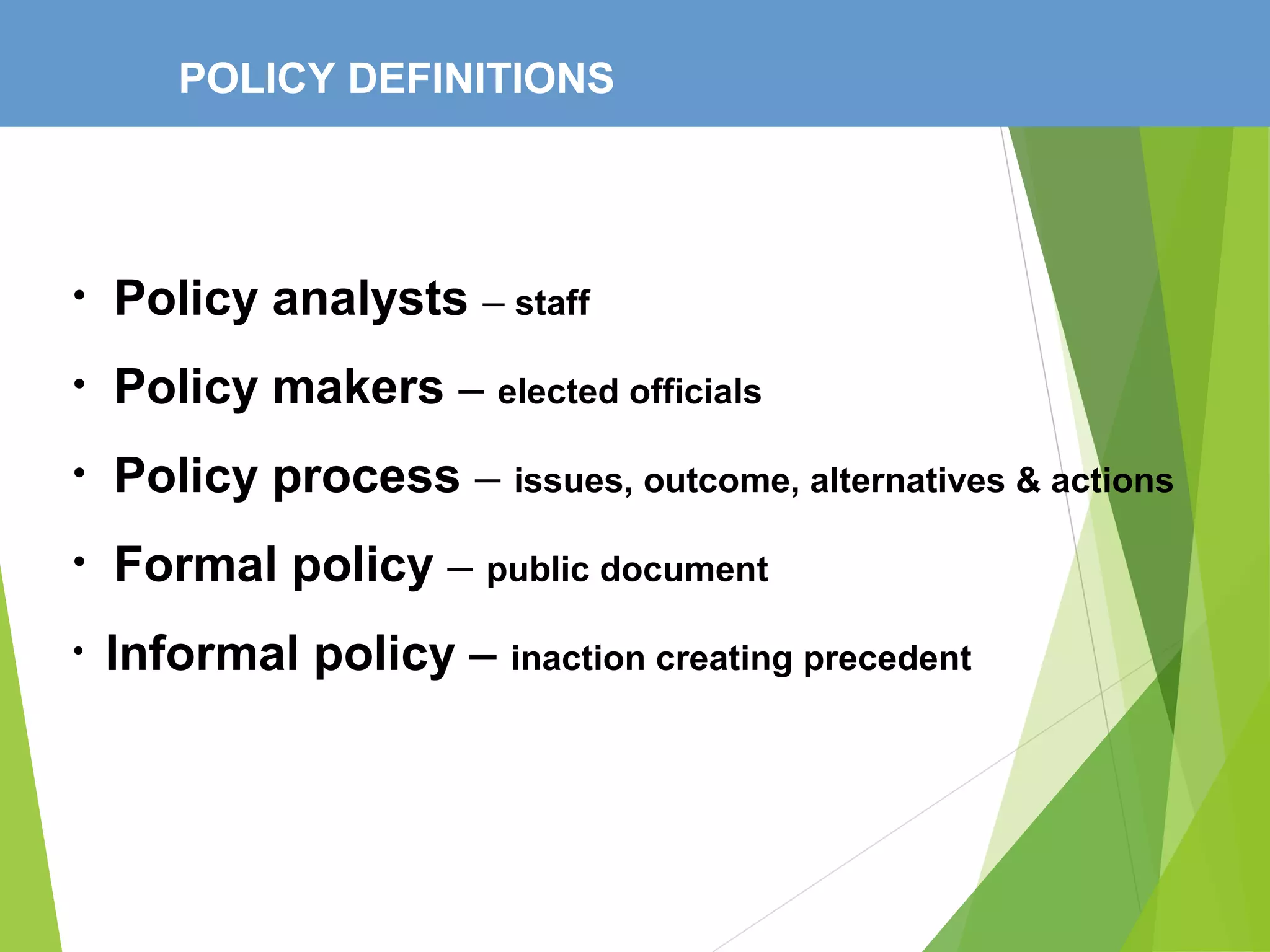
POLICY DEFINITIONS
• Policy analysts – staff
• Policy makers – elected officials
• Policy process – issues, outcome, alternatives & actions
• Formal policy – public document
• Informal policy – inaction creating precedent
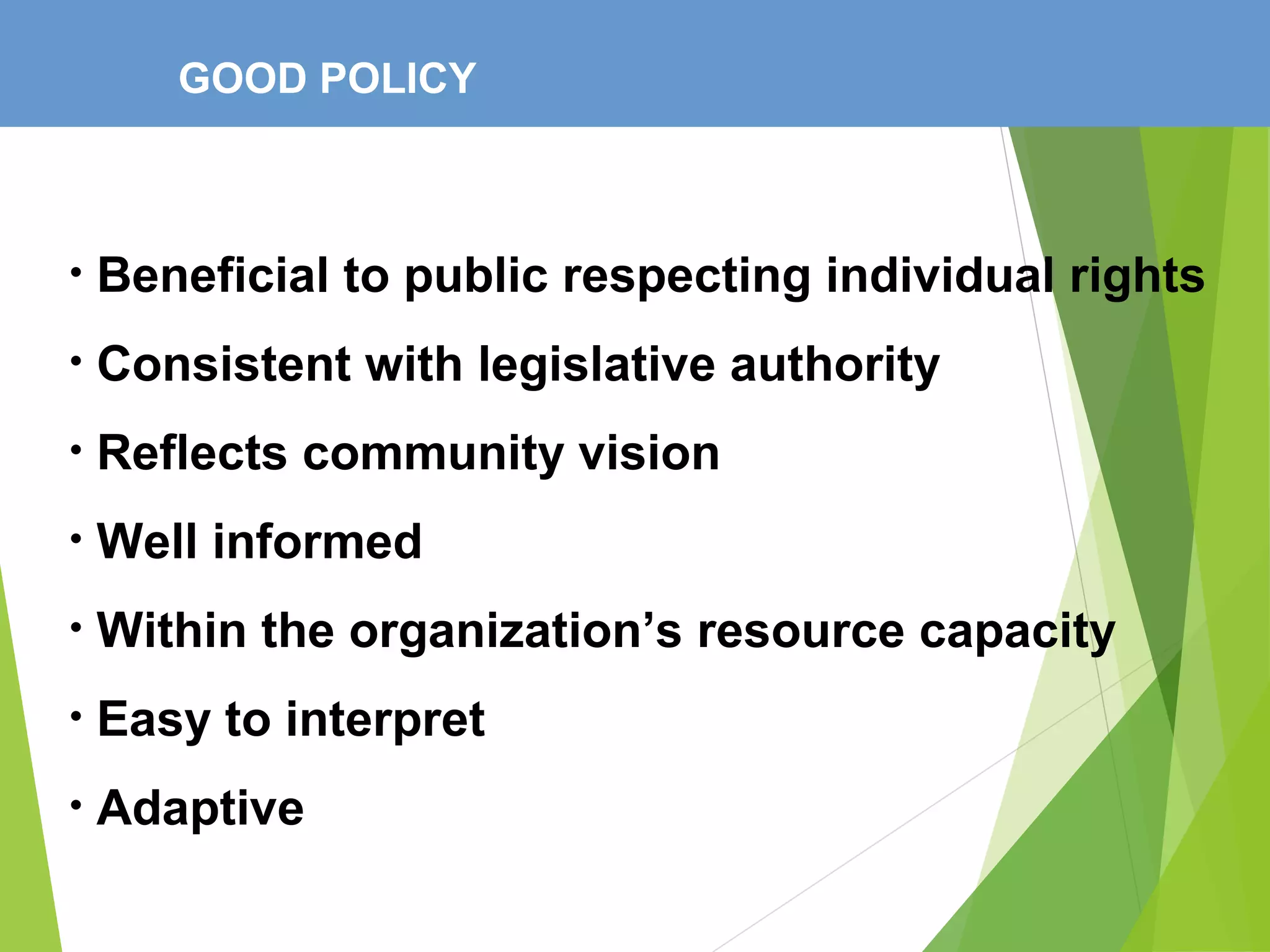
GOOD POLICY
• Beneficial to public respecting individual rights
• Consistent with legislative authority
• Reflects community vision
• Well informed
• Within the organization’s resource capacity
• Easy to interpret
• Adaptive
WHY POLICY?
• legislated requirement for elected officials
• framework for goal setting
• guides program design & service delivery
• rules and regulations for decisions
• principles that guide day-today actions
POLICY CATEGORIES
• governing policies
• operational policies
• administrative policies
What are some examples from your
organization within these categories?
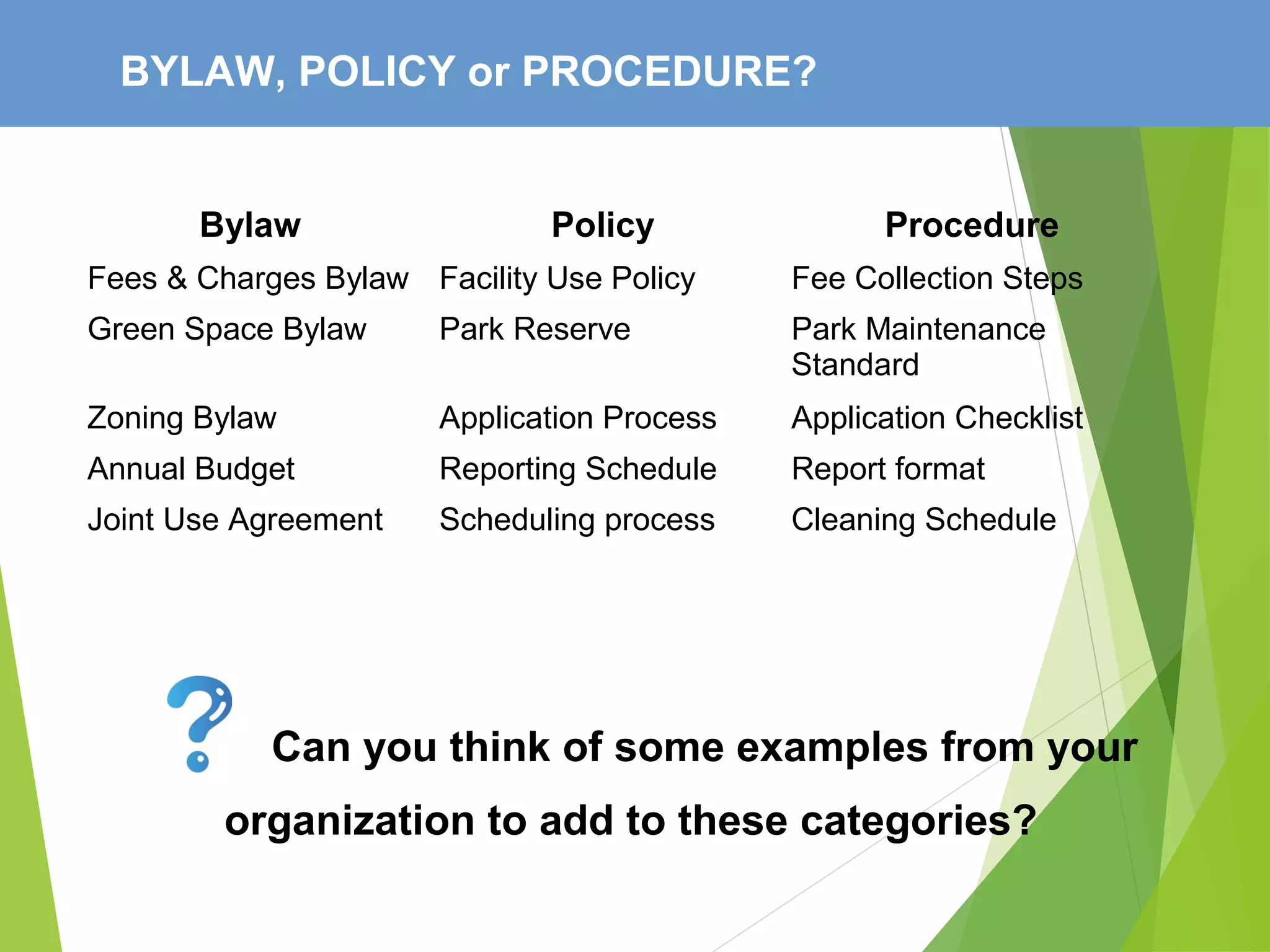
BYLAW, POLICY or PROCEDURE?
Can you think of some examples from your
organization to add to these categories?
Bylaw Policy Procedure
Fees & Charges Bylaw Facility Use Policy Fee Collection Steps
Green Space Bylaw Park Reserve Park Maintenance
Standard
Zoning Bylaw Application Process Application Checklist
Annual Budget Reporting Schedule Report format
Joint Use Agreement Scheduling process Cleaning Schedule
MAJOR APPLICATIONS
• land use
• service delivery
• funding
• administration
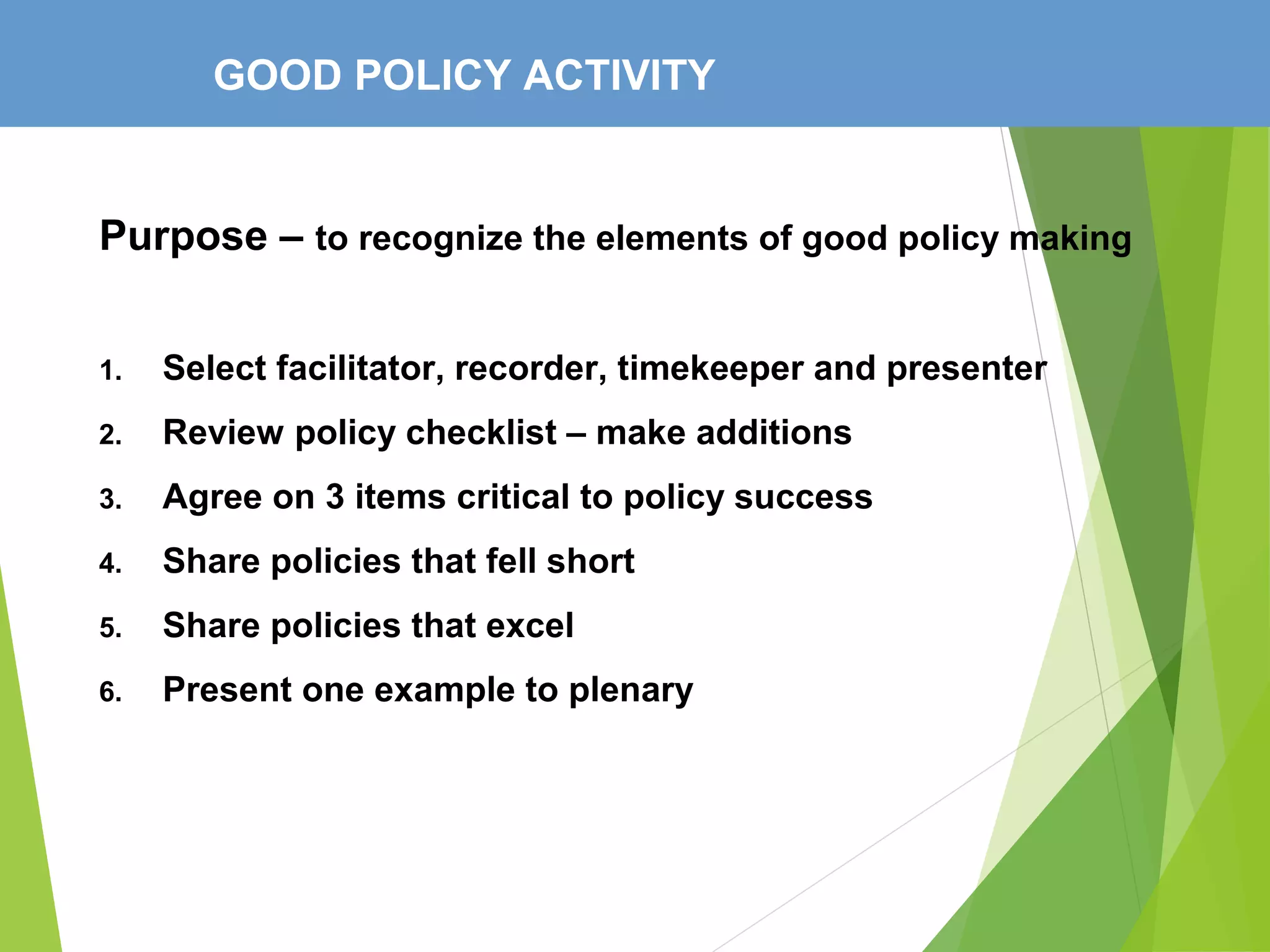
GOOD POLICY ACTIVITY
Purpose – to recognize the elements of good policy making
1. Select facilitator, recorder, timekeeper and presenter
2. Review policy checklist – make additions
3. Agree on 3 items critical to policy success
4. Share policies that fell short
5. Share policies that excel
6. Present one example to plenary
Section 2
Policy Development
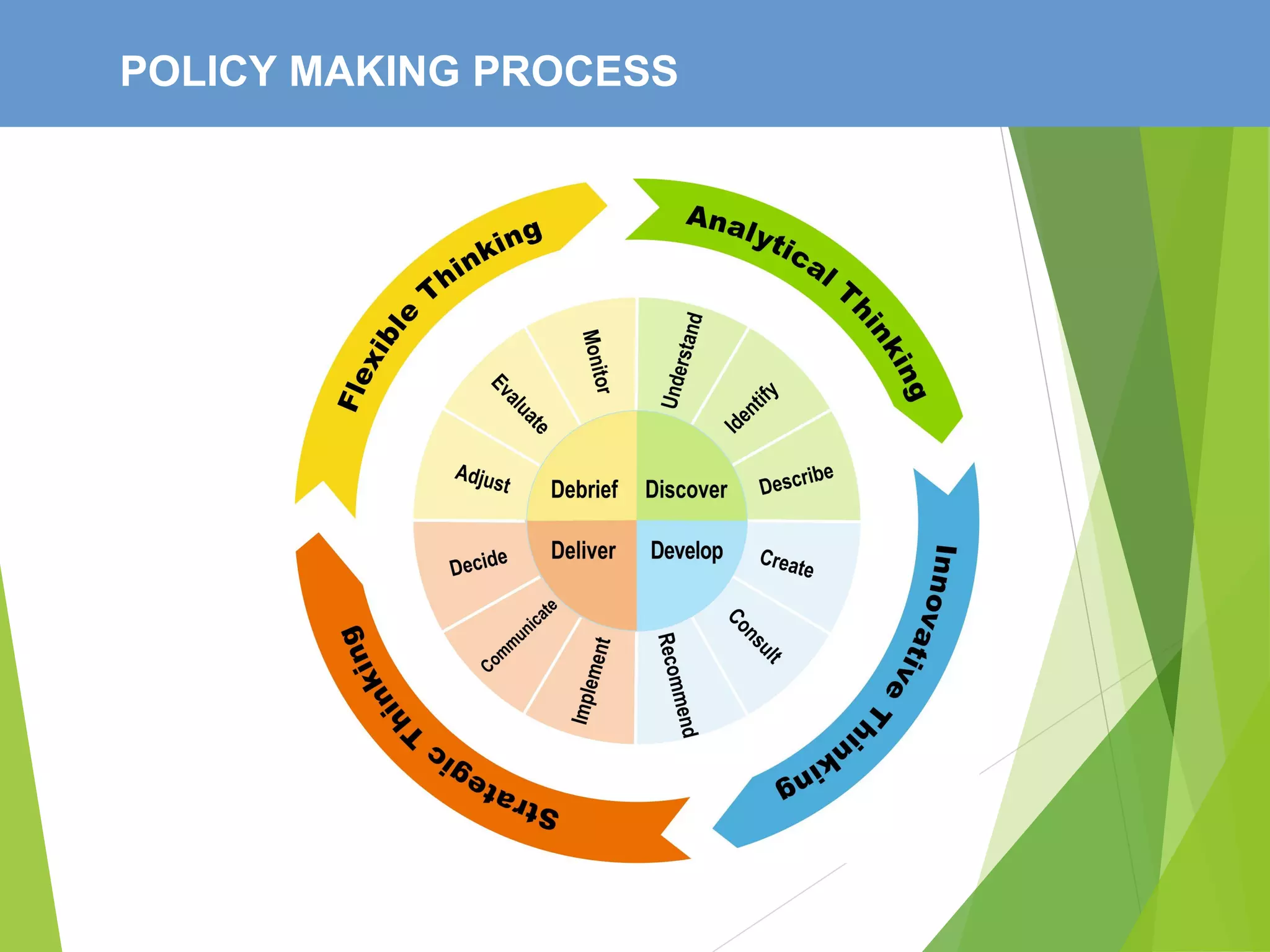
POLICY MAKING PROCESS
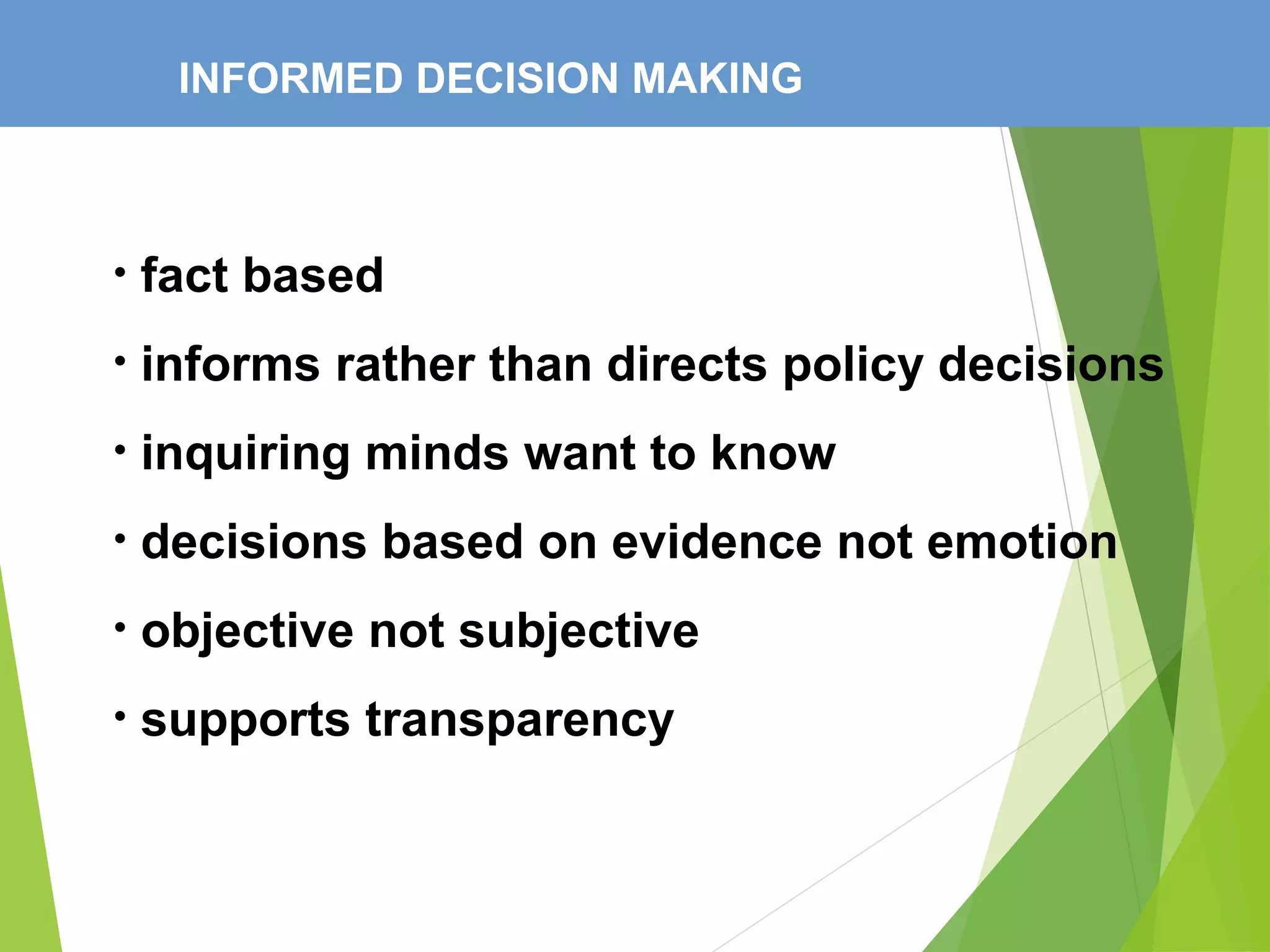
INFORMED DECISION MAKING
• fact based
• informs rather than directs policy decisions
• inquiring minds want to know
• decisions based on evidence not emotion
• objective not subjective
• supports transparency
TYPES OF ISSUES
Routine Policy Challenge
• not new
• solutions known
• policy options clear
Complex Policy Challenge
• new, solutions are not clear
• unexplored policy options
• uncertain policy actions
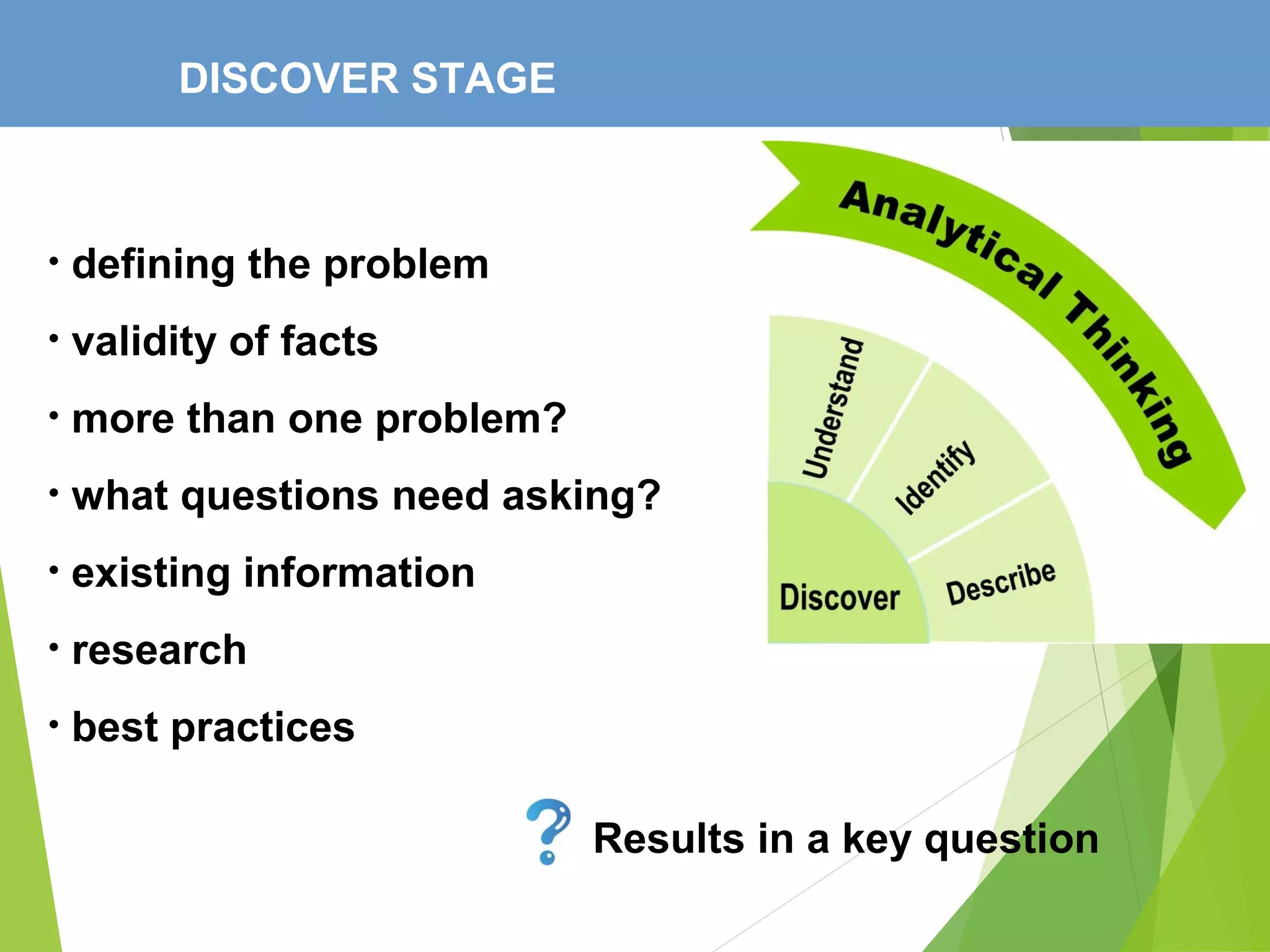
DISCOVER STAGE
• defining the problem
• validity of facts
• more than one problem?
• what questions need asking?
• existing information
• research
• best practices
Results in a key question
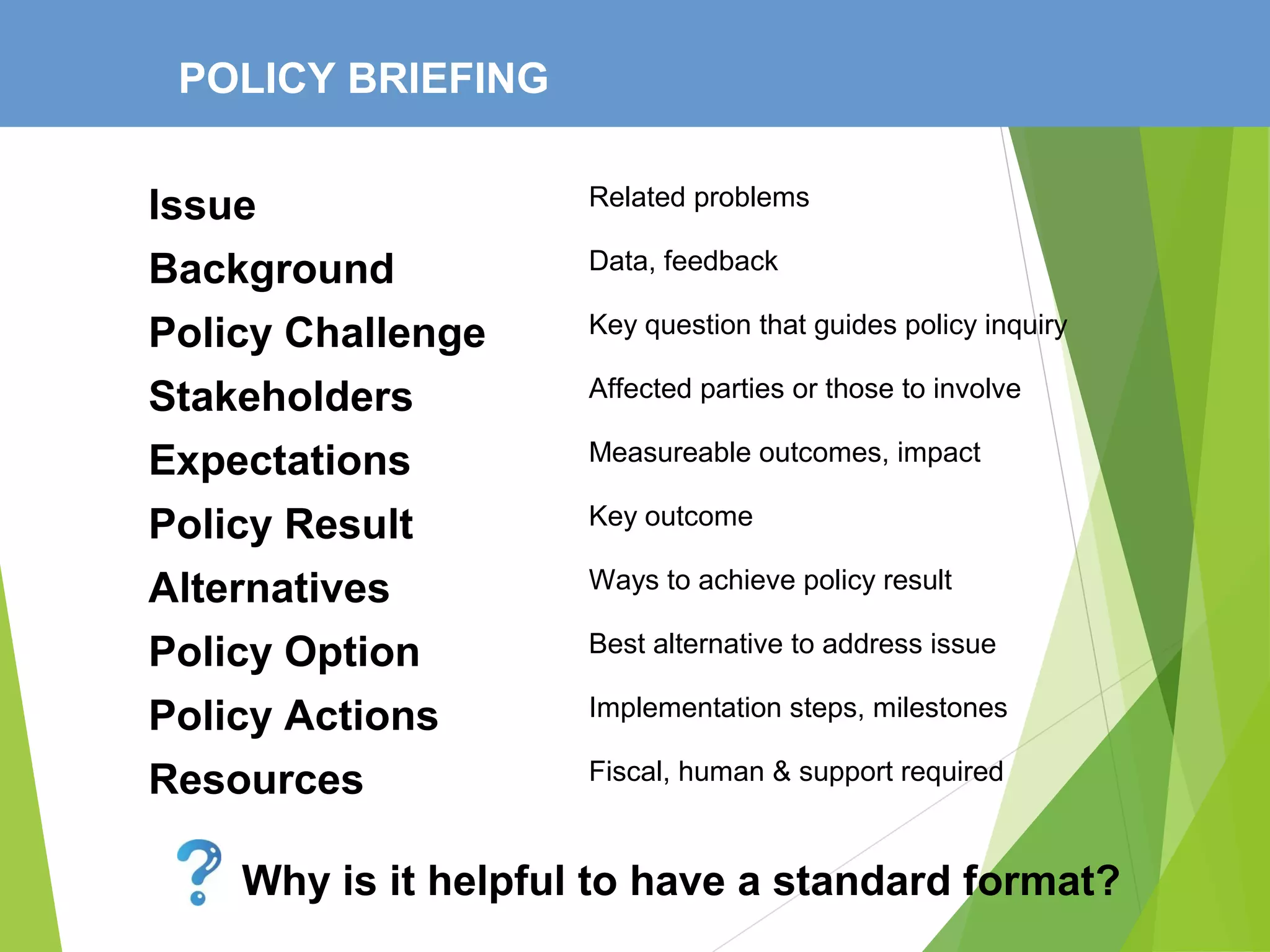
POLICY BRIEFING
Issue Related problems
Background Data, feedback
Policy Challenge Key question that guides policy inquiry
Stakeholders Affected parties or those to involve
Expectations Measureable outcomes, impact
Policy Result Key outcome
Alternatives Ways to achieve policy result
Policy Option Best alternative to address issue
Policy Actions Implementation steps, milestones
Resources Fiscal, human & support required
Why is it helpful to have a standard format?
POLICY DEFINITION ACTIVITY
Purpose – to develop a real life policy recommendation
beginning by identifying the policy issue or problem
1. Select facilitator, recorder, timekeeper and presenter
2. Discuss policy issues you are facing
3. Agree on one to use as a group
4. Identify info available to you (policy briefing worksheet)
5. Identify possible questions
6. Choose one key question
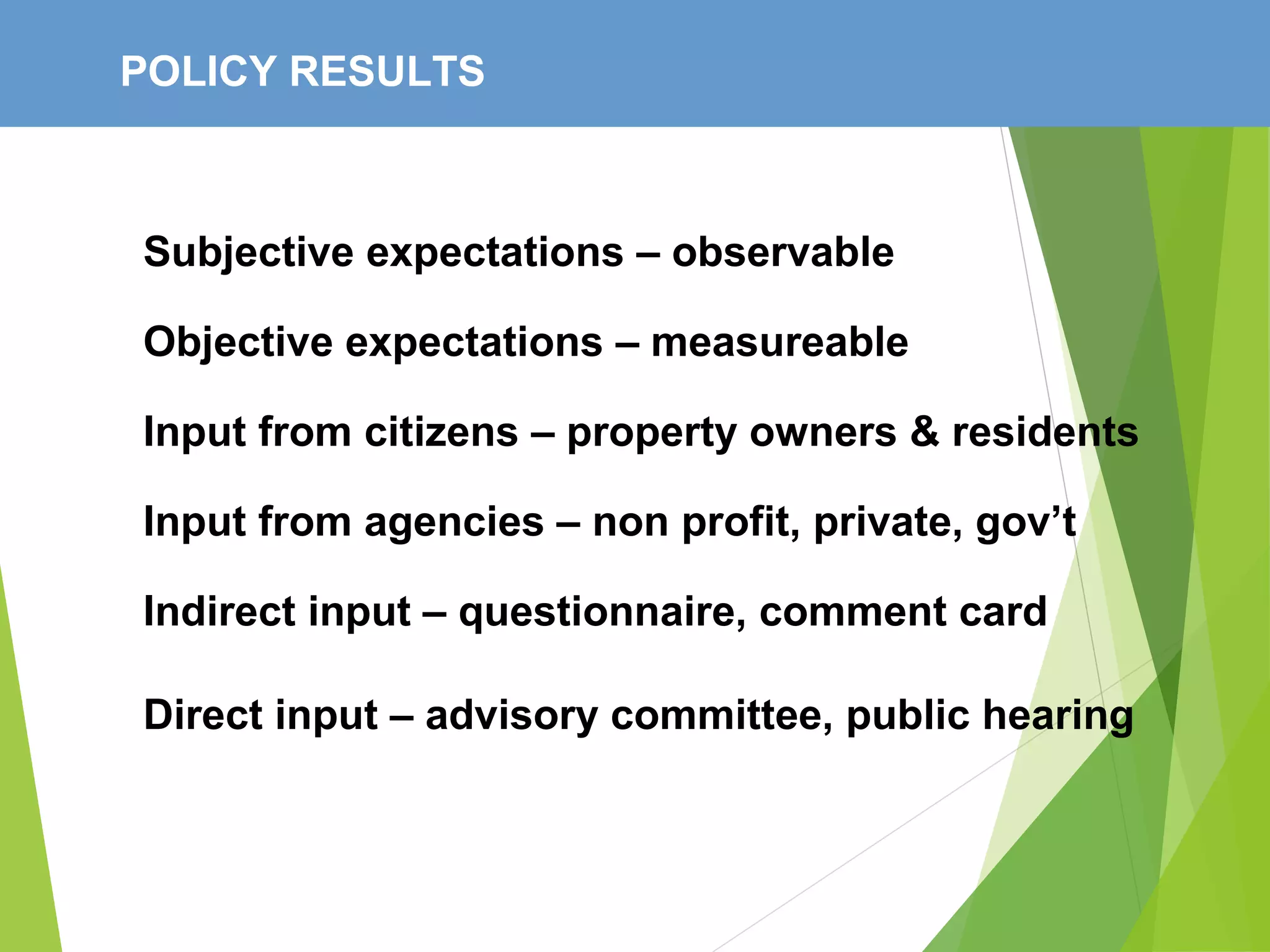
POLICY RESULTS
Subjective expectations – observable
Objective expectations – measureable
Input from citizens – property owners & residents
Input from agencies – non profit, private, gov’t
Indirect input – questionnaire, comment card
Direct input – advisory committee, public hearing
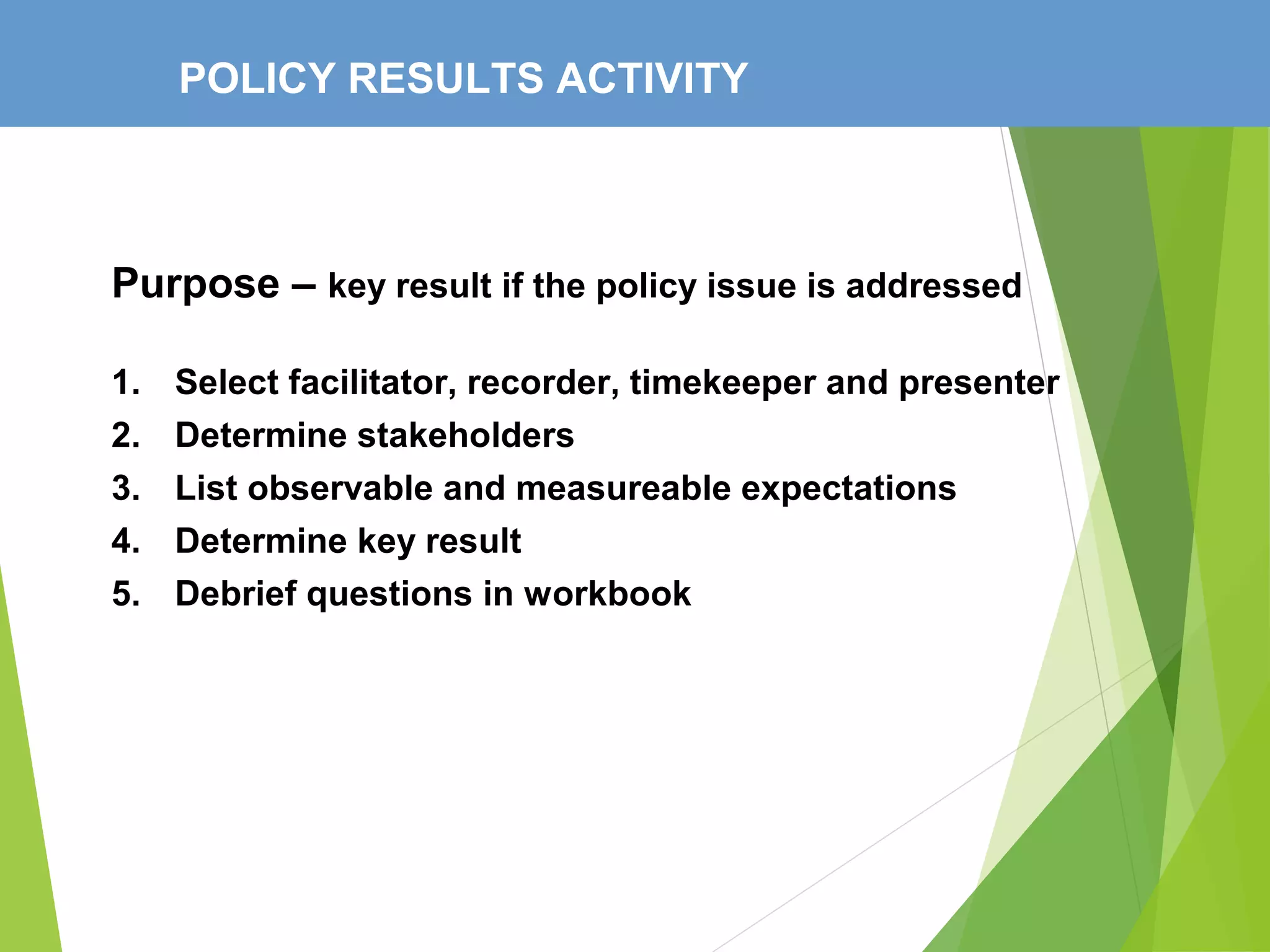
POLICY RESULTS ACTIVITY
Purpose – key result if the policy issue is addressed
1. Select facilitator, recorder, timekeeper and presenter
2. Determine stakeholders
3. List observable and measureable expectations
4. Determine key result
5. Debrief questions in workbook
IS A POLICY NEEDED?
• to comply with legislation
• to establish consistent treatment
• to guide repeat situations
• to establish standards & regulations
• to protect the municipality legally
• if employee actions indicate confusion
Can you think of an example when policy was not
needed for an issue facing Council?
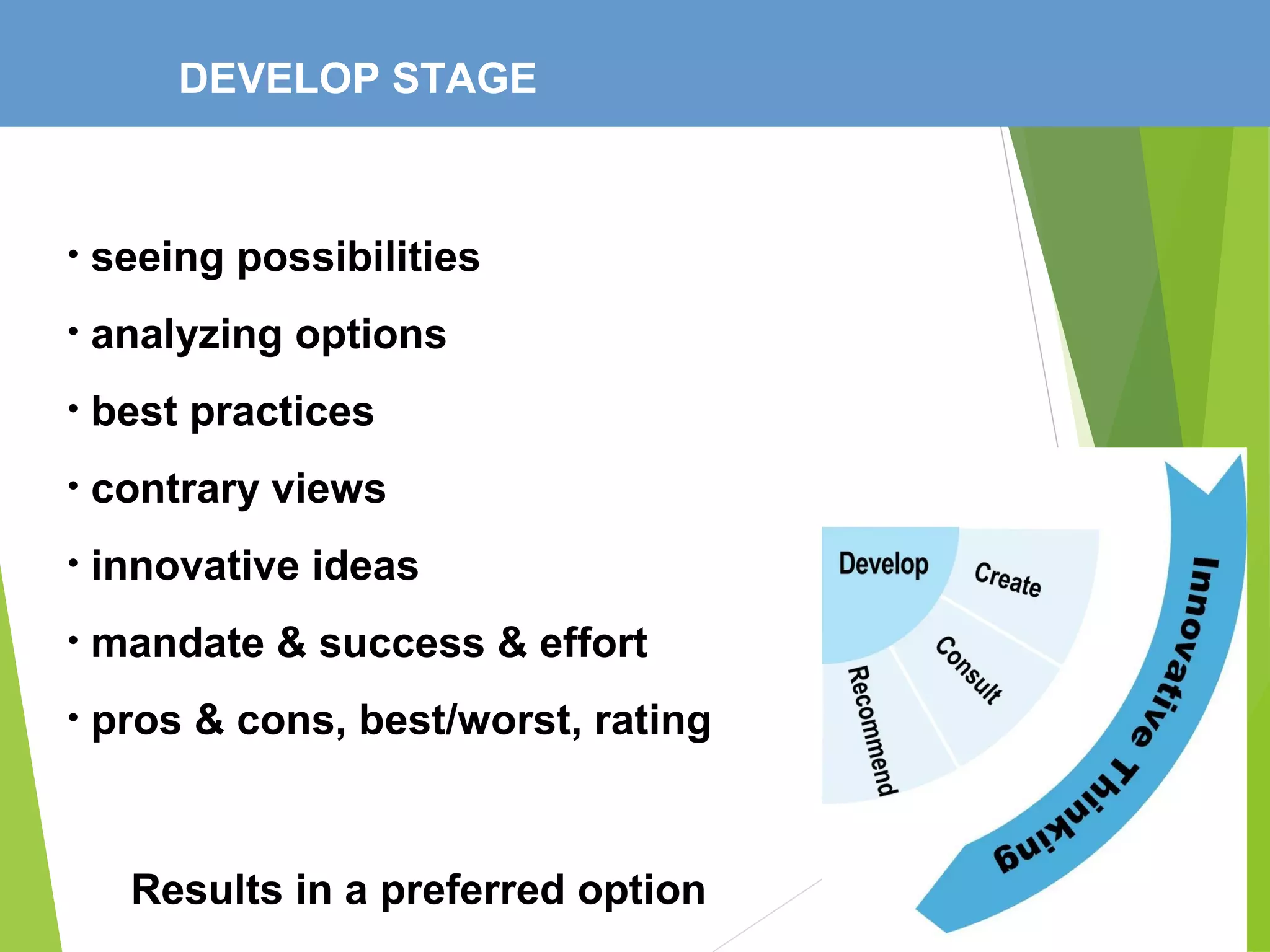
DEVELOP STAGE
• seeing possibilities
• analyzing options
• best practices
• contrary views
• innovative ideas
• mandate & success & effort
• pros & cons, best/worst, rating
Results in a preferred option
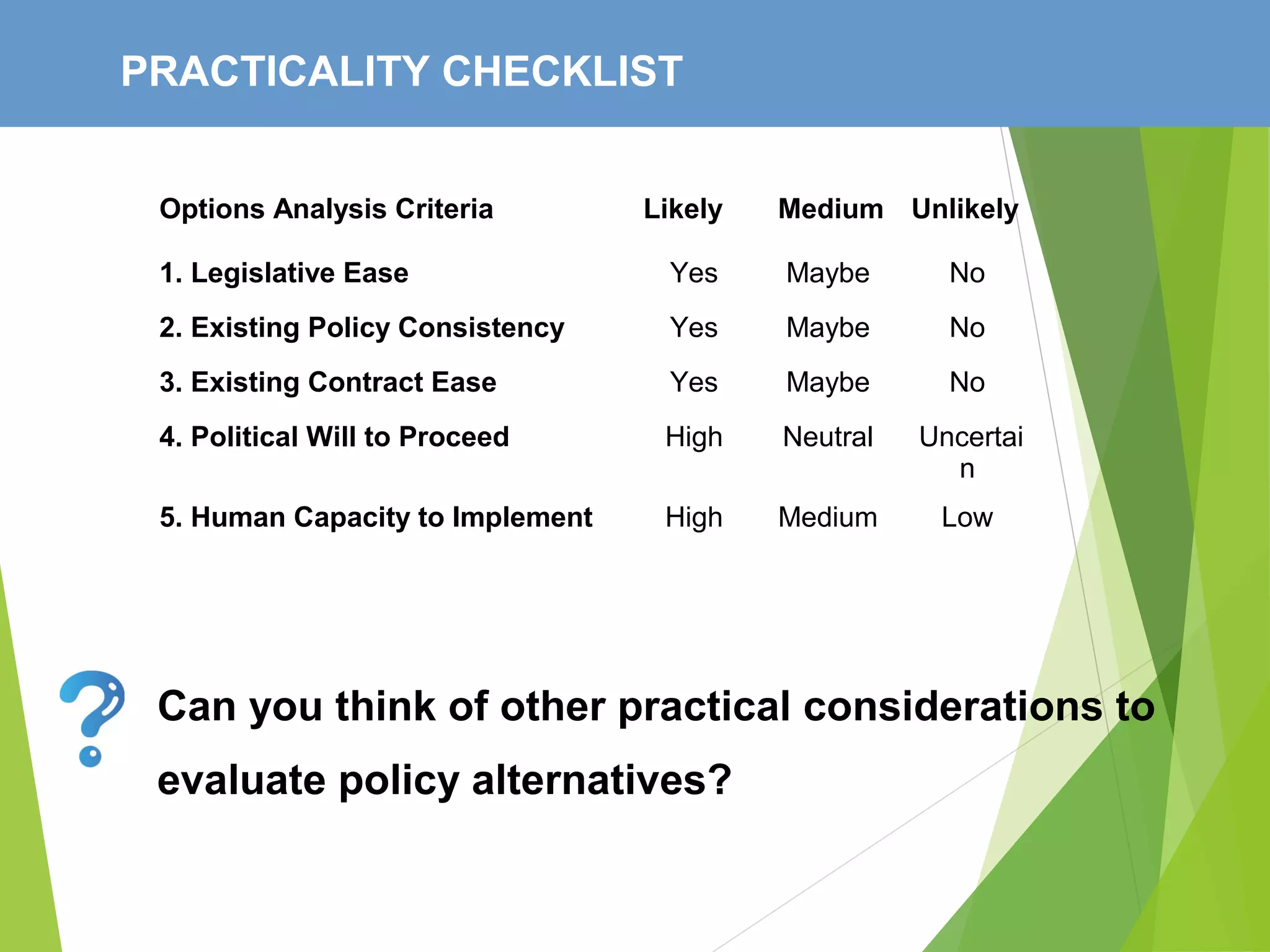
PRACTICALITY CHECKLIST
Can you think of other practical considerations to
evaluate policy alternatives?
Options Analysis Criteria Likely Medium Unlikely
1. Legislative Ease Yes Maybe No
2. Existing Policy Consistency Yes Maybe No
3. Existing Contract Ease Yes Maybe No
4. Political Will to Proceed High Neutral Uncertai
n
5. Human Capacity to Implement High Medium Low
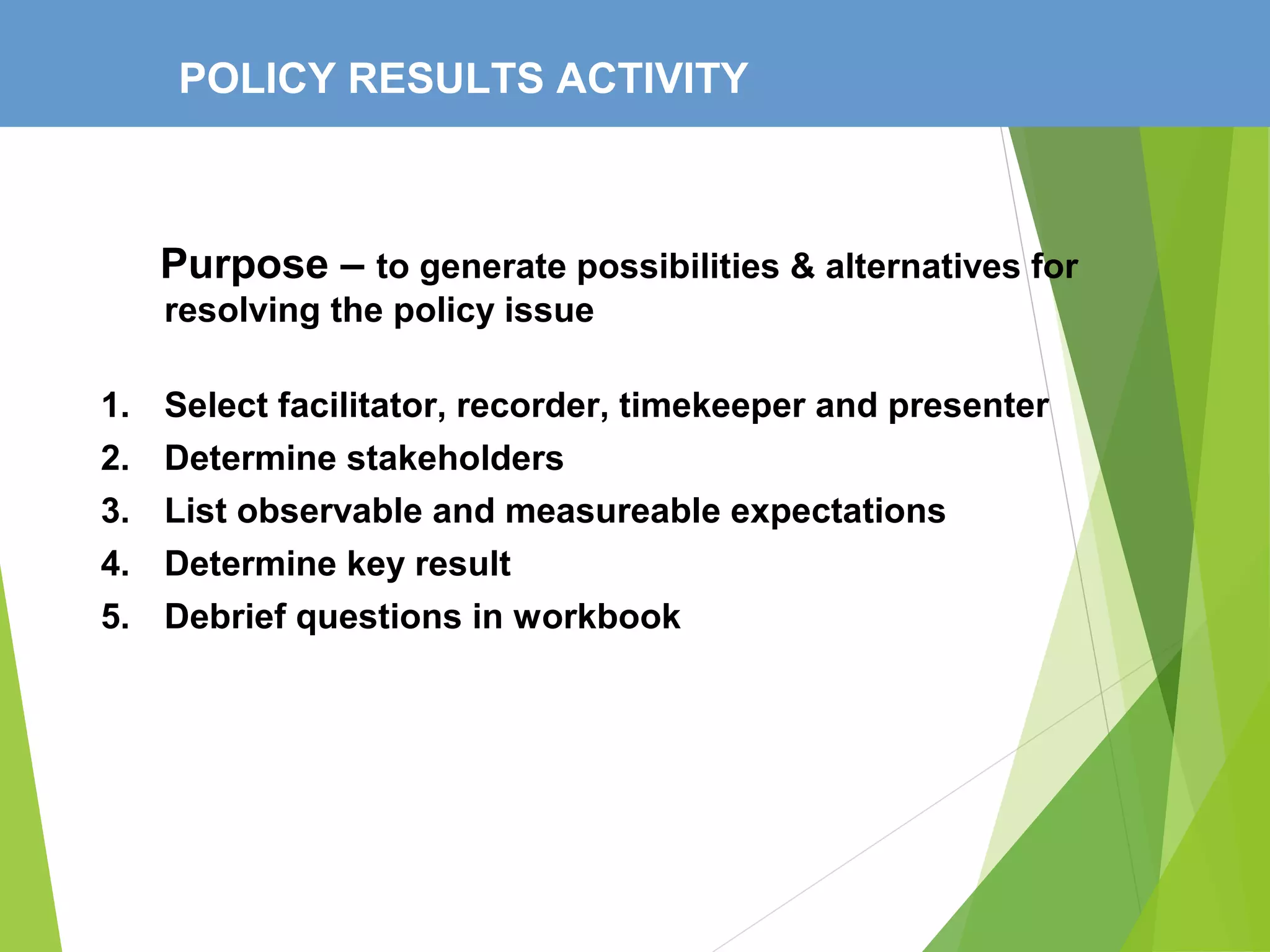
POLICY RESULTS ACTIVITY
Purpose – to generate possibilities & alternatives for
resolving the policy issue
1. Select facilitator, recorder, timekeeper and presenter
2. Determine stakeholders
3. List observable and measureable expectations
4. Determine key result
5. Debrief questions in workbook
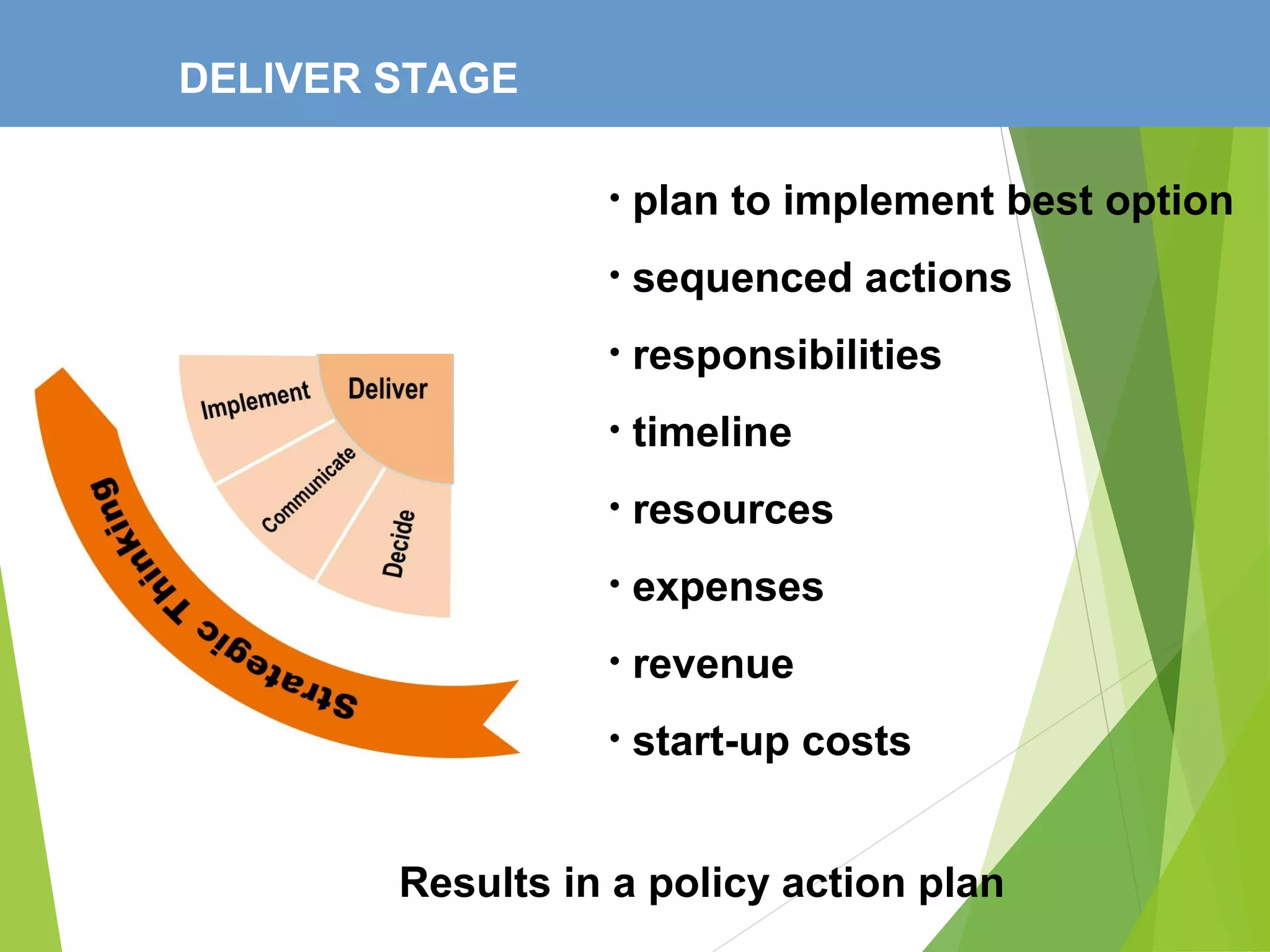
DELIVER STAGE
• plan to implement best option
• sequenced actions
• responsibilities
• timeline
• resources
• expenses
• revenue
• start-up costs
Results in a policy action plan
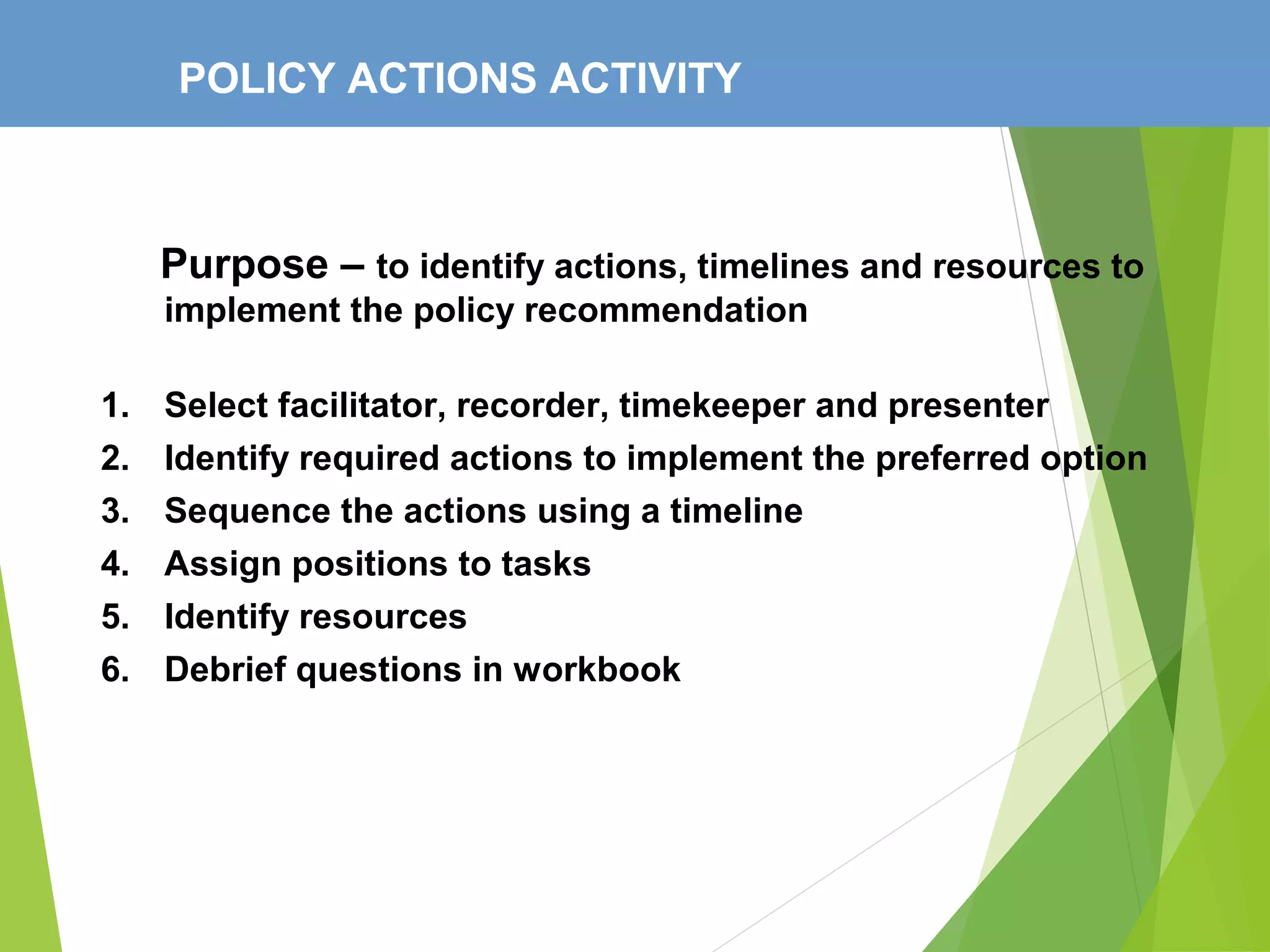
POLICY ACTIONS ACTIVITY
Purpose – to identify actions, timelines and resources to
implement the policy recommendation
1. Select facilitator, recorder, timekeeper and presenter
2. Identify required actions to implement the preferred option
3. Sequence the actions using a timeline
4. Assign positions to tasks
5. Identify resources
6. Debrief questions in workbook
POLICY RECOMMENDATIONS
Policy Briefing
• facts & comparative information
• prepared for Council discussion & debate
Policy Format
• policy recommendation
• prepared for Council debate & approval
Can you recall a time when staff prepared information
that was not what Council was looking for?
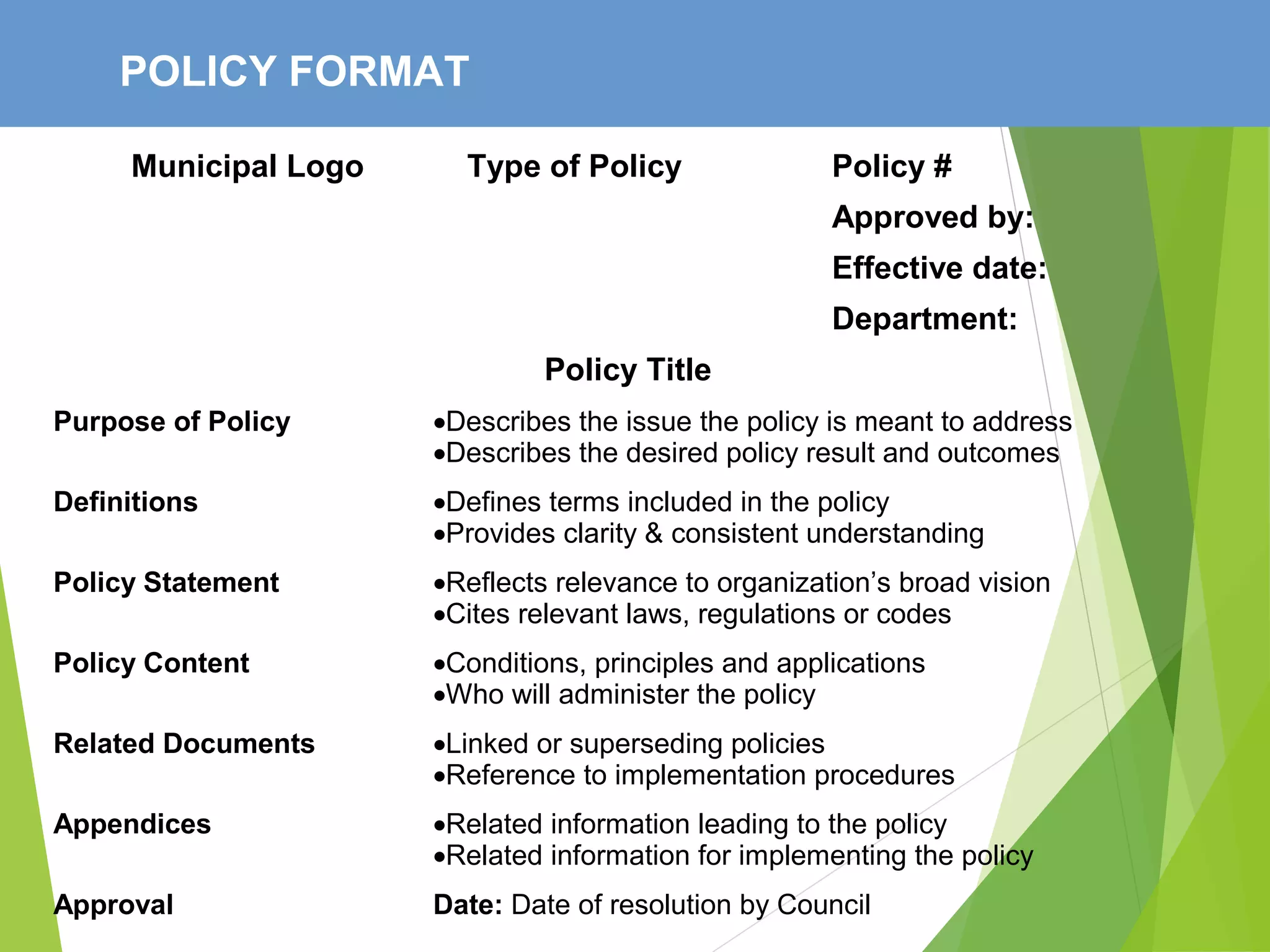
POLICY FORMAT
Municipal Logo Type of Policy Policy #
Approved by:
Effective date:
Department:
Policy Title
Purpose of Policy •Describes the issue the policy is meant to address
•Describes the desired policy result and outcomes
Definitions •Defines terms included in the policy
•Provides clarity & consistent understanding
Policy Statement •Reflects relevance to organization’s broad vision
•Cites relevant laws, regulations or codes
Policy Content •Conditions, principles and applications
•Who will administer the policy
Related Documents •Linked or superseding policies
•Reference to implementation procedures
Appendices •Related information leading to the policy
•Related information for implementing the policy
Approval Date: Date of resolution by Council
POLICY RECOMMENDATION ACTIVITY
Purpose – to review a policy recommendation to ensure
support from Council
1. Select facilitator, recorder, timekeeper and presenter
2. Review Policy Briefing info & determine final recommendation
3. What factors affect the recommendation?
4. How will you address these factors?
5. What information needs to be presented to Council?
6. Debrief
Section 3
Policy Decisions
MAKING DECISIONS
CONSENSUS
INFORMED
DECISION
SIMPLE MAJORITY
IMPOSED
AGREEMENT
Consensus – working through
views until agreement among all
Informed – analyze options
through respectful discussion
Majority – voting by those who
have authority to vote
Imposed – decision by one with
authority
INFORMED DECISION MAKING
• adequate information
• good debate
• factual information and data
• forecasts and trends
• perceptions from various interests
• justification and further analysis
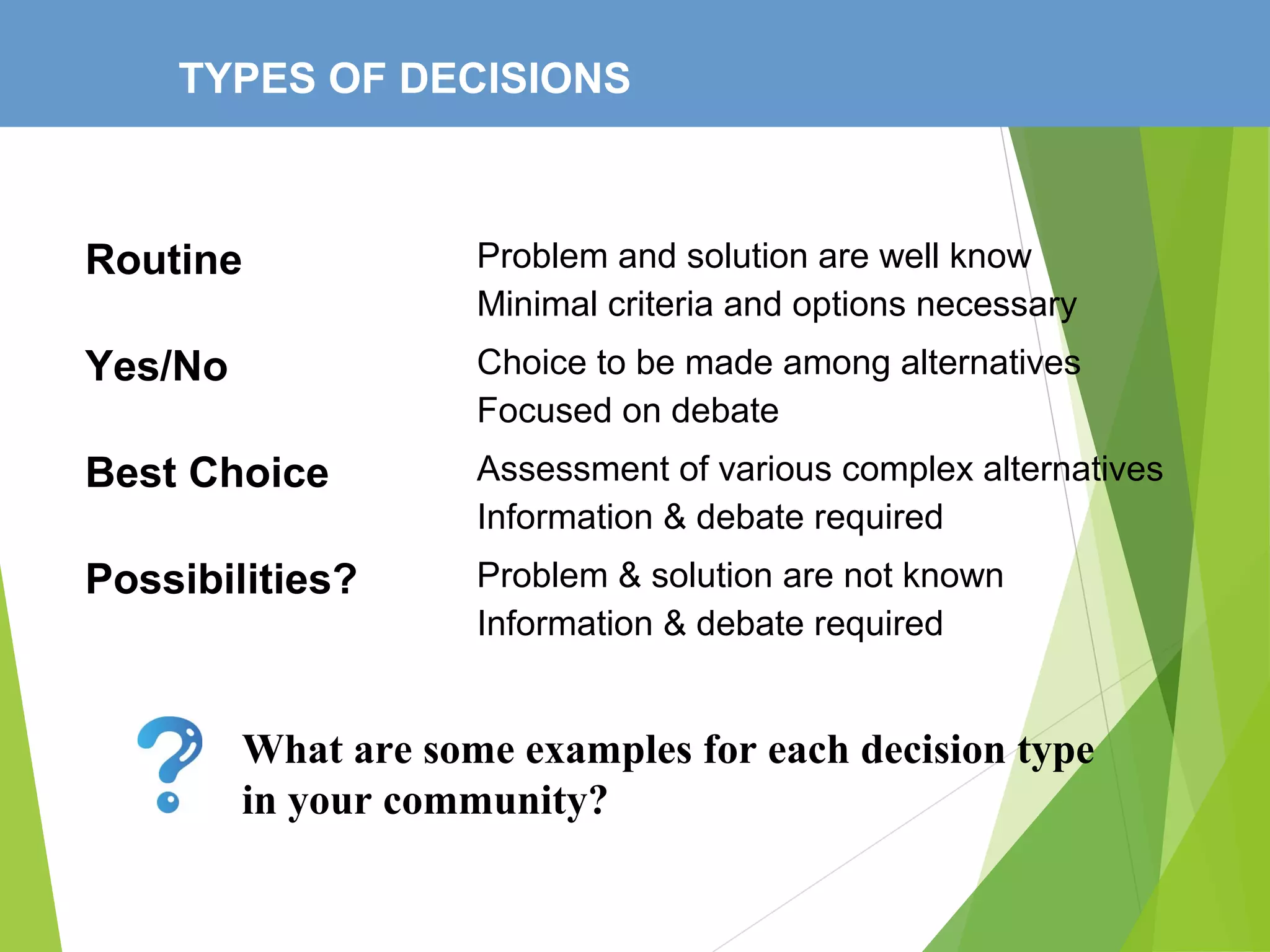
TYPES OF DECISIONS
Routine Problem and solution are well know
Minimal criteria and options necessary
Yes/No Choice to be made among alternatives
Focused on debate
Best Choice Assessment of various complex alternatives
Information & debate required
Possibilities? Problem & solution are not known
Information & debate required
What are some examples for each decision type
in your community?
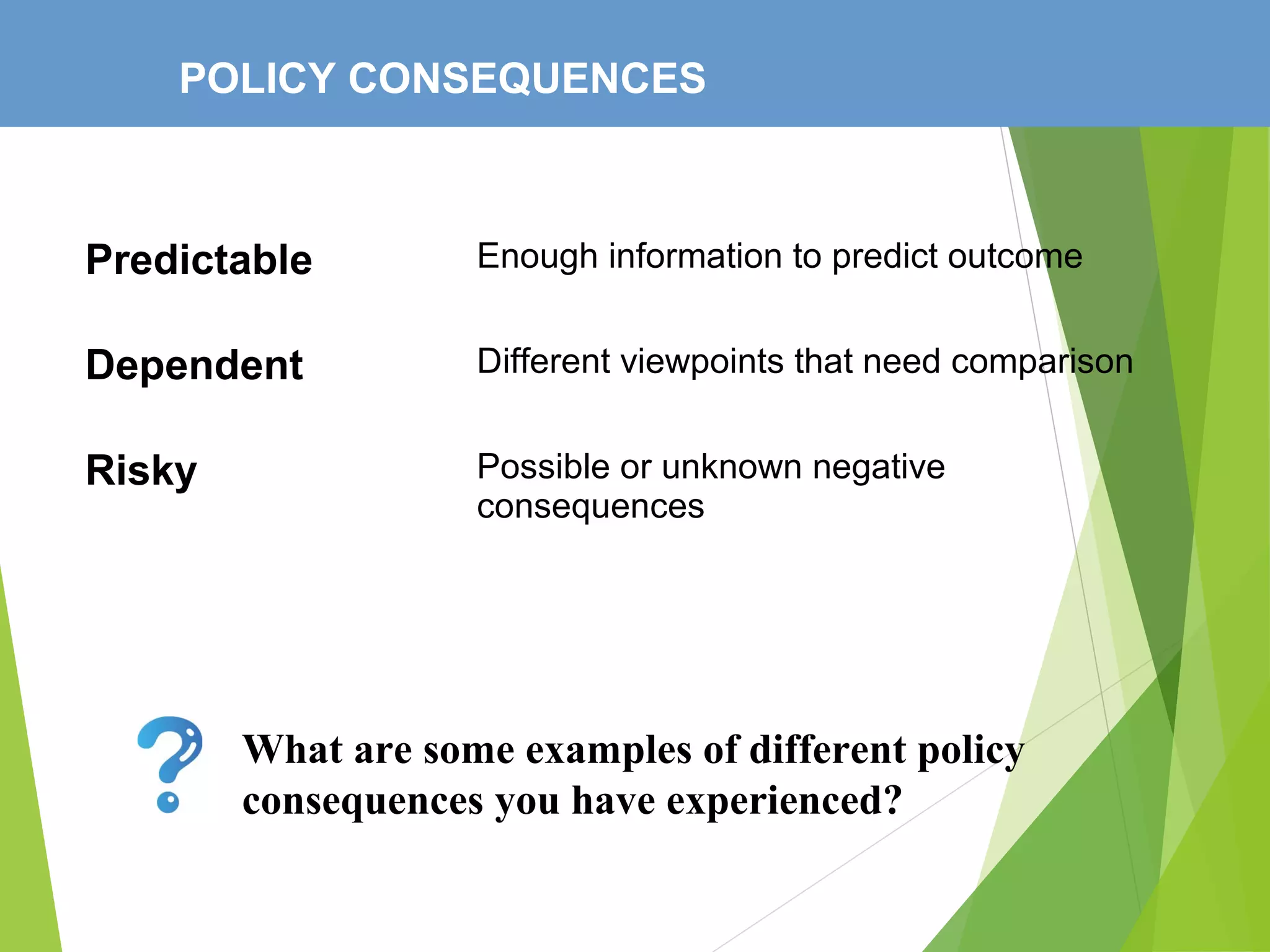
POLICY CONSEQUENCES
Predictable Enough information to predict outcome
Dependent Different viewpoints that need comparison
Risky Possible or unknown negative
consequences
What are some examples of different policy
consequences you have experienced?
GODD DEBATE
• differs from discussion
• good debate intended to result in a decision
• formal process that occurs in public
• yes – agree with recommendations
• no – turn down recommendation
• refer or defer – more information required
DEBATE ACTIVITY
Purpose – to discuss reasons policy debate might derail
1. Select facilitator, recorder, timekeeper and presenter
2. Brainstorm factors that derail policy debate. Choose two
3. As Mayor, how would you deal with these?
4. As Councillor, how could you prevent these from occurring?
5. Report back to plenary
6. Debrief
PRINCIPLES OF GOOD DEBATE
• know what you’re talking about
• use logic to present your side
• be accurate, rely on facts
• be professional in your conduct
• use supportive language
• avoid exaggeration
• follow protocols, points of order
• keep your perspective
Section 4
Policy Implementation
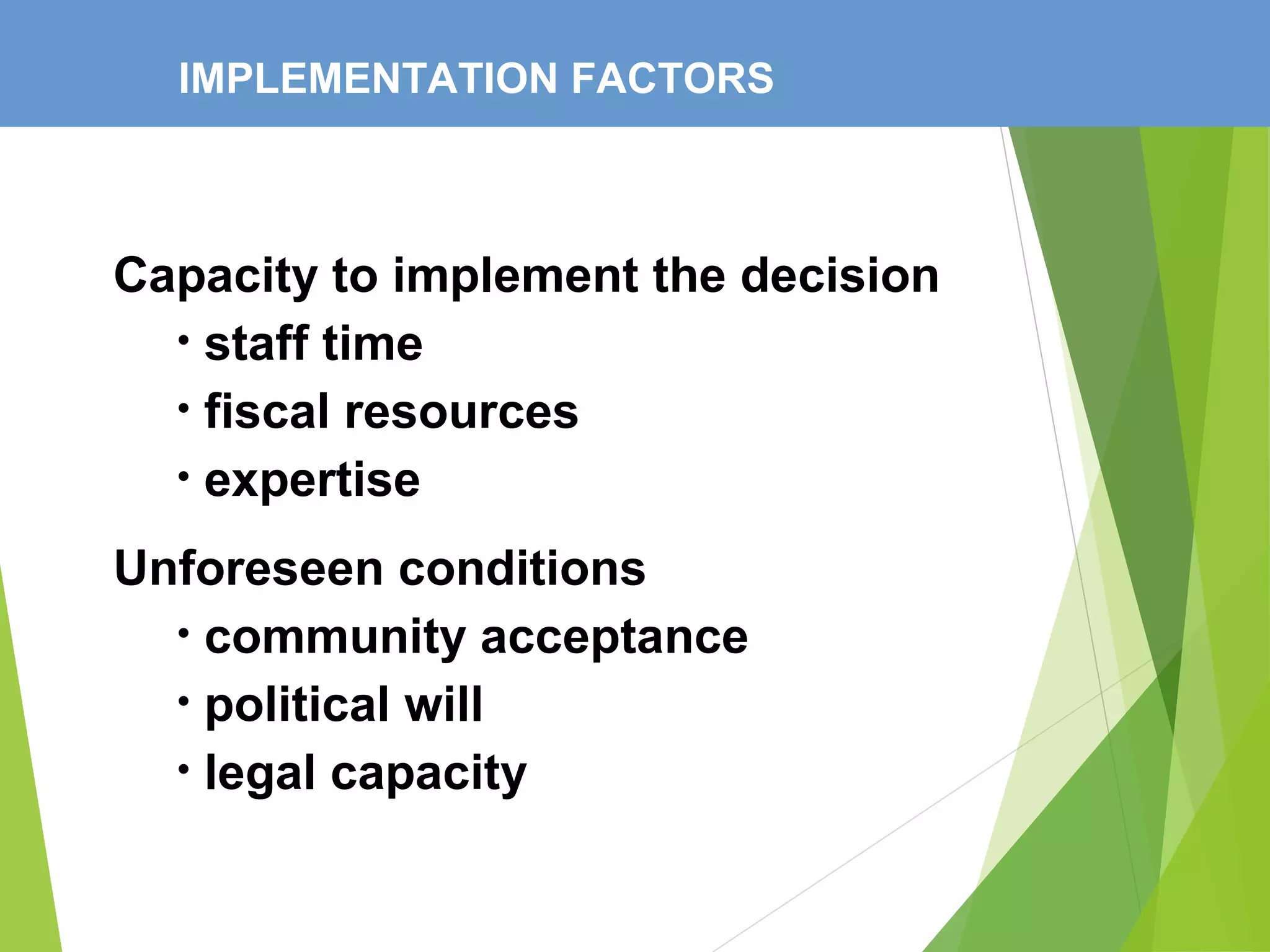
IMPLEMENTATION FACTORS
Capacity to implement the decision
• staff time
• fiscal resources
• expertise
Unforeseen conditions
• community acceptance
• political will
• legal capacity
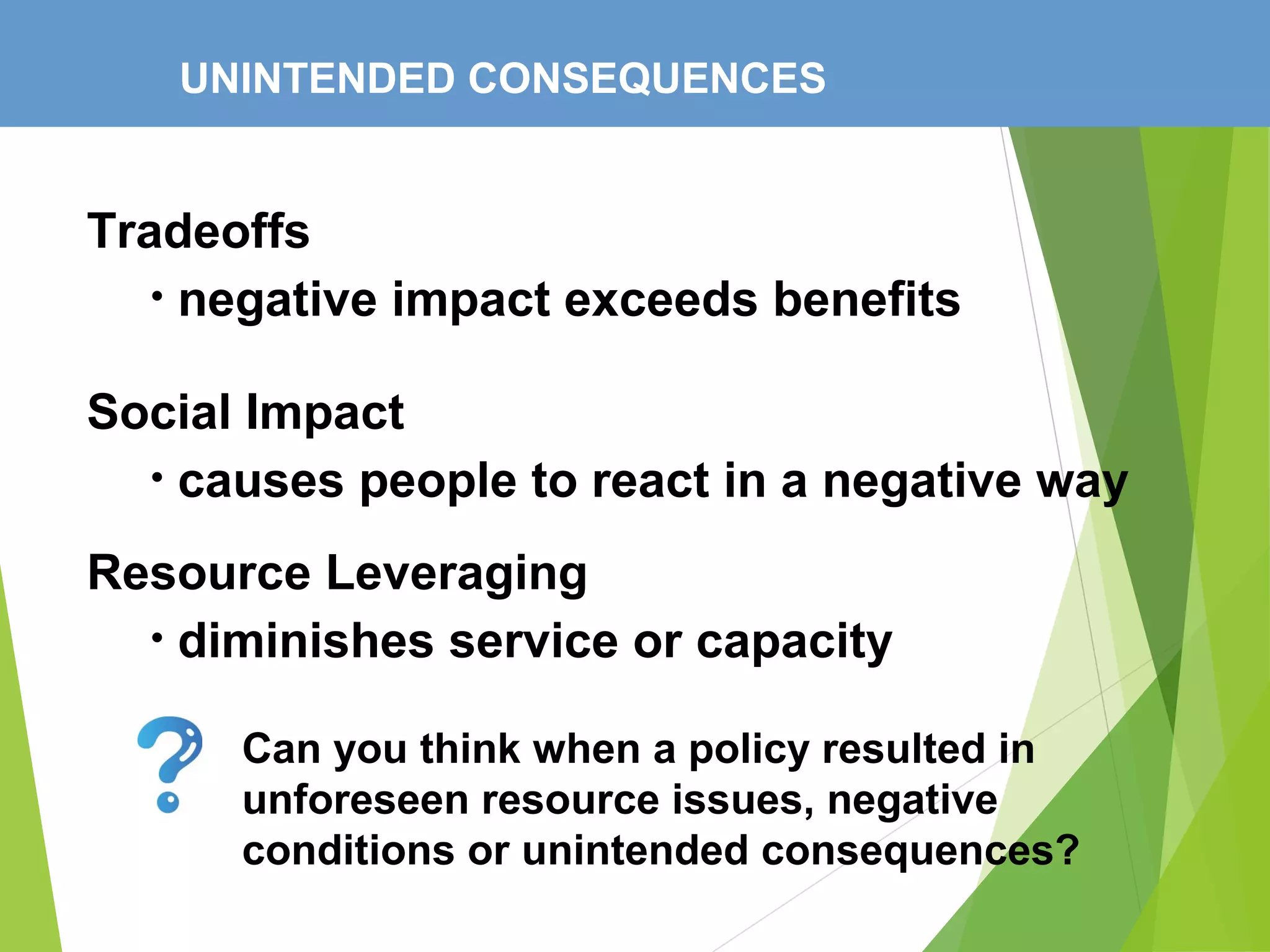
UNINTENDED CONSEQUENCES
Tradeoffs
• negative impact exceeds benefits
Social Impact
• causes people to react in a negative way
Resource Leveraging
• diminishes service or capacity
Can you think when a policy resulted in
unforeseen resource issues, negative
conditions or unintended consequences?
UNINTENDED CONSEQUENCES ACTIVITY
Purpose – to recognize, prevent or correct the impact of
unintended policy consequences
1. Select facilitator, recorder, timekeeper and presenter
2. Identify inadequate resources, unfavorable conditions
and/or unintended consequences that may arise from your
recommendation. Agree on 5 to examine further.
3. How could you have prevented this in the policy definition,
development and decision stages?
4. Is there an opportunity to correct in the debrief or evaluation
stage?
COMMUNICATING POLICY DECISIONS
Explain
• describe the policy process, outcome & action
• gains credibility
Acknowledge
• anticipate concerns & have answers
• phase in actions, monitor & evaluate
Champion
• stress benefits
COMMUNICATION MEDIUMS
Public Media
• radio, newspapers, television
Target Mediums
• website blogs, give-aways, outreach programs
Informal Methods
• coffee shop conversation, trade show booth
How would you communicate your policy
decision?
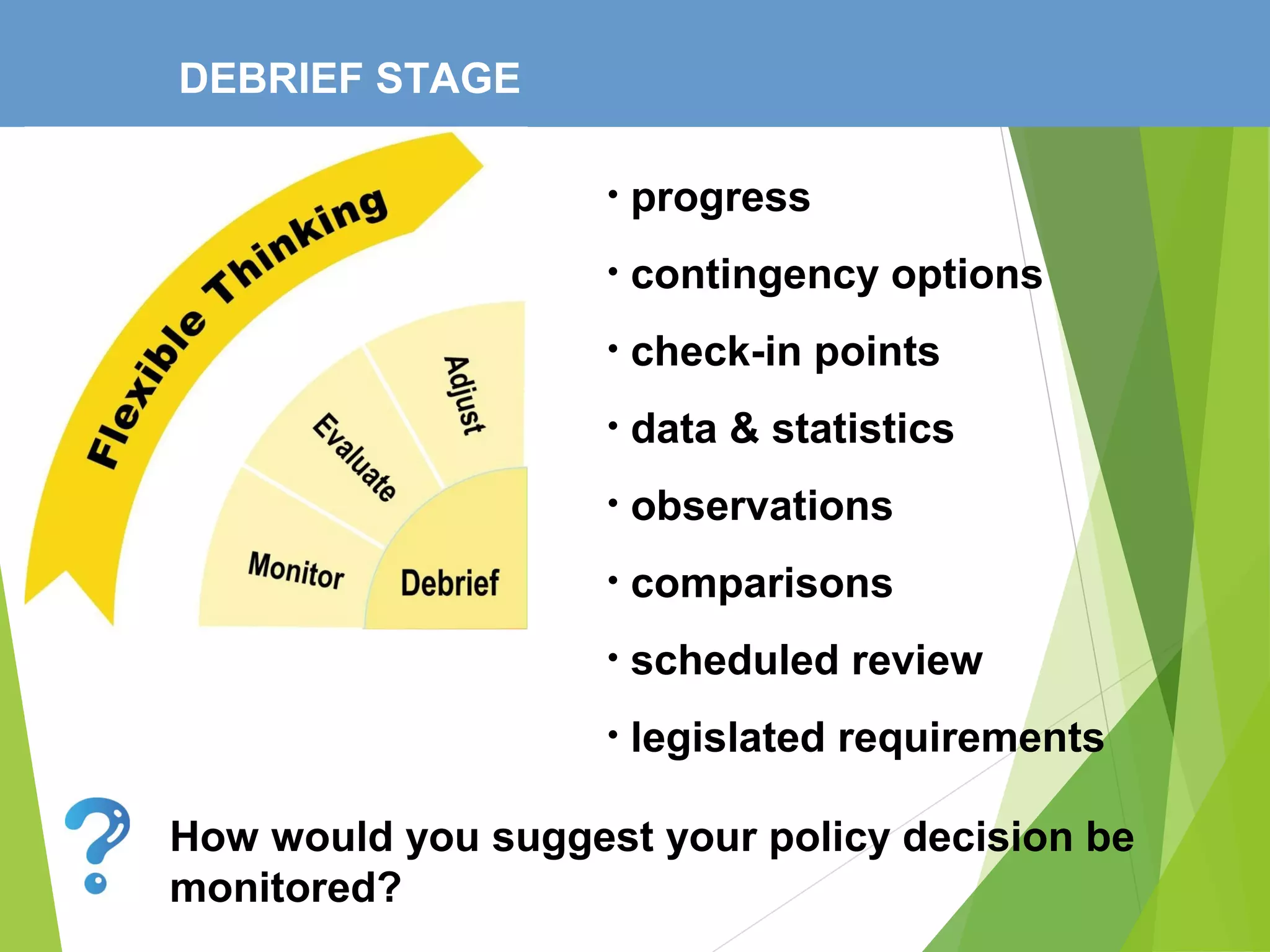
DEBRIEF STAGE
• progress
• contingency options
• check-in points
• data & statistics
• observations
• comparisons
• scheduled review
• legislated requirements
How would you suggest your policy decision be
monitored?
SUMMARY
What are some key ideas you gained from this
session?
How will you apply one of these ideas in your
community?
What is one pitfall you would like your local
government to avoid in the policy making process?

Policy Making Process

  • 1.
  • 2.
    HOW TO’S OF POLICYMAKING OVERVIEW DEFINING POLICY • TYPES • APPLICATIONS IMPLEMENTING POLICY • COMMUNICATION • EVALUATION DEVELOPING POLICY • PROCESS • FACT- BASED POLICY DECISIONS • REOMMENDATIONS • DEBATE
  • 3.
    COMPETENCIES • Understands legislativepowers • Communicates effectively • Approaches problems creatively • Assumes oversight role
  • 4.
  • 5.
    WHAT IS POLICY? •statement of intentions to guide decision-making • translates vision to action • a functional framework for staff actions • regulates how citizens live in a community
  • 6.
    POLICY TERMS • Policychallenge – issue or problem • Policy result – desired outcome • Policy options – strategic alternatives • Policy actions – implementation steps
  • 7.
    POLICY DEFINITIONS • Policyanalysts – staff • Policy makers – elected officials • Policy process – issues, outcome, alternatives & actions • Formal policy – public document • Informal policy – inaction creating precedent
  • 8.
    GOOD POLICY • Beneficialto public respecting individual rights • Consistent with legislative authority • Reflects community vision • Well informed • Within the organization’s resource capacity • Easy to interpret • Adaptive
  • 9.
    WHY POLICY? • legislatedrequirement for elected officials • framework for goal setting • guides program design & service delivery • rules and regulations for decisions • principles that guide day-today actions
  • 10.
    POLICY CATEGORIES • governingpolicies • operational policies • administrative policies What are some examples from your organization within these categories?
  • 11.
    BYLAW, POLICY orPROCEDURE? Can you think of some examples from your organization to add to these categories? Bylaw Policy Procedure Fees & Charges Bylaw Facility Use Policy Fee Collection Steps Green Space Bylaw Park Reserve Park Maintenance Standard Zoning Bylaw Application Process Application Checklist Annual Budget Reporting Schedule Report format Joint Use Agreement Scheduling process Cleaning Schedule
  • 12.
    MAJOR APPLICATIONS • landuse • service delivery • funding • administration
  • 13.
    GOOD POLICY ACTIVITY Purpose– to recognize the elements of good policy making 1. Select facilitator, recorder, timekeeper and presenter 2. Review policy checklist – make additions 3. Agree on 3 items critical to policy success 4. Share policies that fell short 5. Share policies that excel 6. Present one example to plenary
  • 14.
  • 15.
  • 16.
    INFORMED DECISION MAKING •fact based • informs rather than directs policy decisions • inquiring minds want to know • decisions based on evidence not emotion • objective not subjective • supports transparency
  • 17.
    TYPES OF ISSUES RoutinePolicy Challenge • not new • solutions known • policy options clear Complex Policy Challenge • new, solutions are not clear • unexplored policy options • uncertain policy actions
  • 18.
    DISCOVER STAGE • definingthe problem • validity of facts • more than one problem? • what questions need asking? • existing information • research • best practices Results in a key question
  • 19.
    POLICY BRIEFING Issue Relatedproblems Background Data, feedback Policy Challenge Key question that guides policy inquiry Stakeholders Affected parties or those to involve Expectations Measureable outcomes, impact Policy Result Key outcome Alternatives Ways to achieve policy result Policy Option Best alternative to address issue Policy Actions Implementation steps, milestones Resources Fiscal, human & support required Why is it helpful to have a standard format?
  • 20.
    POLICY DEFINITION ACTIVITY Purpose– to develop a real life policy recommendation beginning by identifying the policy issue or problem 1. Select facilitator, recorder, timekeeper and presenter 2. Discuss policy issues you are facing 3. Agree on one to use as a group 4. Identify info available to you (policy briefing worksheet) 5. Identify possible questions 6. Choose one key question
  • 21.
    POLICY RESULTS Subjective expectations– observable Objective expectations – measureable Input from citizens – property owners & residents Input from agencies – non profit, private, gov’t Indirect input – questionnaire, comment card Direct input – advisory committee, public hearing
  • 22.
    POLICY RESULTS ACTIVITY Purpose– key result if the policy issue is addressed 1. Select facilitator, recorder, timekeeper and presenter 2. Determine stakeholders 3. List observable and measureable expectations 4. Determine key result 5. Debrief questions in workbook
  • 23.
    IS A POLICYNEEDED? • to comply with legislation • to establish consistent treatment • to guide repeat situations • to establish standards & regulations • to protect the municipality legally • if employee actions indicate confusion Can you think of an example when policy was not needed for an issue facing Council?
  • 24.
    DEVELOP STAGE • seeingpossibilities • analyzing options • best practices • contrary views • innovative ideas • mandate & success & effort • pros & cons, best/worst, rating Results in a preferred option
  • 25.
    PRACTICALITY CHECKLIST Can youthink of other practical considerations to evaluate policy alternatives? Options Analysis Criteria Likely Medium Unlikely 1. Legislative Ease Yes Maybe No 2. Existing Policy Consistency Yes Maybe No 3. Existing Contract Ease Yes Maybe No 4. Political Will to Proceed High Neutral Uncertai n 5. Human Capacity to Implement High Medium Low
  • 26.
    POLICY RESULTS ACTIVITY Purpose– to generate possibilities & alternatives for resolving the policy issue 1. Select facilitator, recorder, timekeeper and presenter 2. Determine stakeholders 3. List observable and measureable expectations 4. Determine key result 5. Debrief questions in workbook
  • 27.
    DELIVER STAGE • planto implement best option • sequenced actions • responsibilities • timeline • resources • expenses • revenue • start-up costs Results in a policy action plan
  • 28.
    POLICY ACTIONS ACTIVITY Purpose– to identify actions, timelines and resources to implement the policy recommendation 1. Select facilitator, recorder, timekeeper and presenter 2. Identify required actions to implement the preferred option 3. Sequence the actions using a timeline 4. Assign positions to tasks 5. Identify resources 6. Debrief questions in workbook
  • 29.
    POLICY RECOMMENDATIONS Policy Briefing •facts & comparative information • prepared for Council discussion & debate Policy Format • policy recommendation • prepared for Council debate & approval Can you recall a time when staff prepared information that was not what Council was looking for?
  • 30.
    POLICY FORMAT Municipal LogoType of Policy Policy # Approved by: Effective date: Department: Policy Title Purpose of Policy •Describes the issue the policy is meant to address •Describes the desired policy result and outcomes Definitions •Defines terms included in the policy •Provides clarity & consistent understanding Policy Statement •Reflects relevance to organization’s broad vision •Cites relevant laws, regulations or codes Policy Content •Conditions, principles and applications •Who will administer the policy Related Documents •Linked or superseding policies •Reference to implementation procedures Appendices •Related information leading to the policy •Related information for implementing the policy Approval Date: Date of resolution by Council
  • 31.
    POLICY RECOMMENDATION ACTIVITY Purpose– to review a policy recommendation to ensure support from Council 1. Select facilitator, recorder, timekeeper and presenter 2. Review Policy Briefing info & determine final recommendation 3. What factors affect the recommendation? 4. How will you address these factors? 5. What information needs to be presented to Council? 6. Debrief
  • 32.
  • 33.
    MAKING DECISIONS CONSENSUS INFORMED DECISION SIMPLE MAJORITY IMPOSED AGREEMENT Consensus– working through views until agreement among all Informed – analyze options through respectful discussion Majority – voting by those who have authority to vote Imposed – decision by one with authority
  • 34.
    INFORMED DECISION MAKING •adequate information • good debate • factual information and data • forecasts and trends • perceptions from various interests • justification and further analysis
  • 35.
    TYPES OF DECISIONS RoutineProblem and solution are well know Minimal criteria and options necessary Yes/No Choice to be made among alternatives Focused on debate Best Choice Assessment of various complex alternatives Information & debate required Possibilities? Problem & solution are not known Information & debate required What are some examples for each decision type in your community?
  • 36.
    POLICY CONSEQUENCES Predictable Enoughinformation to predict outcome Dependent Different viewpoints that need comparison Risky Possible or unknown negative consequences What are some examples of different policy consequences you have experienced?
  • 37.
    GODD DEBATE • differsfrom discussion • good debate intended to result in a decision • formal process that occurs in public • yes – agree with recommendations • no – turn down recommendation • refer or defer – more information required
  • 38.
    DEBATE ACTIVITY Purpose –to discuss reasons policy debate might derail 1. Select facilitator, recorder, timekeeper and presenter 2. Brainstorm factors that derail policy debate. Choose two 3. As Mayor, how would you deal with these? 4. As Councillor, how could you prevent these from occurring? 5. Report back to plenary 6. Debrief
  • 39.
    PRINCIPLES OF GOODDEBATE • know what you’re talking about • use logic to present your side • be accurate, rely on facts • be professional in your conduct • use supportive language • avoid exaggeration • follow protocols, points of order • keep your perspective
  • 40.
  • 41.
    IMPLEMENTATION FACTORS Capacity toimplement the decision • staff time • fiscal resources • expertise Unforeseen conditions • community acceptance • political will • legal capacity
  • 42.
    UNINTENDED CONSEQUENCES Tradeoffs • negativeimpact exceeds benefits Social Impact • causes people to react in a negative way Resource Leveraging • diminishes service or capacity Can you think when a policy resulted in unforeseen resource issues, negative conditions or unintended consequences?
  • 43.
    UNINTENDED CONSEQUENCES ACTIVITY Purpose– to recognize, prevent or correct the impact of unintended policy consequences 1. Select facilitator, recorder, timekeeper and presenter 2. Identify inadequate resources, unfavorable conditions and/or unintended consequences that may arise from your recommendation. Agree on 5 to examine further. 3. How could you have prevented this in the policy definition, development and decision stages? 4. Is there an opportunity to correct in the debrief or evaluation stage?
  • 44.
    COMMUNICATING POLICY DECISIONS Explain •describe the policy process, outcome & action • gains credibility Acknowledge • anticipate concerns & have answers • phase in actions, monitor & evaluate Champion • stress benefits
  • 45.
    COMMUNICATION MEDIUMS Public Media •radio, newspapers, television Target Mediums • website blogs, give-aways, outreach programs Informal Methods • coffee shop conversation, trade show booth How would you communicate your policy decision?
  • 46.
    DEBRIEF STAGE • progress •contingency options • check-in points • data & statistics • observations • comparisons • scheduled review • legislated requirements How would you suggest your policy decision be monitored?
  • 47.
    SUMMARY What are somekey ideas you gained from this session? How will you apply one of these ideas in your community? What is one pitfall you would like your local government to avoid in the policy making process?