Food Stamp Expansion
TheSupplemental Nutrition
Assistance Program (SNAP)
America’s fastest growing welfare
program.
2010, only 17 million people received
food stamps.
Today over 50 million people do so.
This “non-incremental” growth in a
federal program challenges the notion
that
public policies change slowly.
(StockAB/Alamy)
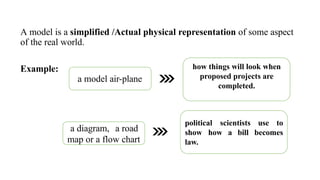
A model isa simplified /Actual physical representation of some aspect
of the real world.
Example:
a model air-plane
how things will look when
proposed projects are
completed.
a diagram, a road
map or a flow chart
political scientists use to
show how a bill becomes
law.
Conceptual Models inPolicy Studies:
•Word-based models that simplify and clarify thinking about politics and
public policy.
Functions of Conceptual Models:
•Identify important aspects of policy problems.
•Facilitate communication by focusing on essential features of political
life.
•Guide understanding by highlighting what is important vs. unimportant.
•Suggest explanations for public policy.
•Predict consequences of policy decisions.
Problem Identification
Agenda Setting
PolicyFormulation
Policy Legitimation
Policy Implementation
Policy Evaluation
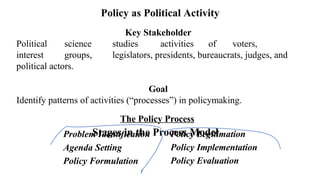
Key Stakeholder
Political science studies activities of voters,
interest groups, legislators, presidents, bureaucrats, judges, and
political actors.
Goal
Identify patterns of activities (“processes”) in policymaking.
The Policy Process
Stages in the Process Model
Policy as Political Activity
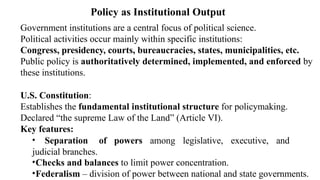
Government institutions area central focus of political science.
Political activities occur mainly within specific institutions:
Congress, presidency, courts, bureaucracies, states, municipalities, etc.
Public policy is authoritatively determined, implemented, and enforced by
these institutions.
U.S. Constitution:
Establishes the fundamental institutional structure for policymaking.
Declared “the supreme Law of the Land” (Article VI).
Key features:
• Separation of powers among legislative, executive, and
judicial branches.
•Checks and balances to limit power concentration.
•Federalism – division of power between national and state governments.
Policy as Institutional Output
13.
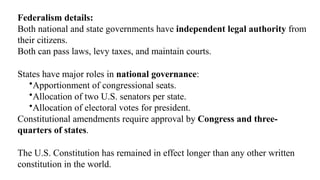
Federalism details:
Both nationaland state governments have independent legal authority from
their citizens.
Both can pass laws, levy taxes, and maintain courts.
States have major roles in national governance:
•Apportionment of congressional seats.
•Allocation of two U.S. senators per state.
•Allocation of electoral votes for president.
Constitutional amendments require approval by Congress and three-
quarters of states.
The U.S. Constitution has remained in effect longer than any other written
constitution in the world.
14.
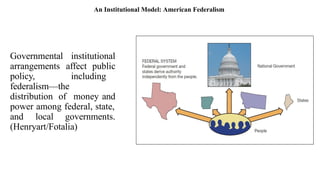
Governmental institutional
arrangements affectpublic
policy, including
federalism—the
distribution of money and
power among federal, state,
and local governments.
(Henryart/Fotalia)
An Institutional Model: American Federalism
A policy asrational when it achieves maximum social gain, it provides
the greatest net benefit.
Key guidelines are:
1.Avoid policies where costs exceed benefits.
2.Choose the option with the highest benefit–cost difference.
Rational policymaking requires:
•Full knowledge of societal values and their relative importance.
•Complete awareness of all policy alternatives.
•Accurate prediction of consequences.
•Correct calculation of benefit–cost ratios.
•A decision-making system that supports rationality.
Policy as Maximum Social Gain
17.
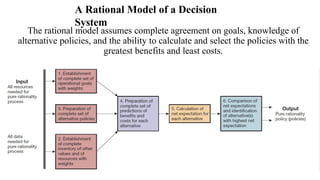
A Rational Modelof a Decision
System
The rational model assumes complete agreement on goals, knowledge of
alternative policies, and the ability to calculate and select the policies with the
greatest benefits and least costs.
Definition:
Incrementalism views publicpolicy as small, gradual modifications of
past government activities rather than radical changes.
Origin:
Introduced by political scientist Charles E. Lindblom
Key Idea:
Policymakers do not review all possible policies comprehensively each
time. they make decisions based on adjustments to existing policies.
Policy as Variations on the Past
20.
Reasons for Incrementalism:
Lackof time, information, and money to explore all alternatives.
Difficulty in predicting consequences of all alternatives.
Inability to accurately calculate cost-benefit ratios across diverse
values
Limitation:
Incrementalism may fail in crisis situations requiring rapid, large-scale policy
changes.
Example
During the 2008 financial crisis, government action broke from incrementalism
with unprecedented federal intervention, large spending, and new authority
granted to agencies.
21.
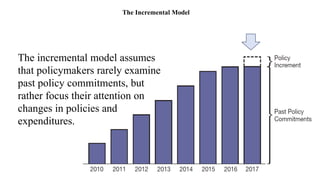
The Incremental Model
Theincremental model assumes
that policymakers rarely examine
past policy commitments, but
rather focus their attention on
changes in policies and
expenditures.
Core Proposition:
Politics centerson the interaction and struggle among groups, rather than
individuals acting alone.
Interest Groups:
An interest group becomes political when it attempts to influence
government policy.
Role of Individuals:
Individuals matter politically only when acting as part of or on behalf of
groups.
Policy as Equilibrium:
Public policy reflects the balance of power among interest groups at a
given time.
Policy shifts when the influence of groups changes.
Policy as Equilibrium in the Group Struggle
24.
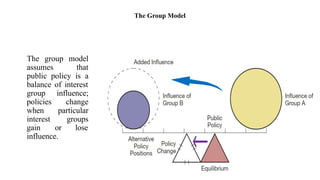
The Group Model
Thegroup model
assumes that
public policy is a
balance of interest
group
policies
when
interest
influence;
change
particular
groups
gain or lose
influence.
Core Ideas:
Power Distribution
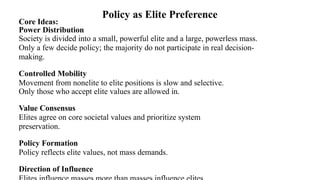
Societyis divided into a small, powerful elite and a large, powerless mass.
Only a few decide policy; the majority do not participate in real decision-
making.
Controlled Mobility
Movement from nonelite to elite positions is slow and selective.
Only those who accept elite values are allowed in.
Value Consensus
Elites agree on core societal values and prioritize system
preservation.
Policy Formation
Policy reflects elite values, not mass demands.
Direction of Influence
Policy as Elite Preference
27.
Implications forPolicy
Analysis Mass opinion is
secondary Change is cautious and
gradual Stability is prioritized
Possible public-mindedness
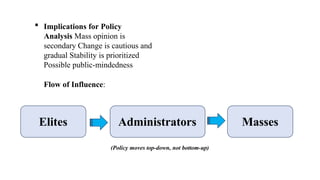
Flow of Influence:
Elites Administrators Masses
(Policy moves top-down, not bottom-up)
28.
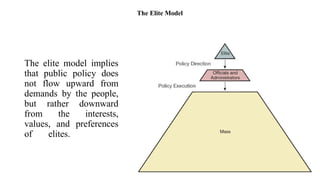
The Elite Model
Theelite model implies
that public policy does
not flow upward from
demands by the people,
but rather downward
from the interests,
values, and preferences
of elites.
Core Ideas:
Origins &Foundations
• Combines economics and political science into the study of public policy making.
• Challenges the traditional assumption that:
• Homo economicus → acts in self-interest in the market.
• Homo politics → acts in public interest in politics.
• all political actors behave like market actors—seeking to maximize personal benefits.
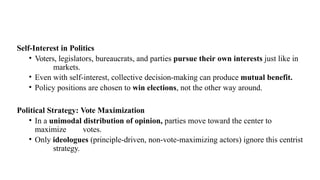
Policy as Collective Decision Making
by Self-Interested Individuals
31.
Self-Interest in Politics
•Voters, legislators, bureaucrats, and parties pursue their own interests just like in
markets.
• Even with self-interest, collective decision-making can produce mutual benefit.
• Policy positions are chosen to win elections, not the other way around.
Political Strategy: Vote Maximization
• In a unimodal distribution of opinion, parties move toward the center to
maximize votes.
• Only ideologues (principle-driven, non-vote-maximizing actors) ignore this centrist
strategy.
32.
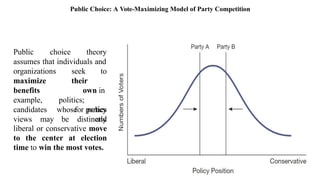
Public Choice: AVote-Maximizing Model of Party Competition
Public choice theory
assumes that individuals and
organizations
maximize
seek to
their
own in
politics;
for parties
and
benefits
example,
candidates whose policy
views may be distinctly
liberal or conservative move
to the center at election
time to win the most votes.
Core Concepts:
Definition
• Thestudy of decisions in situations where two or more rational actors
make interdependent choices.
• Outcomes depend on both your own choices and the choices of others.
Players
• Can be individuals, groups, or even nations.
• Must have well-defined goals and the ability to act rationally.
Interdependence
• Each player’s best decision depends on what they expect the other(s) to do.
• Requires anticipating opponents’ strategies and adjusting accordingly.
Policy as Rational Choice in Competitive Situations
35.
Example:
The Game ofChicken
Scenario: Two drivers head toward each other; the one who swerves is
"chicken."
Strategic complexities:
• Players may value “honor” differently (some may prefer death to
dishonor).
• Bluffing can influence outcomes (e.g., acting drunk to appear
reckless).
• Incomplete information about the opponent’s true values makes
prediction harder.
36.
Key Insight forPolicy Analysis
Game theory emphasizes strategic interaction—policy decisions must
account for how other actors will react, not just your own preferences.
In diplomacy, military planning, and negotiations, anticipating
counter-moves and managing perceptions (credibility, signals,
bluffing) is as important as having strong capabilities.
37.
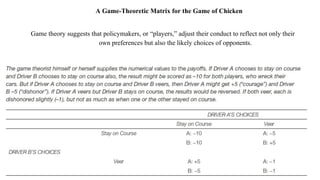
A Game-Theoretic Matrixfor the Game of Chicken
Game theory suggests that policymakers, or “players,” adjust their conduct to reflect not only their
own preferences but also the likely choices of opponents.
38.
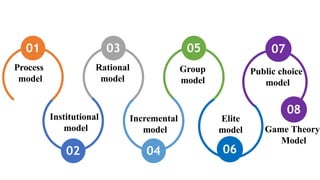
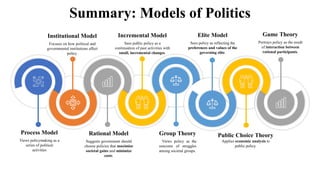
Process Model
Views policymakingas a
series of political
activities
Institutional Model
Focuses on how political and
governmental institutions affect
policy.
Rational Model
Suggests government should
choose policies that maximize
societal gains and minimize
costs.
Incremental Model
Sees public policy as a
continuation of past activities with
small, incremental changes.
Group Theory
Views policy as the
outcome of struggles
among societal groups.
Public Choice Theory
Applies economic analysis to
public policy.
Elite Model
Sees policy as reflecting the
preferences and values of the
governing elite.
Game Theory
Portrays policy as the result
of interaction between
rational participants.
Summary: Models of Politics