PUBLIC POLICY & PROGRAM
         ADMINISTRATION
              By:
   Engr. Rogelio D. Mercado
           DPA 204
What is Public Policy?
• Attempt by the government to address a public
  issue
• Principles & standards regarded by the
  legislature or by the courts as being of
  fundamental concern to the State & the whole
  society
• Course of action or inaction taken by
  governmental entities with regard to a particular
  issue or set of issues
Meaning of Public Policy
• System of courses of action, regulatory measures,
  laws, & funding priorities concerning a given
  topic promulgated by a governmental entity or its
  representatives
• Commonly embodied in constitutions, legislative
  acts and judicial decisions; may also be created
  by an executive order, bureaucratic regulation, or
  provincial/city/municipal/barangay ordinance
Meaning of Public Policy
• Also considered academic discipline as it is
  studied by professors & students at public
  policy schools of major universities
• Basically the legal framework within which
  society operates
• Composite of decisions that government
  makes & programs it embarks upon or
  implements to achieve goals
Meaning of Public Policy
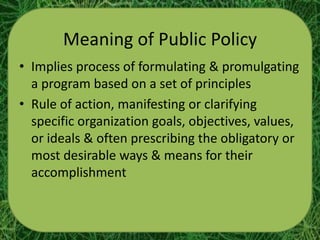
• Implies process of formulating & promulgating
  a program based on a set of principles
• Rule of action, manifesting or clarifying
  specific organization goals, objectives, values,
  or ideals & often prescribing the obligatory or
  most desirable ways & means for their
  accomplishment
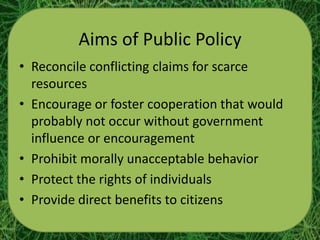
Aims of Public Policy
• Reconcile conflicting claims for scarce
  resources
• Encourage or foster cooperation that would
  probably not occur without government
  influence or encouragement
• Prohibit morally unacceptable behavior
• Protect the rights of individuals
• Provide direct benefits to citizens
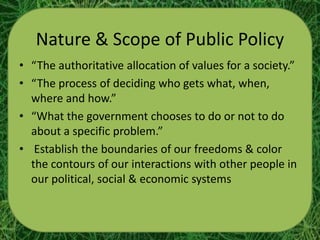
Nature & Scope of Public Policy
• “The authoritative allocation of values for a society.”
• “The process of deciding who gets what, when,
  where and how.”
• “What the government chooses to do or not to do
  about a specific problem.”
• Establish the boundaries of our freedoms & color
  the contours of our interactions with other people in
  our political, social & economic systems
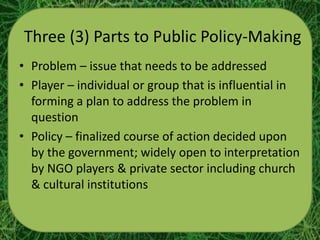
Three (3) Parts to Public Policy-Making
• Problem – issue that needs to be addressed
• Player – individual or group that is influential in
  forming a plan to address the problem in
  question
• Policy – finalized course of action decided upon
  by the government; widely open to interpretation
  by NGO players & private sector including church
  & cultural institutions
Shaping Public Policy
• Complex & multifaceted process
• Interplay of individuals & groups (interest)
  competing/collaborating to influence policy
  makers
• Variety of tools/tactics used to advance aims
• Advocating positions publicly – educating
  supporters/opponents, mobilizing allies
Advocacy
• Attempt to influence public policy thru
  education, lobbying or political pressure
• Educate general public/policy makers re:
  nature of problems, needed legislation &
  funding required for services/research
• Regarded as unseemly but it can clearly
  influence public policy priorities
Guidance for Policy Makers
             (Core Principles)
• Politicians & public servants are accountable
  to the public
• Elites, in politics & private sector, do not have
  the right to pursue their interests without
  constraints
• Government bureaucratic & decision
  processes must be open, accessible, &
  transparent, as well as responsive to public
Guidance to Policy Makers
• Individuals & communities affected by
  projects have the right to information
  regarding proposed developments; the
  right to challenge the need for, and the
  design of, projects, and the right to be
  involved in planning and decision-making
  processes.
Rational Model of Public
          Policy Making Process
• Agenda setting – agencies & government
  officials meet to discuss the problem at hand
• Option-formulation – alternative solutions are
  considered & final decisions are made
  regarding the best policy
• Implementation – the decided policy is
  enforced
Stages in the Policy Process
         (John W. Kingdom, 1984)
•   Agenda setting
•   Policy recognition
•   Policy generation
•   Political action
•   Policy formulation
•   Policy implementation
Agenda Setting
• Certain problems are viewed as needing action while
  others are postponed; competing claims &
  prioritization gain or decline in prominence over time
• Many people contribute – president, members of
  congress, executive branch officials, political parties,
  interest groups, media & the general public – in
  shaping public opinion
Agenda Setting
• From many & competing claims, policy
  makers select issues to be given priority
  & those to be filtered out
• Confluence of 3 streams of events: policy
  recognition, policy generation, & political
  action
Policy Recognition
• Certain topics emerge as significant issues that demand
  action due to many influences such as indicators that
  come to public view, feedback on current programs, or
  events that demand attention
• Policy entrepreneurs invest personal time, energy, &
  often money to pursue policy changes by using
  publicity campaigns, direct contacts with decision
  makers (letters, phone calls) petition drives, etc. Or
  involve themselves in media, political parties, or
  interest groups, that provide access to decision makers
Policy Generation
• May occur almost simultaneously with policy
  recognition; likely that many are trying to
  generate solutions to the problem
• Ideas come from decision makers themselves,
  members of their staff, experts in the
  bureaucracy, members of the scientific
  community, policy think tanks, or from the
  general public
Policy Generation
• Proposed solutions swirl around through
  speeches & articles, papers, & conversations
  until a few ideas begin to gain special currency
• Ideas generated not only seem to correctly
  address the problem but seem also to be
  politically acceptable.
Political Action
• To reach the top of policy agenda, proposal
  must be consistent with emerging political
  realities
   – Consistent with prevailing political climate
   – Favored by incumbent administration &
     legislative majority
   – Support of interest groups
Policy Formulation
• Development of formal policy statements
  (legislation, executive orders, administrative
  rules, etc.) that are viewed as legitimate
• Procedure in legislation: a bill is introduced &
  referred to a committee ( & perhaps a sub-
  committee), hearings are held, the committee
  reports to the larger body, a vote is taken in both
  houses, a conference committee works out
  differences in the 2 versions, & the bill is sent to
  the chief executive for his signature
Policy Formulation
• President has formal & informal means of
  influencing legislation thru program initiatives
  & budget proposals
• Other government officials interact with
  Congress on a regular basis & may also affect
  policy outcomes
• Individual citizens & interest groups also seek
  access & influence
Policy Formulation
• Government agencies usually send program
  proposals to the legislature for its
  consideration
• Agency personnel are often called upon to
  provide testimony regarding particular
  proposals due to their expertise on public
  issues
Policy Formulation
• When relationship among interest
  groups, agency personnel, & members of
  Congress become strong, frequent &
  intense, the resulting alliance is called
  sub-governments or iron triangles that
  often exert great influence
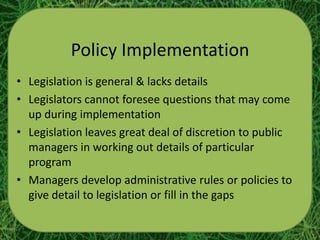
Policy Implementation
• Legislation is general & lacks details
• Legislators cannot foresee questions that may come
  up during implementation
• Legislation leaves great deal of discretion to public
  managers in working out details of particular
  program
• Managers develop administrative rules or policies to
  give detail to legislation or fill in the gaps
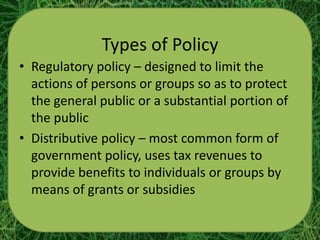
Types of Policy
• Regulatory policy – designed to limit the
  actions of persons or groups so as to protect
  the general public or a substantial portion of
  the public
• Distributive policy – most common form of
  government policy, uses tax revenues to
  provide benefits to individuals or groups by
  means of grants or subsidies
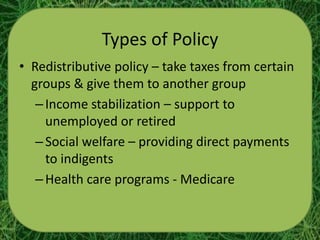
Types of Policy
• Redistributive policy – take taxes from certain
  groups & give them to another group
   – Income stabilization – support to
     unemployed or retired
   – Social welfare – providing direct payments
     to indigents
   – Health care programs - Medicare
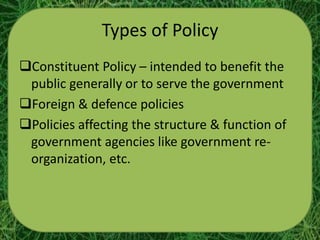
Types of Policy
Constituent Policy – intended to benefit the
 public generally or to serve the government
Foreign & defence policies
Policies affecting the structure & function of
 government agencies like government re-
 organization, etc.
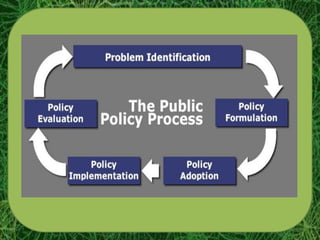
Steps in Making Public Policies
               (Roy Sylvan)
• Identify problem that needs improvement or
  solution
• Develop alternative solutions that can improve or
  solve the problem
• Adopt an alternative or combination of alternatives
• Implement the adopted policy
• Evaluate the effect of the policy on the problem it
  addresses & on the people affected
Steps in Passage of Bill in Philippine
               Legislature
• 1st reading – principal author may propose additional
  authors; contains title, number & names of authors
• Bill referred to appropriate committee for study; if
  disapproved by committee, dies
• 2nd reading – after favorable committee evaluation,
  bill forwarded to Committee on Rules for calendar;
  read for 2nd time in entirety
Steps in Philippine Legislature
• Debates – general debate & amendments
  proposed in accordance with rules
• Printing & distribution – after approval on 2nd
  reading, bill printed in final form & distributed
  to members 3 days before passage
• 3rd reading – last reading where only title is
  read; no amendment allowed & votes (yeas &
  nays) entered in journal; member may
  abstain; majority of quorum can pass bill
Steps in Philippine Legislature
• Bill referred to other house – same procedure
• Bill forwarded to President – if approved on 3rd
  reading by both houses, bill printed in final form &
  transmitted to the President for appropriate action;
  no action within 30 days means the bill becomes law;
  bills re-passed over veto automatically becomes
  law.
Local Legislative Body (Sanggunian)
              Critical Tasks
• Formulating & managing the legislative
  agenda
• Crafting ordinances & resolutions
• Enacting ordinances & codes of ordinances
• Evaluating the implementation of ordinances
Crafting Ordinances & Resolutions
• Identifying & analyzing a policy problem to be
  addressed by legislation
• Gathering research-based information
• Drafting the legislative proposal – requires
  knowledge of its parts or elements, rules of
  construction such as grammar & usage, form
  & style; civil society groups can influence this
  cycle by drafting proposals & giving them to
  legislators
Enactment of Legislation
•   Deliberation
•   Consultation
•   Codification
•   Consideration
Legislative Oversight
• Evaluation of how the policy
  was carried out; that funds
  were not wasted
Elements of Effective Local Legislation

• Efficient institution or organization
• Participatory legislation process
• Development perspective; addresses
  development objectives: poverty reduction,
  environmental protection, gender equality,
  peace & unity, accountability & transparency,
  citizen participation
Citizen Participation
• Awareness-raising on areas & mechanisms for
  participation
• Making existing legislative mechanisms for
  participation work
• Developing innovative tools to encourage &
  sustain participation in legislative decision
  making
Mechanisms for Legislative
            Participation
• Committee meetings
• Committee hearings
• Legislative agenda formulation – public
  consultations & workshop
• Budget hearings
• Accreditation (research, writing, information)
Methods to Solicit Input
           /Comment from Public
•   Public hearing
•   Public consultation
•   Focus group discussion
•   Community needs assessment survey
•   Consultation by individual legislators
Tools To Reach Out Public
•   Legislative digest
•   Sanggunian brochure
•   Media tools
•   Website
•   Letters to constituents
•   Barangay or purok hopping
•   Study visits for students

Public Policy & Program Administration

  • 1.
    PUBLIC POLICY &PROGRAM ADMINISTRATION By: Engr. Rogelio D. Mercado DPA 204
  • 2.
    What is PublicPolicy? • Attempt by the government to address a public issue • Principles & standards regarded by the legislature or by the courts as being of fundamental concern to the State & the whole society • Course of action or inaction taken by governmental entities with regard to a particular issue or set of issues
  • 3.
    Meaning of PublicPolicy • System of courses of action, regulatory measures, laws, & funding priorities concerning a given topic promulgated by a governmental entity or its representatives • Commonly embodied in constitutions, legislative acts and judicial decisions; may also be created by an executive order, bureaucratic regulation, or provincial/city/municipal/barangay ordinance
  • 4.
    Meaning of PublicPolicy • Also considered academic discipline as it is studied by professors & students at public policy schools of major universities • Basically the legal framework within which society operates • Composite of decisions that government makes & programs it embarks upon or implements to achieve goals
  • 5.
    Meaning of PublicPolicy • Implies process of formulating & promulgating a program based on a set of principles • Rule of action, manifesting or clarifying specific organization goals, objectives, values, or ideals & often prescribing the obligatory or most desirable ways & means for their accomplishment
  • 6.
    Aims of PublicPolicy • Reconcile conflicting claims for scarce resources • Encourage or foster cooperation that would probably not occur without government influence or encouragement • Prohibit morally unacceptable behavior • Protect the rights of individuals • Provide direct benefits to citizens
  • 7.
    Nature & Scopeof Public Policy • “The authoritative allocation of values for a society.” • “The process of deciding who gets what, when, where and how.” • “What the government chooses to do or not to do about a specific problem.” • Establish the boundaries of our freedoms & color the contours of our interactions with other people in our political, social & economic systems
  • 8.
    Three (3) Partsto Public Policy-Making • Problem – issue that needs to be addressed • Player – individual or group that is influential in forming a plan to address the problem in question • Policy – finalized course of action decided upon by the government; widely open to interpretation by NGO players & private sector including church & cultural institutions
  • 9.
    Shaping Public Policy •Complex & multifaceted process • Interplay of individuals & groups (interest) competing/collaborating to influence policy makers • Variety of tools/tactics used to advance aims • Advocating positions publicly – educating supporters/opponents, mobilizing allies
  • 10.
    Advocacy • Attempt toinfluence public policy thru education, lobbying or political pressure • Educate general public/policy makers re: nature of problems, needed legislation & funding required for services/research • Regarded as unseemly but it can clearly influence public policy priorities
  • 11.
    Guidance for PolicyMakers (Core Principles) • Politicians & public servants are accountable to the public • Elites, in politics & private sector, do not have the right to pursue their interests without constraints • Government bureaucratic & decision processes must be open, accessible, & transparent, as well as responsive to public
  • 12.
    Guidance to PolicyMakers • Individuals & communities affected by projects have the right to information regarding proposed developments; the right to challenge the need for, and the design of, projects, and the right to be involved in planning and decision-making processes.
  • 13.
    Rational Model ofPublic Policy Making Process • Agenda setting – agencies & government officials meet to discuss the problem at hand • Option-formulation – alternative solutions are considered & final decisions are made regarding the best policy • Implementation – the decided policy is enforced
  • 14.
    Stages in thePolicy Process (John W. Kingdom, 1984) • Agenda setting • Policy recognition • Policy generation • Political action • Policy formulation • Policy implementation
  • 15.
    Agenda Setting • Certainproblems are viewed as needing action while others are postponed; competing claims & prioritization gain or decline in prominence over time • Many people contribute – president, members of congress, executive branch officials, political parties, interest groups, media & the general public – in shaping public opinion
  • 16.
    Agenda Setting • Frommany & competing claims, policy makers select issues to be given priority & those to be filtered out • Confluence of 3 streams of events: policy recognition, policy generation, & political action
  • 17.
    Policy Recognition • Certaintopics emerge as significant issues that demand action due to many influences such as indicators that come to public view, feedback on current programs, or events that demand attention • Policy entrepreneurs invest personal time, energy, & often money to pursue policy changes by using publicity campaigns, direct contacts with decision makers (letters, phone calls) petition drives, etc. Or involve themselves in media, political parties, or interest groups, that provide access to decision makers
  • 18.
    Policy Generation • Mayoccur almost simultaneously with policy recognition; likely that many are trying to generate solutions to the problem • Ideas come from decision makers themselves, members of their staff, experts in the bureaucracy, members of the scientific community, policy think tanks, or from the general public
  • 19.
    Policy Generation • Proposedsolutions swirl around through speeches & articles, papers, & conversations until a few ideas begin to gain special currency • Ideas generated not only seem to correctly address the problem but seem also to be politically acceptable.
  • 20.
    Political Action • Toreach the top of policy agenda, proposal must be consistent with emerging political realities – Consistent with prevailing political climate – Favored by incumbent administration & legislative majority – Support of interest groups
  • 21.
    Policy Formulation • Developmentof formal policy statements (legislation, executive orders, administrative rules, etc.) that are viewed as legitimate • Procedure in legislation: a bill is introduced & referred to a committee ( & perhaps a sub- committee), hearings are held, the committee reports to the larger body, a vote is taken in both houses, a conference committee works out differences in the 2 versions, & the bill is sent to the chief executive for his signature
  • 22.
    Policy Formulation • Presidenthas formal & informal means of influencing legislation thru program initiatives & budget proposals • Other government officials interact with Congress on a regular basis & may also affect policy outcomes • Individual citizens & interest groups also seek access & influence
  • 23.
    Policy Formulation • Governmentagencies usually send program proposals to the legislature for its consideration • Agency personnel are often called upon to provide testimony regarding particular proposals due to their expertise on public issues
  • 24.
    Policy Formulation • Whenrelationship among interest groups, agency personnel, & members of Congress become strong, frequent & intense, the resulting alliance is called sub-governments or iron triangles that often exert great influence
  • 25.
    Policy Implementation • Legislationis general & lacks details • Legislators cannot foresee questions that may come up during implementation • Legislation leaves great deal of discretion to public managers in working out details of particular program • Managers develop administrative rules or policies to give detail to legislation or fill in the gaps
  • 26.
    Types of Policy •Regulatory policy – designed to limit the actions of persons or groups so as to protect the general public or a substantial portion of the public • Distributive policy – most common form of government policy, uses tax revenues to provide benefits to individuals or groups by means of grants or subsidies
  • 27.
    Types of Policy •Redistributive policy – take taxes from certain groups & give them to another group – Income stabilization – support to unemployed or retired – Social welfare – providing direct payments to indigents – Health care programs - Medicare
  • 28.
    Types of Policy ConstituentPolicy – intended to benefit the public generally or to serve the government Foreign & defence policies Policies affecting the structure & function of government agencies like government re- organization, etc.
  • 29.
    Steps in MakingPublic Policies (Roy Sylvan) • Identify problem that needs improvement or solution • Develop alternative solutions that can improve or solve the problem • Adopt an alternative or combination of alternatives • Implement the adopted policy • Evaluate the effect of the policy on the problem it addresses & on the people affected
  • 31.
    Steps in Passageof Bill in Philippine Legislature • 1st reading – principal author may propose additional authors; contains title, number & names of authors • Bill referred to appropriate committee for study; if disapproved by committee, dies • 2nd reading – after favorable committee evaluation, bill forwarded to Committee on Rules for calendar; read for 2nd time in entirety
  • 32.
    Steps in PhilippineLegislature • Debates – general debate & amendments proposed in accordance with rules • Printing & distribution – after approval on 2nd reading, bill printed in final form & distributed to members 3 days before passage • 3rd reading – last reading where only title is read; no amendment allowed & votes (yeas & nays) entered in journal; member may abstain; majority of quorum can pass bill
  • 33.
    Steps in PhilippineLegislature • Bill referred to other house – same procedure • Bill forwarded to President – if approved on 3rd reading by both houses, bill printed in final form & transmitted to the President for appropriate action; no action within 30 days means the bill becomes law; bills re-passed over veto automatically becomes law.
  • 34.
    Local Legislative Body(Sanggunian) Critical Tasks • Formulating & managing the legislative agenda • Crafting ordinances & resolutions • Enacting ordinances & codes of ordinances • Evaluating the implementation of ordinances
  • 35.
    Crafting Ordinances &Resolutions • Identifying & analyzing a policy problem to be addressed by legislation • Gathering research-based information • Drafting the legislative proposal – requires knowledge of its parts or elements, rules of construction such as grammar & usage, form & style; civil society groups can influence this cycle by drafting proposals & giving them to legislators
  • 36.
    Enactment of Legislation • Deliberation • Consultation • Codification • Consideration
  • 37.
    Legislative Oversight • Evaluationof how the policy was carried out; that funds were not wasted
  • 38.
    Elements of EffectiveLocal Legislation • Efficient institution or organization • Participatory legislation process • Development perspective; addresses development objectives: poverty reduction, environmental protection, gender equality, peace & unity, accountability & transparency, citizen participation
  • 39.
    Citizen Participation • Awareness-raisingon areas & mechanisms for participation • Making existing legislative mechanisms for participation work • Developing innovative tools to encourage & sustain participation in legislative decision making
  • 40.
    Mechanisms for Legislative Participation • Committee meetings • Committee hearings • Legislative agenda formulation – public consultations & workshop • Budget hearings • Accreditation (research, writing, information)
  • 41.
    Methods to SolicitInput /Comment from Public • Public hearing • Public consultation • Focus group discussion • Community needs assessment survey • Consultation by individual legislators
  • 42.
    Tools To ReachOut Public • Legislative digest • Sanggunian brochure • Media tools • Website • Letters to constituents • Barangay or purok hopping • Study visits for students