Conceptual Clarification onStages
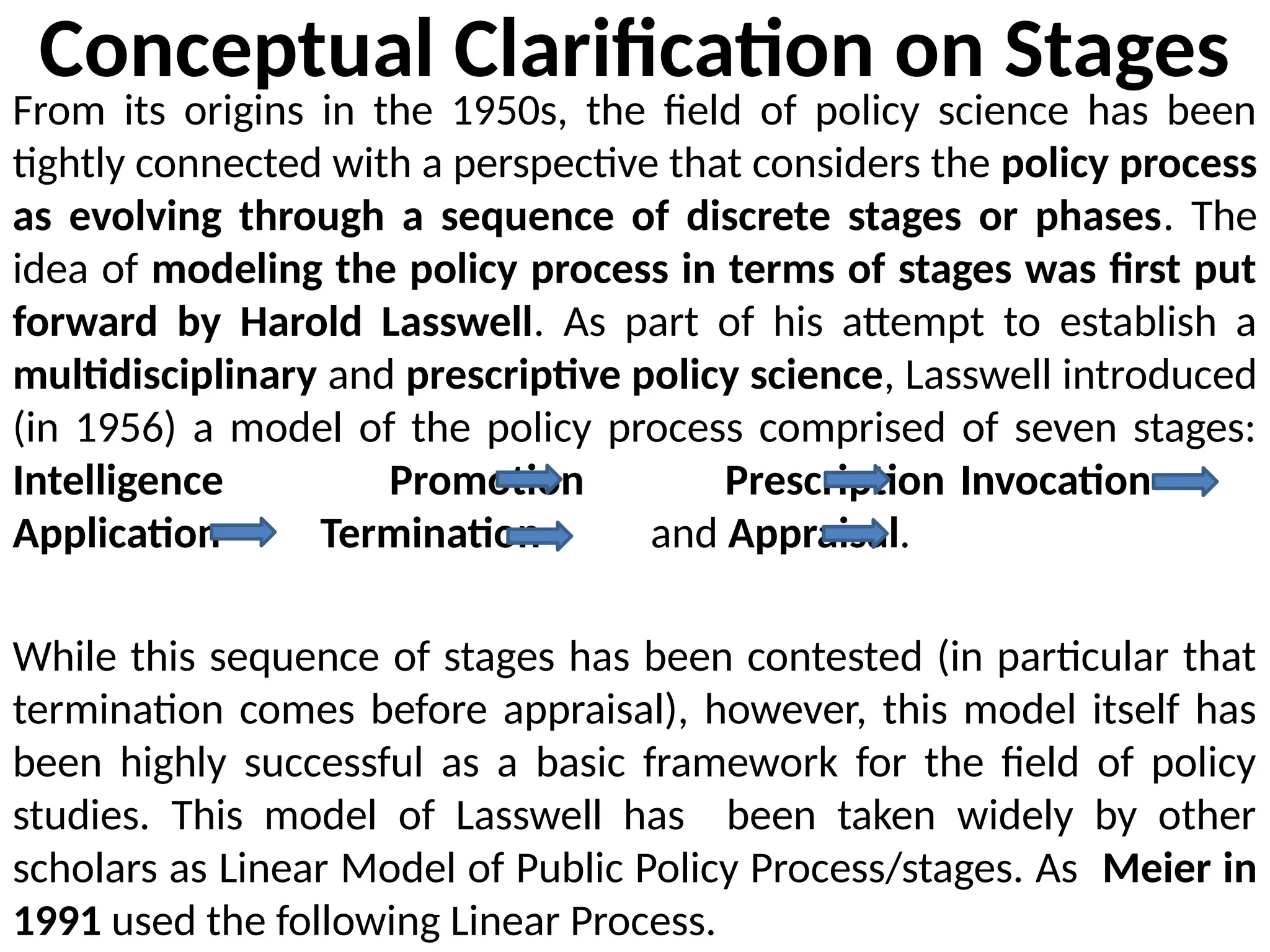
From its origins in the 1950s, the field of policy science has been
tightly connected with a perspective that considers the policy process
as evolving through a sequence of discrete stages or phases. The
idea of modeling the policy process in terms of stages was first put
forward by Harold Lasswell. As part of his attempt to establish a
multidisciplinary and prescriptive policy science, Lasswell introduced
(in 1956) a model of the policy process comprised of seven stages:
Intelligence Promotion Prescription Invocation
Application Termination and Appraisal.
While this sequence of stages has been contested (in particular that
termination comes before appraisal), however, this model itself has
been highly successful as a basic framework for the field of policy
studies. This model of Lasswell has been taken widely by other
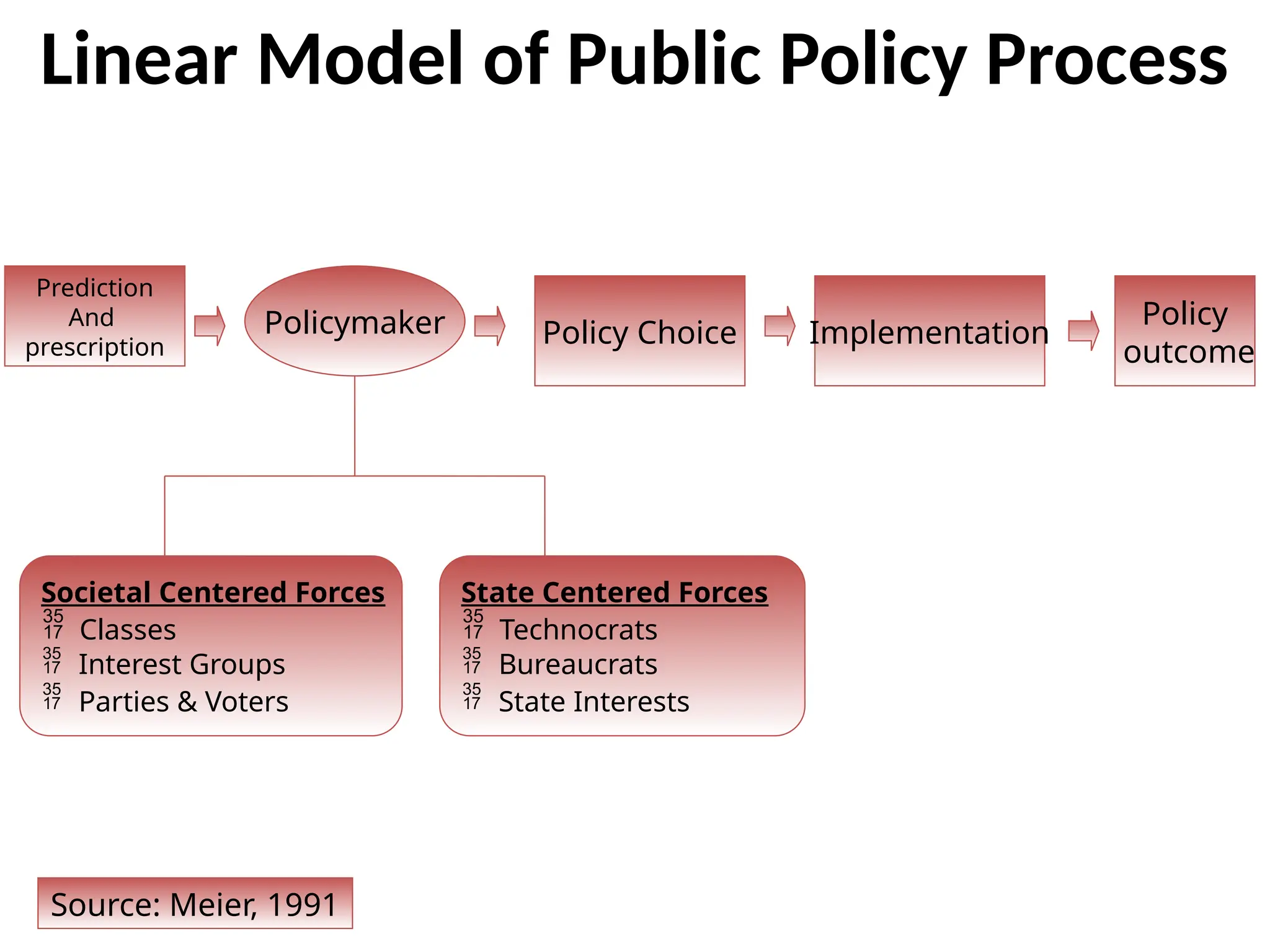
scholars as Linear Model of Public Policy Process/stages. As Meier in
1991 used the following Linear Process.
3.
Prediction
And
prescription
Policymaker Policy ChoiceImplementation
Policy
outcome
Societal Centered Forces
Classes
Interest Groups
Parties & Voters
State Centered Forces
Technocrats
Bureaucrats
State Interests
Source: Meier, 1991
Linear Model of Public Policy Process
4.
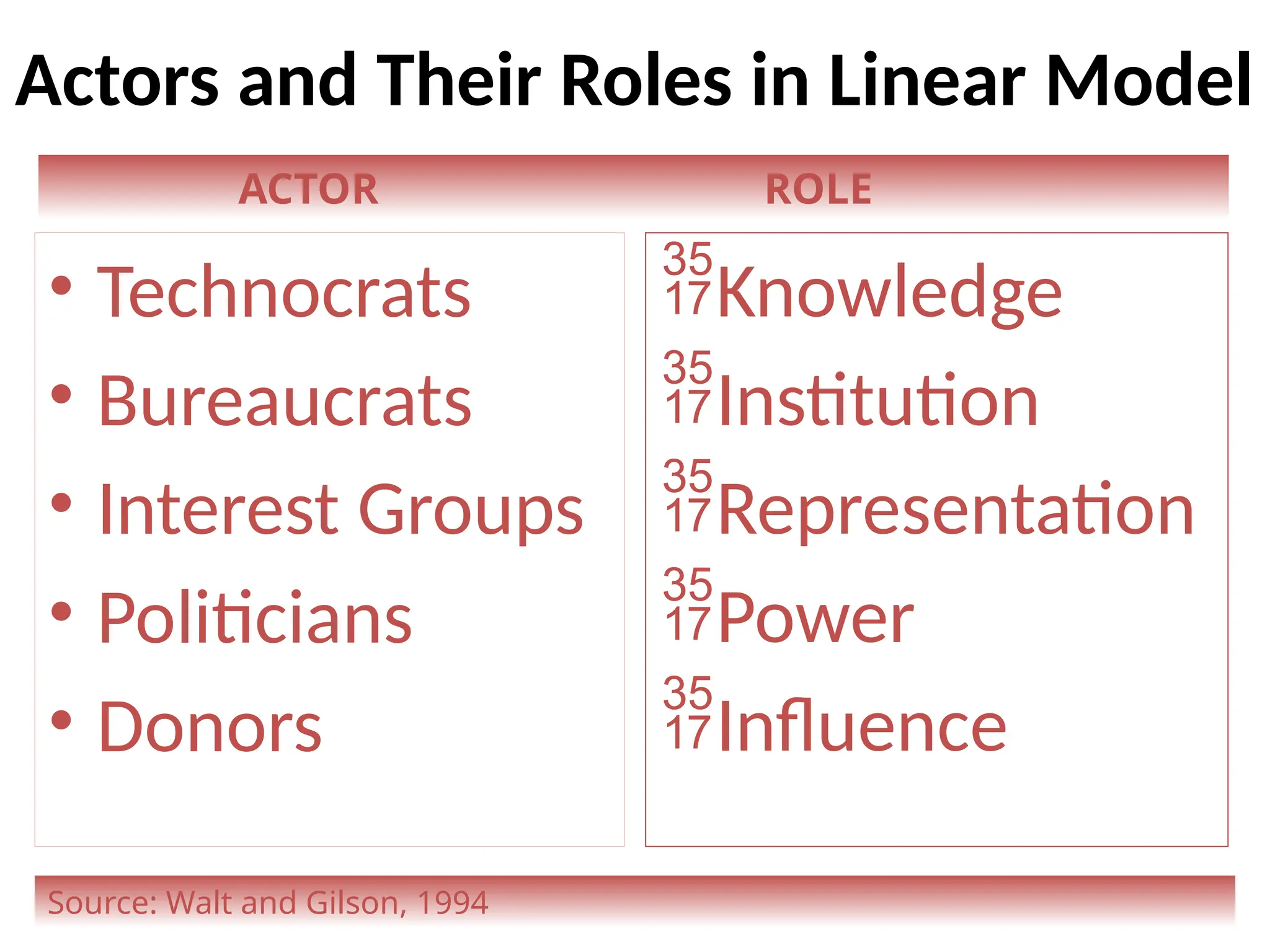
• Technocrats
• Bureaucrats
•Interest Groups
• Politicians
• Donors
Knowledge
Institution
Representation
Power
Influence
ACTOR ROLE
Source: Walt and Gilson, 1994
Actors and Their Roles in Linear Model
5.
Conceptual Clarification…Cont..
Based onthe growth of the field of policy studies during the 1960s and
1970s, a number of different variations of the stages typology have
been put forward, usually offering further differentiations of (sub-)
stages. The versions developed by Brewer and DeLeon (1983), May and
Wildavsky (1978), Anderson (1975), and Jenkins (1978) are among the
most widely adopted ones. Today, the differentiation between agenda-
setting, policy formulation, decision making, implementation, and
evaluation (eventually leading to termination) has become the
conventional way to describe the chronology of a policy process.
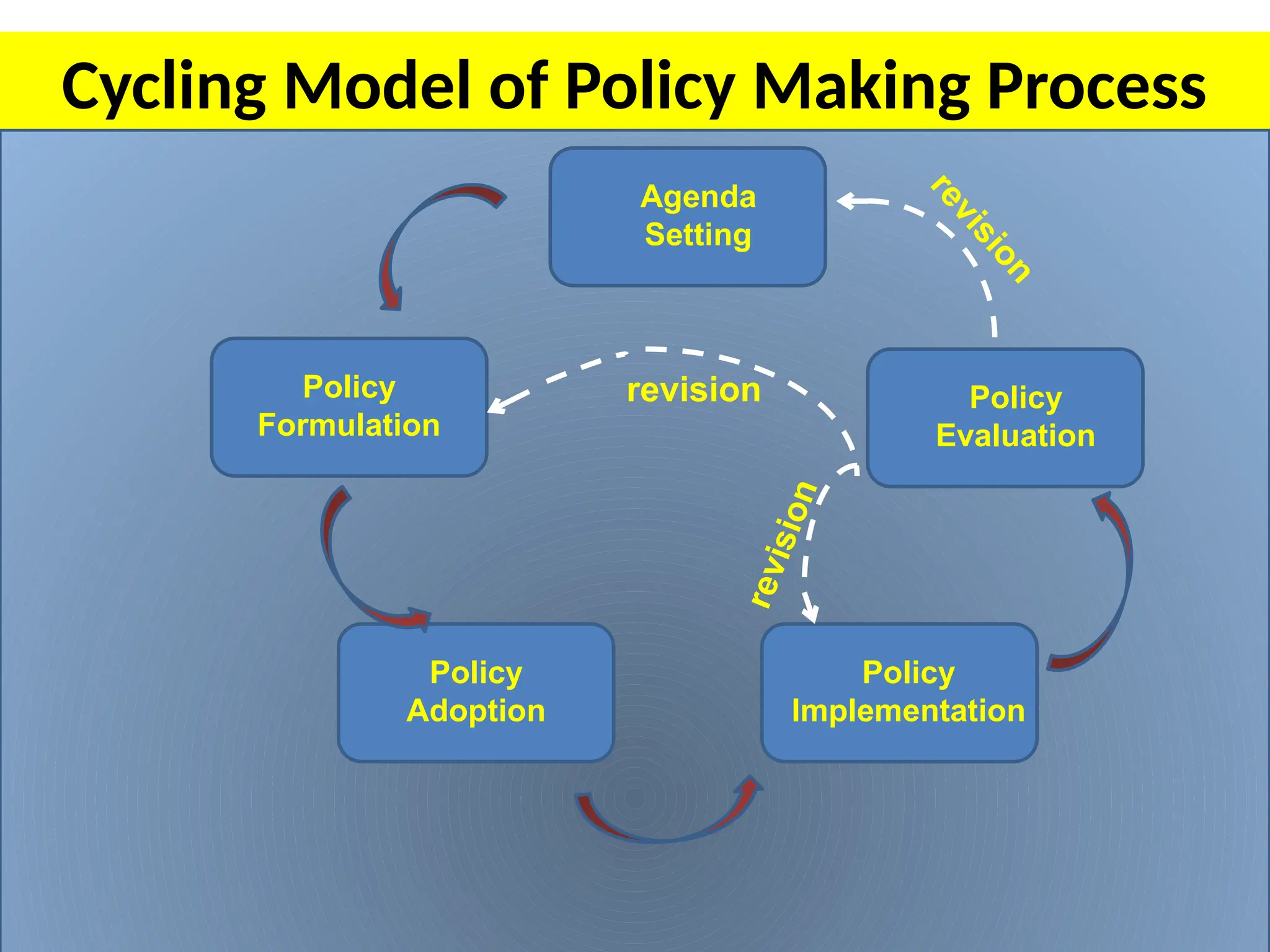
However, the stages of policy-making were originally conceived as
evolving in a chronological order—first, problems are defined and put
on the agenda, next, policies are developed, adopted and implemented;
and, finally these policies will be assessed against their effectiveness and
efficiency and either terminated or restarted after revision. Combined
with Easton’s input-output model this stage perspective was then
transformed into a cyclical model, the so-called policy cycle.
6.
Cyclical Model ofPublic Policy Making
The cyclical perspective emphasizes feed-back (loop) processes
between inputs and outputs of policy-making, leading to the
continual perpetuation of the policy process. Outputs of policy
processes at t₁ have an impact on the wider society and will be
transformed into an input (demands and support) to a succeeding
policy process at t₂. The integration of Easton’s input-output model
also contributed to the further differentiation of the policy process.
Instead of ending or terminating with the decision to adopt a
particular course of action which is entirely new, the focus was
extended to cover the implementation of policies and, in particular,
the reaction of the affected target group (impact) and the wider
effects of the policy within the respective social sector (outcome).
Also, the tendency of policies to create unintended consequences or
side-effects became apparent through this policy cycling perspective.
This Policy Cycling model is widely accepted now-a-days in public
policy making.
Factors That InfluencePublic Policy Making
• Before going to discuss about the various stages of
public policy making, it is very essential to know some
of the important factors by which Policy-making gets
attention directly or indirectly. Policy-making
presupposes the recognition of a policy problem from
the given environmental factors. Therefore, policy-
making can not be adequately understood without
understanding environmental factors. These are:
• Political Culture
• Public Opinion
• Social System
• Economic system.
• Others – Micro and Macro-politics
9.
Political culture refersto the set of political beliefs and values
that sustain any political system. And it is the political system
that determines the decision making.
In political culture, goodness, badness, desirability and
undesirability of good action or bad action is considered
significantly to shape and reshape the policy framework and
thereby society at large.
Sociologist Robin Williams has described “major value
orientation” in American society such as individual freedom,
equity, progress and efficiency. These values and others such as
democracy, individualism, humanitarianism (in early phase) and
material achievements have significance for policy making. In the
like manner each society has its own certain specific values to be
recognized while making the public policy. As India had been
made the confluence of the best of the East and West by her
stalwart and visionary leaders in early stage of revolution to
determine the specific dimension for future generation.
1. Environmental Factor – Political Culture
10.
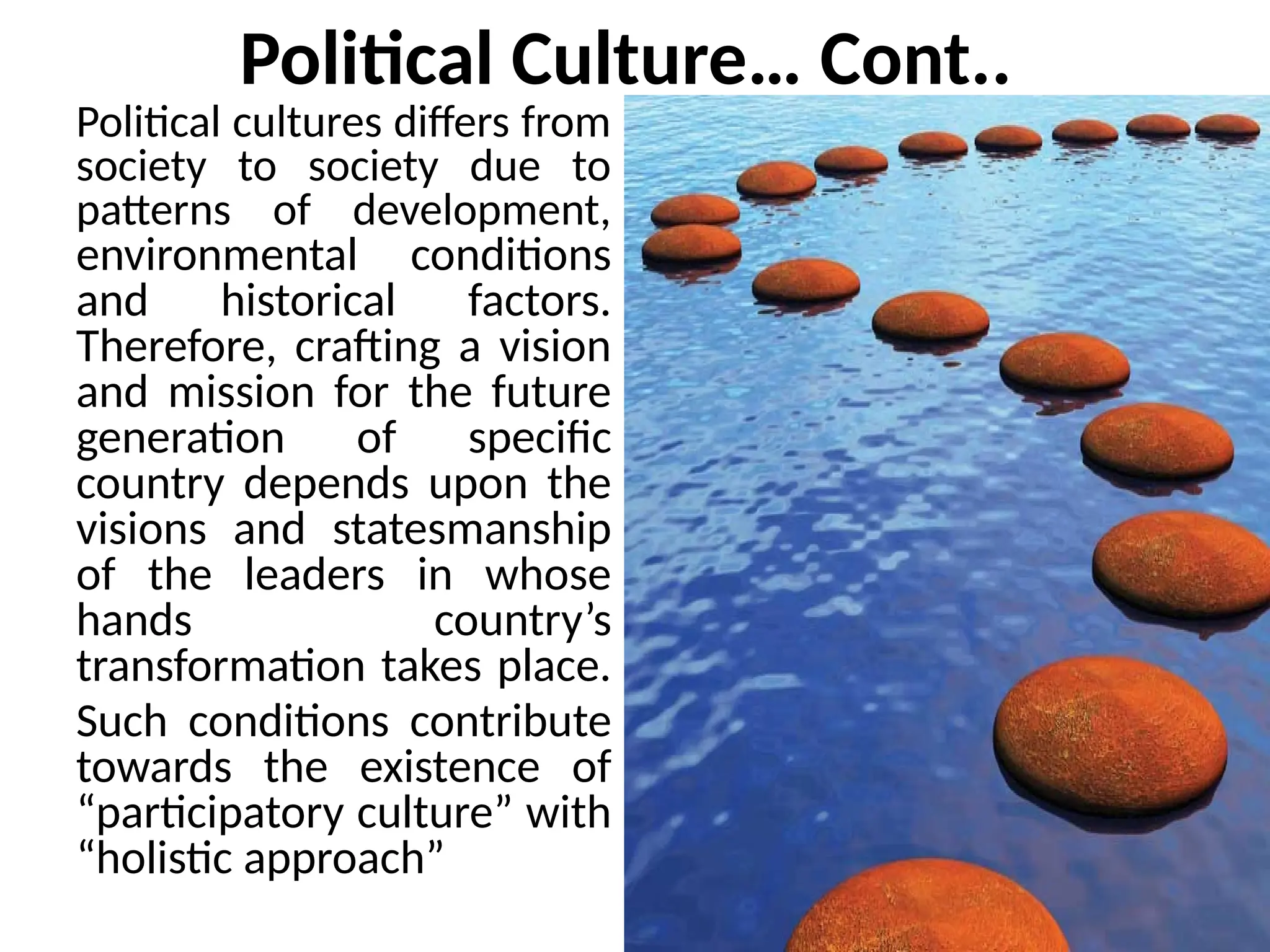
Political Culture… Cont..
Politicalcultures differs from
society to society due to
patterns of development,
environmental conditions
and historical factors.
Therefore, crafting a vision
and mission for the future
generation of specific
country depends upon the
visions and statesmanship
of the leaders in whose
hands country’s
transformation takes place.
Such conditions contribute
towards the existence of
“participatory culture” with
“holistic approach”
11.
2. Environmental Factor– Public Opinion
Public opinion refers to the expression of public
attitudes or beliefs about current social, economic and
political issues.
• The articulation of opinion depends on the type of
political culture it has framed for its citizens.
• The articulation of public opinion is determined by the
public interest which in most cases is not applied
equally.
• While examining the impact of public opinion on policy
making, V.O Key observes: “Many, if not most, policy
decisions by legislatures and by other authorities
exercising broad discretion are made under
circumstances in which extremely small proportions of
the general public have any awareness of the particular
issue, much less any understanding of the
consequences of the decision.”
12.
3. Environmental Factor– Social System
• Societies are not generally homogenous, rather consist of social
groups with varying degree of social, political and economic
influence.
• In pluralist society such groups can mount heavy pressure on
the political system as viewed by Robert Dahl in his concept of
“polyarchy” which means “rule by the many”. Power is about
resources that groups among many can command in the
competitive market.
• Most pluralists incorporate a theory of democracy, viewed as a
form of interest articulation and market competition, into their
view of the state. For Robert Dahl and Schumpeter, democracy
is concerned with the competition between groups and the
selection of leaders. The successful group(s), from the electoral
process, formulate policy through government functionaries and
serve as major source of demands for policy making.
13.
4. Environmental Factor– Economic System
• Economic activities vary from society to society.
Some societies have very simple economic
system but some have very complex and
hostile economic futurity.
• Economic activities are major source of conflict
in modern societies.
• And those possess economic means control
political power.
• In most of the societies the policy making is
the elite activity and policies are fashioned in
way that reflects elite aspiration.
14.
5. Other EnvironmentalFactors
• Micro-politics
Refers to the attempts made by particular
companies or communities to secure favorable
govt. action for their own.
Micro-politics involves groups or communities at
grassroots level
• Macro-politics
It involves the community as whole and the
leaders of the govt. in the formation of public
policy.
The participants in the macro-political arena
include president, executive departments, MP’s
and communication and media persons and
donors.
15.
1. Policy Making- Agenda Setting
The agenda is nothing more than “the list of subjects or
problems to which governmental officials, and people
outside the government closely associated with those
officials, are paying some serious attention at any given
time” (Kingdon, 1995). The government’s (or institutional)
agenda has been distinguished from the wider media and
the overall Public – (Society or systemic) agenda (Cobb
and Elder, 1972). While the government’s (formal and
informal) agenda presents the center of attention of
studies on agenda-setting, the means and mechanisms of
problem recognition and issue selection are tightly
connected with the way a social problem is recognized and
perceived on the public/media agenda.
16.
1. Policy Making- Agenda Setting..Cont.
• Actors within and outside government constantly seek
to influence and collectively shape the agenda (e.g., by
taking advantage of rising attention to a particular issue,
dramatizing a problem, or advancing a particular
problem definition). The involvement of particular actors
(e.g., experts), the choice of institutional venues in which
problems are debated and the strategic use of media
coverage have been identified as tactical means to define
issues (Kingdon, 1995; Baumgartner and Jones 1993).
While a number of actors are involved in these activities
of agenda control or shaping, most of the variables and
mechanisms affecting agenda-setting lie outside the
direct control of any single actor.
17.
1. Policy Making- Agenda Setting..Cont..
How the different variables — actors, institutions, ideas, and material
conditions — interact is highly contingent, depending on the specific
situation. That also implies that agenda-setting is far from a rational
selection of issues in terms of their relevance as a problem for the
wider society. Instead, the shifting of attention and agendas (Jones
2001) could eventually lead governments to adopt policies that
contradict measures introduced earlier. The most influential model that
tries to conceptualize the contingency of agenda-setting is Kingdon’s
multiple streams model that builds on the garbage-can- model of
organizational choice. Kingdon introduced the notion of windows of
opportunity that open up at a specific time for a specific policy
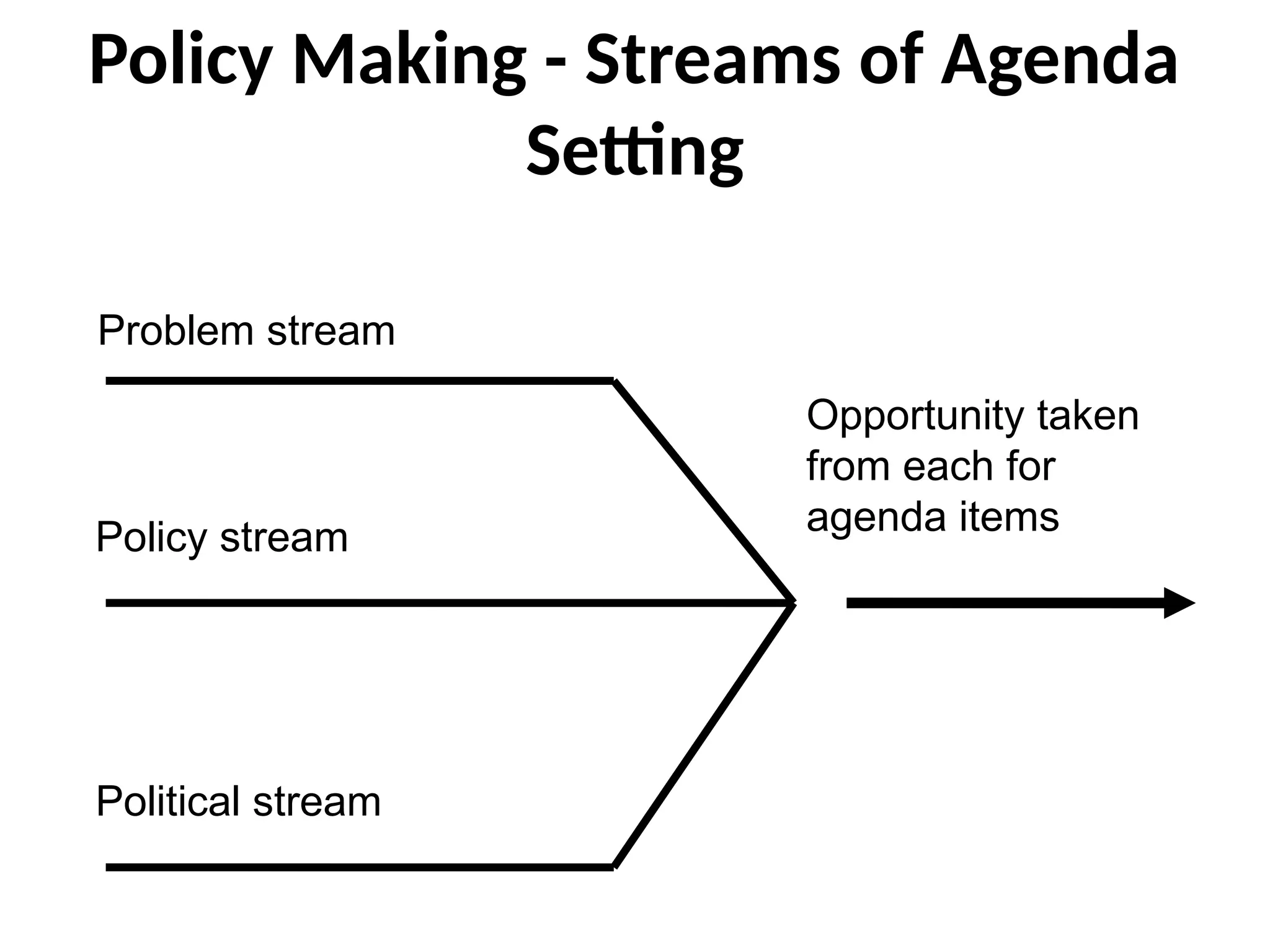
(Kingdon, 1995). The policy window opens when three usually separate
and independent Streams — problem stream (problem perception), the
political stream (public sentiments, change in governments, and the
like), and the policy stream (participants/actors for solution) —
intersect. The classical garbage-can-model distinguishes these three
Streams to measure the impact on public policy making.
18.
Policy Making -Streams of Agenda
Setting
Problem stream
Policy stream
Political stream
Opportunity taken
from each for
agenda items
19.
2. Policy Formulationand Decision-Making
During this stage of the policy cycle, expressed problems,
proposals, and demands are transformed into
government programs. Policy formulation and adoption
includes the definition of objectives — what should be
achieved with the policy — and the consideration of
different action alternatives. Some authors differentiate
between formulation (where different alternatives are
possible for action) and the final adoption (which is the
formal-decision to take on the policy). Because policies
will not always be formalized into separate programs and
a clear-cut separation between formulation and
decision-making is very often impossible, we treat them
as sub-stages in a single stage of the policy cycle.
20.
2. Policy Formulationand Decision-Making
Studies of policy formulation have long been strongly influenced by
efforts to improve practices within governments by introducing
techniques and tools of more rational decision-making. Western
governments were strongly receptive to these ideas given the
widespread confidence in the necessity and feasibility of long-term
planning. Pioneered by attempts of the U.S. government to introduce
Planning Programming Budgeting Systems (PPBS), European
governments engaged in similar efforts of long-term planning. Among
parts of the policy research community and government actors, PPBS
was perceived as a basis for rational planning and, hence, decision-
making. The establishment of clearly defined goals, output targets within
the budget statement, and the application of cost-benefit analysis to
political programs were regarded as tools facilitating the definition of
long-term political priorities. From this perspective, a rationalistic branch
of policy analysis as analysis for policy was developed, inspired by micro-
economics and operational research (Stokey and Zeckhauser, 1978).
21.
2. Actors ofPolicy Formulation
Policy proposals can be formulated through political
channels by policy-planning organizations, interest
groups, Think Tanks, government bureaucracies, state
legislatures, and the heads of the state and
government.
Finally, policy is legitimized and adopted as a result of
the public statements or actions of government
officials; both elected and appointed — the president,
Parliament, state legislators, agency officials, and the
courts. This includes executive orders; budgets; laws
and appropriations (allocation of appropriate budget);
rules and regulations, and administrative and court
decisions that set policy directions.
22.
3. Implementation
The decisionon a specific course of action and the adoption of a
program Does Not Guarantee that the action on the ground will
strictly follow policy makers’ aims and objectives. The stage of
execution or enforcement of a policy by the responsible
institutions and organizations that are often, but not always, part
of the public sector, is referred to as implementation. Policy
implementation is broadly defined as “what happens between the
establishment of an apparent intention on the part of the
government to do something, or to stop doing something, and the
ultimate impact in the world of action” (O’Toole, 2000). This stage
is critical as political and administrative action at the frontline are
hardly ever perfectly controllable by objectives, programs, laws,
and the like (cf. Hogwood and Gunn, 1984). Therefore, policies and
their intentions will very often be changed or even distorted; its
execution delayed or even blocked altogether.
23.
3. Implementation
An idealprocess of policy implementation would include the following core
elements:
Specification of program details (i.e., how and by which agencies/organizations
should the program be executed? How should the law/program be interpreted?);
Allocation of resources (i.e., how are budgets distributed? Which personnel will
execute the program? Which units of an organization will be in charge for the
execution?);
Decisions (i.e., how will decisions of single cases be carried out?).
In sum, implementation research played a major role in triggering the move of policy
research away from a state-centered endeavor, which was primarily interested in
enhancing the internal administrative and governmental capacities and in fine-
tuning program design and implementation. Since the late 1980s, policy research is
primarily interested in patterns of state-society interaction with participatory
approach as stakeholders or owners of the policy/programs/projects and has
shifted its attention toward the institutional set-up of organizational fields in the
wider society (e.g., the health, education, agriculture, water, electricity, forests
etc.). Based on the multiplicity of empirical studies in numerous policy areas, the
classic leitmotiv of hierarchical governance has been abandoned and has been
transformed to participatory governance to get real impact of implemented policy.
24.
4. Policy Evaluationand Revision
Policy-making is supposed to contribute to problem solving or at least
to the reduction of the problem load. During the evaluation stage of the
policy cycle, these intended outcomes of policies move into the center
of attention. The plausible normative rationale is that policy-making
should be appraised against intended objectives whereas impacts under
the intended objectives form the starting point of policy evaluation.
But, evaluation is not only associated with the final stage in the policy
cycle that either ends with the termination of the policy or its
redesign/revision based on modified problem perception and agenda-
setting.
At the same time, evaluation research forms a separate sub-discipline in
the policy sciences that focuses on the intended results and unintended
consequences of policies. Evaluation studies are not restricted to a
particular stage in the policy cycle; instead, the perspective is applied to
the whole policy-making process and from different perspectives in
terms of timing (condition before and after policy implementation).
25.
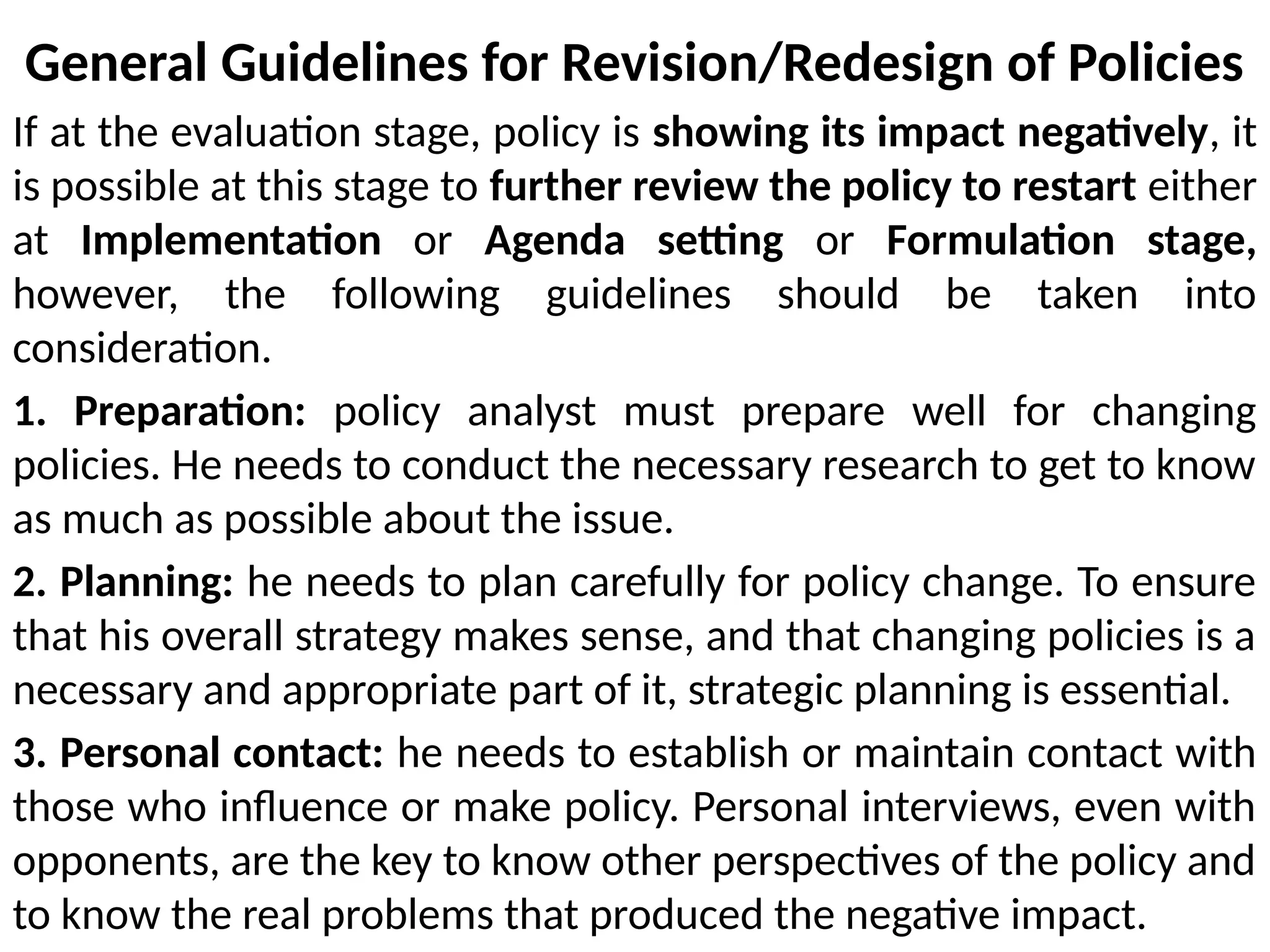
General Guidelines forRevision/Redesign of Policies
If at the evaluation stage, policy is showing its impact negatively, it
is possible at this stage to further review the policy to restart either
at Implementation or Agenda setting or Formulation stage,
however, the following guidelines should be taken into
consideration.
1. Preparation: policy analyst must prepare well for changing
policies. He needs to conduct the necessary research to get to know
as much as possible about the issue.
2. Planning: he needs to plan carefully for policy change. To ensure
that his overall strategy makes sense, and that changing policies is a
necessary and appropriate part of it, strategic planning is essential.
3. Personal contact: he needs to establish or maintain contact with
those who influence or make policy. Personal interviews, even with
opponents, are the key to know other perspectives of the policy and
to know the real problems that produced the negative impact.
26.
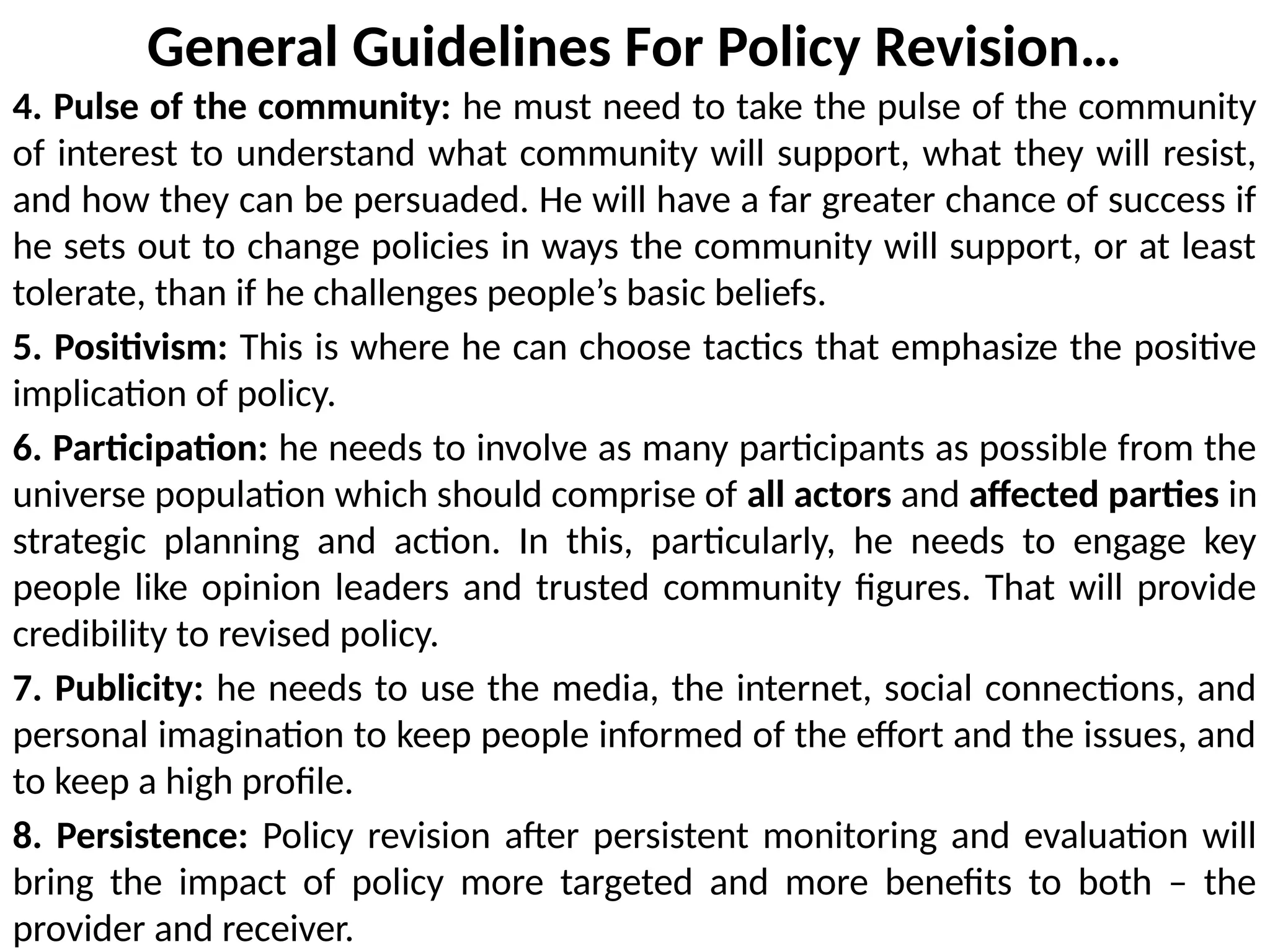
General Guidelines ForPolicy Revision…
4. Pulse of the community: he must need to take the pulse of the community
of interest to understand what community will support, what they will resist,
and how they can be persuaded. He will have a far greater chance of success if
he sets out to change policies in ways the community will support, or at least
tolerate, than if he challenges people’s basic beliefs.
5. Positivism: This is where he can choose tactics that emphasize the positive
implication of policy.
6. Participation: he needs to involve as many participants as possible from the
universe population which should comprise of all actors and affected parties in
strategic planning and action. In this, particularly, he needs to engage key
people like opinion leaders and trusted community figures. That will provide
credibility to revised policy.
7. Publicity: he needs to use the media, the internet, social connections, and
personal imagination to keep people informed of the effort and the issues, and
to keep a high profile.
8. Persistence: Policy revision after persistent monitoring and evaluation will
bring the impact of policy more targeted and more benefits to both – the
provider and receiver.