Governance :Concepts & Contents 
Keshav Raj Pande 
Ass. Prof.
Meaning 
 Governance concerns mostly the rules 
of the game of political rule, and it is a 
conscious management of regime 
structures with a view to enhancing the 
legitimacy of the public realm (Goran 
Hyden, 1992).
 State and public administration are 
regarded as the basic actors and 
arenas of governance.
Conception of Governance 
There are three conceptions of governance are: 
 Governance is simply a surrogate word for public 
administration and policy implementation. 
 Governance equates to the managerialist or NPM movement. 
 Governance is a body of theory that comprehends lateral 
relations, inter-institutional relations, the decline of 
sovereignty, the diminishing importance of jurisdictional 
borders, and a general institutional fragmentation (Gerry 
Stoker, 1998).
Conceptions… 
1. Governance is a conceptual approach that frames a 
comparative analysis of macro-politics. 
2. Governance concerns big questions of a ‘constitutional’ 
nature that establish the rules of political conduct, 
3. Governance involves creative intervention of political actors 
to change structures, 
4. Governance emphasizes interaction between state and 
social actors, and among social actors themselves, and 
5. Governance refers to a particular type of relationships 
among political actors; that is, those which are socially 
sanctioned rather than arbitrary (Goran Hyden, 1992).
Proposition of Governance 
 Five propositions are: 
 Governance refers to a set of institutions and actors that are 
drawn from but also beyond government; 
 Governance identifies blurring of boundaries and 
responsibilities for tackling social and economic issues; 
 Governance identifies the power dependence involve in the 
relationship between institutions involve in collective actions; 
 Governance is about autonomous self-governing network of 
actors; 
 Governance recognizes the capacity to get things done 
which does not rest to the power of government to command 
or use its authority. It sees government as able to use new 
tools and techniques to steer and guide.
Major features of four models 
of governance 
Parameters Market 
Government 
Participative 
Government 
Flexible 
Government 
Deregulated 
Government 
Principal 
diagnosis 
Monopoly Hierarchy Permanence Internal regulation 
Structure Decentralization Flatter 
organizations 
Virtual organizations No particular 
recommendations 
Management Pay for 
performance; other 
private techniques 
TQM teams Managing 
temporary 
personnel 
Greater managerial 
freedom 
Policy-making Internal markets; 
market incentives 
Consultation; 
negotiation 
Experimentation Entrepreneurial 
government 
Public interest Low cost Involvement; 
consultation 
Low cost; 
coordination 
Creativity; activism
Shifts in the use of the 
governance concept 
1990s 2000s 2010s 
Agenda setters Academics Donors Citizen Activities 
Main approach Analytical Programmatic Empowering 
Position adopted Detached Managerial Engaged 
Principal aim Generating 
knowledge 
Reforming Checking power 
use 
Goran Hyden, 
2011
Public Sector Governance 
Core functions of 
the state 
(Public Administration) 
Public business 
functions 
(Public Companies) 
Public service 
functions 
(Service Providers) 
Rule of law, economy, 
efficiency, effectiveness, 
transparency 
Profitability Value for money 
Good service 
Public management Public corporate 
governance 
Service management
Meaning of Good governance 
Good governance is a process, 
where rules and well-functioning 
institutions are applied to manage 
nation's affairs in a manner that 
safeguards democracy, human 
rights, good order and human 
security, and economy and 
efficiency are followed in 
management of country’s resources 
(World Bank, 1990).
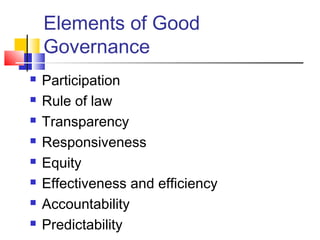
Elements of Good 
Governance 
 Participation 
 Rule of law 
 Transparency 
 Responsiveness 
 Equity 
 Effectiveness and efficiency 
 Accountability 
 Predictability
Aims of good governance 
Good governance aims at the following: 
 Enhancing the effectiveness and efficiency of administration 
 Improving the quality of life of citizens 
 Establishing the legitimacy and credibility of institutions 
 Securing the freedom of information and expression 
 Ensuring accountability 
 Using IT-based services to improve citizen-government 
interface 
 Improving or enhancing the productivity of employees 
 Promoting organizational pluralism-state, market and civil 
society organizations for governance
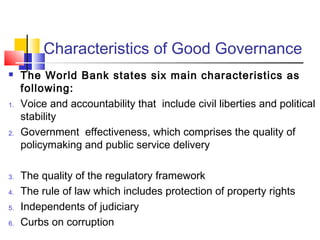
Characteristics of Good Governance 
 The World Bank states six main characteristics as 
following: 
1. Voice and accountability that include civil liberties and political 
stability 
2. Government effectiveness, which comprises the quality of 
policymaking and public service delivery 
3. The quality of the regulatory framework 
4. The rule of law which includes protection of property rights 
5. Independents of judiciary 
6. Curbs on corruption
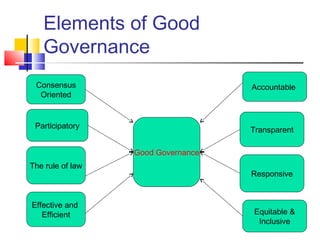
Elements of Good 
Governance 
A Consensus 
Oriented 
Participatory 
The rule of law 
Good Governance 
Effective and 
Efficient 
Accountable 
Transparent 
Responsive 
Equitable & 
Inclusive

Governance

  • 1.
    Governance :Concepts &Contents Keshav Raj Pande Ass. Prof.
  • 2.
    Meaning  Governanceconcerns mostly the rules of the game of political rule, and it is a conscious management of regime structures with a view to enhancing the legitimacy of the public realm (Goran Hyden, 1992).
  • 3.
     State andpublic administration are regarded as the basic actors and arenas of governance.
  • 4.
    Conception of Governance There are three conceptions of governance are:  Governance is simply a surrogate word for public administration and policy implementation.  Governance equates to the managerialist or NPM movement.  Governance is a body of theory that comprehends lateral relations, inter-institutional relations, the decline of sovereignty, the diminishing importance of jurisdictional borders, and a general institutional fragmentation (Gerry Stoker, 1998).
  • 5.
    Conceptions… 1. Governanceis a conceptual approach that frames a comparative analysis of macro-politics. 2. Governance concerns big questions of a ‘constitutional’ nature that establish the rules of political conduct, 3. Governance involves creative intervention of political actors to change structures, 4. Governance emphasizes interaction between state and social actors, and among social actors themselves, and 5. Governance refers to a particular type of relationships among political actors; that is, those which are socially sanctioned rather than arbitrary (Goran Hyden, 1992).
  • 6.
    Proposition of Governance  Five propositions are:  Governance refers to a set of institutions and actors that are drawn from but also beyond government;  Governance identifies blurring of boundaries and responsibilities for tackling social and economic issues;  Governance identifies the power dependence involve in the relationship between institutions involve in collective actions;  Governance is about autonomous self-governing network of actors;  Governance recognizes the capacity to get things done which does not rest to the power of government to command or use its authority. It sees government as able to use new tools and techniques to steer and guide.
  • 7.
    Major features offour models of governance Parameters Market Government Participative Government Flexible Government Deregulated Government Principal diagnosis Monopoly Hierarchy Permanence Internal regulation Structure Decentralization Flatter organizations Virtual organizations No particular recommendations Management Pay for performance; other private techniques TQM teams Managing temporary personnel Greater managerial freedom Policy-making Internal markets; market incentives Consultation; negotiation Experimentation Entrepreneurial government Public interest Low cost Involvement; consultation Low cost; coordination Creativity; activism
  • 8.
    Shifts in theuse of the governance concept 1990s 2000s 2010s Agenda setters Academics Donors Citizen Activities Main approach Analytical Programmatic Empowering Position adopted Detached Managerial Engaged Principal aim Generating knowledge Reforming Checking power use Goran Hyden, 2011
  • 9.
    Public Sector Governance Core functions of the state (Public Administration) Public business functions (Public Companies) Public service functions (Service Providers) Rule of law, economy, efficiency, effectiveness, transparency Profitability Value for money Good service Public management Public corporate governance Service management
  • 10.
    Meaning of Goodgovernance Good governance is a process, where rules and well-functioning institutions are applied to manage nation's affairs in a manner that safeguards democracy, human rights, good order and human security, and economy and efficiency are followed in management of country’s resources (World Bank, 1990).
  • 11.
    Elements of Good Governance  Participation  Rule of law  Transparency  Responsiveness  Equity  Effectiveness and efficiency  Accountability  Predictability
  • 12.
    Aims of goodgovernance Good governance aims at the following:  Enhancing the effectiveness and efficiency of administration  Improving the quality of life of citizens  Establishing the legitimacy and credibility of institutions  Securing the freedom of information and expression  Ensuring accountability  Using IT-based services to improve citizen-government interface  Improving or enhancing the productivity of employees  Promoting organizational pluralism-state, market and civil society organizations for governance
  • 13.
    Characteristics of GoodGovernance  The World Bank states six main characteristics as following: 1. Voice and accountability that include civil liberties and political stability 2. Government effectiveness, which comprises the quality of policymaking and public service delivery 3. The quality of the regulatory framework 4. The rule of law which includes protection of property rights 5. Independents of judiciary 6. Curbs on corruption
  • 14.
    Elements of Good Governance A Consensus Oriented Participatory The rule of law Good Governance Effective and Efficient Accountable Transparent Responsive Equitable & Inclusive