Course Teacher: Associate Professor Khairul Chowdhury,
Department of Sociology, University of Dhaka.
Presented by:
Nazia Afroz
Masters of Social Policy
University of Dhaka
Topic: Structural Adjustment Programme (SAPs)
"Structural adjustment" is the name given
to a set of "free market" economic policy
reforms imposed on developing countries
by the Bretton Woods institutions [the
World Bank and International Monetary
Fund (IMF)] as a condition for receipt of
loans.
 Developed in the early 1980s
 Initiated in Turkey
 Gaining stronger influence over the
economies of debt-strapped
governments in the South
 187 SAPs negotiated for 64 developing
countries
Structural Adjustment Programmes (SAPs)
VS.
IMF’s SAPs
 IMF mainly lends to
countries that have
balance of payment
problems,
 IMF loans focus on
temporarily fixing
problems that countries
face as a whole,
 IMF loans were meant
to be repaid in a short
duration between 2½
and 4 years.
World Bank’s SAPs
 World bank offers loans
to fund particular
development projects,
 World Bank SAPs focus
on providing loans and
grants to countries that
provide funding on a
project basis,
 The World Bank is
divided into two lending
and development
institutions; the IBRD
and IDA. IBRD focuses
on "middle income and
credit-worthy poor
countries" while the IDA
focuses on the lowest
income and least credit
worthy countries.
SAPs are Designed…………
 to improve a country's foreign investment climate
by eliminating trade and investment regulations,
 to boost foreign exchange earnings by promoting
exports, and
 to reduce government deficits through cuts in
spending.
Objectives of SAPs
SAPs have 4 fundamental objectives according to which they
are shaped:
1. Liberalisation: promoting the free movement of capital;
opening of national markets to international competition.
2.Privatisation of public services and companies.
3.De-regulations of labour relations and cutting social safety
nets.
4.Improving competitiveness (Toissant and Comanne 1995:14)
Measures Imposed Under SAPs
Although SAPs differ somewhat from country to country, they typically include:
 a shift from growing diverse food crops for domestic consumption to specializing in
the production of cash crops or other commodities (like rubber, cotton, coffee,
copper, tin etc.) for export;
 abolishing food and agricultural subsidies to reduce government expenditures;
 deep cuts to social programmes usually in the areas of health, education and
housing and massive layoffs in the civil service;
 currency devaluation measures which increase import costs while reducing the value
of domestically produced goods;
 liberalization of trade and investment and high interest rates to attract foreign
investment;
 privatization of government-held enterprises.
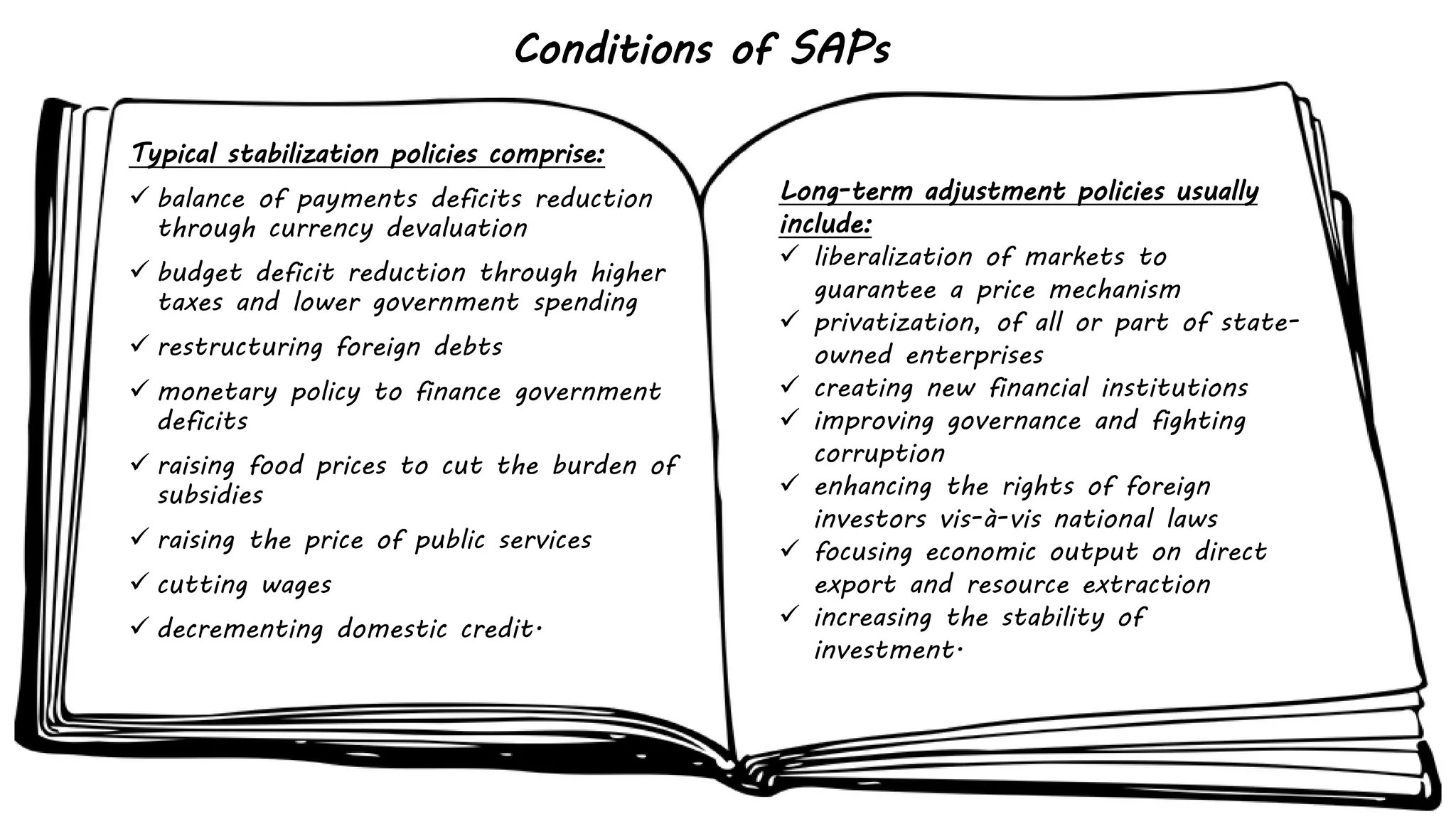
Typical stabilization policies comprise:
 balance of payments deficits reduction
through currency devaluation
 budget deficit reduction through higher
taxes and lower government spending
 restructuring foreign debts
 monetary policy to finance government
deficits
 raising food prices to cut the burden of
subsidies
 raising the price of public services
 cutting wages
 decrementing domestic credit.
Long-term adjustment policies usually
include:
 liberalization of markets to
guarantee a price mechanism
 privatization, of all or part of state-
owned enterprises
 creating new financial institutions
 improving governance and fighting
corruption
 enhancing the rights of foreign
investors vis-à-vis national laws
 focusing economic output on direct
export and resource extraction
 increasing the stability of
investment.
Conditions of SAPs
Impact of SAPs
• Benefits of Structural Adjustment in Ghana:
 Economic growth increased (becoming slightly positive, 1-2% annual per capita
growth).
 Agricultural production began growing again
 Imports and exports (including in agriculture) grew
 Inflation fell to low levels
 Budget deficits reduced
 Growth in “civil society”, civic organizations
• Countries like Zambia & Ivory Coast received dozens of loans without
actually implementing any reforms
• Lenders (like the World Bank) have incentives to make large loans, but
few incentives to carry out evaluations of their programs
• There is basically no cross-country empirical evidence that increased
foreign aid improves economic performance in less developed countries
(despite claims by Jeff Sachs)
Effect of SAPs
• End of the Structuralist model of development
• Competitive insertion into the world market
• Removal of trade and financial barriers
1. Sovereignty
- SAPs threaten the sovereignty of
national economies because an outside
organization is dictating a nation's
economic policy.
2. Privatisation
- When resources are transferred to
foreign corporations and/or national
elites, the goal of public prosperity is
replaced with the goal of private
accumulation.
3. Austerity
- SAPs emphasize maintaining a
balanced budget, which forces austerity
programs. The casualties of balancing a
budget are often social programs.
Criticisms of SAPs
What Went Wrong with SAPs?
• SAPs lead to decreasing the quality education.
• SAPs have had a particularly negative effect on women because:
 Privatisation of social services like health and education makes these services
unaffordable,
 Women's unpaid work increased,
 Greater unemployment decreased purchasing power and cutbacks in social services,
 Cuts in education services lead to an increase in illiteracy among women and girls,
• In Zambia, the hardships caused by SAPs led to an increase in divorces
• Reduced spending on health leads to an increase in child mortality
• Collapse of small enterprises
• Trade Unions lost 60% of their members in 1990
• Drop in formal sector employment to less then 14% of active population
• Collapse of small enterprises
 WB and IMF needed to launch a new initiative to address the
raising levels of poverty as well as the level of dissatisfaction and
disappointment caused by SAPs.
 In 1999, Poverty Reduction Strategy Papers (PRSPs) became
the “successor” to structural adjustment programmes.
 In responding to these criticisms, the UN has came out with a
set of goals known as the Millennium Development Goals
(MDGs).
 PRSPs are seen as the key tool for operationalizing the World
Bank’s approach to poverty as identified in 2000/01 World
Development Report highlighted above and for meeting the
Millennium Development Goals.
SAPs to PRSPs & MDG
Structural Adjustment Programmes (SAPs) ppt

Structural Adjustment Programmes (SAPs) ppt

  • 1.
    Course Teacher: AssociateProfessor Khairul Chowdhury, Department of Sociology, University of Dhaka. Presented by: Nazia Afroz Masters of Social Policy University of Dhaka Topic: Structural Adjustment Programme (SAPs)
  • 2.
    "Structural adjustment" isthe name given to a set of "free market" economic policy reforms imposed on developing countries by the Bretton Woods institutions [the World Bank and International Monetary Fund (IMF)] as a condition for receipt of loans.  Developed in the early 1980s  Initiated in Turkey  Gaining stronger influence over the economies of debt-strapped governments in the South  187 SAPs negotiated for 64 developing countries Structural Adjustment Programmes (SAPs)
  • 3.
    VS. IMF’s SAPs  IMFmainly lends to countries that have balance of payment problems,  IMF loans focus on temporarily fixing problems that countries face as a whole,  IMF loans were meant to be repaid in a short duration between 2½ and 4 years. World Bank’s SAPs  World bank offers loans to fund particular development projects,  World Bank SAPs focus on providing loans and grants to countries that provide funding on a project basis,  The World Bank is divided into two lending and development institutions; the IBRD and IDA. IBRD focuses on "middle income and credit-worthy poor countries" while the IDA focuses on the lowest income and least credit worthy countries.
  • 5.
    SAPs are Designed………… to improve a country's foreign investment climate by eliminating trade and investment regulations,  to boost foreign exchange earnings by promoting exports, and  to reduce government deficits through cuts in spending.
  • 6.
    Objectives of SAPs SAPshave 4 fundamental objectives according to which they are shaped: 1. Liberalisation: promoting the free movement of capital; opening of national markets to international competition. 2.Privatisation of public services and companies. 3.De-regulations of labour relations and cutting social safety nets. 4.Improving competitiveness (Toissant and Comanne 1995:14)
  • 7.
    Measures Imposed UnderSAPs Although SAPs differ somewhat from country to country, they typically include:  a shift from growing diverse food crops for domestic consumption to specializing in the production of cash crops or other commodities (like rubber, cotton, coffee, copper, tin etc.) for export;  abolishing food and agricultural subsidies to reduce government expenditures;  deep cuts to social programmes usually in the areas of health, education and housing and massive layoffs in the civil service;  currency devaluation measures which increase import costs while reducing the value of domestically produced goods;  liberalization of trade and investment and high interest rates to attract foreign investment;  privatization of government-held enterprises.
  • 8.
    Typical stabilization policiescomprise:  balance of payments deficits reduction through currency devaluation  budget deficit reduction through higher taxes and lower government spending  restructuring foreign debts  monetary policy to finance government deficits  raising food prices to cut the burden of subsidies  raising the price of public services  cutting wages  decrementing domestic credit. Long-term adjustment policies usually include:  liberalization of markets to guarantee a price mechanism  privatization, of all or part of state- owned enterprises  creating new financial institutions  improving governance and fighting corruption  enhancing the rights of foreign investors vis-à-vis national laws  focusing economic output on direct export and resource extraction  increasing the stability of investment. Conditions of SAPs
  • 9.
    Impact of SAPs •Benefits of Structural Adjustment in Ghana:  Economic growth increased (becoming slightly positive, 1-2% annual per capita growth).  Agricultural production began growing again  Imports and exports (including in agriculture) grew  Inflation fell to low levels  Budget deficits reduced  Growth in “civil society”, civic organizations • Countries like Zambia & Ivory Coast received dozens of loans without actually implementing any reforms • Lenders (like the World Bank) have incentives to make large loans, but few incentives to carry out evaluations of their programs • There is basically no cross-country empirical evidence that increased foreign aid improves economic performance in less developed countries (despite claims by Jeff Sachs)
  • 10.
    Effect of SAPs •End of the Structuralist model of development • Competitive insertion into the world market • Removal of trade and financial barriers
  • 13.
    1. Sovereignty - SAPsthreaten the sovereignty of national economies because an outside organization is dictating a nation's economic policy. 2. Privatisation - When resources are transferred to foreign corporations and/or national elites, the goal of public prosperity is replaced with the goal of private accumulation. 3. Austerity - SAPs emphasize maintaining a balanced budget, which forces austerity programs. The casualties of balancing a budget are often social programs. Criticisms of SAPs
  • 14.
    What Went Wrongwith SAPs? • SAPs lead to decreasing the quality education. • SAPs have had a particularly negative effect on women because:  Privatisation of social services like health and education makes these services unaffordable,  Women's unpaid work increased,  Greater unemployment decreased purchasing power and cutbacks in social services,  Cuts in education services lead to an increase in illiteracy among women and girls, • In Zambia, the hardships caused by SAPs led to an increase in divorces • Reduced spending on health leads to an increase in child mortality • Collapse of small enterprises • Trade Unions lost 60% of their members in 1990 • Drop in formal sector employment to less then 14% of active population • Collapse of small enterprises
  • 15.
     WB andIMF needed to launch a new initiative to address the raising levels of poverty as well as the level of dissatisfaction and disappointment caused by SAPs.  In 1999, Poverty Reduction Strategy Papers (PRSPs) became the “successor” to structural adjustment programmes.  In responding to these criticisms, the UN has came out with a set of goals known as the Millennium Development Goals (MDGs).  PRSPs are seen as the key tool for operationalizing the World Bank’s approach to poverty as identified in 2000/01 World Development Report highlighted above and for meeting the Millennium Development Goals. SAPs to PRSPs & MDG