EXECUTING PUBLIC POLICY WITH
STRATEGIC MANAGEMENT AND
BENCHMARKING
Prepared by: Mildred B. Villacorta
MPA Student
Nature and Thrust of Public Policy
PUBLIC POLICY
 addresses a host of issues like hosting,
transportation, education, health, social
services, among others
 it creates orderly structures and standards,
and a sense of direction
 a course of action which a government
adopts to tackle specific public concern or
issue in the form of regulations, laws, program
or decisions
Three Components of Public Policy
Making
1. Problem – is a particular apprehension that
often requires specific resolution
2. Players – refers to the actors or group of
actors that design specific formula to tackle
the issue at hand
3. Policy – is the finished course of action ready
for implementation
Building Public Policy
Public policy commences with the
discovery of a problem and usually the
government is confronted with the varying
ways to deal with it.
a) citizens
b) interest groups
c) private sector
Otherwise, the pressure groups may
exploit the situation through different forms
of lobbying techniques as they spot the
problem.
With this, Congress or the legislative
department comes in but in many cases the
government and the citizens may work
together to formulate a sound policy resulting
from public opinion, which is seen as the most
influential factor in policy making process.
Public Opinion is Advanced Through:
a) lobby groups
b) survey studies
c) media exposure or mileage
The Policy making process revolves within
several factors which trigger agenda
initiation, government formulation and
implementation, and policy evaluation.
Every policy designed for public purpose
aims to bring solvency and normalcy to the
situation once jeopardized. The success of
policy implementation, however, is largely
dependent on policy implementers. This is the
stage of the policy process, which is
purportedly regarded as the common cause of
policy defeat and eventual failure.
Does Government Exist? Does It Really
Matter?
Government policies generally are aimed at
achieving the betterment of the lives of the
people in the state, or in crude terms, they refer
to the ability of the government to make things
either better or worst for the people.
The most basic principle is either potentially
true or plausibly false.
Public Administration and Public Policy
Aims to examine:
a) how policy was initiated
b) prepared
c) executed and reviewed
d) how the policy outcomes could be
improved for the better
Earlier in 1922
Charles Merriam – a political scientist, started to
hypothesize the relationship between political
theory and its application to reality.
Shafritz (2009) – government perpetually suffers
from a problem similar to that faced by
Shakespare’s Hamlet, the indecisive prince of
denmark, who struggled whether “to be or
not to be”
Thus, public policy and public administration are
two sides of the same coin. One decides the
other does. They cannot be separated because
one side cannot exist without the other does. But
because policy is a continuous process, it cannot
end with implementation.
Therefore, public administration cannot exist in a
policy vacuum. It must have administrative
structures that are directed by leaders who wish
to do something-if only to maintain the status
quo. Thus, all of public administration is
inherently an instrument of policy, whether that
instrument plays well, poorly, or not at all.
Defining Public Policy
Thomas Dye - defined public policy as “
whatever governments choose to do or not to
do.”
Roskins – a political analyst, modified the earlier
definition in this wise: “whatever the
government does to do or not to do”
Policy – is a course of action of action or a series
of program adopted by a group or a person or
a government in view to address or respond
to existing issues or concerns.
Issues – is a topic or matter of significance; it is a
recognized part of a political agenda which is
being sought to remedy its spills.
Public Policy – is an action taken by the
government to meet a particular demand
growing out of the society.
Public Policy Analysis
a) is the study of how governmental policies are
made and implemented
b) the application of the available knowledge to
governmental policies for the purpose of
improving their formulation and
implementation
c) referred to “the monitoring of different
government agencies that directly affect a
specific community
d) to provide the government with facts and
statistics about the extent to which such
initiatives are working
Three Traditional Ethics of Public Administration:
1. effectiveness
2. efficiency
3. economy
Hogwood and Peters (1991) in Hague (2001)
- Declare the profession of policy analysis is to
social science while medicine is to biology.
Policy outputs – are those referring to what
government does, or better put
to what government achieves
or fails to achieve
Outputs – are reasonably measurable
Outcomes – are rather harder to quantify since
outcomes are the effects of a policy,
both unforeseen effects and
unintended ones.
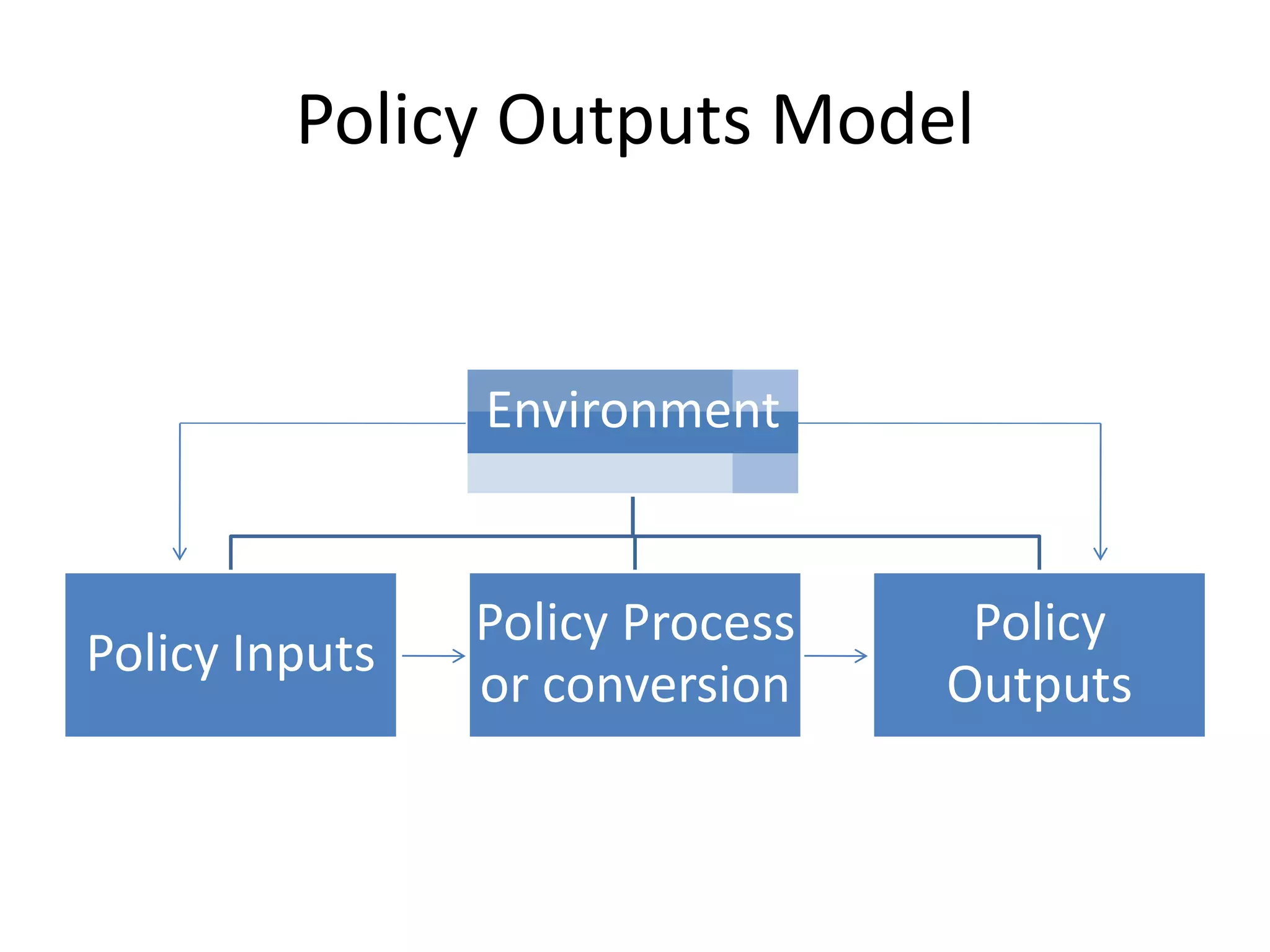
Policy Outputs Model
Environment
Policy Inputs
Policy Process
or conversion
Policy
Outputs
Policymaking Process
Two Aspects:
1) it involves in a link series of actions or events
2) it is a process in the sense that it
distinguishes the ‘how’ of the government
from the ‘what’ of government
The Public Policymaking Process
Environment Situationer
---------------
Feedback
Agenda Setting
Policy Decision or Non-
Decision
Implementation of a New
Program
Criticism from Citizens
and Formal Program
Evaluation
Source: Modified from Shafritz, 2009
Policy Initiation/Agenda Setting
Initiation
• is the primary stage of policy agenda that
resulted from an issue regarded to come out as a
problem if not attended to appropriately.
• refers to the making of decisions in a certain
aspect where policy initiation determines the
political agenda through identification of
emerging problems as issues of relevance, and by
determining how those significant matters are to
be responded by the government
Agenda Setting
• is the process by which ideas or issues bubble
up through the various political channels to
wind up for consideration by a political
institution such as a legislator or court
Policy initiation
• Can be influenced from top leader, state
bureaucrats or lawmakers or “from above”
and “from bottom” is also worth noting
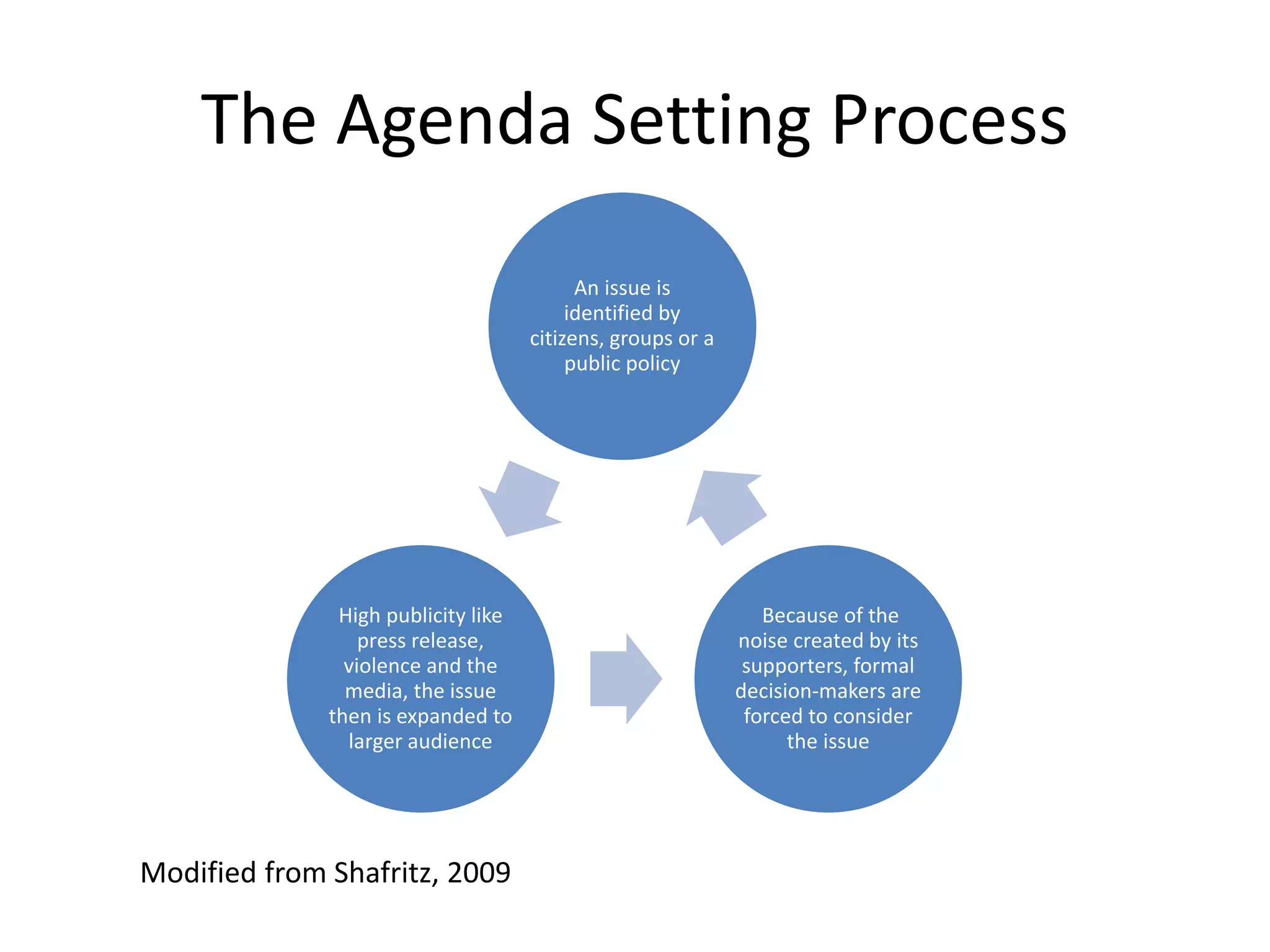
The Agenda Setting Process
An issue is
identified by
citizens, groups or a
public policy
Because of the
noise created by its
supporters, formal
decision-makers are
forced to consider
the issue
High publicity like
press release,
violence and the
media, the issue
then is expanded to
larger audience
Modified from Shafritz, 2009
Anthony Downs attempts to explain the way in
which many policy problems evolve on the
political agenda. The cycle is premised on the
notion that the public attention rarely remains
focused on any one issue. Downs in Shafritz
(2009) said that the cycle consists of five steps:
1. The pre-problem
2. Alarmed discovery and euphoric enthusiasm
3. Recognition of the costs of change
4. Decline of public interest
5. The post-problem stage
Policy Formulation
• is the job for government officials, politicians,
consulted groups and key advisers
• entails also the definition of issues, framing of
objectives, and setting priorities
• is the conceptualization stage of policy
process where the detailed development of a
policy is framed into more or less concrete
proposals
• includes “not only the translation of broad
proposal into specific and detailed
recommendations but also the filtering out of
proposals and perhaps even the fundamental
recasting of the issue under consideration
As Heywoods (2002) puts it, it is important to note
however, that the final decision which brings the
formulation process to an end, may be little
more, than a formality: discussion, arguments,
and debate having summits thus often ratify or “
rubber stamp” decisions that have effectively
been made elsewhere.
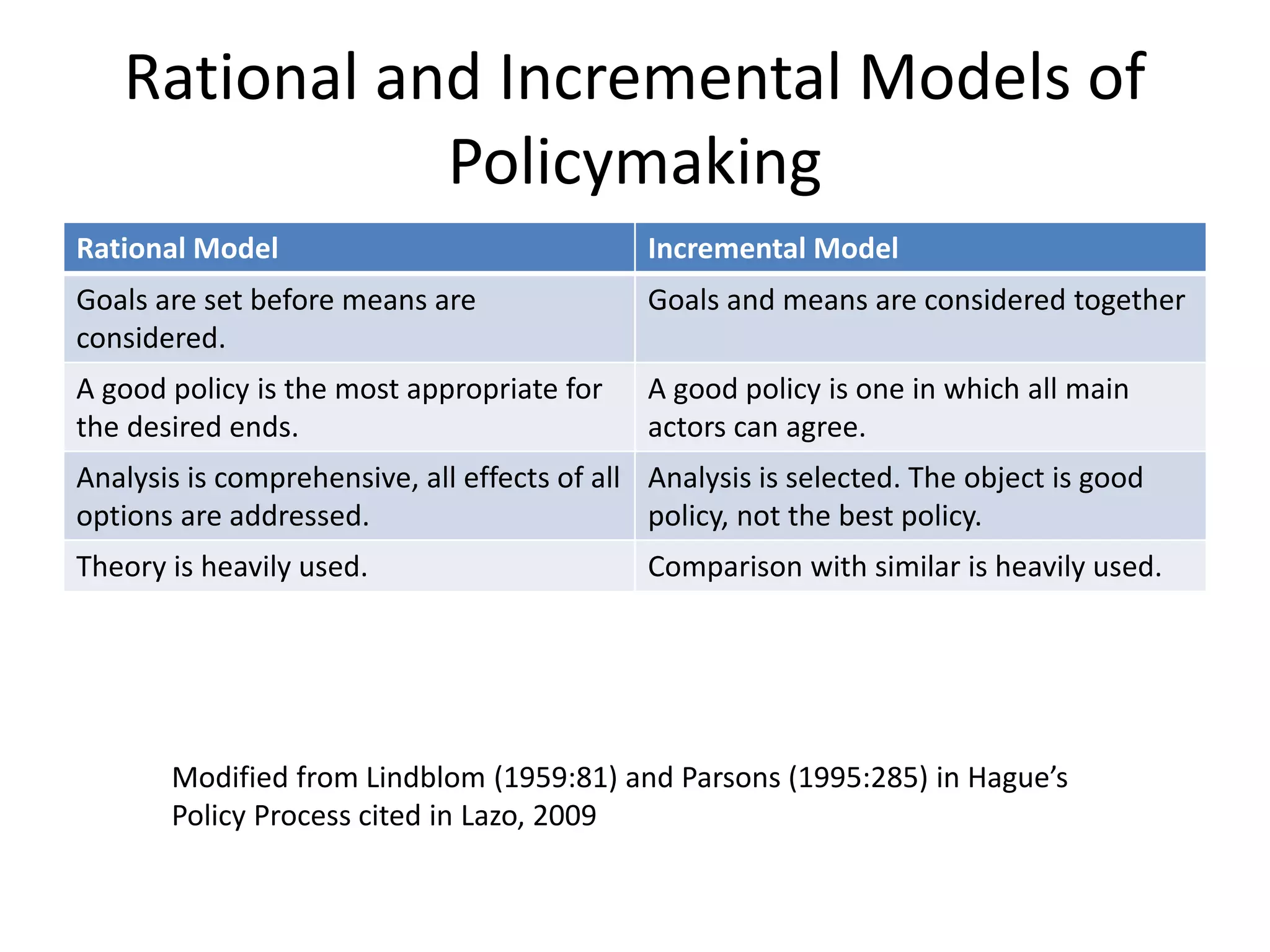
Rational and Incremental Models of
Policymaking
Rational Model Incremental Model
Goals are set before means are
considered.
Goals and means are considered together
A good policy is the most appropriate for
the desired ends.
A good policy is one in which all main
actors can agree.
Analysis is comprehensive, all effects of all
options are addressed.
Analysis is selected. The object is good
policy, not the best policy.
Theory is heavily used. Comparison with similar is heavily used.
Modified from Lindblom (1959:81) and Parsons (1995:285) in Hague’s
Policy Process cited in Lazo, 2009
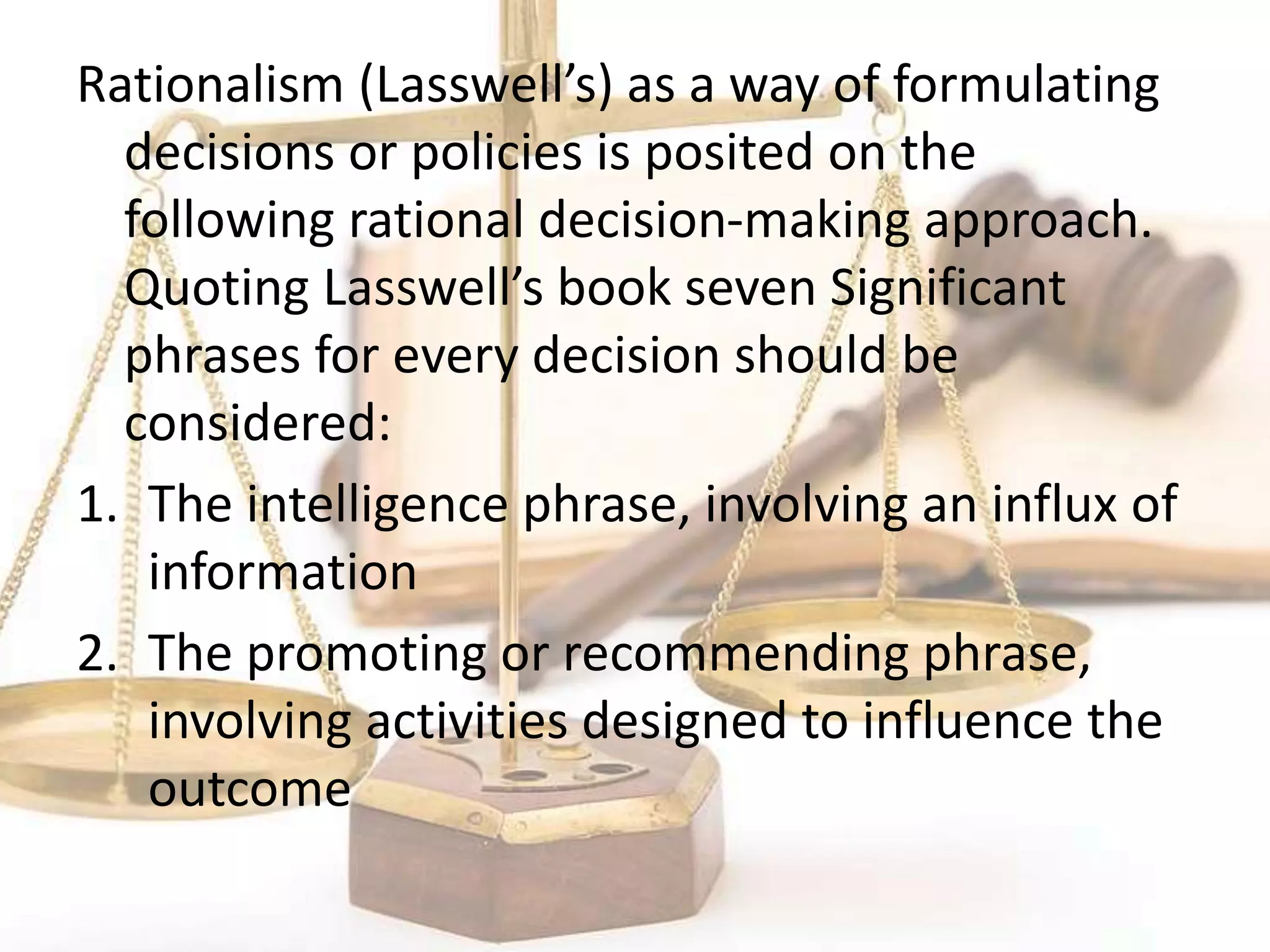
Rationalism (Lasswell’s) as a way of formulating
decisions or policies is posited on the
following rational decision-making approach.
Quoting Lasswell’s book seven Significant
phrases for every decision should be
considered:
1. The intelligence phrase, involving an influx of
information
2. The promoting or recommending phrase,
involving activities designed to influence the
outcome
3. The prescribing phase, involving the
articulation of norms
4. The invoking phase, involving establishing
correspondence between prescriptions and
concrete circumstances
5. The application phase, in which the
prescription is executed
6. The appraisal phase, assessing intent in
relation to effect
7. The terminating phase, treating expectations
(right) established while the prescription was
enforce.
Policy Implementation
Implementation
• is the process of putting the government
policy into effect; it is total process of
translating a legal mandate, whether an
executive order or an enacted statute, into
appropriate program directives and structures
that provides services or create goods.
• the doing part of public administration
Policy implementation
• is also called policy execution, meaning
putting out the policy into practice.
There are some conditions to be required in
order to achieve perfect implementation in
the sense of ensuring that policy is delivered
exactly as intended:
a) a unitary administrative system with a single
line of authority to ensure central control;
b) uniform norms and rules that operate
through the system;
c) perfect control;
d) perfect information, perfect communication
and perfect condition;
e) Sufficient time for administrative resources
to be modified.
Policy Evaluation
• appraises outcomes of a policy as
implemented; meaning, what the government
achieves
• is the appraisal or review of a policy being
implemented as to its success or failure
Policy appraisal – is the culmination of a course
of action which will result in a decision
whether it will be continued, altered or
terminated
It has been said and overly stated that without
the mechanism of policy evaluation, the
government will almost always fail to learn
from its experience. In fact in highly
developed democracies like the United States,
at least 1% of the funds allotted to any
government project or program shall accrue to
system evaluation.
Distributive, Preventive, and
Regulatory Policies
Preventive policies – are those courses of
actions intended to curb or derail any
significant impact of an issue or perceived
problem to arise by preventing the occurence
of a shock
Distributive policies – are programs which by
nature aim to provide goods and services
among members to the society
Regulatory policies – do impose certain
performance operations, standards of services
delivery and other rules and mandates are
rigid policies to ensure continuity, consistency
and accessibility of these provisions to the
general public
Strategic Management and
Benchmarking Approaches
Benchmarking management
• is basically culled from a military strategy of
operation success through tactical planning
and systematic execution
Benchmarking
• is often seen as dramatic and ambitious
management approach to compare or
contrast successful organization endeavors,
• it nevertheless proved that benchmarking is
truly something to reckon with as institutions,
public or private, grow in search for winning
ways of dealing and coping with the challenges of
the millennium
• offers new meaning in public administration
as it tries to look into best practices of the other
governmental entities as to how they
operationally work successfully thereby enticing a
unique and more effective governance
framework being demonstrated in some parts of
the world
Nature and Thrust of Strategic
Management
6 features that identify a strategic management
approach:
1. The identification of objectives to be
achieved in the future which are often
announced in a vision statement;
2. The adoption of a time frame or planning
horizon in which these objectives are to be
achieved;
3. A systematic analysis o a current
circumstances of an organization especially
its capabilities;
4. An assessment of the environment
surrounding the organization both now and
within the planning horizon;
5. The selection of a strategy for the
achievement of desired objectives by future
date, often comparing various alternatives;
and
6. The integrity of organizational efforts among
this strategy.
Strategic Management in the Public
Sector
2 Major Challenges
a) the long term policy consistency required
accommodating the planning and
implementation of the organizational
changes often triggered by the introduction
of new management techniques is hard to
obtain
b) the relatively simple accountability model
found in modern private sector organization,
wherein executive directors are responsible
to the board for both strategy formation and
the management of the execution of this
strategy
Attempt at Strategizing National
Security Framework
• Was first propounded by Col. E. Dimacali in
1996
• He argued that designing a foreign policy
direction should anchor on multifarious
national goals.
• He propagated the framework of geo politics
vis a vis foreign policy objectives for national
security device
Adopting Strategic Management
Approach in the Public Sector
The public sector should juxtapose its strategic
management approach with that of the
private sector strategy in order for the
government to reassess the capability of the
business group in attaining its objectives, or to
compare or compete with them by adopting
some of their best practices or strategies.
Benchmarking the Best Practices
• Benchmarking systematically compares work
process with those of competitors or with best
practices in the industry.
• It involves choosing and strategizing key
performance areas in an organization and
often involves entering into cooperative
arrangement with particular organizations.
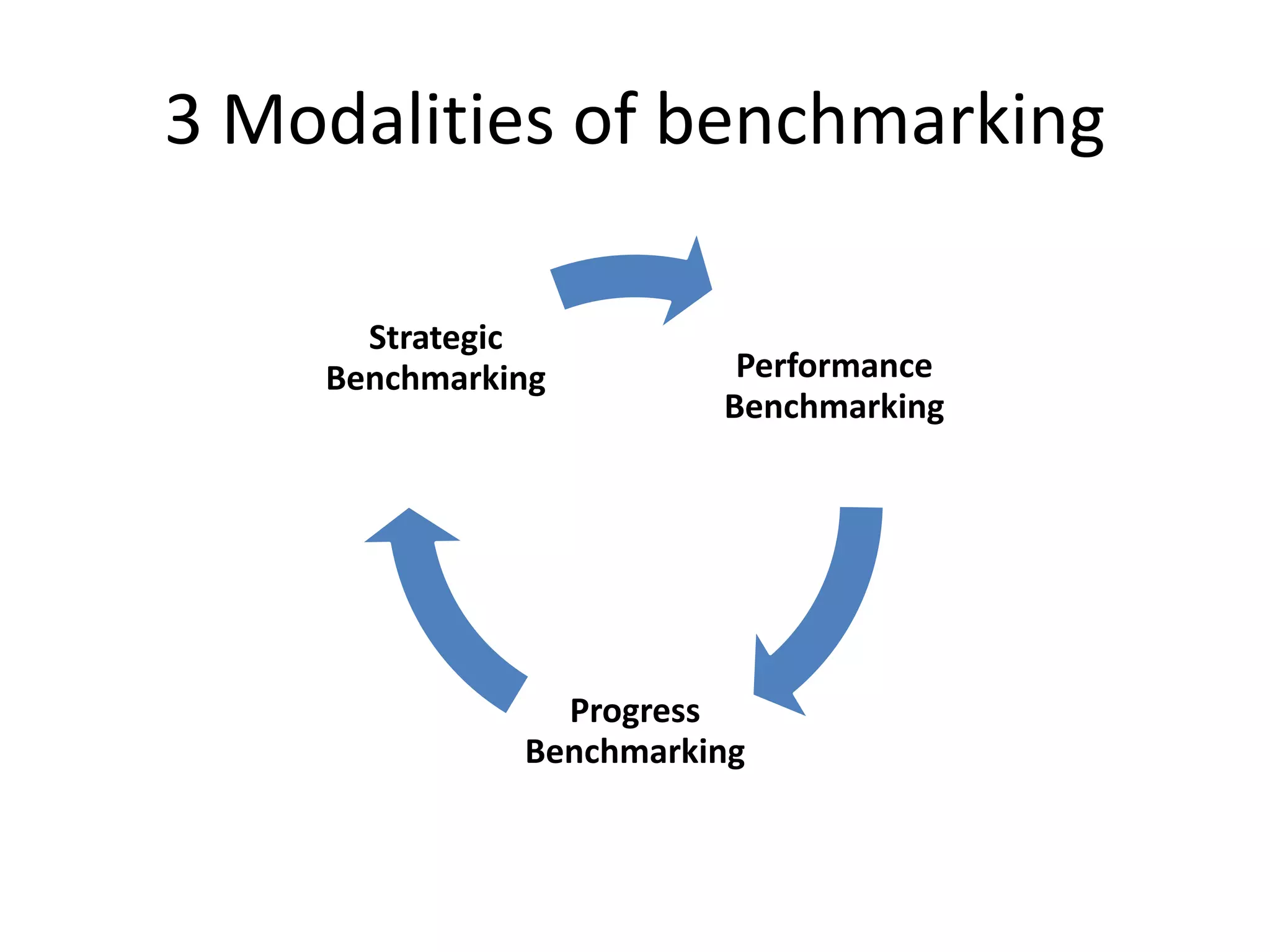
3 Modalities of benchmarking
Performance
Benchmarking
Progress
Benchmarking
Strategic
Benchmarking
The Role of NEDA in Planning
Development
• serves as the national and regional
development plan and program coordinator
based on its mandate from Presidential
Decree 1 and Executive Order 230
• it issues the planning guidelines and
conducts multisectoral and regional
consultations for inputs to the development
plan
• it is tasked with the coordination of official
development assistance and the appraisal of
programs and projects and conducts program
and project evaluation and onsite reviews and
consultations
2 Distinct Entities
a. The NEDA Board is a cabinet level board
composed of the major government
departments and is chaired by the President
of the Philippines.
b. The Secretariat provides technical and
secretariat services to the different NEDA
Committees, inter-agency bodies in
governments and other clients such as local
government units.
• It is tasked to provide technical staff support
and assistance including the conduct of
studies and the development of policy
measures and other recommendations
Source:
PRINCIPLES AND PRACTICES OF
PUBLIC ADMINISTRATION IN THE
PHILIPPINES
by: RICARDO S. LAZO
Chapter 8
EXECUTING PUBLIC POLICY WITH STRATEGIC
MANAGEMENT AND BENCHMARKING

Executing public policy with strategic management and benchmarking

  • 1.
    EXECUTING PUBLIC POLICYWITH STRATEGIC MANAGEMENT AND BENCHMARKING Prepared by: Mildred B. Villacorta MPA Student
  • 2.
    Nature and Thrustof Public Policy PUBLIC POLICY  addresses a host of issues like hosting, transportation, education, health, social services, among others  it creates orderly structures and standards, and a sense of direction  a course of action which a government adopts to tackle specific public concern or issue in the form of regulations, laws, program or decisions
  • 3.
    Three Components ofPublic Policy Making 1. Problem – is a particular apprehension that often requires specific resolution 2. Players – refers to the actors or group of actors that design specific formula to tackle the issue at hand 3. Policy – is the finished course of action ready for implementation
  • 4.
    Building Public Policy Publicpolicy commences with the discovery of a problem and usually the government is confronted with the varying ways to deal with it. a) citizens b) interest groups c) private sector
  • 5.
    Otherwise, the pressuregroups may exploit the situation through different forms of lobbying techniques as they spot the problem. With this, Congress or the legislative department comes in but in many cases the government and the citizens may work together to formulate a sound policy resulting from public opinion, which is seen as the most influential factor in policy making process.
  • 6.
    Public Opinion isAdvanced Through: a) lobby groups b) survey studies c) media exposure or mileage The Policy making process revolves within several factors which trigger agenda initiation, government formulation and implementation, and policy evaluation.
  • 7.
    Every policy designedfor public purpose aims to bring solvency and normalcy to the situation once jeopardized. The success of policy implementation, however, is largely dependent on policy implementers. This is the stage of the policy process, which is purportedly regarded as the common cause of policy defeat and eventual failure.
  • 8.
    Does Government Exist?Does It Really Matter? Government policies generally are aimed at achieving the betterment of the lives of the people in the state, or in crude terms, they refer to the ability of the government to make things either better or worst for the people. The most basic principle is either potentially true or plausibly false.
  • 9.
    Public Administration andPublic Policy Aims to examine: a) how policy was initiated b) prepared c) executed and reviewed d) how the policy outcomes could be improved for the better
  • 10.
    Earlier in 1922 CharlesMerriam – a political scientist, started to hypothesize the relationship between political theory and its application to reality. Shafritz (2009) – government perpetually suffers from a problem similar to that faced by Shakespare’s Hamlet, the indecisive prince of denmark, who struggled whether “to be or not to be”
  • 11.
    Thus, public policyand public administration are two sides of the same coin. One decides the other does. They cannot be separated because one side cannot exist without the other does. But because policy is a continuous process, it cannot end with implementation. Therefore, public administration cannot exist in a policy vacuum. It must have administrative structures that are directed by leaders who wish to do something-if only to maintain the status quo. Thus, all of public administration is inherently an instrument of policy, whether that instrument plays well, poorly, or not at all.
  • 12.
    Defining Public Policy ThomasDye - defined public policy as “ whatever governments choose to do or not to do.” Roskins – a political analyst, modified the earlier definition in this wise: “whatever the government does to do or not to do”
  • 13.
    Policy – isa course of action of action or a series of program adopted by a group or a person or a government in view to address or respond to existing issues or concerns. Issues – is a topic or matter of significance; it is a recognized part of a political agenda which is being sought to remedy its spills. Public Policy – is an action taken by the government to meet a particular demand growing out of the society.
  • 14.
    Public Policy Analysis a)is the study of how governmental policies are made and implemented b) the application of the available knowledge to governmental policies for the purpose of improving their formulation and implementation c) referred to “the monitoring of different government agencies that directly affect a specific community d) to provide the government with facts and statistics about the extent to which such initiatives are working
  • 15.
    Three Traditional Ethicsof Public Administration: 1. effectiveness 2. efficiency 3. economy Hogwood and Peters (1991) in Hague (2001) - Declare the profession of policy analysis is to social science while medicine is to biology.
  • 16.
    Policy outputs –are those referring to what government does, or better put to what government achieves or fails to achieve Outputs – are reasonably measurable Outcomes – are rather harder to quantify since outcomes are the effects of a policy, both unforeseen effects and unintended ones.
  • 17.
    Policy Outputs Model Environment PolicyInputs Policy Process or conversion Policy Outputs
  • 18.
    Policymaking Process Two Aspects: 1)it involves in a link series of actions or events 2) it is a process in the sense that it distinguishes the ‘how’ of the government from the ‘what’ of government
  • 19.
    The Public PolicymakingProcess Environment Situationer --------------- Feedback Agenda Setting Policy Decision or Non- Decision Implementation of a New Program Criticism from Citizens and Formal Program Evaluation Source: Modified from Shafritz, 2009
  • 20.
    Policy Initiation/Agenda Setting Initiation •is the primary stage of policy agenda that resulted from an issue regarded to come out as a problem if not attended to appropriately. • refers to the making of decisions in a certain aspect where policy initiation determines the political agenda through identification of emerging problems as issues of relevance, and by determining how those significant matters are to be responded by the government
  • 21.
    Agenda Setting • isthe process by which ideas or issues bubble up through the various political channels to wind up for consideration by a political institution such as a legislator or court Policy initiation • Can be influenced from top leader, state bureaucrats or lawmakers or “from above” and “from bottom” is also worth noting
  • 22.
    The Agenda SettingProcess An issue is identified by citizens, groups or a public policy Because of the noise created by its supporters, formal decision-makers are forced to consider the issue High publicity like press release, violence and the media, the issue then is expanded to larger audience Modified from Shafritz, 2009
  • 23.
    Anthony Downs attemptsto explain the way in which many policy problems evolve on the political agenda. The cycle is premised on the notion that the public attention rarely remains focused on any one issue. Downs in Shafritz (2009) said that the cycle consists of five steps: 1. The pre-problem 2. Alarmed discovery and euphoric enthusiasm 3. Recognition of the costs of change 4. Decline of public interest 5. The post-problem stage
  • 24.
    Policy Formulation • isthe job for government officials, politicians, consulted groups and key advisers • entails also the definition of issues, framing of objectives, and setting priorities • is the conceptualization stage of policy process where the detailed development of a policy is framed into more or less concrete proposals
  • 25.
    • includes “notonly the translation of broad proposal into specific and detailed recommendations but also the filtering out of proposals and perhaps even the fundamental recasting of the issue under consideration As Heywoods (2002) puts it, it is important to note however, that the final decision which brings the formulation process to an end, may be little more, than a formality: discussion, arguments, and debate having summits thus often ratify or “ rubber stamp” decisions that have effectively been made elsewhere.
  • 26.
    Rational and IncrementalModels of Policymaking Rational Model Incremental Model Goals are set before means are considered. Goals and means are considered together A good policy is the most appropriate for the desired ends. A good policy is one in which all main actors can agree. Analysis is comprehensive, all effects of all options are addressed. Analysis is selected. The object is good policy, not the best policy. Theory is heavily used. Comparison with similar is heavily used. Modified from Lindblom (1959:81) and Parsons (1995:285) in Hague’s Policy Process cited in Lazo, 2009
  • 27.
    Rationalism (Lasswell’s) asa way of formulating decisions or policies is posited on the following rational decision-making approach. Quoting Lasswell’s book seven Significant phrases for every decision should be considered: 1. The intelligence phrase, involving an influx of information 2. The promoting or recommending phrase, involving activities designed to influence the outcome
  • 28.
    3. The prescribingphase, involving the articulation of norms 4. The invoking phase, involving establishing correspondence between prescriptions and concrete circumstances 5. The application phase, in which the prescription is executed 6. The appraisal phase, assessing intent in relation to effect 7. The terminating phase, treating expectations (right) established while the prescription was enforce.
  • 29.
    Policy Implementation Implementation • isthe process of putting the government policy into effect; it is total process of translating a legal mandate, whether an executive order or an enacted statute, into appropriate program directives and structures that provides services or create goods. • the doing part of public administration
  • 30.
    Policy implementation • isalso called policy execution, meaning putting out the policy into practice. There are some conditions to be required in order to achieve perfect implementation in the sense of ensuring that policy is delivered exactly as intended: a) a unitary administrative system with a single line of authority to ensure central control;
  • 31.
    b) uniform normsand rules that operate through the system; c) perfect control; d) perfect information, perfect communication and perfect condition; e) Sufficient time for administrative resources to be modified.
  • 32.
    Policy Evaluation • appraisesoutcomes of a policy as implemented; meaning, what the government achieves • is the appraisal or review of a policy being implemented as to its success or failure Policy appraisal – is the culmination of a course of action which will result in a decision whether it will be continued, altered or terminated
  • 33.
    It has beensaid and overly stated that without the mechanism of policy evaluation, the government will almost always fail to learn from its experience. In fact in highly developed democracies like the United States, at least 1% of the funds allotted to any government project or program shall accrue to system evaluation.
  • 34.
    Distributive, Preventive, and RegulatoryPolicies Preventive policies – are those courses of actions intended to curb or derail any significant impact of an issue or perceived problem to arise by preventing the occurence of a shock Distributive policies – are programs which by nature aim to provide goods and services among members to the society
  • 35.
    Regulatory policies –do impose certain performance operations, standards of services delivery and other rules and mandates are rigid policies to ensure continuity, consistency and accessibility of these provisions to the general public
  • 36.
    Strategic Management and BenchmarkingApproaches Benchmarking management • is basically culled from a military strategy of operation success through tactical planning and systematic execution Benchmarking • is often seen as dramatic and ambitious management approach to compare or contrast successful organization endeavors,
  • 37.
    • it neverthelessproved that benchmarking is truly something to reckon with as institutions, public or private, grow in search for winning ways of dealing and coping with the challenges of the millennium • offers new meaning in public administration as it tries to look into best practices of the other governmental entities as to how they operationally work successfully thereby enticing a unique and more effective governance framework being demonstrated in some parts of the world
  • 38.
    Nature and Thrustof Strategic Management 6 features that identify a strategic management approach: 1. The identification of objectives to be achieved in the future which are often announced in a vision statement; 2. The adoption of a time frame or planning horizon in which these objectives are to be achieved;
  • 39.
    3. A systematicanalysis o a current circumstances of an organization especially its capabilities; 4. An assessment of the environment surrounding the organization both now and within the planning horizon; 5. The selection of a strategy for the achievement of desired objectives by future date, often comparing various alternatives; and 6. The integrity of organizational efforts among this strategy.
  • 40.
    Strategic Management inthe Public Sector 2 Major Challenges a) the long term policy consistency required accommodating the planning and implementation of the organizational changes often triggered by the introduction of new management techniques is hard to obtain
  • 41.
    b) the relativelysimple accountability model found in modern private sector organization, wherein executive directors are responsible to the board for both strategy formation and the management of the execution of this strategy
  • 42.
    Attempt at StrategizingNational Security Framework • Was first propounded by Col. E. Dimacali in 1996 • He argued that designing a foreign policy direction should anchor on multifarious national goals. • He propagated the framework of geo politics vis a vis foreign policy objectives for national security device
  • 43.
    Adopting Strategic Management Approachin the Public Sector The public sector should juxtapose its strategic management approach with that of the private sector strategy in order for the government to reassess the capability of the business group in attaining its objectives, or to compare or compete with them by adopting some of their best practices or strategies.
  • 44.
    Benchmarking the BestPractices • Benchmarking systematically compares work process with those of competitors or with best practices in the industry. • It involves choosing and strategizing key performance areas in an organization and often involves entering into cooperative arrangement with particular organizations.
  • 45.
    3 Modalities ofbenchmarking Performance Benchmarking Progress Benchmarking Strategic Benchmarking
  • 46.
    The Role ofNEDA in Planning Development • serves as the national and regional development plan and program coordinator based on its mandate from Presidential Decree 1 and Executive Order 230 • it issues the planning guidelines and conducts multisectoral and regional consultations for inputs to the development plan
  • 47.
    • it istasked with the coordination of official development assistance and the appraisal of programs and projects and conducts program and project evaluation and onsite reviews and consultations 2 Distinct Entities a. The NEDA Board is a cabinet level board composed of the major government departments and is chaired by the President of the Philippines.
  • 48.
    b. The Secretariatprovides technical and secretariat services to the different NEDA Committees, inter-agency bodies in governments and other clients such as local government units. • It is tasked to provide technical staff support and assistance including the conduct of studies and the development of policy measures and other recommendations
  • 49.
    Source: PRINCIPLES AND PRACTICESOF PUBLIC ADMINISTRATION IN THE PHILIPPINES by: RICARDO S. LAZO Chapter 8 EXECUTING PUBLIC POLICY WITH STRATEGIC MANAGEMENT AND BENCHMARKING