Public Policy Analysis: An
                Introduction
                                               William N. Dunn
                                 Associate Dean and Professor
                                        University of Pittsburg


Dr. Dunn is a scholar, educator, and academic administrator. His
most well-known publication is Public Policy Analysis, 4th
ed.,which is one of the most widely cited books on the
methodology of policy research and analysis in print.
What is Policy Analysis: Definitions
 The use of reason and evidence to select the best policy
  among a number of alternatives to address a particular policy
  problem. (MacRae and Wilde).

 “An applied social science that utilizes multiple research
  methods, in argumentation and debate contexts, to create,
  estimate critically, and communicate knowledge that is
  relevant to the policies.” (Dunn)

 A process through which one identifies and evaluates
  “alternative policies or programs that are intended to lessen
  or resolve social, economic or physical problems” (Patton &
  Sawicki)
“Policy analysis is client oriented
advice relevant to public, or private,
decisions and informed by social
values”
                  Weiner & Vining
A good analysis or even a good
decision Does Not Guarantee that
the optimal solution will be selected
and / or implemented.
What Policy Analysis Can and Cannot
Do…….
Policy analysis can assist decision makers in choosing a
 preferred course of action from complex alternatives
 and under uncertain conditions.

Policy analysis is not a panacea or a substitute for
 inadequate policymaking processes, defects of public
 decisions, bad judgment on the part of analysts or
 policymakers, an exact science or a tool for advocacy by
 the analyst for his/her own views.
One way to look at the Analysis

 The Problem & the Solution
     “a problem well formulated is a problem half solved”


Defining the Policy Problem is easier said than
                   done…..
Not all Public Problems are amenable to
policy analysis, but when they.., the
analysis can support decision making to:
Determine whether a new policy is required to address
 the problem
If a policy already exists, determine whether it needs to
 be modified or terminated
Analyze one policy (retrospectively or prospectively)
Compare two or more policies that address a similar
 problem
Assess future implications of current or new policies
Explore stages in the development of particular policies
We want to learn how to look at
     problems from multiple
perspectives to achieve the best
problem definition and possible /
        feasible solutions
Example:
Increasing rates of lung cancer among certain population
groups could be framed as:

The failure of individuals to stop smoking, or

Failure of the health care providers to provide adequate
 / timely information, or

Failure of the Government to regulate smoking in public
 places, or

Failure on the part of Government to take the
 opportunity to improve research, to raise taxes by
 increasing the price of cigarettes

All of the above
Increasing obesity among youngsters and among
certain population groups could be framed as:

The failure of parents or individual will to change their
 eating behaviors, or

The inability of health care providers to provide
 adequate and timely information, or

Failure of the government to:

  Regulate health care dept.

  Eliminate harmful substances from the general diet

  Build more places for people to exercise

All of the above
Problem Definition
“There is a difference between a condition and a
problem…conditions become defined as problems
when we come to believe that we should do
something about them…the problem doesn’t have to
get any worse or better”.

                                    Kingdon, 1984
Problem Definition in Decision Making

Problem definition depends on:

  How issues are framed, portrayed

  How obvious is the crisis that the problem evokes

  How it is measured

Endless ways to look at a particular problem, yet
 limited time, money and energy.

Hence, highly complex issues are simplified; focus on
 certain aspects happens at the expense of other aspects
 / elements
Challenges of Public Policy problems
(Social problems)

May show up in ways that are difficult to address

“Inherently multidimensional”, overlap & contradict

Are ill defined, so “wicked problems”

The consensus over social goals may be illusory

Decision-makers have different preferences and values,
 often conflicting

The definition of a policy problem is not completely
 scientific or systematic: creativity, sagacity, socially
 constructed
Situation that can be perceived as important
                into a problem


Indicators reveal its existence, magnitude, severity

Events or crisis call attention on a problem

The results of evaluations (or monitoring/surveillance)
 show
Methodology of Policy Analysis: integrates
elements from Multiple disciplines

Political Science

Sociology

Psychology

Economics

Philosophy
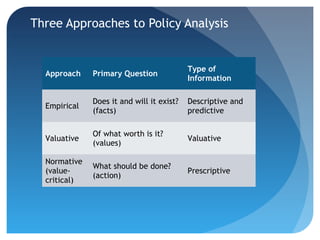
Three Approaches to Policy Analysis


                                           Type of
  Approach    Primary Question
                                           Information

              Does it and will it exist?   Descriptive and
  Empirical
              (facts)                      predictive

              Of what worth is it?
  Valuative                                Valuative
              (values)

  Normative
              What should be done?
  (value-                                  Prescriptive
              (action)
  critical)
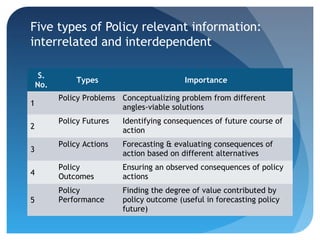
Five types of Policy relevant information:
interrelated and interdependent

     S.
               Types                        Importance
    No.
          Policy Problems Conceptualizing problem from different
1                         angles-viable solutions
          Policy Futures   Identifying consequences of future course of
2                          action
          Policy Actions   Forecasting & evaluating consequences of
3                          action based on different alternatives
          Policy           Ensuring an observed consequences of policy
4         Outcomes         actions
          Policy           Finding the degree of value contributed by
5         Performance      policy outcome (useful in forecasting policy
                           future)
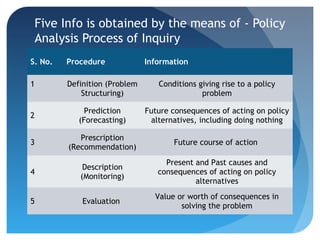
Five Info is obtained by the means of - Policy
 Analysis Process of Inquiry
S. No.   Procedure             Information

1        Definition (Problem      Conditions giving rise to a policy
             Structuring)                     problem

              Prediction       Future consequences of acting on policy
2
            (Forecasting)       alternatives, including doing nothing

            Prescription
3                                     Future course of action
         (Recommendation)
                                    Present and Past causes and
             Description
4                                 consequences of acting on policy
            (Monitoring)
                                            alternatives
                                 Value or worth of consequences in
5            Evaluation
                                        solving the problem
Process of Policy Communication: 4
    Stage Process Knowledge:
                               Policy Problems
                    1           Policy Futures          2
                  Policy        Policy Actions       Materials
                 Analysis     Policy Performance   Development


   Stakeholders:                                              Documents:
  Agenda Setting                                              Policy Memo
Policy Formulation                                            Policy Issue
  Policy Adoption                 Policy                         Papers
 Policy Implemen.                 Analyst                    Exe. Summary
Policy Assessment                                             Appendices
                                                             News Release


                     4           Presentations:           3
                Knowledge        Conversations       Interactive
                Utilization       Conferences      Communication
                                    Meetings
                                    Briefings
                                    Hearings
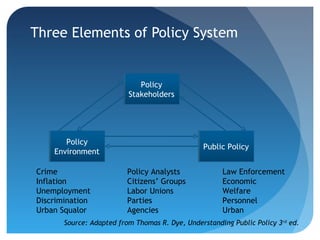
Three Elements of Policy System


                             Policy
                          Stakeholders


       Policy
                                                 Public Policy
    Environment

Crime                     Policy Analysts             Law Enforcement
Inflation                 Citizens’ Groups            Economic
Unemployment              Labor Unions                Welfare
Discrimination            Parties                     Personnel
Urban Squalor             Agencies                    Urban
       Source: Adapted from Thomas R. Dye, Understanding Public Policy 3rd ed.
Six Elements of Policy Arguments: the main
      vehicle for conducting debates about PP
      Issues

                 1. Policy
                 Relevant                            (Therefore)               2. Policy
                                                     6. Qualifier               Claim
               Information
                                                       Probably               Govt. should invest in
Nuclear power is two or three                                                 The construction of
Times more efficient than                                                     Nuclear power plants
Conventional Power Sources                                  (Unless)
                                  (Since)
                                                               5.
                                3. Warrant
                                                            Rebuttal
                 Production of Nuclear energy is               Solar Energy can be developed
                 The only way to ensure continuing growth      On a large scale
                 Of the economy


                                  (Bcoz)                     (Bcoz)
                                4. Backing
                                                            Backing
               Arab Countires can continue
               To embargo oil. Other sources            This is the conclusion of panel of experts
               Are limited
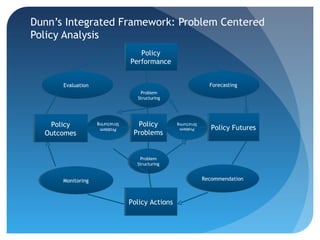
Dunn’s Integrated Framework: Problem Centered
Policy Analysis
                                    Policy
                                 Performance


      Evaluation                                                  Forecasting
                                    Problem
                                   Structuring


   Policy
                   Structuring
                                   Policy         Structuring
                    Problem                        Problem         Policy Futures
  Outcomes                        Problems


                                    Problem
                                   Structuring


      Monitoring                                                Recommendation


                                 Policy Actions
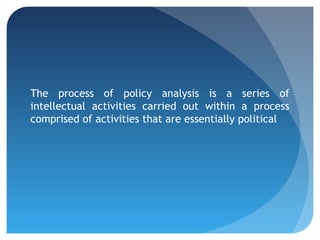
The process of policy analysis is a series of
intellectual activities carried out within a process
comprised of activities that are essentially political
Reconstructed Logic Vs. Logic-in-Use

Reconstructed Logic        Logic-in-Use

Process – problem          Variation can occur due to personal
centered policy analysis   characteristics of analysts and the
                           institutional setting


Designed for               Factors that Influence variation:
methodological purposes    •Cognitive Style: diff. Knowledge
ie. For studying the       •Analytical Roles: Entrep, Politicians and
strengths and              Technicians
weaknesses of different    •Institutional Incentive system: Different
methods & techniques       orientation – humanistic & scientific; quality
of Policy Analysis         control also differs
                           •Institutional time constraints: expedite
                           • Professional Socialization: varied
                           orientation (traditional/basic & applied)
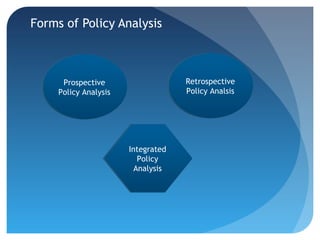
Forms of Policy Analysis


      Prospective                   Retrospective
     Policy Analysis                Policy Analsis


                       Integrated
                          Policy
                         Analysis
Three major forms of Policy Analysis:


Prospective Policy Analysis:

  Involves the production and transformation of
  information before policy actions are initiated and
  implemented.

  Tends to Characterize the operating styles of
  economists, systems analysts, and operations
  researchers.

  Synthesizes information to draw policy alternatives
  and preferences.
Prospective Analysis often creates large gap


                                 Efforts of
           Preferred
                                 Govt. to
          Solutions to
                                resolve the
           Problems
                                 problem
                         Gaps
Retrospective Policy Analysis

Confined to the production and transformation of
information after policy actions have been taken.

Operating styles of three major groups of analysts:

1.Discipline oriented analysts

2.Problem oriented analysts

3.Application oriented analysts
Discipline Oriented           Problem Oriented              Application Oriented
Analysis                      Analysis                      Analysis

Political Scientists &        Political Scientists &        Also persons from social
Sociologists – seeks to       Sociologists - seeks to       work, public
develop and test              describe the causes and       administration &
discipline based theories.    consequences of policies.     evaluation research. Seeks
                                                            to describe causes & consq
Describe the causes and       Less concerned with the       Not concerned with dev.
consequences of the           development and testing of    And testing of discipline
policies.                     theories. Discipline          based theories.
                              Oriented Analysis
                              What affected the policies
Seldom attempts to            Seldom provides info about    They are concerned with
identity specific goals and   specific goals and            the identification of goals
objectives of policymakers    objectives of policymakers.   and objectives of policy
(does not distinguish         Coz the problem they          makers and other
“policy variables”).          analyze are usually of        stakeholders. Good info for
                              general nature.               evaluating policy outcome.
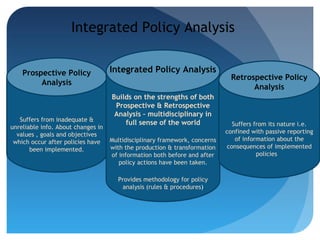
Integrated Policy Analysis


    Prospective Policy              Integrated Policy Analysis
                                                                              Retrospective Policy
         Analysis
                                                                                    Analysis
                                    Builds on the strengths of both
                                     Prospective & Retrospective
                                     Analysis – multidisciplinary in
   Suffers from inadequate &
                                        full sense of the world               Suffers from its nature i.e.
unreliable info. About changes in
  values , goals and objectives                                             confined with passive reporting
 which occur after policies have    Multidisciplinary framework, concerns      of information about the
       been implemented.            with the production & transformation    consequences of implemented
                                    of information both before and after               policies
                                       policy actions have been taken.

                                      Provides methodology for policy
                                       analysis (rules & procedures)
An Integrated Framework

                                 Policy
                              Performance

Evaluation    Retrospective                       Prospective
                                                                    Forecasting
                                  P. S.


 Policy               P.S.       Policy           P.S.                Policy
Outcomes                        Problems                             Futures


             What happened?       P.S.         What will happen?
              After action                      Before action
                                                                   Recommend
        Monitoring
                                                                      ation
                              Policy Actions
Methodology of Policy Analysis: Distinction
between theories

Descriptive Decision Theory: set of logically consistent
 propositions that describe action. Primary aim is to
 understand a policy problem rather than to solve it.

Normative Decision Theory: set of logically consistent
 propositions that provide a basis for improving the
 consequences of action. Appropriate for predicting and
 recommending different courses of action before they
 have occurred. Aim is to solve the problem - “Problem
 Solving” methodology.
Summary
A combination and transformation of the
 substance and methods of several disciplines,
 intends to produce policy relevant information
 to resolve the problems
Knowledge of what is (fact), what is right
 (values) and what to do (action) requires /
 demands the use of multiple methods of
 inquiry
Policy analysis has 3 main forms: prospective,
 retrospective & integrated
Thank you

Public policy analysis_dunn

  • 1.
    Public Policy Analysis:An Introduction William N. Dunn Associate Dean and Professor University of Pittsburg Dr. Dunn is a scholar, educator, and academic administrator. His most well-known publication is Public Policy Analysis, 4th ed.,which is one of the most widely cited books on the methodology of policy research and analysis in print.
  • 2.
    What is PolicyAnalysis: Definitions  The use of reason and evidence to select the best policy among a number of alternatives to address a particular policy problem. (MacRae and Wilde).  “An applied social science that utilizes multiple research methods, in argumentation and debate contexts, to create, estimate critically, and communicate knowledge that is relevant to the policies.” (Dunn)  A process through which one identifies and evaluates “alternative policies or programs that are intended to lessen or resolve social, economic or physical problems” (Patton & Sawicki)
  • 3.
    “Policy analysis isclient oriented advice relevant to public, or private, decisions and informed by social values” Weiner & Vining
  • 4.
    A good analysisor even a good decision Does Not Guarantee that the optimal solution will be selected and / or implemented.
  • 5.
    What Policy AnalysisCan and Cannot Do……. Policy analysis can assist decision makers in choosing a preferred course of action from complex alternatives and under uncertain conditions. Policy analysis is not a panacea or a substitute for inadequate policymaking processes, defects of public decisions, bad judgment on the part of analysts or policymakers, an exact science or a tool for advocacy by the analyst for his/her own views.
  • 6.
    One way tolook at the Analysis The Problem & the Solution “a problem well formulated is a problem half solved” Defining the Policy Problem is easier said than done…..
  • 7.
    Not all PublicProblems are amenable to policy analysis, but when they.., the analysis can support decision making to: Determine whether a new policy is required to address the problem If a policy already exists, determine whether it needs to be modified or terminated Analyze one policy (retrospectively or prospectively) Compare two or more policies that address a similar problem Assess future implications of current or new policies Explore stages in the development of particular policies
  • 8.
    We want tolearn how to look at problems from multiple perspectives to achieve the best problem definition and possible / feasible solutions
  • 9.
    Example: Increasing rates oflung cancer among certain population groups could be framed as: The failure of individuals to stop smoking, or Failure of the health care providers to provide adequate / timely information, or Failure of the Government to regulate smoking in public places, or Failure on the part of Government to take the opportunity to improve research, to raise taxes by increasing the price of cigarettes All of the above
  • 10.
    Increasing obesity amongyoungsters and among certain population groups could be framed as: The failure of parents or individual will to change their eating behaviors, or The inability of health care providers to provide adequate and timely information, or Failure of the government to: Regulate health care dept. Eliminate harmful substances from the general diet Build more places for people to exercise All of the above
  • 11.
    Problem Definition “There isa difference between a condition and a problem…conditions become defined as problems when we come to believe that we should do something about them…the problem doesn’t have to get any worse or better”. Kingdon, 1984
  • 12.
    Problem Definition inDecision Making Problem definition depends on: How issues are framed, portrayed How obvious is the crisis that the problem evokes How it is measured Endless ways to look at a particular problem, yet limited time, money and energy. Hence, highly complex issues are simplified; focus on certain aspects happens at the expense of other aspects / elements
  • 13.
    Challenges of PublicPolicy problems (Social problems) May show up in ways that are difficult to address “Inherently multidimensional”, overlap & contradict Are ill defined, so “wicked problems” The consensus over social goals may be illusory Decision-makers have different preferences and values, often conflicting The definition of a policy problem is not completely scientific or systematic: creativity, sagacity, socially constructed
  • 14.
    Situation that canbe perceived as important into a problem Indicators reveal its existence, magnitude, severity Events or crisis call attention on a problem The results of evaluations (or monitoring/surveillance) show
  • 15.
    Methodology of PolicyAnalysis: integrates elements from Multiple disciplines Political Science Sociology Psychology Economics Philosophy
  • 16.
    Three Approaches toPolicy Analysis Type of Approach Primary Question Information Does it and will it exist? Descriptive and Empirical (facts) predictive Of what worth is it? Valuative Valuative (values) Normative What should be done? (value- Prescriptive (action) critical)
  • 17.
    Five types ofPolicy relevant information: interrelated and interdependent S. Types Importance No. Policy Problems Conceptualizing problem from different 1 angles-viable solutions Policy Futures Identifying consequences of future course of 2 action Policy Actions Forecasting & evaluating consequences of 3 action based on different alternatives Policy Ensuring an observed consequences of policy 4 Outcomes actions Policy Finding the degree of value contributed by 5 Performance policy outcome (useful in forecasting policy future)
  • 18.
    Five Info isobtained by the means of - Policy Analysis Process of Inquiry S. No. Procedure Information 1 Definition (Problem Conditions giving rise to a policy Structuring) problem Prediction Future consequences of acting on policy 2 (Forecasting) alternatives, including doing nothing Prescription 3 Future course of action (Recommendation) Present and Past causes and Description 4 consequences of acting on policy (Monitoring) alternatives Value or worth of consequences in 5 Evaluation solving the problem
  • 19.
    Process of PolicyCommunication: 4 Stage Process Knowledge: Policy Problems 1 Policy Futures 2 Policy Policy Actions Materials Analysis Policy Performance Development Stakeholders: Documents: Agenda Setting Policy Memo Policy Formulation Policy Issue Policy Adoption Policy Papers Policy Implemen. Analyst Exe. Summary Policy Assessment Appendices News Release 4 Presentations: 3 Knowledge Conversations Interactive Utilization Conferences Communication Meetings Briefings Hearings
  • 20.
    Three Elements ofPolicy System Policy Stakeholders Policy Public Policy Environment Crime Policy Analysts Law Enforcement Inflation Citizens’ Groups Economic Unemployment Labor Unions Welfare Discrimination Parties Personnel Urban Squalor Agencies Urban Source: Adapted from Thomas R. Dye, Understanding Public Policy 3rd ed.
  • 21.
    Six Elements ofPolicy Arguments: the main vehicle for conducting debates about PP Issues 1. Policy Relevant (Therefore) 2. Policy 6. Qualifier Claim Information Probably Govt. should invest in Nuclear power is two or three The construction of Times more efficient than Nuclear power plants Conventional Power Sources (Unless) (Since) 5. 3. Warrant Rebuttal Production of Nuclear energy is Solar Energy can be developed The only way to ensure continuing growth On a large scale Of the economy (Bcoz) (Bcoz) 4. Backing Backing Arab Countires can continue To embargo oil. Other sources This is the conclusion of panel of experts Are limited
  • 22.
    Dunn’s Integrated Framework:Problem Centered Policy Analysis Policy Performance Evaluation Forecasting Problem Structuring Policy Structuring Policy Structuring Problem Problem Policy Futures Outcomes Problems Problem Structuring Monitoring Recommendation Policy Actions
  • 23.
    The process ofpolicy analysis is a series of intellectual activities carried out within a process comprised of activities that are essentially political
  • 24.
    Reconstructed Logic Vs.Logic-in-Use Reconstructed Logic Logic-in-Use Process – problem Variation can occur due to personal centered policy analysis characteristics of analysts and the institutional setting Designed for Factors that Influence variation: methodological purposes •Cognitive Style: diff. Knowledge ie. For studying the •Analytical Roles: Entrep, Politicians and strengths and Technicians weaknesses of different •Institutional Incentive system: Different methods & techniques orientation – humanistic & scientific; quality of Policy Analysis control also differs •Institutional time constraints: expedite • Professional Socialization: varied orientation (traditional/basic & applied)
  • 25.
    Forms of PolicyAnalysis Prospective Retrospective Policy Analysis Policy Analsis Integrated Policy Analysis
  • 26.
    Three major formsof Policy Analysis: Prospective Policy Analysis: Involves the production and transformation of information before policy actions are initiated and implemented. Tends to Characterize the operating styles of economists, systems analysts, and operations researchers. Synthesizes information to draw policy alternatives and preferences.
  • 27.
    Prospective Analysis oftencreates large gap Efforts of Preferred Govt. to Solutions to resolve the Problems problem Gaps
  • 28.
    Retrospective Policy Analysis Confinedto the production and transformation of information after policy actions have been taken. Operating styles of three major groups of analysts: 1.Discipline oriented analysts 2.Problem oriented analysts 3.Application oriented analysts
  • 29.
    Discipline Oriented Problem Oriented Application Oriented Analysis Analysis Analysis Political Scientists & Political Scientists & Also persons from social Sociologists – seeks to Sociologists - seeks to work, public develop and test describe the causes and administration & discipline based theories. consequences of policies. evaluation research. Seeks to describe causes & consq Describe the causes and Less concerned with the Not concerned with dev. consequences of the development and testing of And testing of discipline policies. theories. Discipline based theories. Oriented Analysis What affected the policies Seldom attempts to Seldom provides info about They are concerned with identity specific goals and specific goals and the identification of goals objectives of policymakers objectives of policymakers. and objectives of policy (does not distinguish Coz the problem they makers and other “policy variables”). analyze are usually of stakeholders. Good info for general nature. evaluating policy outcome.
  • 30.
    Integrated Policy Analysis Prospective Policy Integrated Policy Analysis Retrospective Policy Analysis Analysis Builds on the strengths of both Prospective & Retrospective Analysis – multidisciplinary in Suffers from inadequate & full sense of the world Suffers from its nature i.e. unreliable info. About changes in values , goals and objectives confined with passive reporting which occur after policies have Multidisciplinary framework, concerns of information about the been implemented. with the production & transformation consequences of implemented of information both before and after policies policy actions have been taken. Provides methodology for policy analysis (rules & procedures)
  • 31.
    An Integrated Framework Policy Performance Evaluation Retrospective Prospective Forecasting P. S. Policy P.S. Policy P.S. Policy Outcomes Problems Futures What happened? P.S. What will happen? After action Before action Recommend Monitoring ation Policy Actions
  • 32.
    Methodology of PolicyAnalysis: Distinction between theories Descriptive Decision Theory: set of logically consistent propositions that describe action. Primary aim is to understand a policy problem rather than to solve it. Normative Decision Theory: set of logically consistent propositions that provide a basis for improving the consequences of action. Appropriate for predicting and recommending different courses of action before they have occurred. Aim is to solve the problem - “Problem Solving” methodology.
  • 33.
    Summary A combination andtransformation of the substance and methods of several disciplines, intends to produce policy relevant information to resolve the problems Knowledge of what is (fact), what is right (values) and what to do (action) requires / demands the use of multiple methods of inquiry Policy analysis has 3 main forms: prospective, retrospective & integrated
  • 34.