Social Policy and Policy
Analysis
What is Social Policy and Policy Analysis? (1c)
Key General
Reading
What is Social Policy?
Social policy has two main meanings:
1. Social Policy in practice
 The state-based supply of goods and services designed to meet basic needs and mitigate the
worst inequalities of capitalism (Marshall, 1950)
 A range of measures concerned with the reduction of poverty and need provided by not only
the state but private and voluntary organisations
2. Social Policy as an academic discipline
As a discipline, social policy stands at the centre of the social sciences, importing from – and
exporting to – other disciplines such as political science, sociology, public management,
economics, health economics and criminology. In other words social policy is an
‘interdisciplinary’ area of study.
Social policy is in this position because…
…It is eclectic in nature
To understand policy it is important to be aware of:
 the social, political and economic contexts of policy making
 key ideas and ideologies that form the basis of social and political argument about, for
example, human need and (in)equality.
 the different national and cultural understandings that inform the differential development
and implementation of specific policies
 the costs of social policies and the various methods that governments have devised for
paying (or not paying) for key goods and services.
Ultimately, I would argue, social policy is a highly political area of study
because both the practice of policy making and the academic analysis of
social policy are primarily concerned with contested debates about
‘fairness’, ‘justice’, ‘liberty’ – and also about the relative needs of different
social groups…women, minority ethnic populations, disabled people and
the very young and older people.
This module
As the title and module aims suggest, this module is concerned with policy analysis,
but its main concern is with the conditions (social, political, economic) within which
‘policy’ gets ‘made’ and implemented. With this formulation in mind we are
interested in:
 Processes of policy making, implementation and impact
 The delivery and implementation of specific social policies (health, education,
employment)
 The complexities associated with the above.
One of the most important general questions to think about is whether policy making is a rational process – or
whether it is rather more chaotic and messy…
A Rational Process?...
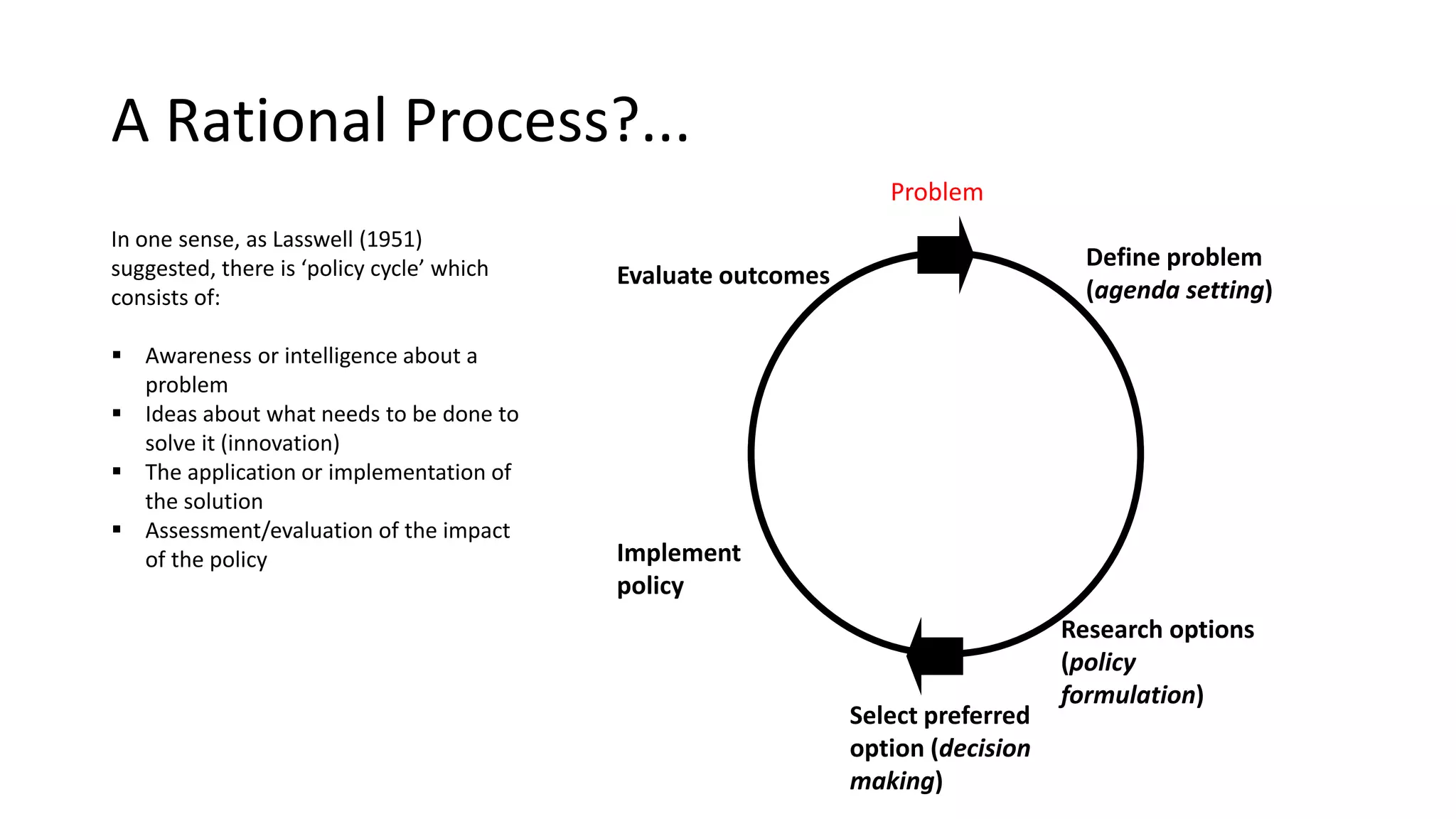
In one sense, as Lasswell (1951)
suggested, there is ‘policy cycle’ which
consists of:
 Awareness or intelligence about a
problem
 Ideas about what needs to be done to
solve it (innovation)
 The application or implementation of
the solution
 Assessment/evaluation of the impact
of the policy
Evaluate outcomes
Problem
Define problem
(agenda setting)
Research options
(policy
formulation)
Select preferred
option (decision
making)
Implement
policy
…or Complexity and Mess
As key scholars like Charles Lindblom (1959) said many years ago…things are
rather more muddled than this. The ‘cycle’ can be affected by (at least):
 Unacknowledged conditions and unintended consequences of action
 Opposition from different groups and movements
 Institutional inertia
As Lindblom argued, policy making tends to be incremental and gradual. Much depends on
‘context’…and also much depends on the scale that we are working to and the particular
focus of interest at a specific analytical point. However…we live in interesting times and
perhaps the conditions that affect policy making are becoming ever less stable and
predictable (they were never ‘predictable’!).
Approaches to Policy Analysis: macro-, meso-
and micro-levels
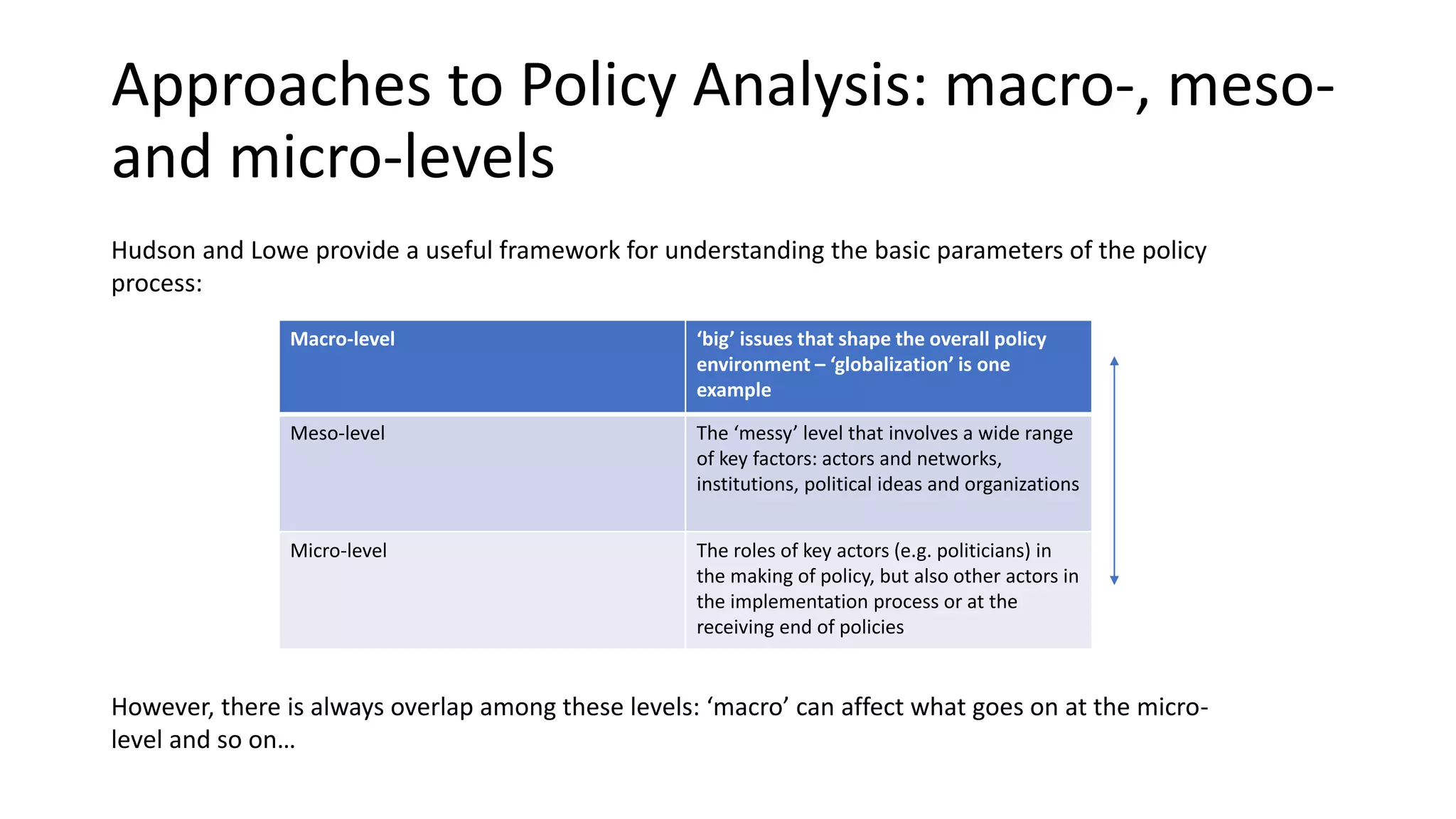
Hudson and Lowe provide a useful framework for understanding the basic parameters of the policy
process:
Macro-level ‘big’ issues that shape the overall policy
environment – ‘globalization’ is one
example
Meso-level The ‘messy’ level that involves a wide range
of key factors: actors and networks,
institutions, political ideas and organizations
Micro-level The roles of key actors (e.g. politicians) in
the making of policy, but also other actors in
the implementation process or at the
receiving end of policies
However, there is always overlap among these levels: ‘macro’ can affect what goes on at the micro-
level and so on…
What is ‘Policy’?
For Spicker (2008: 69), policy is a contested term:
 A label for a field of government activity
 An expression of a desired state of affairs
 A set of specific proposals
 Decisions made by government
 Strategies or programmes for action
 The product of a process of decision making
Spicker is talking about public policy (which incorporates social
policy) – but this hardly narrows the field. We are interested in:
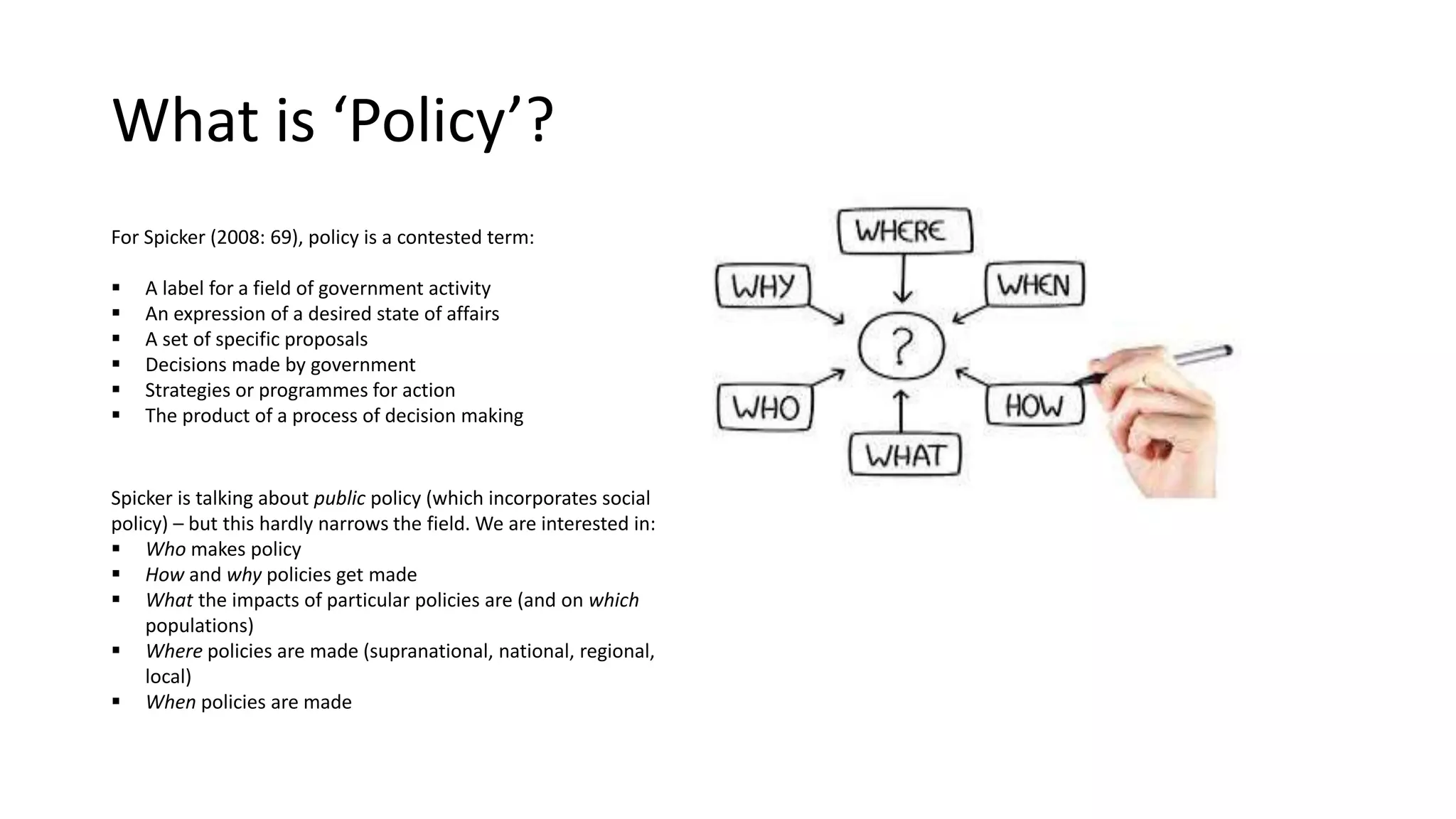
 Who makes policy
 How and why policies get made
 What the impacts of particular policies are (and on which
populations)
 Where policies are made (supranational, national, regional,
local)
 When policies are made
What is ‘Policy’?
Is this a ‘policy’, an ideology,
a political demand…or all
three?

Introduction to Social Policy Analysis 1c.pptx

  • 1.
    Social Policy andPolicy Analysis What is Social Policy and Policy Analysis? (1c)
  • 2.
  • 3.
    What is SocialPolicy? Social policy has two main meanings: 1. Social Policy in practice  The state-based supply of goods and services designed to meet basic needs and mitigate the worst inequalities of capitalism (Marshall, 1950)  A range of measures concerned with the reduction of poverty and need provided by not only the state but private and voluntary organisations 2. Social Policy as an academic discipline As a discipline, social policy stands at the centre of the social sciences, importing from – and exporting to – other disciplines such as political science, sociology, public management, economics, health economics and criminology. In other words social policy is an ‘interdisciplinary’ area of study. Social policy is in this position because…
  • 4.
    …It is eclecticin nature To understand policy it is important to be aware of:  the social, political and economic contexts of policy making  key ideas and ideologies that form the basis of social and political argument about, for example, human need and (in)equality.  the different national and cultural understandings that inform the differential development and implementation of specific policies  the costs of social policies and the various methods that governments have devised for paying (or not paying) for key goods and services. Ultimately, I would argue, social policy is a highly political area of study because both the practice of policy making and the academic analysis of social policy are primarily concerned with contested debates about ‘fairness’, ‘justice’, ‘liberty’ – and also about the relative needs of different social groups…women, minority ethnic populations, disabled people and the very young and older people.
  • 5.
    This module As thetitle and module aims suggest, this module is concerned with policy analysis, but its main concern is with the conditions (social, political, economic) within which ‘policy’ gets ‘made’ and implemented. With this formulation in mind we are interested in:  Processes of policy making, implementation and impact  The delivery and implementation of specific social policies (health, education, employment)  The complexities associated with the above. One of the most important general questions to think about is whether policy making is a rational process – or whether it is rather more chaotic and messy…
  • 6.
    A Rational Process?... Inone sense, as Lasswell (1951) suggested, there is ‘policy cycle’ which consists of:  Awareness or intelligence about a problem  Ideas about what needs to be done to solve it (innovation)  The application or implementation of the solution  Assessment/evaluation of the impact of the policy Evaluate outcomes Problem Define problem (agenda setting) Research options (policy formulation) Select preferred option (decision making) Implement policy
  • 7.
    …or Complexity andMess As key scholars like Charles Lindblom (1959) said many years ago…things are rather more muddled than this. The ‘cycle’ can be affected by (at least):  Unacknowledged conditions and unintended consequences of action  Opposition from different groups and movements  Institutional inertia As Lindblom argued, policy making tends to be incremental and gradual. Much depends on ‘context’…and also much depends on the scale that we are working to and the particular focus of interest at a specific analytical point. However…we live in interesting times and perhaps the conditions that affect policy making are becoming ever less stable and predictable (they were never ‘predictable’!).
  • 8.
    Approaches to PolicyAnalysis: macro-, meso- and micro-levels Hudson and Lowe provide a useful framework for understanding the basic parameters of the policy process: Macro-level ‘big’ issues that shape the overall policy environment – ‘globalization’ is one example Meso-level The ‘messy’ level that involves a wide range of key factors: actors and networks, institutions, political ideas and organizations Micro-level The roles of key actors (e.g. politicians) in the making of policy, but also other actors in the implementation process or at the receiving end of policies However, there is always overlap among these levels: ‘macro’ can affect what goes on at the micro- level and so on…
  • 9.
    What is ‘Policy’? ForSpicker (2008: 69), policy is a contested term:  A label for a field of government activity  An expression of a desired state of affairs  A set of specific proposals  Decisions made by government  Strategies or programmes for action  The product of a process of decision making Spicker is talking about public policy (which incorporates social policy) – but this hardly narrows the field. We are interested in:  Who makes policy  How and why policies get made  What the impacts of particular policies are (and on which populations)  Where policies are made (supranational, national, regional, local)  When policies are made
  • 10.
    What is ‘Policy’? Isthis a ‘policy’, an ideology, a political demand…or all three?

Editor's Notes

  • #3 This slide is for information only. It provides pictures of some key book titles.
  • #5 The picture is for decorative purposes only!
  • #7 The diagram in the slide provides a very basic model of the ‘policy process’. We start with a problem and define it, then we move on researching possible options for policy and this is followed by selecting a particular policy or set of options. The policy is then implemented and finally it is evaluated…then the cycle starts again. This is an ‘ideal typical’ model.
  • #10 The diagram is largely for decorative purposes. It asks about the where, what and who of policy making…this will be explained verbally and is also depicted in the text.
  • #11 The picture is for decorative purposes.