Slide Show of Principles of
Public Administration
By Kamil Sayed Baloch
BPA 2nd Semester
BZU Multan
1
Principles of Public Adminstration
• Definition
• Nature & Sope
• Role in a Welfare State
• Major Schools of Thought
• Bureaucracy
• Concept, Theories, & Ecology
2
• Financial Administration
• Budget Making Process.
• Approaches to Public Budgeting.
• Fiscal Reforms
• Administrative Accountability
• Organization
&
Decision Making
3
• Public Personnel Administration
• Motivation
• What is Motivation?
• Types.
• Approaches
• Planning & Public Sector Project Management
• New Public Management
• The Future of Public Administration
4
Public Administration
Introduction, Nature & Scope
• Difficult to define
• Public Administration has no generally accepted definition because
the scope of the subject is so great and so debatable and diversified
that it is easier to explain than define
• Public Administration-the implementation of government policy
– an academic discipline that studies this implementation and that
prepares civil servants for this work.
– As a field of inquiry into all sorts of government activities with a
diverse scope.
– Its fundamental goal is to advance management processes and
policies so that government can function.
5
Public Administration comprises establishments
primarily engaged in activities of a governmental
in nature i.e. the enactment and judicial
interpretation of laws and their regulations, and
the administration of programs based on them.
– This includes
• Legislative activities,
• Dispensation of justice
• Tax administration
• national defense
• public order and safety
• immigration services
• foreign affairs and international assistance
• the administration of government programs
6
Definitions
• L D White
“The coordination of collective efforts to implement
public policy”
• E N Gladden
“Public Administration is concerned with the administration
of the government”
• David Rosenbloom
“Public administration is the use of managerial,
political, and legal theories and processes to fulfill
legislative, executive, judicial mandates for the
provision of governmental regulatory and service
functions.”
7
• Public Administration is the study of
interaction of executive, legislative, and
judicial branches of government from
managerial, political and legal perspectives to
implement public policies and programmes.
8
Nature & Scope
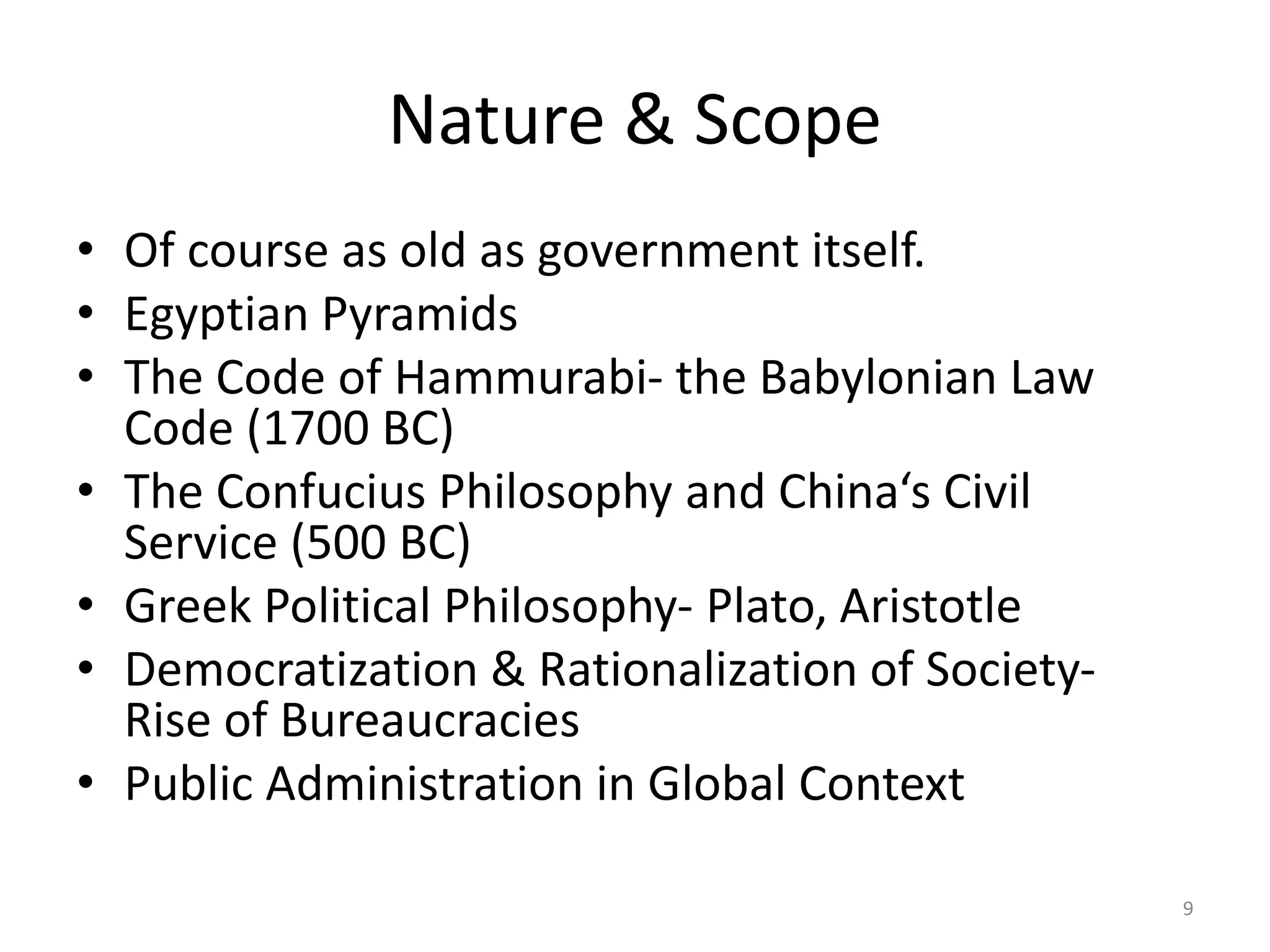
• Of course as old as government itself.
• Egyptian Pyramids
• The Code of Hammurabi- the Babylonian Law
Code (1700 BC)
• The Confucius Philosophy and China‘s Civil
Service (500 BC)
• Greek Political Philosophy- Plato, Aristotle
• Democratization & Rationalization of Society-
Rise of Bureaucracies
• Public Administration in Global Context
9
Woodrow Wilson-1887
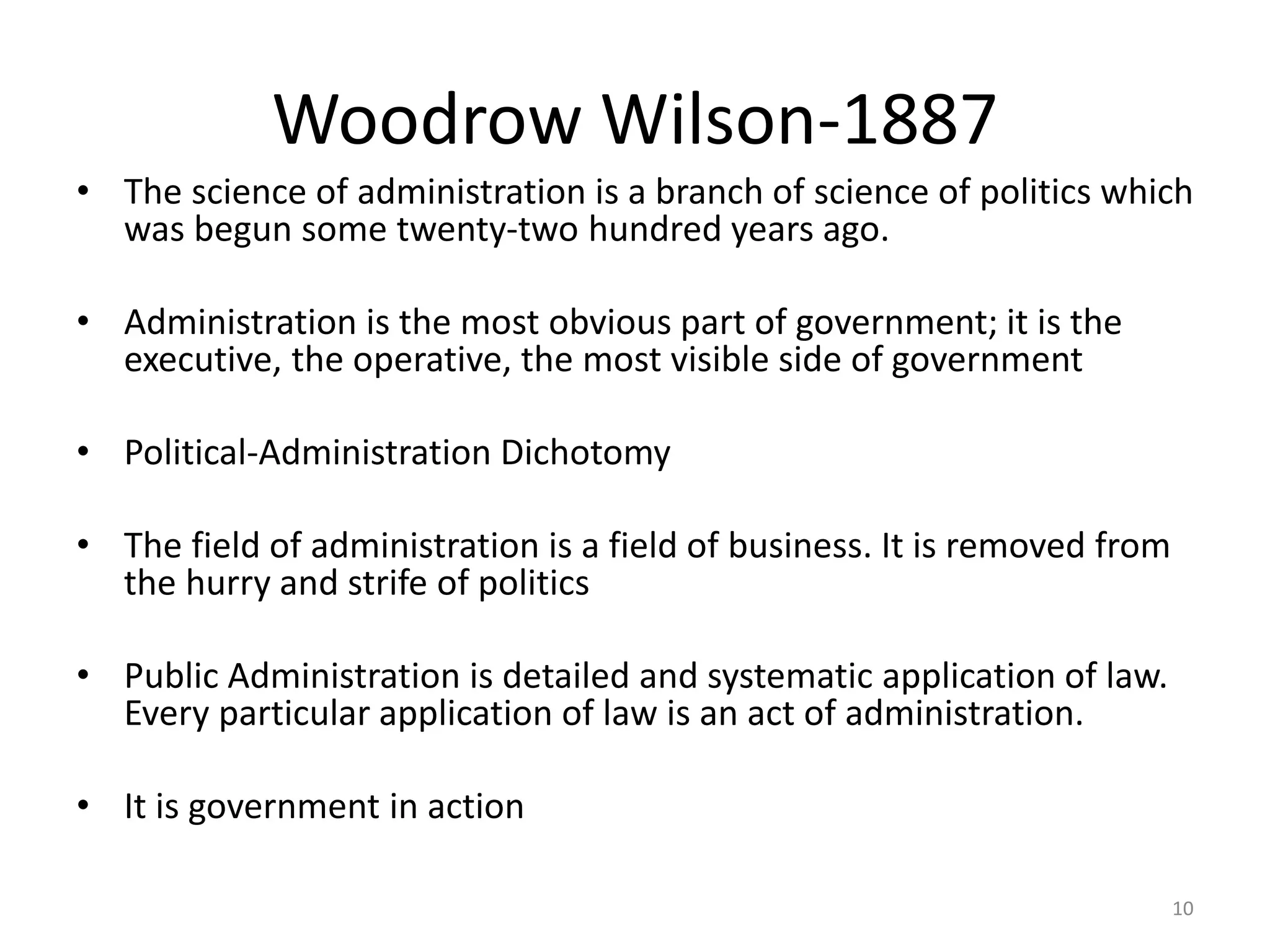
• The science of administration is a branch of science of politics which
was begun some twenty-two hundred years ago.
• Administration is the most obvious part of government; it is the
executive, the operative, the most visible side of government
• Political-Administration Dichotomy
• The field of administration is a field of business. It is removed from
the hurry and strife of politics
• Public Administration is detailed and systematic application of law.
Every particular application of law is an act of administration.
• It is government in action
10
Luther Gulick
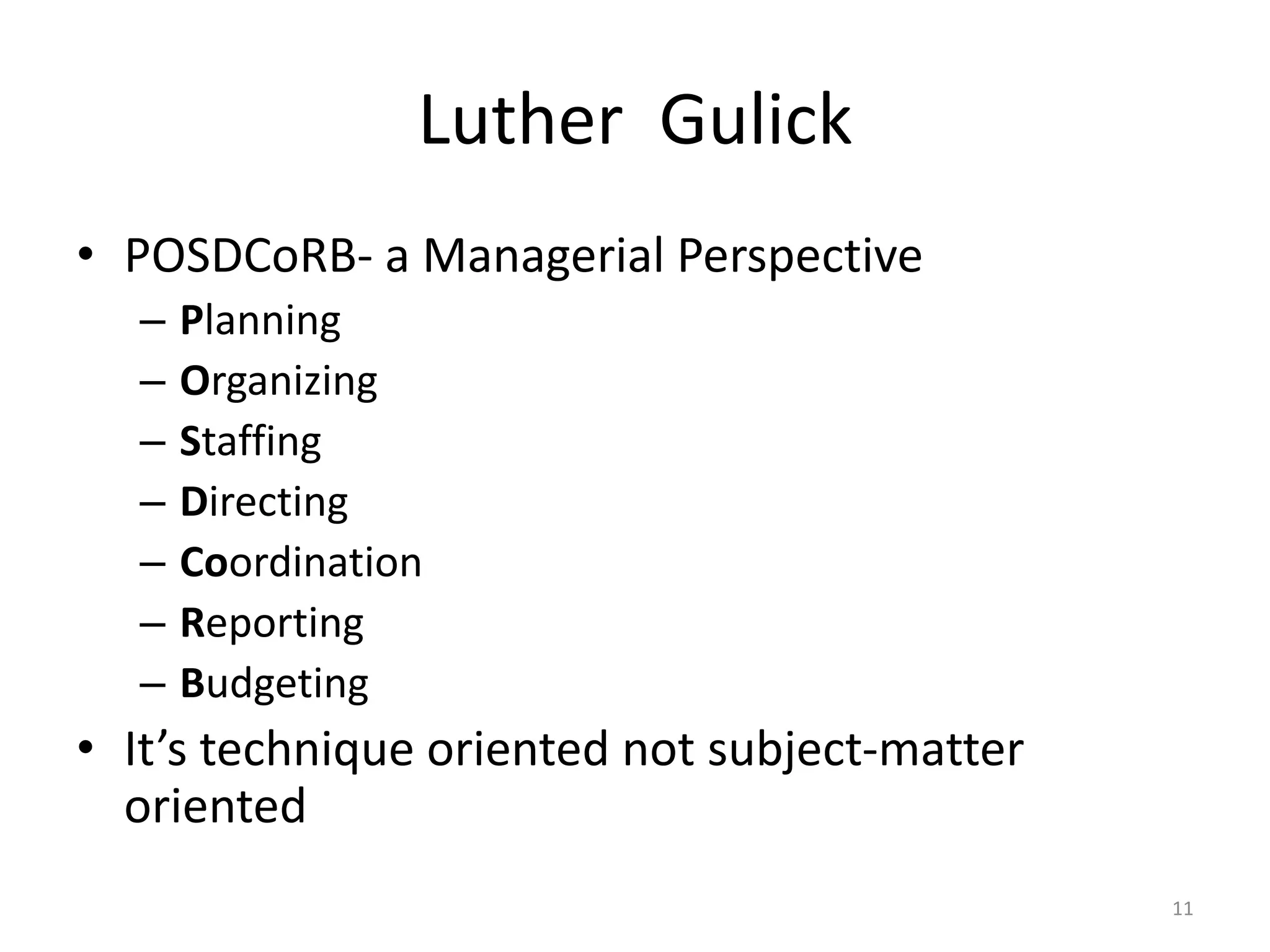
• POSDCoRB- a Managerial Perspective
– Planning
– Organizing
– Staffing
– Directing
– Coordination
– Reporting
– Budgeting
• It’s technique oriented not subject-matter
oriented
11
Prof. J M Pfiffner
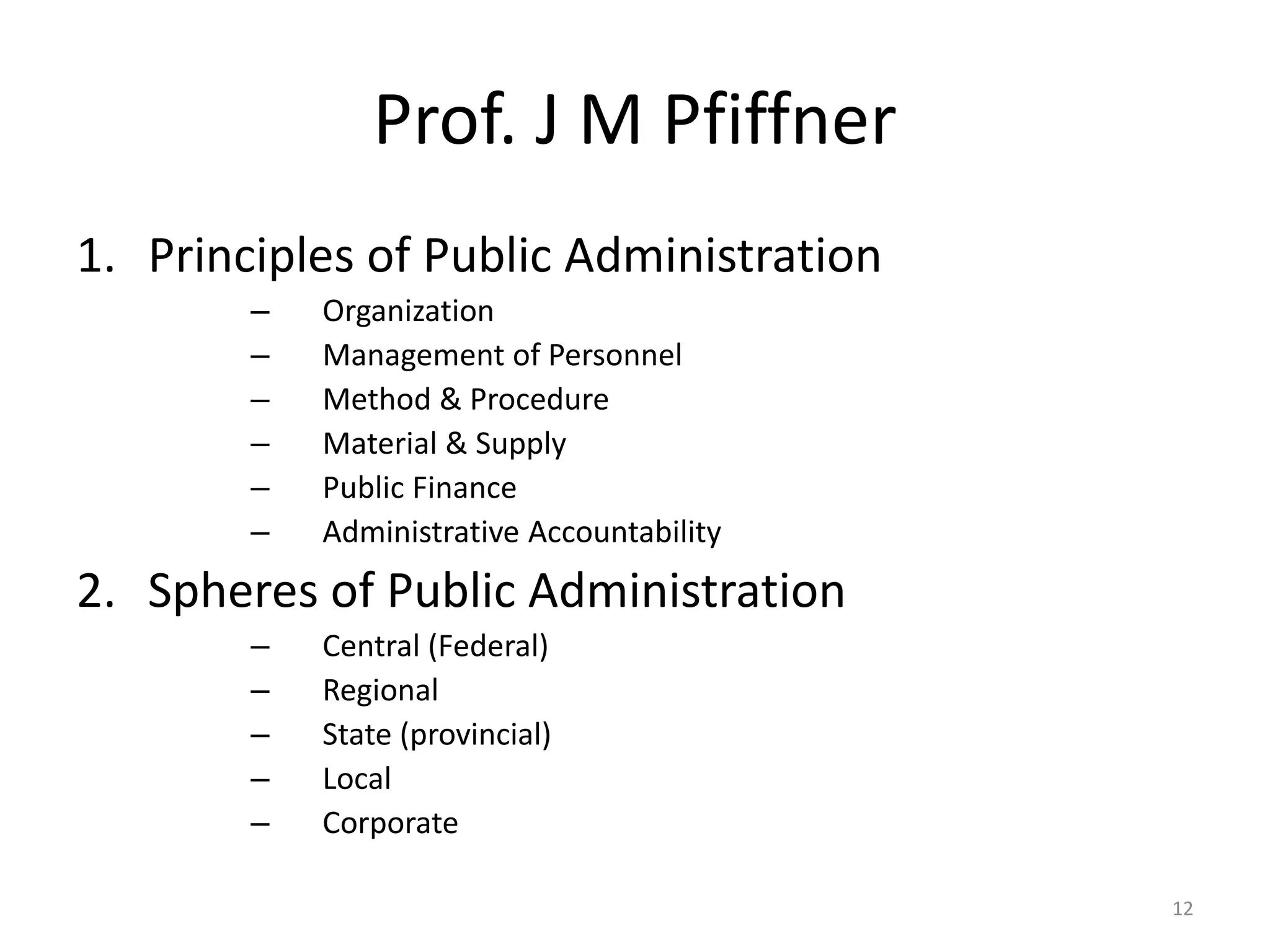
1. Principles of Public Administration
– Organization
– Management of Personnel
– Method & Procedure
– Material & Supply
– Public Finance
– Administrative Accountability
2. Spheres of Public Administration
– Central (Federal)
– Regional
– State (provincial)
– Local
– Corporate
12
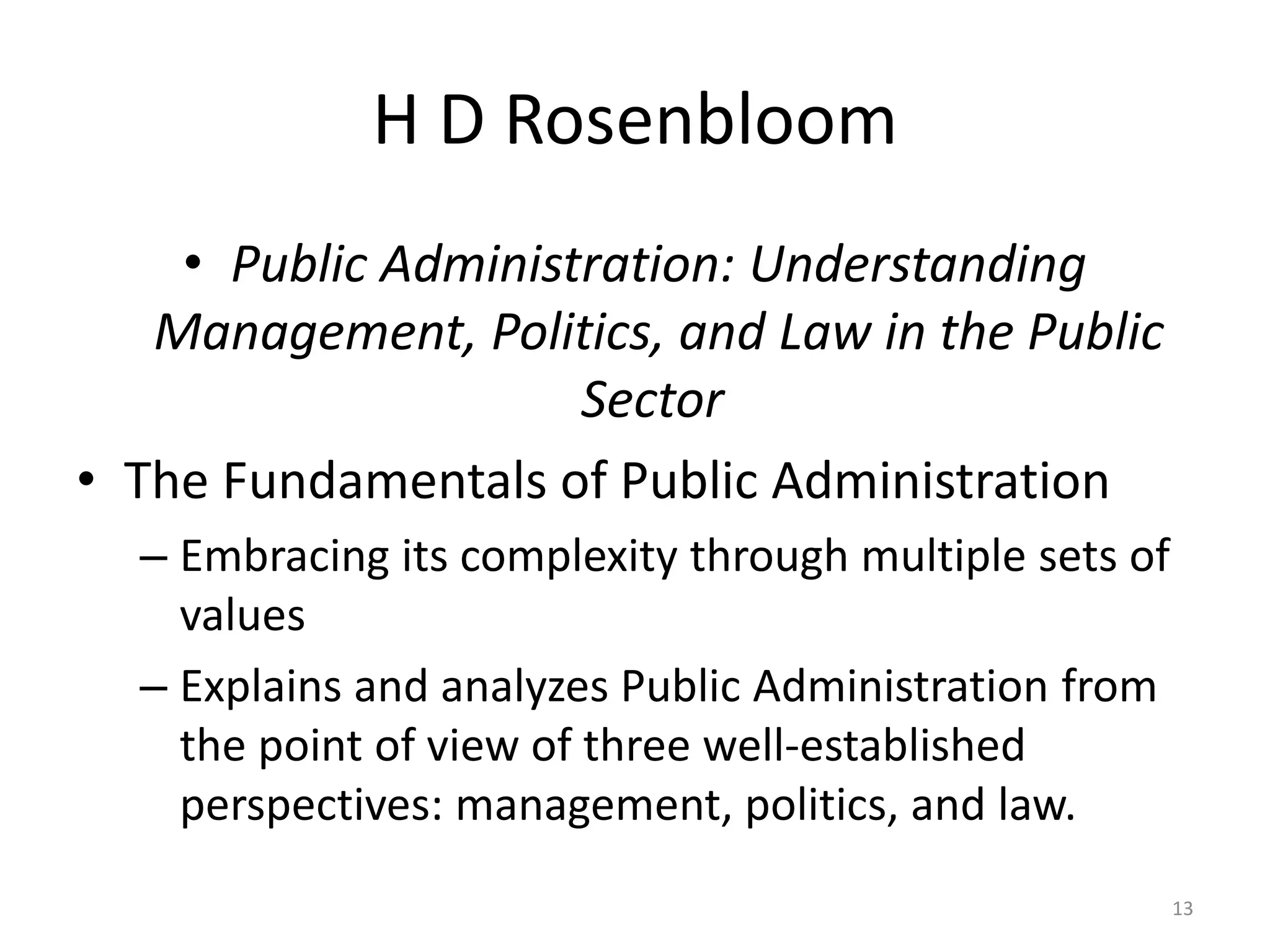
H D Rosenbloom
• Public Administration: Understanding
Management, Politics, and Law in the Public
Sector
• The Fundamentals of Public Administration
– Embracing its complexity through multiple sets of
values
– Explains and analyzes Public Administration from
the point of view of three well-established
perspectives: management, politics, and law.
13
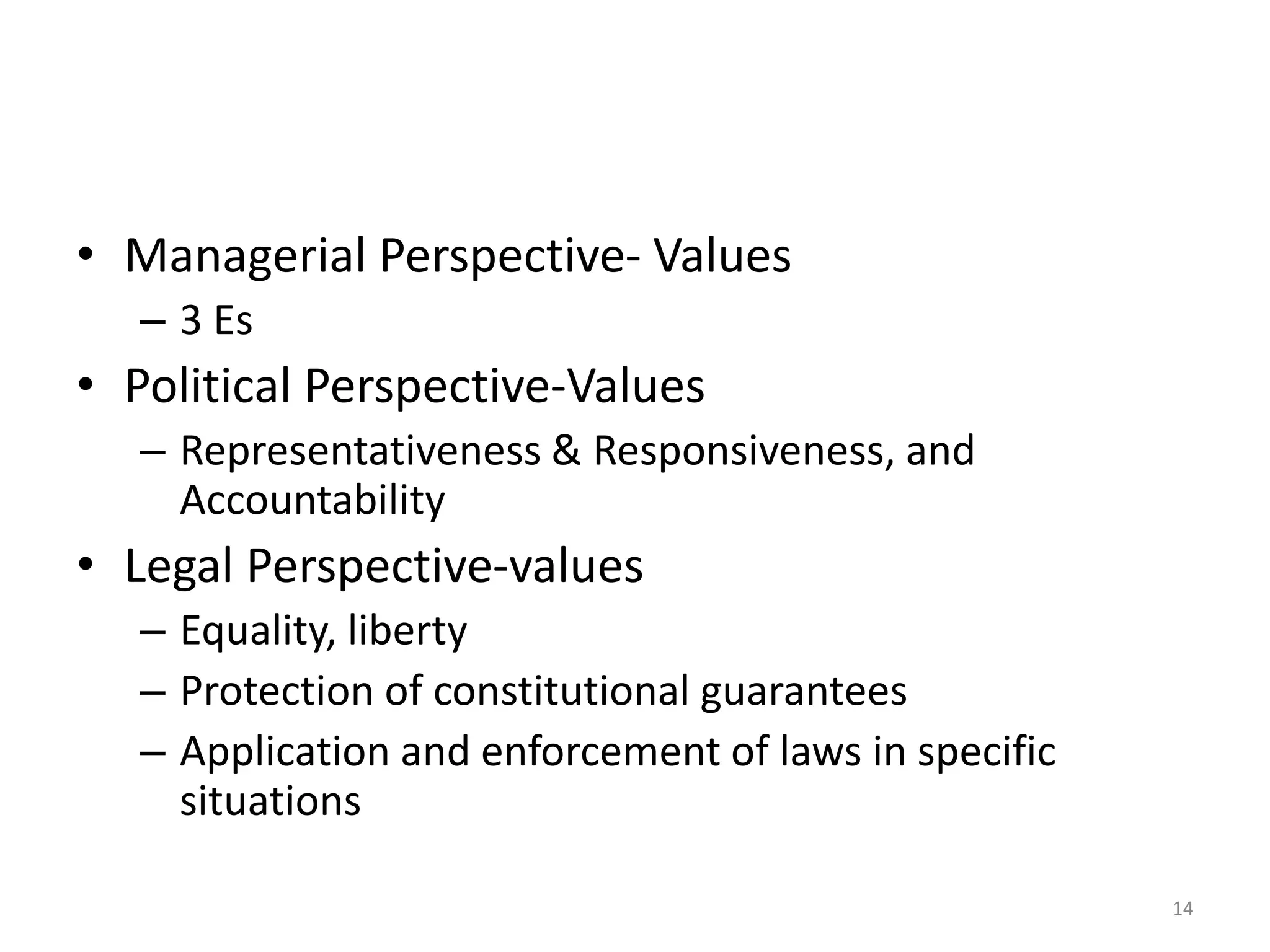
• Managerial Perspective- Values
– 3 Es
• Political Perspective-Values
– Representativeness & Responsiveness, and
Accountability
• Legal Perspective-values
– Equality, liberty
– Protection of constitutional guarantees
– Application and enforcement of laws in specific
situations
14
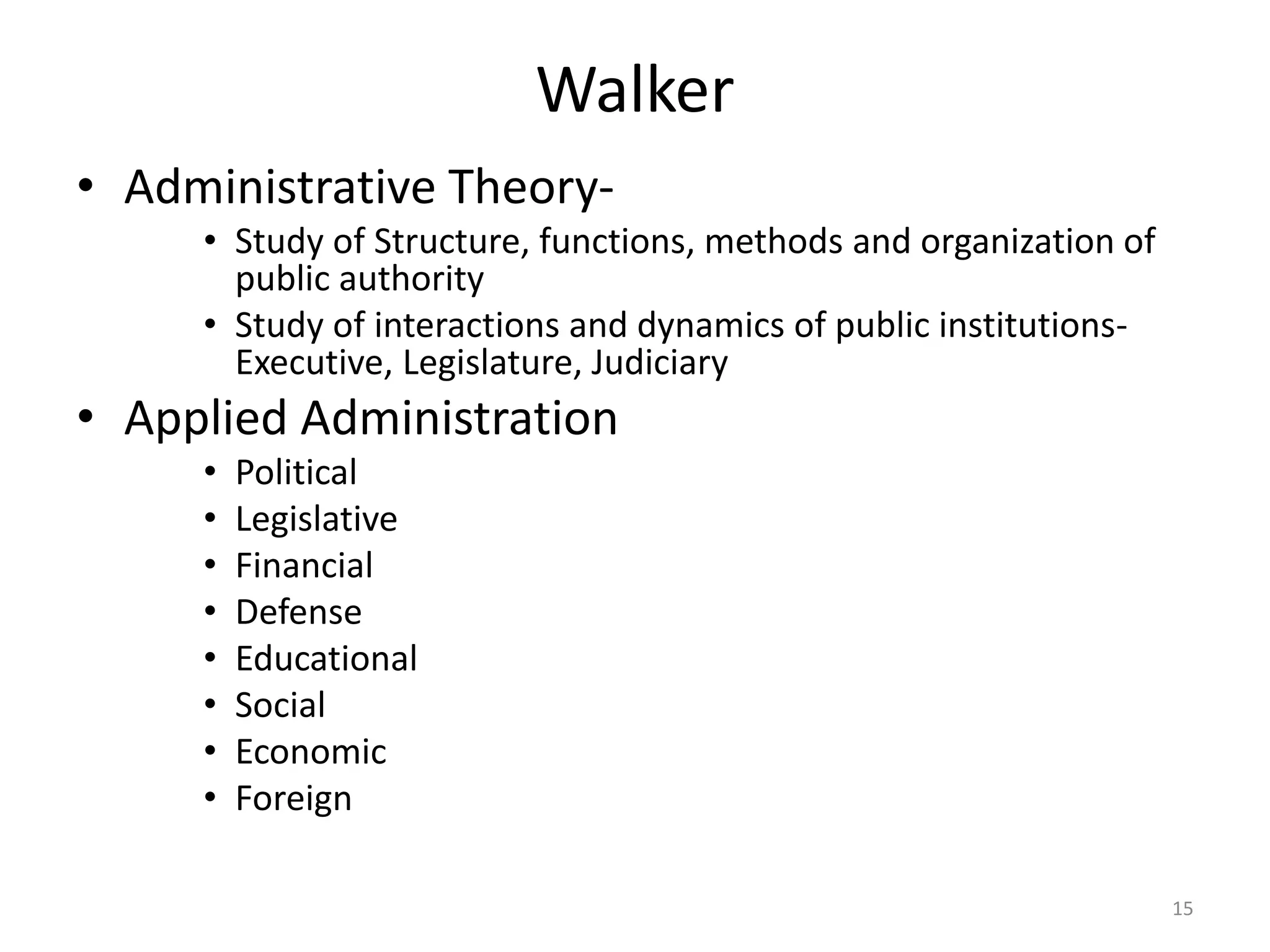
Walker
• Administrative Theory-
• Study of Structure, functions, methods and organization of
public authority
• Study of interactions and dynamics of public institutions-
Executive, Legislature, Judiciary
• Applied Administration
• Political
• Legislative
• Financial
• Defense
• Educational
• Social
• Economic
• Foreign
15
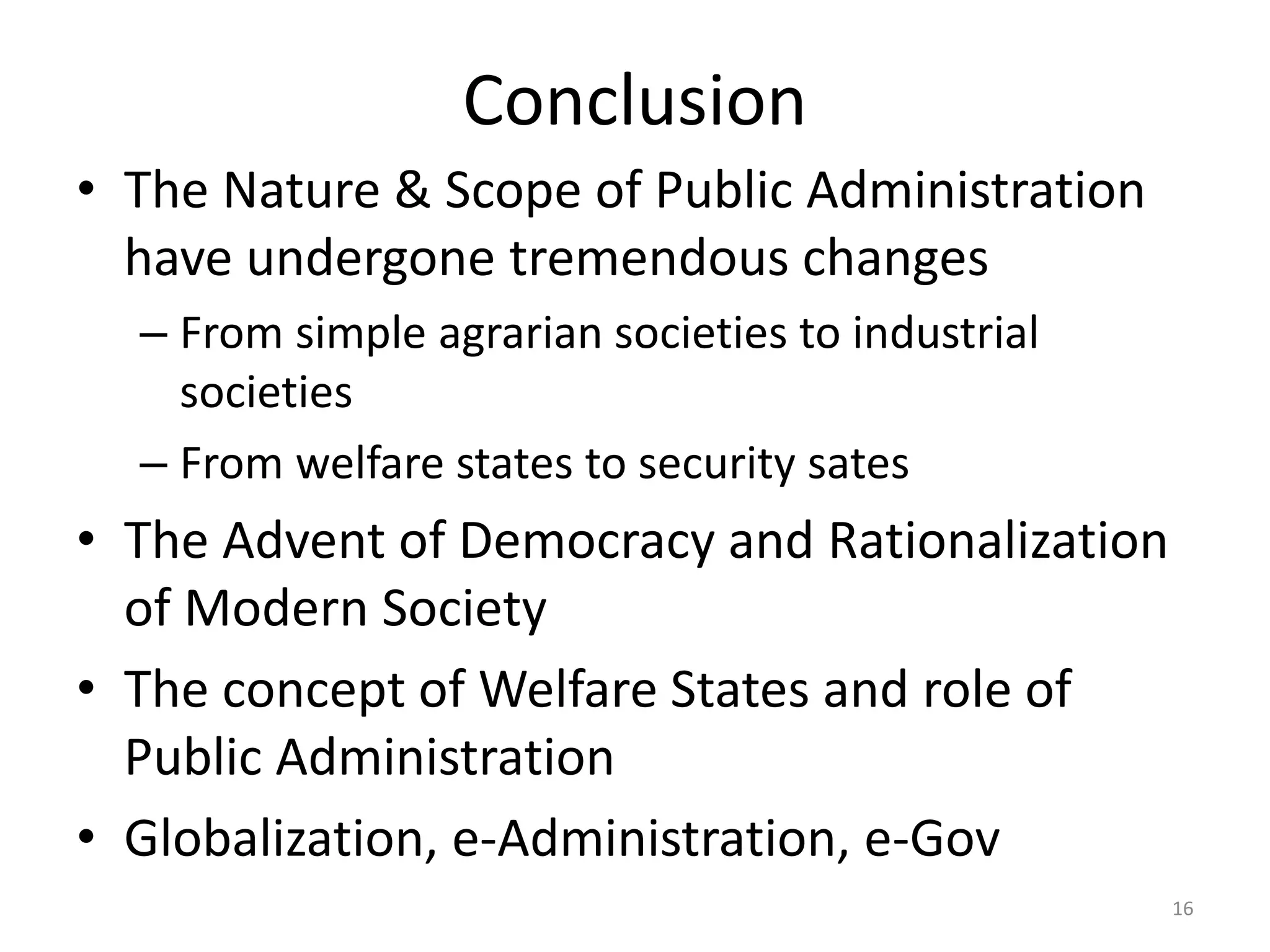
Conclusion
• The Nature & Scope of Public Administration
have undergone tremendous changes
– From simple agrarian societies to industrial
societies
– From welfare states to security sates
• The Advent of Democracy and Rationalization
of Modern Society
• The concept of Welfare States and role of
Public Administration
• Globalization, e-Administration, e-Gov
16
All the actions of Public Administrators take
place within a political context: a commitment
to democratic ideals and practices.
17
Role of Public Administration (Bureaucracy) in Modern
Welfare State
• Administration provides a certain degree of
organization to the chaos that exists in society.
• Administration seeks to protect peoples' rights,
• It regulates industry, stabilizes economic conditions,
and enables a safe environment.
• Whether you like government or not, you cannot deny
that it has become an integral part of society.
• Hence, this is why one studies "public" administration.
18
Public administration acts as a bridge
between government and society, and plays a
fundamental role in shaping legitimate state-
society relationships.
19
Govt. is everywhere !!!!
• government seems to permeate every aspect of life
– From Garbage Collection to Space Exploration
– From Child Birth to Burial Rites
– From Health Insurance to Old Age Benefits
– From primary school enrollment to higher education
– From HR training to Employment and labor market
regulations
– Culture, Sports and festivals
– Transportation and Infrastructure
– Security, Defense, Law and Order
20
1. Public Administration and Individual
2. Public Administration and Society
3. An Instrument For Social Change
4. Essential For Stability, Integrity and Continuity
5. Public Administration and National Level
Resource Planning
6. Public Administration During War and Peace
7. Public Administration and Democracy
8. Economic Development
9. Public Admin. & Challenges of Globalization
21
Bureaucracy as a Change Agent
Historical Perspective
• For almost two decades (i.e. 1950-1970)
bureaucracy in the developing countries was
considered as engine of growth, development
and an agent of change.
• Bureaucracy in Pakistan provided a lead for its
role in initiating economic development and
promoting social & political stability (Braibanti)
• Bureaucratic elites and public institutions were
expected to provide leadership, order and
stability.
• In late 1960s, we witnessed movements of popular
protest and agitation against the authoritarian and
repressive role of the government.
• The opposition political parties, and a segment of the
print media started portraying the bureaucracy as an
instrument of oppression.
• By the mid-1970s the academic community and the
World Bank began to reassess and reevaluate the role
of bureaucracy .
• The Civil Service Reforms 1973
• Corruption, inefficiency, bloated size, absence of
accountability, and resistance to change were
portrayed as the manifestations of bureaucracy-
World Bank Report (1983-1993)
• The World Bank recognized that governance and
change were no longer a matter of economic
development alone.
• There were cultural, political and institutional
factors that influenced the process of governance
and social change in Pakistan.
• good governance was a function of political will
and commitment of the leadership
• In 1990s , public policy debate underwent a
paradigm shift in which institutional reforms i.e.
reforms of the bureaucracy were considered
serious issues in underdeveloped countries like
Pakistan
• That’s why the traditional concept of governance
(i.e hierarchical, authoritarian, and emphasizing
chain of command) is under-going a change
(Osborne)
In a developing country, what are the
major functions of bureaucracy?
• Ensure continuity of policies
• Uphold rule of law- Good Governance
• National level resource planning
• Promote economic development
• To provide enabling business environment
…….conti
• Poverty alleviation and provision of social
security nets
• Skill development and adoption of new
technology in govt functions.
• Cultural cohesion and national integration-
stability
• Expansion of government functions
• Growing complexity of govt functions and
bureaucracy
28
Conclusion
• the authority and social elite status of bureaucracy is still
recognized; despite erosion of power and politicization.
• Its major failure is its inability to promote welfare,
development, equity and provide justice to the citizens.
• The challenge for the state is to reform and rebuild the
public institutions that would be competitive, enterprising
and capable of upholding the rule of law.
• The challenge is: how to build a bureaucracy that is
efficient, humane, development-driven, is citizen-friendly
and facilitates good governance and human development?
• It can be achieved through;
– Civil Service Reforms- institutional overhauling
– decentralization and deregulation
– Reforms in delivery of basic services
– Security, law and order and protection of citizens
– Strengthening key institutions of governance.
30
THE END
THANK YOU
31

Public Administration Role Scope and Defination

  • 1.
    Slide Show ofPrinciples of Public Administration By Kamil Sayed Baloch BPA 2nd Semester BZU Multan 1
  • 2.
    Principles of PublicAdminstration • Definition • Nature & Sope • Role in a Welfare State • Major Schools of Thought • Bureaucracy • Concept, Theories, & Ecology 2
  • 3.
    • Financial Administration •Budget Making Process. • Approaches to Public Budgeting. • Fiscal Reforms • Administrative Accountability • Organization & Decision Making 3
  • 4.
    • Public PersonnelAdministration • Motivation • What is Motivation? • Types. • Approaches • Planning & Public Sector Project Management • New Public Management • The Future of Public Administration 4
  • 5.
    Public Administration Introduction, Nature& Scope • Difficult to define • Public Administration has no generally accepted definition because the scope of the subject is so great and so debatable and diversified that it is easier to explain than define • Public Administration-the implementation of government policy – an academic discipline that studies this implementation and that prepares civil servants for this work. – As a field of inquiry into all sorts of government activities with a diverse scope. – Its fundamental goal is to advance management processes and policies so that government can function. 5
  • 6.
    Public Administration comprisesestablishments primarily engaged in activities of a governmental in nature i.e. the enactment and judicial interpretation of laws and their regulations, and the administration of programs based on them. – This includes • Legislative activities, • Dispensation of justice • Tax administration • national defense • public order and safety • immigration services • foreign affairs and international assistance • the administration of government programs 6
  • 7.
    Definitions • L DWhite “The coordination of collective efforts to implement public policy” • E N Gladden “Public Administration is concerned with the administration of the government” • David Rosenbloom “Public administration is the use of managerial, political, and legal theories and processes to fulfill legislative, executive, judicial mandates for the provision of governmental regulatory and service functions.” 7
  • 8.
    • Public Administrationis the study of interaction of executive, legislative, and judicial branches of government from managerial, political and legal perspectives to implement public policies and programmes. 8
  • 9.
    Nature & Scope •Of course as old as government itself. • Egyptian Pyramids • The Code of Hammurabi- the Babylonian Law Code (1700 BC) • The Confucius Philosophy and China‘s Civil Service (500 BC) • Greek Political Philosophy- Plato, Aristotle • Democratization & Rationalization of Society- Rise of Bureaucracies • Public Administration in Global Context 9
  • 10.
    Woodrow Wilson-1887 • Thescience of administration is a branch of science of politics which was begun some twenty-two hundred years ago. • Administration is the most obvious part of government; it is the executive, the operative, the most visible side of government • Political-Administration Dichotomy • The field of administration is a field of business. It is removed from the hurry and strife of politics • Public Administration is detailed and systematic application of law. Every particular application of law is an act of administration. • It is government in action 10
  • 11.
    Luther Gulick • POSDCoRB-a Managerial Perspective – Planning – Organizing – Staffing – Directing – Coordination – Reporting – Budgeting • It’s technique oriented not subject-matter oriented 11
  • 12.
    Prof. J MPfiffner 1. Principles of Public Administration – Organization – Management of Personnel – Method & Procedure – Material & Supply – Public Finance – Administrative Accountability 2. Spheres of Public Administration – Central (Federal) – Regional – State (provincial) – Local – Corporate 12
  • 13.
    H D Rosenbloom •Public Administration: Understanding Management, Politics, and Law in the Public Sector • The Fundamentals of Public Administration – Embracing its complexity through multiple sets of values – Explains and analyzes Public Administration from the point of view of three well-established perspectives: management, politics, and law. 13
  • 14.
    • Managerial Perspective-Values – 3 Es • Political Perspective-Values – Representativeness & Responsiveness, and Accountability • Legal Perspective-values – Equality, liberty – Protection of constitutional guarantees – Application and enforcement of laws in specific situations 14
  • 15.
    Walker • Administrative Theory- •Study of Structure, functions, methods and organization of public authority • Study of interactions and dynamics of public institutions- Executive, Legislature, Judiciary • Applied Administration • Political • Legislative • Financial • Defense • Educational • Social • Economic • Foreign 15
  • 16.
    Conclusion • The Nature& Scope of Public Administration have undergone tremendous changes – From simple agrarian societies to industrial societies – From welfare states to security sates • The Advent of Democracy and Rationalization of Modern Society • The concept of Welfare States and role of Public Administration • Globalization, e-Administration, e-Gov 16
  • 17.
    All the actionsof Public Administrators take place within a political context: a commitment to democratic ideals and practices. 17
  • 18.
    Role of PublicAdministration (Bureaucracy) in Modern Welfare State • Administration provides a certain degree of organization to the chaos that exists in society. • Administration seeks to protect peoples' rights, • It regulates industry, stabilizes economic conditions, and enables a safe environment. • Whether you like government or not, you cannot deny that it has become an integral part of society. • Hence, this is why one studies "public" administration. 18
  • 19.
    Public administration actsas a bridge between government and society, and plays a fundamental role in shaping legitimate state- society relationships. 19
  • 20.
    Govt. is everywhere!!!! • government seems to permeate every aspect of life – From Garbage Collection to Space Exploration – From Child Birth to Burial Rites – From Health Insurance to Old Age Benefits – From primary school enrollment to higher education – From HR training to Employment and labor market regulations – Culture, Sports and festivals – Transportation and Infrastructure – Security, Defense, Law and Order 20
  • 21.
    1. Public Administrationand Individual 2. Public Administration and Society 3. An Instrument For Social Change 4. Essential For Stability, Integrity and Continuity 5. Public Administration and National Level Resource Planning 6. Public Administration During War and Peace 7. Public Administration and Democracy 8. Economic Development 9. Public Admin. & Challenges of Globalization 21
  • 22.
    Bureaucracy as aChange Agent
  • 23.
    Historical Perspective • Foralmost two decades (i.e. 1950-1970) bureaucracy in the developing countries was considered as engine of growth, development and an agent of change. • Bureaucracy in Pakistan provided a lead for its role in initiating economic development and promoting social & political stability (Braibanti) • Bureaucratic elites and public institutions were expected to provide leadership, order and stability.
  • 24.
    • In late1960s, we witnessed movements of popular protest and agitation against the authoritarian and repressive role of the government. • The opposition political parties, and a segment of the print media started portraying the bureaucracy as an instrument of oppression. • By the mid-1970s the academic community and the World Bank began to reassess and reevaluate the role of bureaucracy . • The Civil Service Reforms 1973
  • 25.
    • Corruption, inefficiency,bloated size, absence of accountability, and resistance to change were portrayed as the manifestations of bureaucracy- World Bank Report (1983-1993) • The World Bank recognized that governance and change were no longer a matter of economic development alone. • There were cultural, political and institutional factors that influenced the process of governance and social change in Pakistan.
  • 26.
    • good governancewas a function of political will and commitment of the leadership • In 1990s , public policy debate underwent a paradigm shift in which institutional reforms i.e. reforms of the bureaucracy were considered serious issues in underdeveloped countries like Pakistan • That’s why the traditional concept of governance (i.e hierarchical, authoritarian, and emphasizing chain of command) is under-going a change (Osborne)
  • 27.
    In a developingcountry, what are the major functions of bureaucracy? • Ensure continuity of policies • Uphold rule of law- Good Governance • National level resource planning • Promote economic development • To provide enabling business environment
  • 28.
    …….conti • Poverty alleviationand provision of social security nets • Skill development and adoption of new technology in govt functions. • Cultural cohesion and national integration- stability • Expansion of government functions • Growing complexity of govt functions and bureaucracy 28
  • 29.
    Conclusion • the authorityand social elite status of bureaucracy is still recognized; despite erosion of power and politicization. • Its major failure is its inability to promote welfare, development, equity and provide justice to the citizens. • The challenge for the state is to reform and rebuild the public institutions that would be competitive, enterprising and capable of upholding the rule of law. • The challenge is: how to build a bureaucracy that is efficient, humane, development-driven, is citizen-friendly and facilitates good governance and human development?
  • 30.
    • It canbe achieved through; – Civil Service Reforms- institutional overhauling – decentralization and deregulation – Reforms in delivery of basic services – Security, law and order and protection of citizens – Strengthening key institutions of governance. 30
  • 31.