1
Pakistan’s Parliamentary System:
National & Provincial Set-up, Theory &
Practice
2
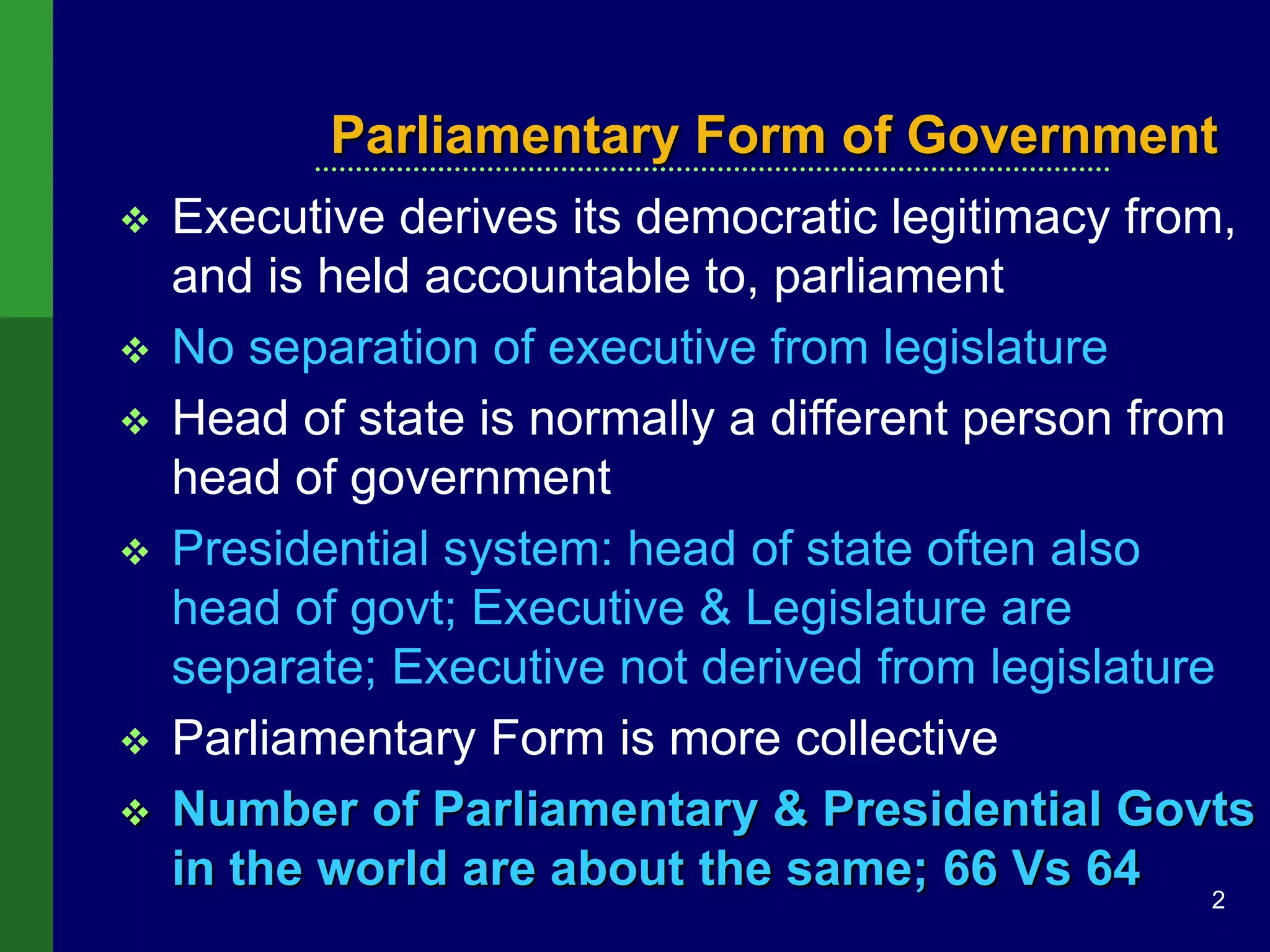
 Executive derives its democratic legitimacy from,
and is held accountable to, parliament
 No separation of executive from legislature
 Head of state is normally a different person from
head of government
 Presidential system: head of state often also
head of govt; Executive & Legislature are
separate; Executive not derived from legislature
 Parliamentary Form is more collective
 Number of Parliamentary & Presidential Govts
in the world are about the same; 66 Vs 64
Parliamentary Form of Government
3
 Inherited British System but Evolved since
 Since beginning, tendency was towards a
strong individual which is more suited to
Presidential Form; Quaid, ZAB, BB, NS
 Cabinet is generally subdued before a PM
 ‘In the performance of his functions … the
PM may act either directly or thru the Federal
Ministers’ Article 90 (2)
 Parliament is ‘controlled’ by Party Heads
 More of a Prime Ministerial form of Govt. in
which the concept of collective responsibility
is rather a theoretical one
Pakistan’s Parliamentary Form
4
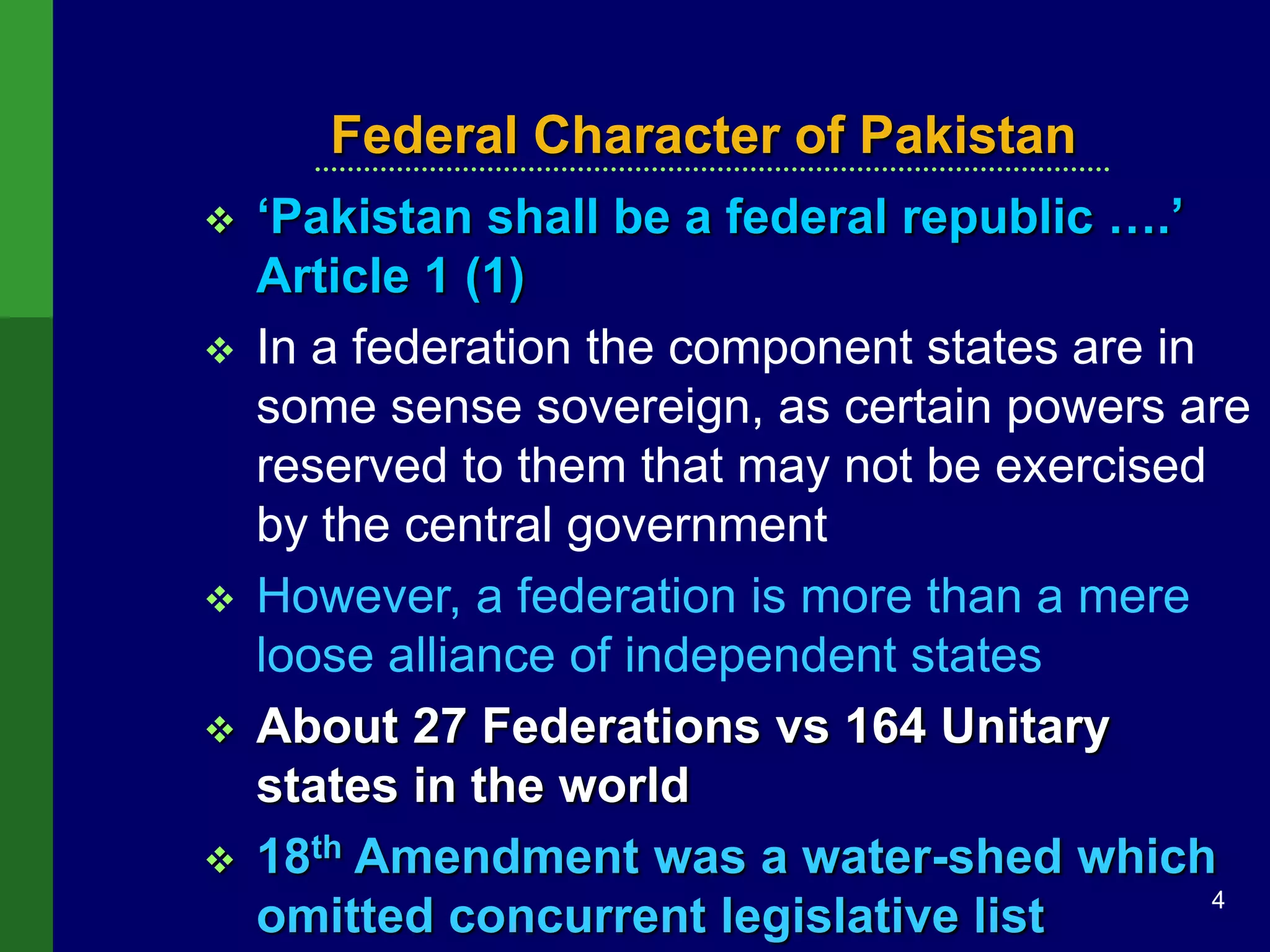
 ‘Pakistan shall be a federal republic ….’
Article 1 (1)
 In a federation the component states are in
some sense sovereign, as certain powers are
reserved to them that may not be exercised
by the central government
 However, a federation is more than a mere
loose alliance of independent states
 About 27 Federations vs 164 Unitary
states in the world
 18th Amendment was a water-shed which
omitted concurrent legislative list
Federal Character of Pakistan
5
 Articles 153-155 deal with Council of
Common Interests (CCI)
 ‘The Council shall formulate and regulate
policies in relation to matters in Part II of the
Federal Legislative List and shall exercise
supervision and control over related
institutions’ Article 154 (1)
 About 10 new entries added to Part II under 18th
amendment greatly enhancing the power of CCI
 CCI is a de-facto super-Cabinet making
governance more complex
Federal Character of Pakistan (…Contd)
6
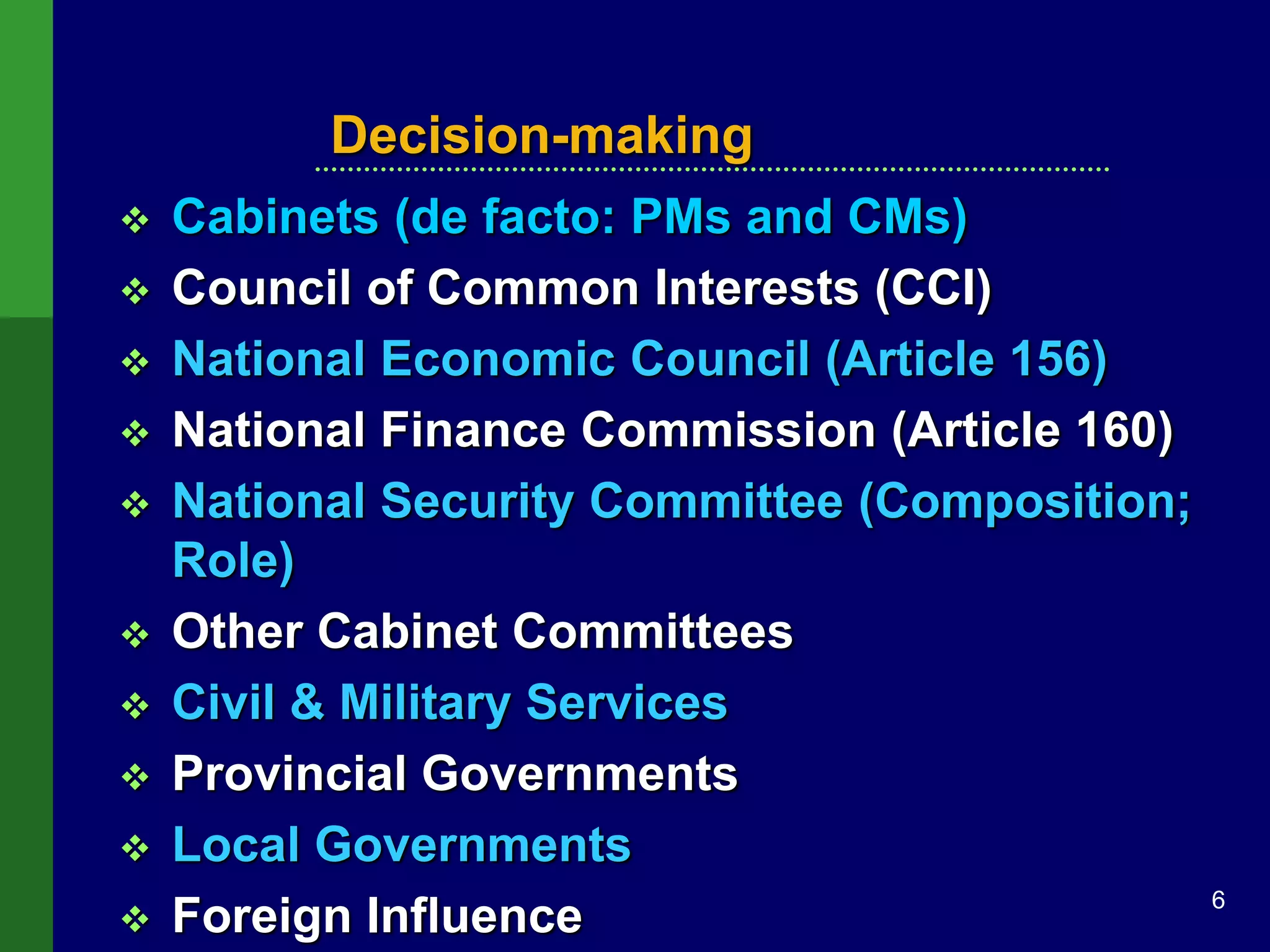
 Cabinets (de facto: PMs and CMs)
 Council of Common Interests (CCI)
 National Economic Council (Article 156)
 National Finance Commission (Article 160)
 National Security Committee (Composition;
Role)
 Other Cabinet Committees
 Civil & Military Services
 Provincial Governments
 Local Governments
 Foreign Influence
Decision-making
7
 Federal Republic
 Parliamentary Democracy
 Islam is the State Religion
 Constitution guarantees Fundamental
Rights
 Population: 132 M (1998); 180 M (2013)
Estimated
 Area: 796,000 Sq. Km. (226
persons/Sq. Km; US Density: 34 / Sq. Km)
Fundamentals of Pakistan’s Political System
8
 Legislature:
-Senate (104 Members)
-National Assembly (342 Members)
-Four Provincial Assemblies (728 Members)
 Judiciary:
-Supreme Court
-High Courts
-Subordinate Courts
 Executive:
Branches of the Government
9
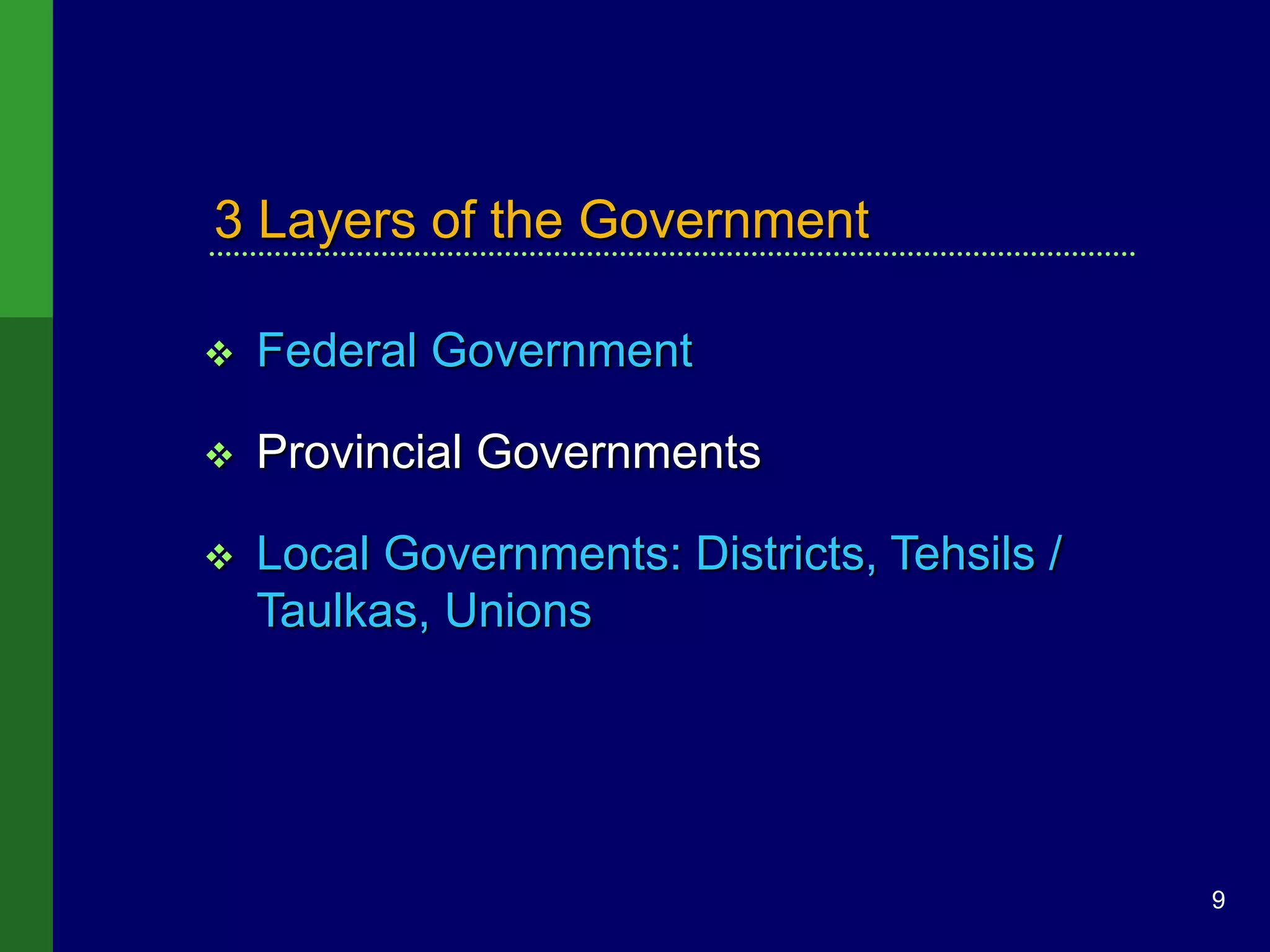
 Federal Government
 Provincial Governments
 Local Governments: Districts, Tehsils /
Taulkas, Unions
3 Layers of the Government
10
 Senate
-104 members indirectly elected
-23 from each Province (4 Women, 4
Technocrats, 1 Non-Muslim)
-8 from FATA
-4 from Capital (1 Woman, 1 Technocrat)
 National Assembly
-342 Members
-272 General Seats
-60 Seats for Women (List System; further
strengthened party leaders)
-10 Seats for non-Muslims
Parliament or Majlis e Shoora
11
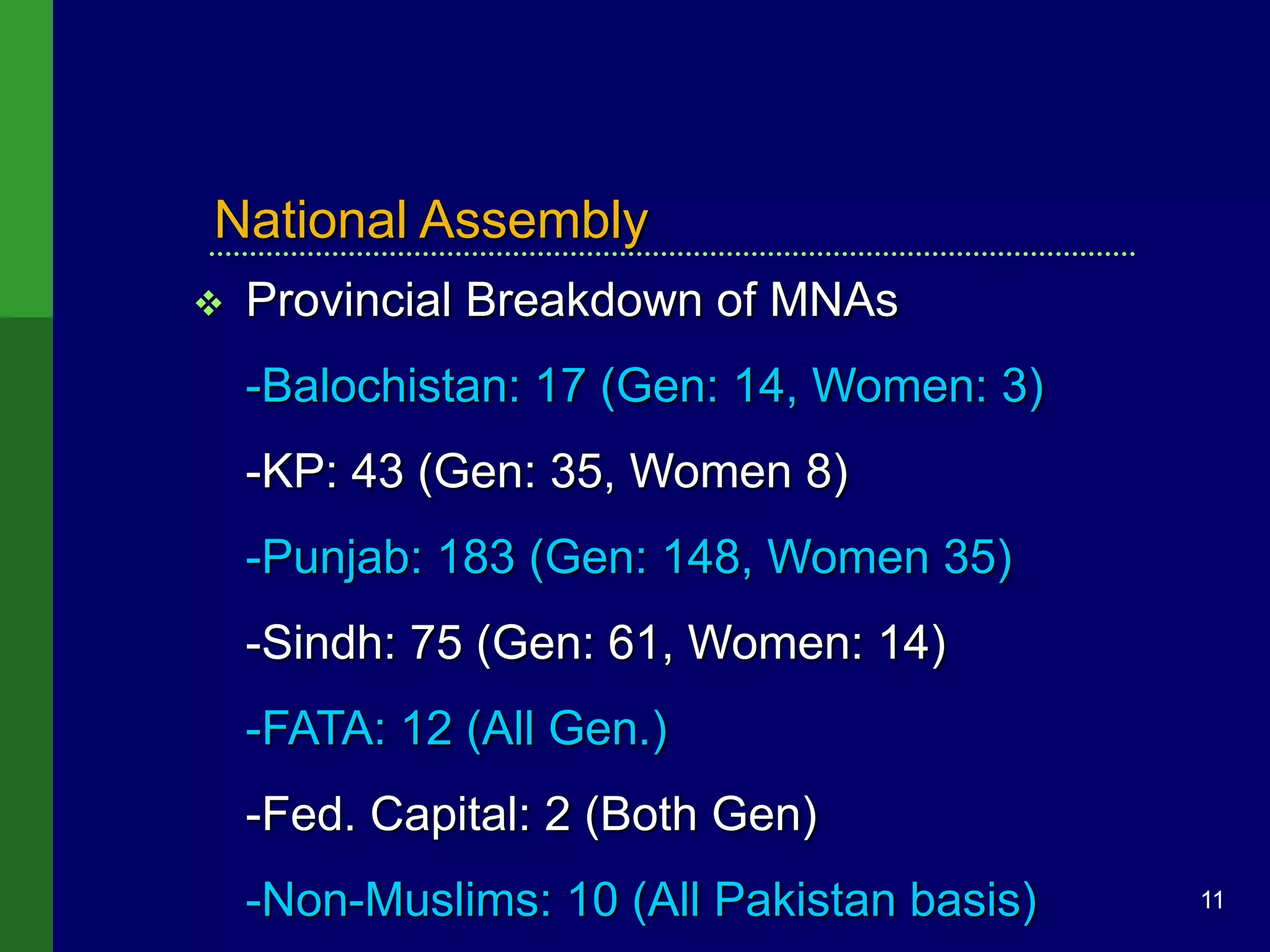
 Provincial Breakdown of MNAs
-Balochistan: 17 (Gen: 14, Women: 3)
-KP: 43 (Gen: 35, Women 8)
-Punjab: 183 (Gen: 148, Women 35)
-Sindh: 75 (Gen: 61, Women: 14)
-FATA: 12 (All Gen.)
-Fed. Capital: 2 (Both Gen)
-Non-Muslims: 10 (All Pakistan basis)
National Assembly
12
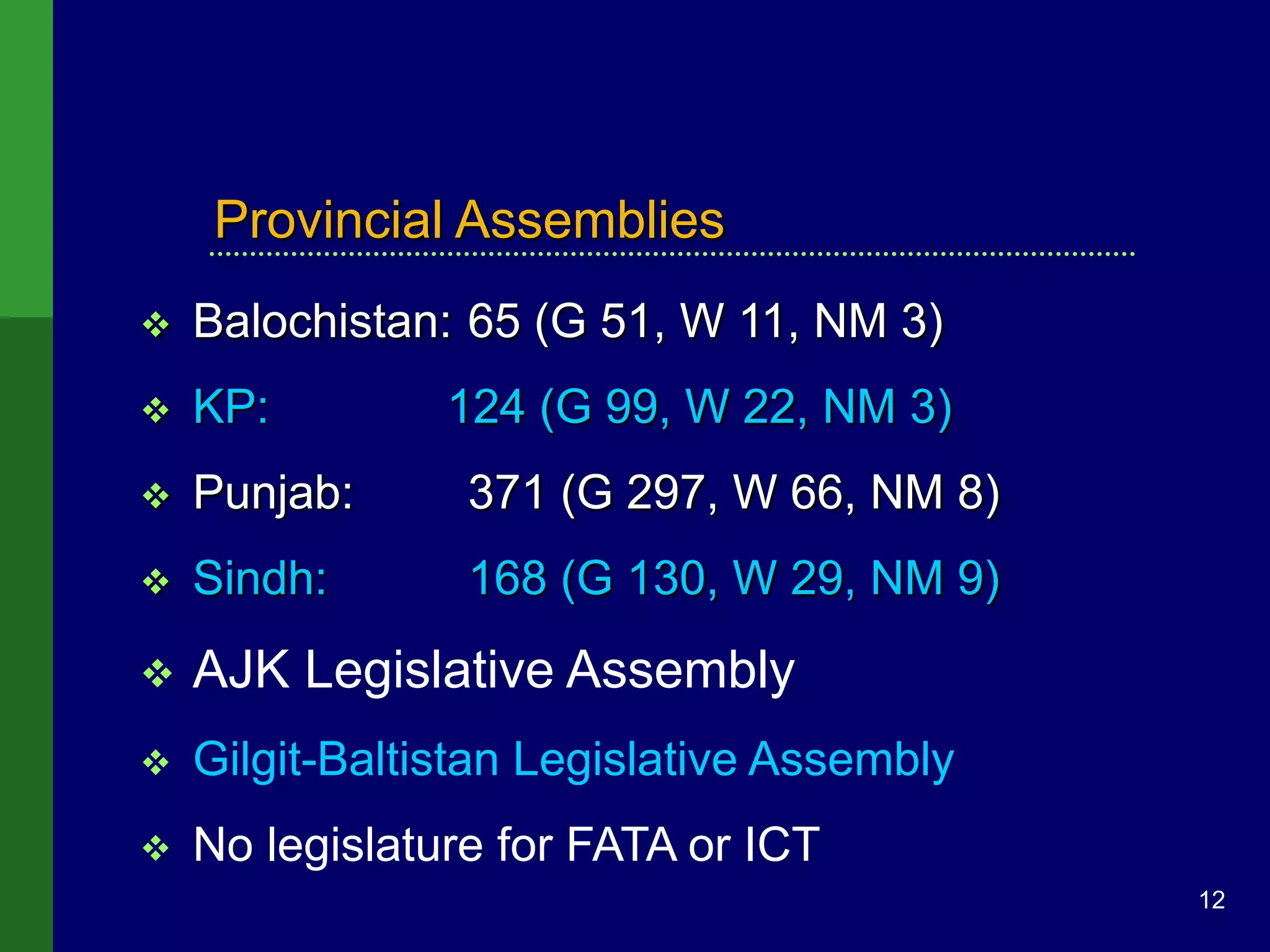
 Balochistan: 65 (G 51, W 11, NM 3)
 KP: 124 (G 99, W 22, NM 3)
 Punjab: 371 (G 297, W 66, NM 8)
 Sindh: 168 (G 130, W 29, NM 9)
 AJK Legislative Assembly
 Gilgit-Baltistan Legislative Assembly
 No legislature for FATA or ICT
Provincial Assemblies
13
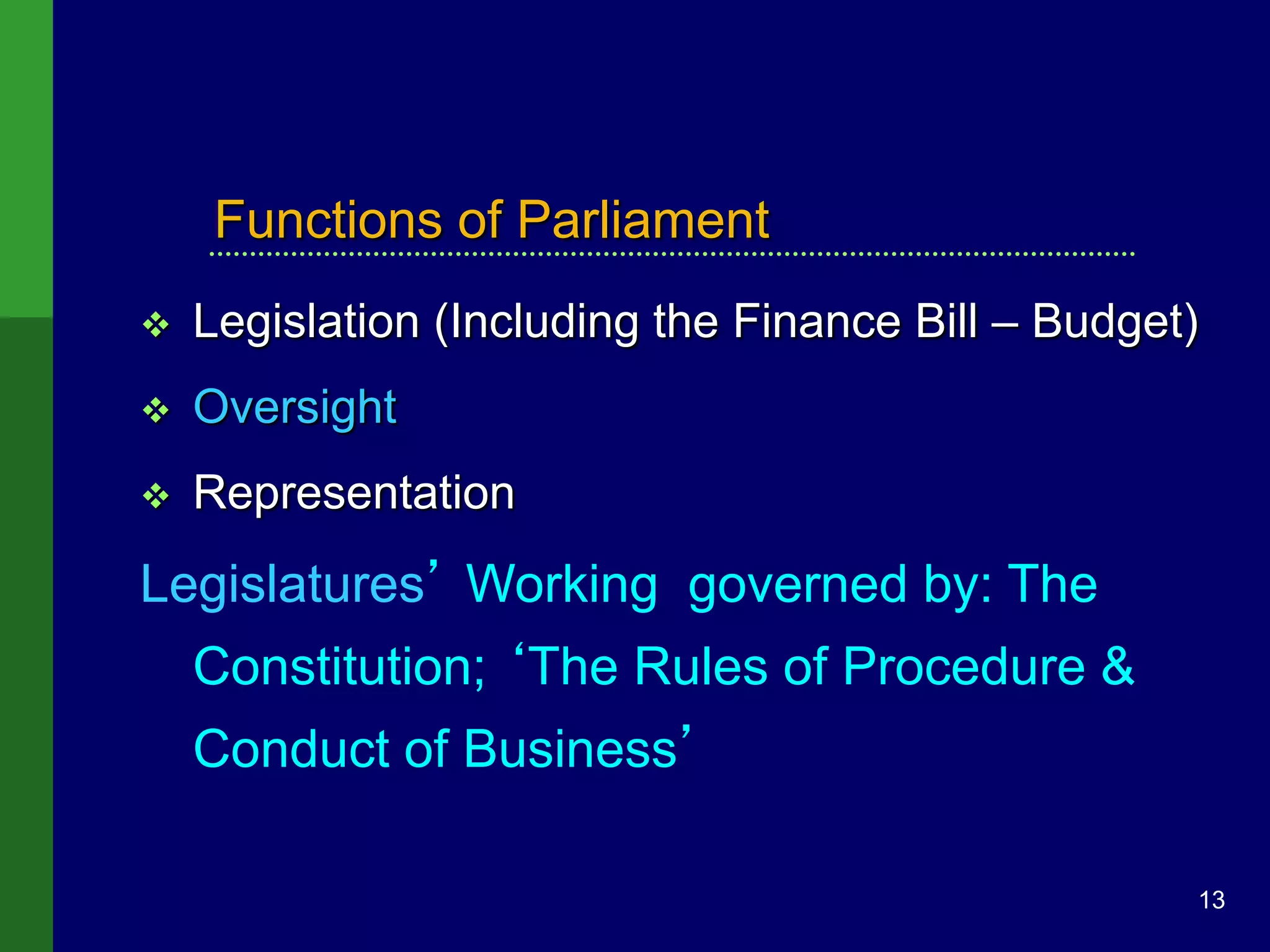
 Legislation (Including the Finance Bill – Budget)
 Oversight
 Representation
Legislatures’ Working governed by: The
Constitution; ‘The Rules of Procedure &
Conduct of Business’
Functions of Parliament
14
a) 10 Political Parties represented
b) 76 Women (16 Gen Seats, 60 W), 23 %
c) Young (Below 30): 8 %
d) PhDs: 2 %; Masters: 34 %
e) 40 % Agriculturists
f) 90 % Married
g) 15 % Teachers (3rd Profession after
Agriculture & Business)
14th National Assembly
15
Increasing Role
a)Legislation
b)Oversight of Executive (Policy,
Performance)
c)Receiving Public Petitions
d)Pre-Budget Recommendations (NA)
e)Public Accounts
f)Appointments
Committees System in the Legislatures
16
19 to 23 Members in each Committee
Types of Committees (38)
a)Ministerial Standing Committees (28)
b)Non-Ministerial Standing Committees (6)
c)Special Committees (1)
d)Select Committees (None)
e)Parliamentary Committees (on Appointments) (3)
Committees System in National Assembly
17
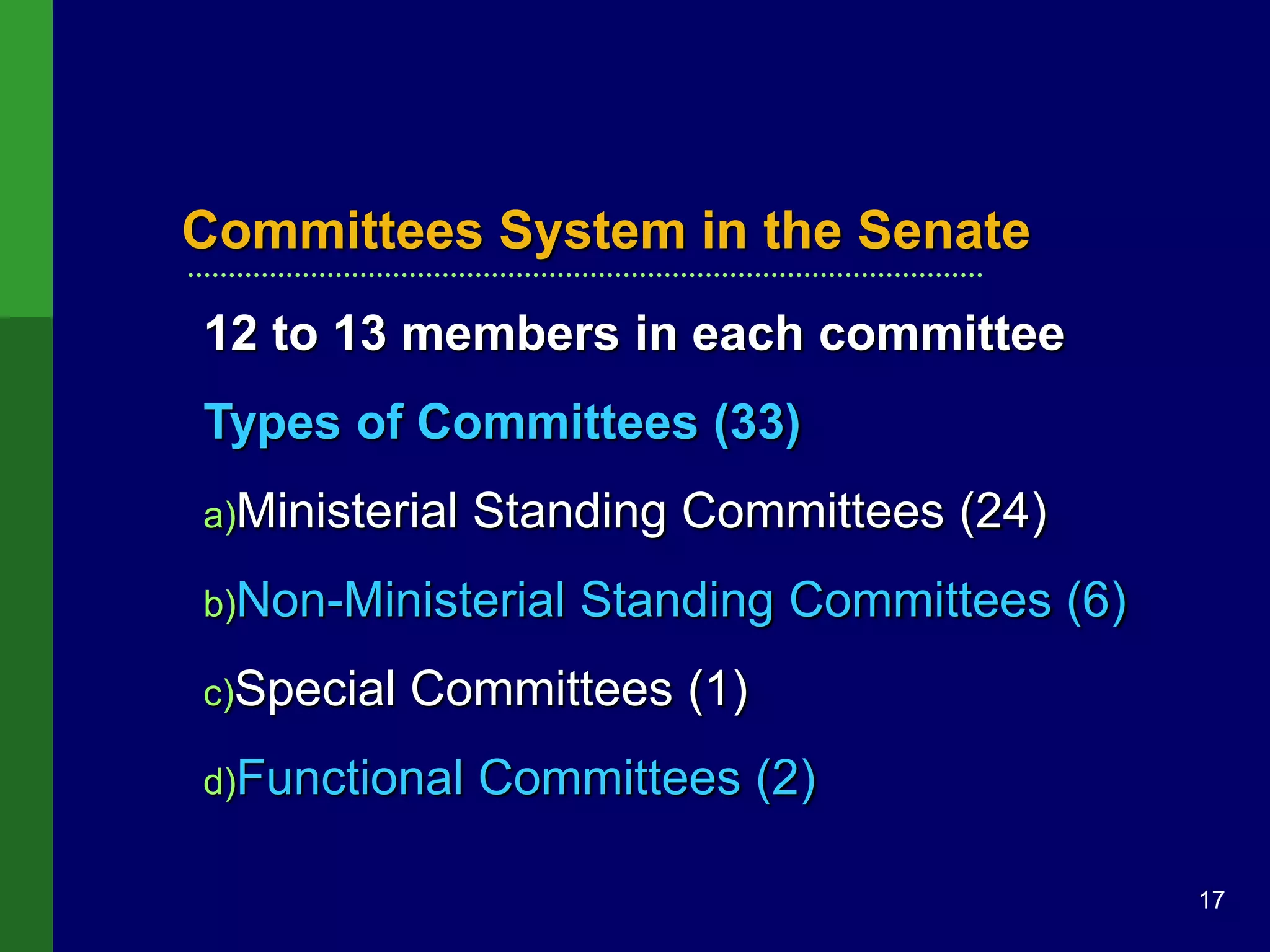
12 to 13 members in each committee
Types of Committees (33)
a)Ministerial Standing Committees (24)
b)Non-Ministerial Standing Committees (6)
c)Special Committees (1)
d)Functional Committees (2)
Committees System in the Senate
18
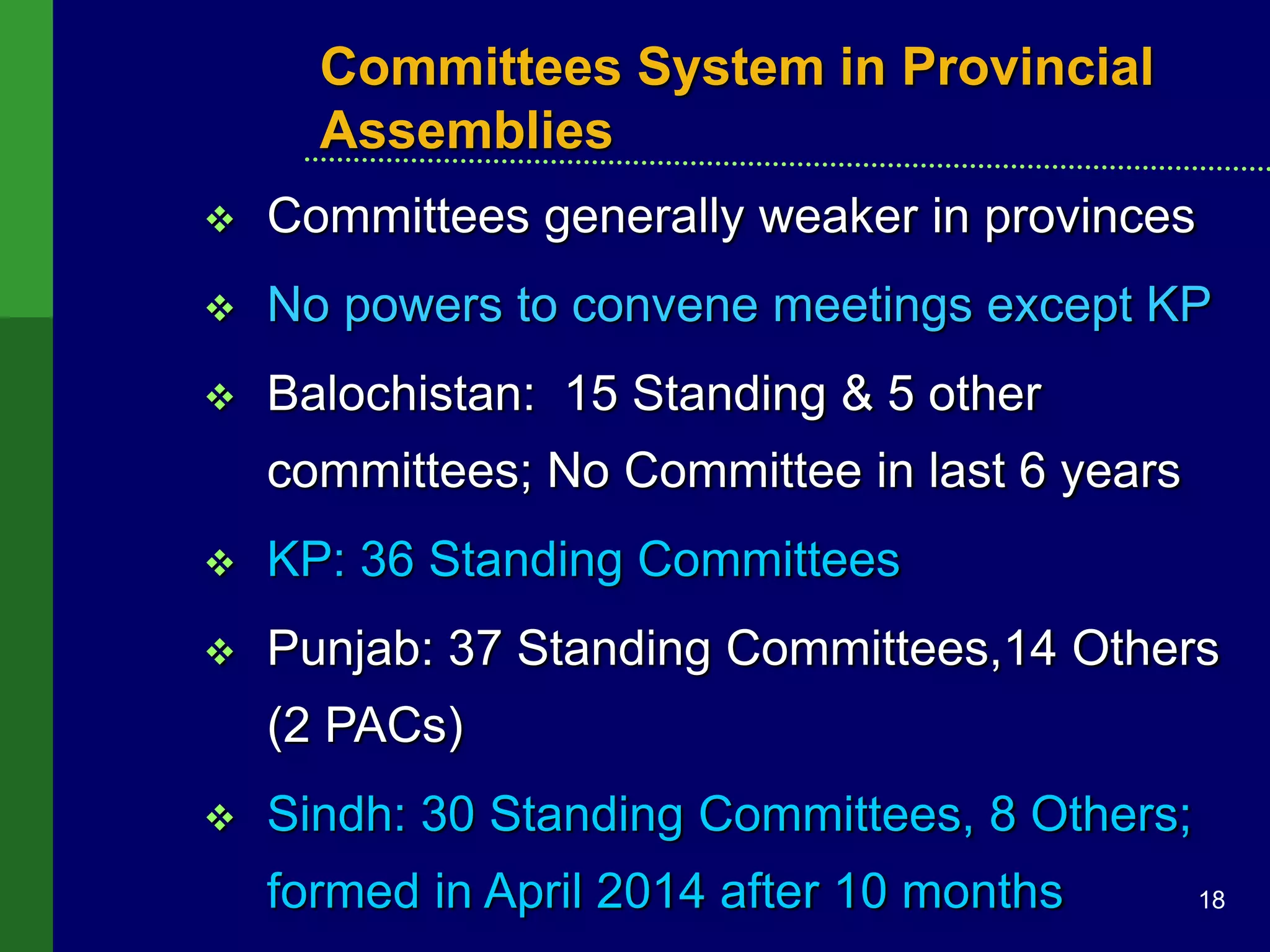
 Committees generally weaker in provinces
 No powers to convene meetings except KP
 Balochistan: 15 Standing & 5 other
committees; No Committee in last 6 years
 KP: 36 Standing Committees
 Punjab: 37 Standing Committees,14 Others
(2 PACs)
 Sindh: 30 Standing Committees, 8 Others;
formed in April 2014 after 10 months
Committees System in Provincial
Assemblies
19
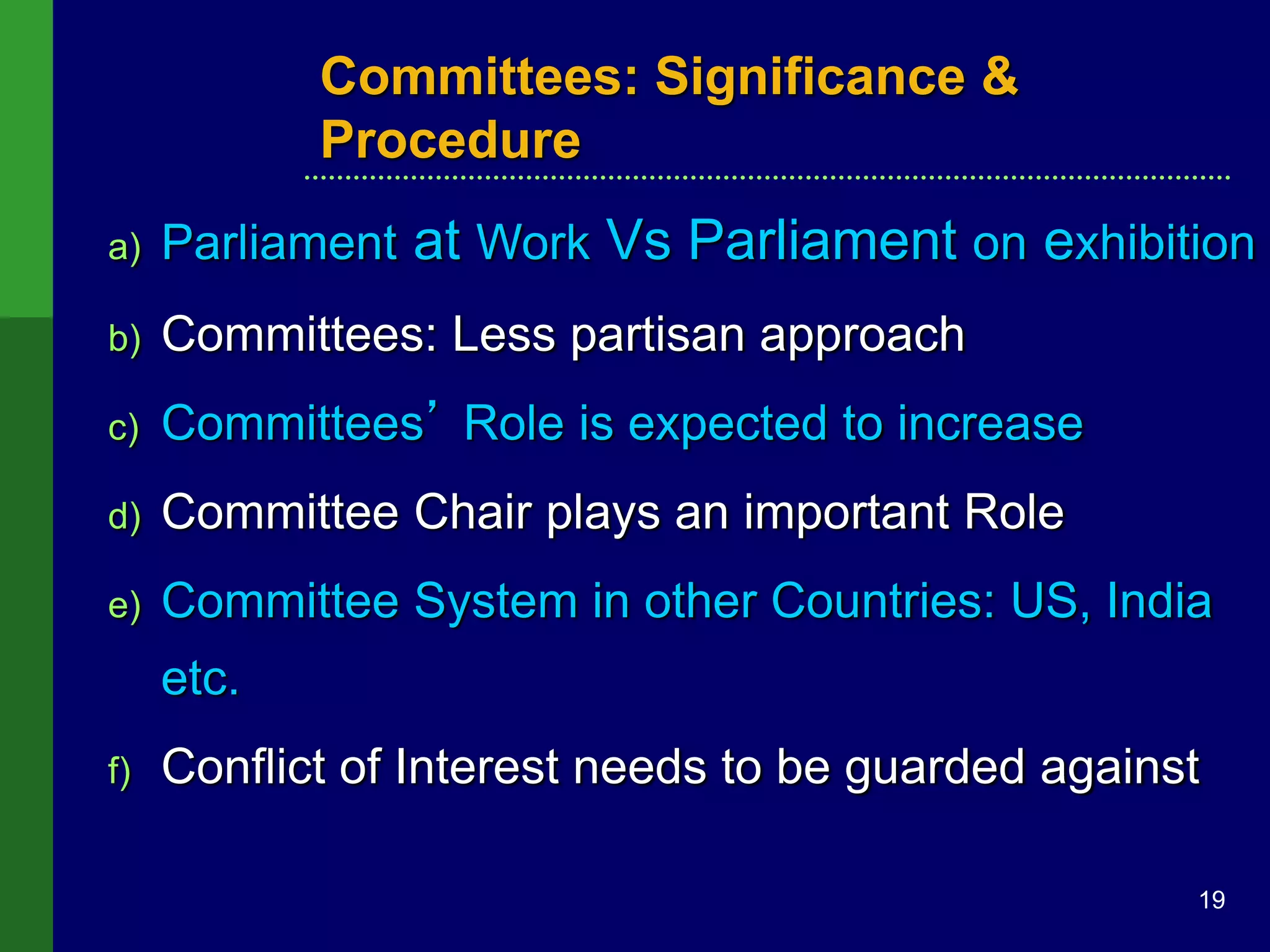
a) Parliament at Work Vs Parliament on exhibition
b) Committees: Less partisan approach
c) Committees’ Role is expected to increase
d) Committee Chair plays an important Role
e) Committee System in other Countries: US, India
etc.
f) Conflict of Interest needs to be guarded against
Committees: Significance &
Procedure
20
a) Parliament should legislate: Executive dictates
b) Budget Process: a farse
c) Oversight by Parliament: Weak Committees
d) MPs: Parliamentarians or Constituency lords?
e) Cabinet role weak; PM dictates
f) Political Parties not democratic; Kingdoms
g) Military a subordinate institution or a super Govt?
h) Provinces: Concentration of Power Vs Devolution
i) Civil Services: Political Influence vs independenc
Summing up: Theory & Practice
21
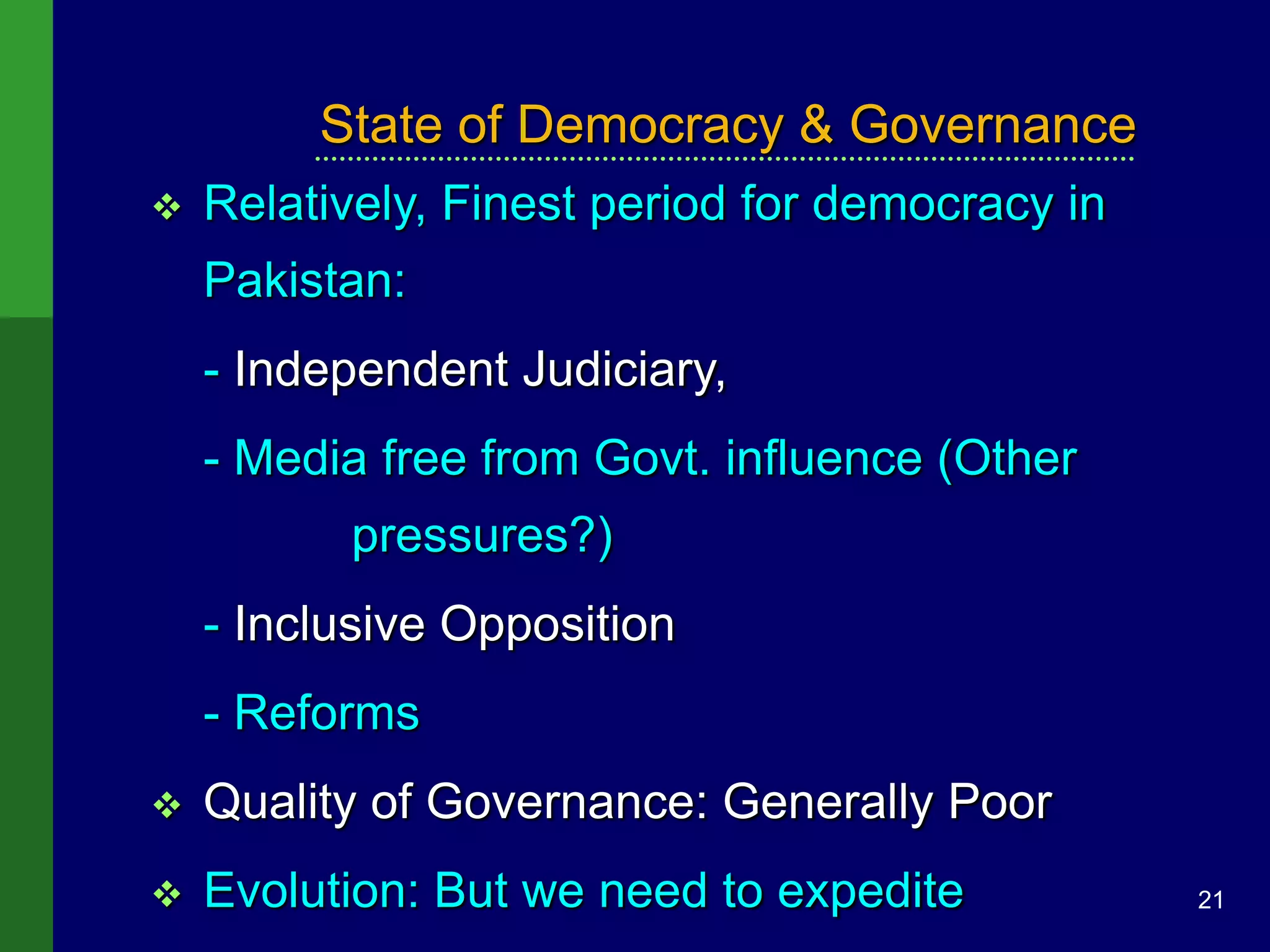
 Relatively, Finest period for democracy in
Pakistan:
- Independent Judiciary,
- Media free from Govt. influence (Other
pressures?)
- Inclusive Opposition
- Reforms
 Quality of Governance: Generally Poor
 Evolution: But we need to expedite
State of Democracy & Governance
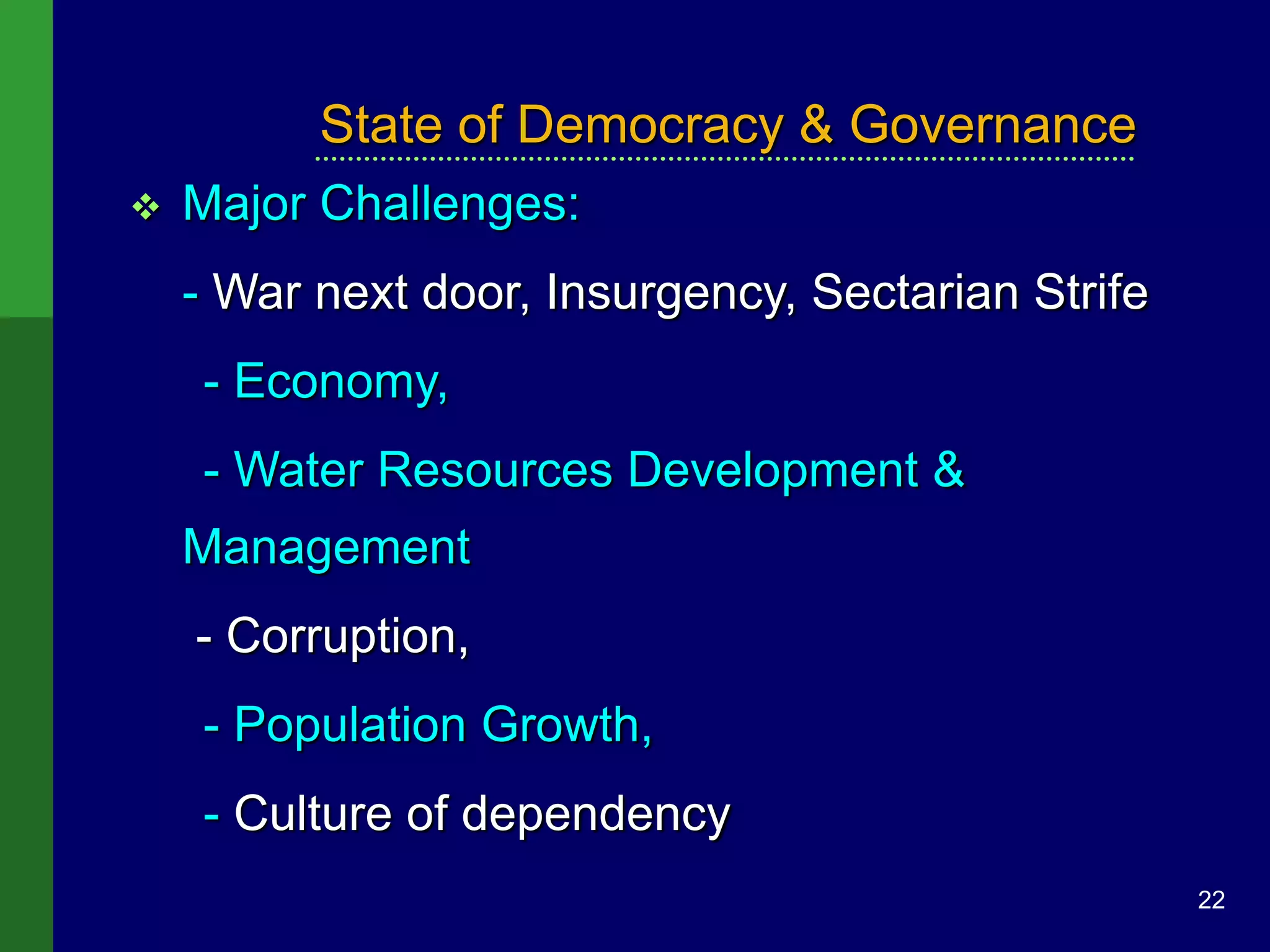
22
 Major Challenges:
- War next door, Insurgency, Sectarian Strife
- Economy,
- Water Resources Development &
Management
- Corruption,
- Population Growth,
- Culture of dependency
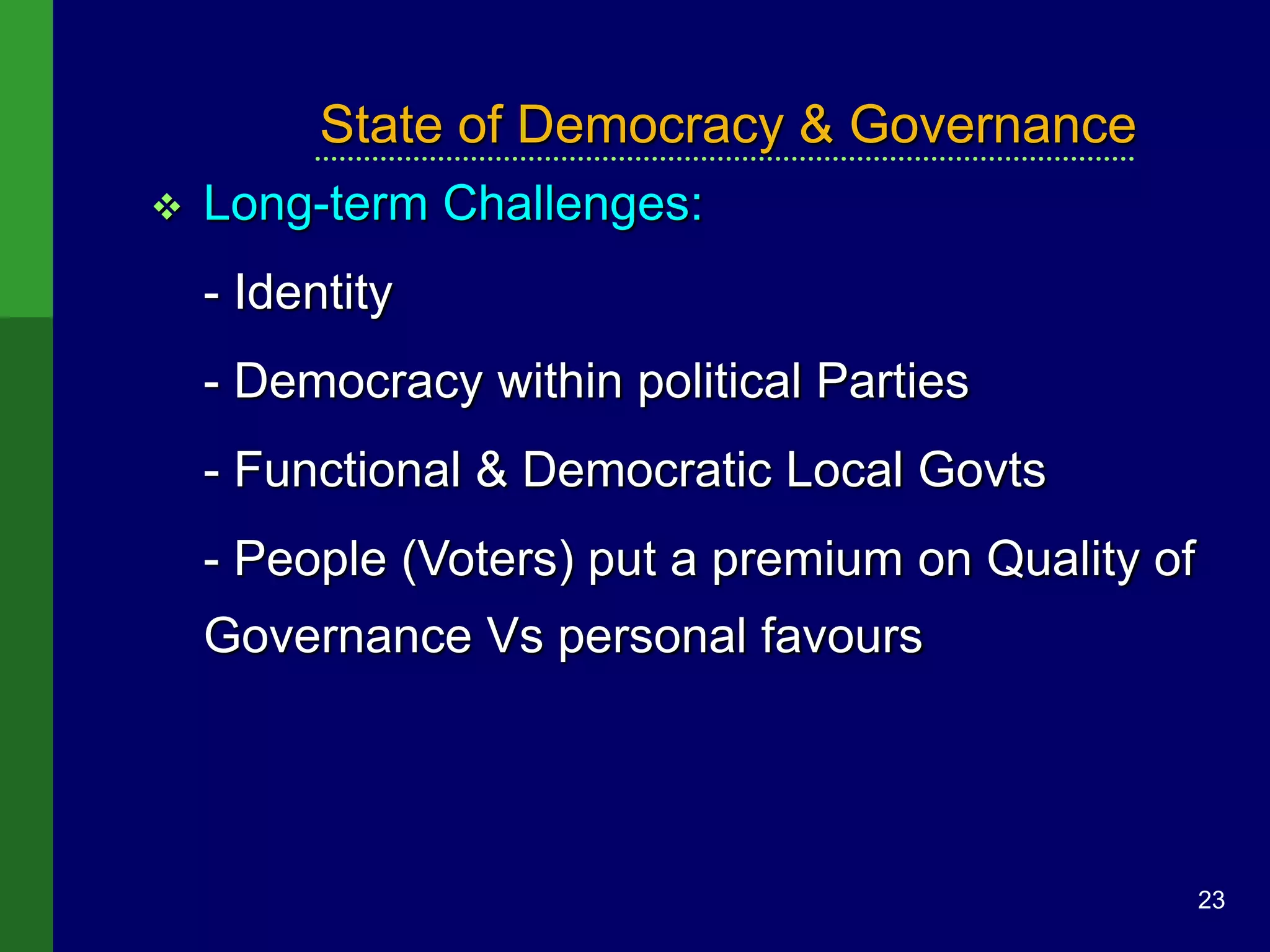
State of Democracy & Governance
23
 Long-term Challenges:
- Identity
- Democracy within political Parties
- Functional & Democratic Local Govts
- People (Voters) put a premium on Quality of
Governance Vs personal favours
State of Democracy & Governance

Parliamentary system of Pakistan.pptx

  • 1.
    1 Pakistan’s Parliamentary System: National& Provincial Set-up, Theory & Practice
  • 2.
    2  Executive derivesits democratic legitimacy from, and is held accountable to, parliament  No separation of executive from legislature  Head of state is normally a different person from head of government  Presidential system: head of state often also head of govt; Executive & Legislature are separate; Executive not derived from legislature  Parliamentary Form is more collective  Number of Parliamentary & Presidential Govts in the world are about the same; 66 Vs 64 Parliamentary Form of Government
  • 3.
    3  Inherited BritishSystem but Evolved since  Since beginning, tendency was towards a strong individual which is more suited to Presidential Form; Quaid, ZAB, BB, NS  Cabinet is generally subdued before a PM  ‘In the performance of his functions … the PM may act either directly or thru the Federal Ministers’ Article 90 (2)  Parliament is ‘controlled’ by Party Heads  More of a Prime Ministerial form of Govt. in which the concept of collective responsibility is rather a theoretical one Pakistan’s Parliamentary Form
  • 4.
    4  ‘Pakistan shallbe a federal republic ….’ Article 1 (1)  In a federation the component states are in some sense sovereign, as certain powers are reserved to them that may not be exercised by the central government  However, a federation is more than a mere loose alliance of independent states  About 27 Federations vs 164 Unitary states in the world  18th Amendment was a water-shed which omitted concurrent legislative list Federal Character of Pakistan
  • 5.
    5  Articles 153-155deal with Council of Common Interests (CCI)  ‘The Council shall formulate and regulate policies in relation to matters in Part II of the Federal Legislative List and shall exercise supervision and control over related institutions’ Article 154 (1)  About 10 new entries added to Part II under 18th amendment greatly enhancing the power of CCI  CCI is a de-facto super-Cabinet making governance more complex Federal Character of Pakistan (…Contd)
  • 6.
    6  Cabinets (defacto: PMs and CMs)  Council of Common Interests (CCI)  National Economic Council (Article 156)  National Finance Commission (Article 160)  National Security Committee (Composition; Role)  Other Cabinet Committees  Civil & Military Services  Provincial Governments  Local Governments  Foreign Influence Decision-making
  • 7.
    7  Federal Republic Parliamentary Democracy  Islam is the State Religion  Constitution guarantees Fundamental Rights  Population: 132 M (1998); 180 M (2013) Estimated  Area: 796,000 Sq. Km. (226 persons/Sq. Km; US Density: 34 / Sq. Km) Fundamentals of Pakistan’s Political System
  • 8.
    8  Legislature: -Senate (104Members) -National Assembly (342 Members) -Four Provincial Assemblies (728 Members)  Judiciary: -Supreme Court -High Courts -Subordinate Courts  Executive: Branches of the Government
  • 9.
    9  Federal Government Provincial Governments  Local Governments: Districts, Tehsils / Taulkas, Unions 3 Layers of the Government
  • 10.
    10  Senate -104 membersindirectly elected -23 from each Province (4 Women, 4 Technocrats, 1 Non-Muslim) -8 from FATA -4 from Capital (1 Woman, 1 Technocrat)  National Assembly -342 Members -272 General Seats -60 Seats for Women (List System; further strengthened party leaders) -10 Seats for non-Muslims Parliament or Majlis e Shoora
  • 11.
    11  Provincial Breakdownof MNAs -Balochistan: 17 (Gen: 14, Women: 3) -KP: 43 (Gen: 35, Women 8) -Punjab: 183 (Gen: 148, Women 35) -Sindh: 75 (Gen: 61, Women: 14) -FATA: 12 (All Gen.) -Fed. Capital: 2 (Both Gen) -Non-Muslims: 10 (All Pakistan basis) National Assembly
  • 12.
    12  Balochistan: 65(G 51, W 11, NM 3)  KP: 124 (G 99, W 22, NM 3)  Punjab: 371 (G 297, W 66, NM 8)  Sindh: 168 (G 130, W 29, NM 9)  AJK Legislative Assembly  Gilgit-Baltistan Legislative Assembly  No legislature for FATA or ICT Provincial Assemblies
  • 13.
    13  Legislation (Includingthe Finance Bill – Budget)  Oversight  Representation Legislatures’ Working governed by: The Constitution; ‘The Rules of Procedure & Conduct of Business’ Functions of Parliament
  • 14.
    14 a) 10 PoliticalParties represented b) 76 Women (16 Gen Seats, 60 W), 23 % c) Young (Below 30): 8 % d) PhDs: 2 %; Masters: 34 % e) 40 % Agriculturists f) 90 % Married g) 15 % Teachers (3rd Profession after Agriculture & Business) 14th National Assembly
  • 15.
    15 Increasing Role a)Legislation b)Oversight ofExecutive (Policy, Performance) c)Receiving Public Petitions d)Pre-Budget Recommendations (NA) e)Public Accounts f)Appointments Committees System in the Legislatures
  • 16.
    16 19 to 23Members in each Committee Types of Committees (38) a)Ministerial Standing Committees (28) b)Non-Ministerial Standing Committees (6) c)Special Committees (1) d)Select Committees (None) e)Parliamentary Committees (on Appointments) (3) Committees System in National Assembly
  • 17.
    17 12 to 13members in each committee Types of Committees (33) a)Ministerial Standing Committees (24) b)Non-Ministerial Standing Committees (6) c)Special Committees (1) d)Functional Committees (2) Committees System in the Senate
  • 18.
    18  Committees generallyweaker in provinces  No powers to convene meetings except KP  Balochistan: 15 Standing & 5 other committees; No Committee in last 6 years  KP: 36 Standing Committees  Punjab: 37 Standing Committees,14 Others (2 PACs)  Sindh: 30 Standing Committees, 8 Others; formed in April 2014 after 10 months Committees System in Provincial Assemblies
  • 19.
    19 a) Parliament atWork Vs Parliament on exhibition b) Committees: Less partisan approach c) Committees’ Role is expected to increase d) Committee Chair plays an important Role e) Committee System in other Countries: US, India etc. f) Conflict of Interest needs to be guarded against Committees: Significance & Procedure
  • 20.
    20 a) Parliament shouldlegislate: Executive dictates b) Budget Process: a farse c) Oversight by Parliament: Weak Committees d) MPs: Parliamentarians or Constituency lords? e) Cabinet role weak; PM dictates f) Political Parties not democratic; Kingdoms g) Military a subordinate institution or a super Govt? h) Provinces: Concentration of Power Vs Devolution i) Civil Services: Political Influence vs independenc Summing up: Theory & Practice
  • 21.
    21  Relatively, Finestperiod for democracy in Pakistan: - Independent Judiciary, - Media free from Govt. influence (Other pressures?) - Inclusive Opposition - Reforms  Quality of Governance: Generally Poor  Evolution: But we need to expedite State of Democracy & Governance
  • 22.
    22  Major Challenges: -War next door, Insurgency, Sectarian Strife - Economy, - Water Resources Development & Management - Corruption, - Population Growth, - Culture of dependency State of Democracy & Governance
  • 23.
    23  Long-term Challenges: -Identity - Democracy within political Parties - Functional & Democratic Local Govts - People (Voters) put a premium on Quality of Governance Vs personal favours State of Democracy & Governance