JAPAN
THE LAND OF RISING SUN
HRMin Japan:
Practices, Issues & Challenges
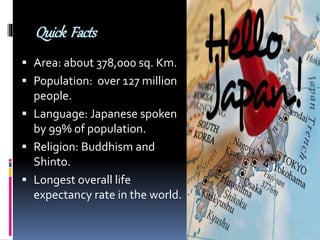
Quick Facts
 Area: about 378,000 sq. Km.
 Population: over 127 million
people.
 Language: Japanese spoken
by 99% of population.
 Religion: Buddhism and
Shinto.
 Longest overall life
expectancy rate in the world.
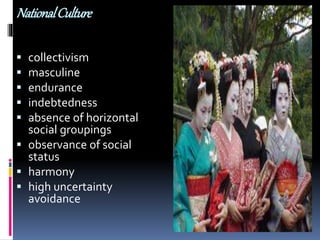
NationalCulture
 collectivism
 masculine
 endurance
 indebtedness
 absence of horizontal
social groupings
 observance of social
status
 harmony
 high uncertainty
avoidance
HRMand otheremployee related values and practices
• Enterprise-based trade unions, cooperative relationship between
employees and company, avoidance of open conflict
• Emotional and dependent relation between company and employees
• The Japanese are experts at the "soft S's" of management: staff, skills,
and style.
• Ringi method: collective decision making
• Implicit discrete performance appraisal
• Teamwork: multi-skill work teams, team appraisal and reward
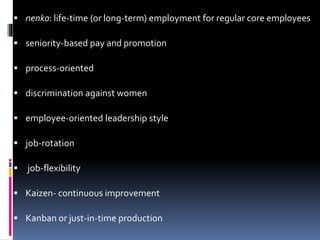
 nenko: life-time (or long-term) employment for regular core employees
 seniority-based pay and promotion
 process-oriented
 discrimination against women
 employee-oriented leadership style
 job-rotation
 job-flexibility
 Kaizen- continuous improvement
 Kanban or just-in-time production
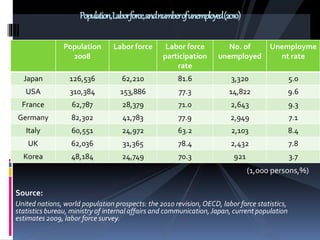
(1,000 persons,%)
Source:
United nations, world population prospects: the 2010 revision,OECD, labor force statistics,
statistics bureau, ministry of internal affairs and communication,Japan, current population
estimates 2009, labor force survey.
Population,Laborforce,andnumberofunemployed(2010)
Population
2008
Labor force Labor force
participation
rate
No. of
unemployed
Unemployme
nt rate
Japan 126,536 62,210 81.6 3,320 5.0
USA 310,384 153,886 77.3 14,822 9.6
France 62,787 28,379 71.0 2,643 9.3
Germany 82,302 41,783 77.9 2,949 7.1
Italy 60,551 24,972 63.2 2,103 8.4
UK 62,036 31,365 78.4 2,432 7.8
Korea 48,184 24,749 70.3 921 3.7
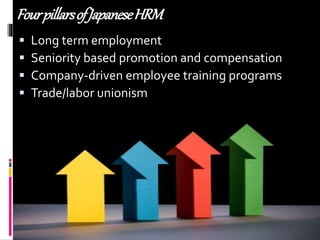
FourpillarsofJapaneseHRM
 Long term employment
 Seniority based promotion and compensation
 Company-driven employee training programs
 Trade/labor unionism
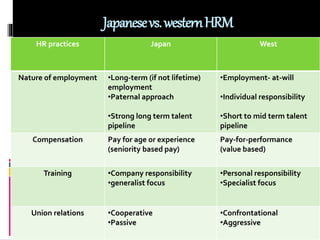
Japanesevs.westernHRM
HR practices Japan West
Nature of employment •Long-term (if not lifetime)
employment
•Paternal approach
•Strong long term talent
pipeline
•Employment- at-will
•Individual responsibility
•Short to mid term talent
pipeline
Compensation Pay for age or experience
(seniority based pay)
Pay-for-performance
(value based)
Training •Company responsibility
•generalist focus
•Personal responsibility
•Specialist focus
Union relations •Cooperative
•Passive
•Confrontational
•Aggressive
Recruitment and Selection
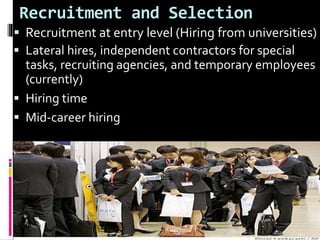
 Recruitment at entry level (Hiring from universities)
 Lateral hires, independent contractors for special
tasks, recruiting agencies, and temporary employees
(currently)
 Hiring time
 Mid-career hiring
• Advertisements in
newspapers, through web
sites, employment agencies
and through special seminars
and meetings
• Hiring on the basis of
reference
• Internship system
• Selection criteria
Training and development
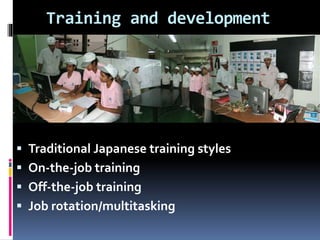
 Traditional Japanese training styles
 On-the-job training
 Off-the-job training
 Job rotation/multitasking
Training and development (cont’d)
 Occupational skills are valued over firm-
specific skills
 Support employees to improve technical
skills and to acquire qualifications.
 Creates generalists than specialists
Compensation and benefits
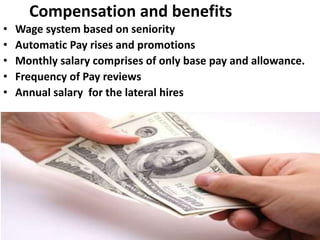
• Wage system based on seniority
• Automatic Pay rises and promotions
• Monthly salary comprises of only base pay and allowance.
• Frequency of Pay reviews
• Annual salary for the lateral hires
Compensation and benefits (cont’d)
 Retirement benefit
 Bonuses are tied to the broader performance of
the organization.
 Bonuses frequently comprise a significant portion
of take home pay.
 Many companies are now reviewing this system to
prepare one based on performance.
 Growing numbers of companies are explicitly
weighting ability and performance over tenure and
age in salary decision.
Performance management:
 Appraisal and evaluation policies
 Based on an employee's performance
 Interviews with superiors once or twice a year
 Management By Objectives (MBO)
 Companies make a team assessment by project.
Career management
• Promotion system distinct
from that of the West.
• No clear demarcation
between the white collar and
the blue collar.
• The rise to the senior level
managerial post.
• Japanese follow the late
selection criterion mixed
with simultaneous and
divergent promotion.
 Reasons for Staffing
o factor for international
staffing
o more PCNs than HCNs and
TCNs
 Selection methods
 Selections criteria
 Training
 Pre-mature return and failure
Ethics:
• Japanese business ethics are a direct product of Japanese culture
and religion.
• The Keidanren Charter-Charter for Good Corporate Behavior
clarifies ten principles
• Punctuality and work ethics
CorporateSocial Responsibility
May 2009, the CSR ranking in Japan
• SHARP-ranked at the first place-supports more than 500 environmental
education classes with nongovernmental organizations for elementary
school students.
• TOYOTA, the second highest ranking company is famous about hybrid
car PRIUS.
• “Ecology” is the most important key word for the CSR activities in
Japan.
• Panasonic follow it in a respective order
• Other highly ranked companies are renowned manufactures, except
NTT DOCOMO, the largest mobile phone carrier in Japan.
• Kyoto Protocol and low emission vehicles such as hybrid cars and
low-fuel consumption cars are the subjects of lowering tax rates which
offers the 50-100% of car purchasing related taxes
ISSUES & CHALLENGES
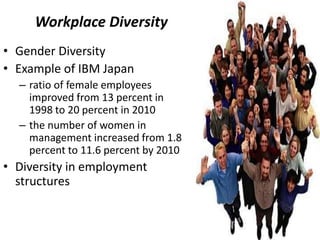
Workplace Diversity
• Gender Diversity
• Example of IBM Japan
– ratio of female employees
improved from 13 percent in
1998 to 20 percent in 2010
– the number of women in
management increased from 1.8
percent to 11.6 percent by 2010
• Diversity in employment
structures
Equality
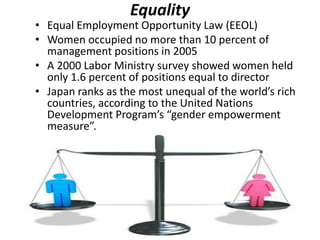
• Equal Employment Opportunity Law (EEOL)
• Women occupied no more than 10 percent of
management positions in 2005
• A 2000 Labor Ministry survey showed women held
only 1.6 percent of positions equal to director
• Japan ranks as the most unequal of the world’s rich
countries, according to the United Nations
Development Program’s “gender empowerment
measure”.
Convergence towards Western HRM practices
• Convergence debate at the
centre of Japanese
management research.
• Convergence toward Western
HRM practices.
• Convergence to the extreme i.e.
end of Japanese-style HRM.
Other Issues and Challenges
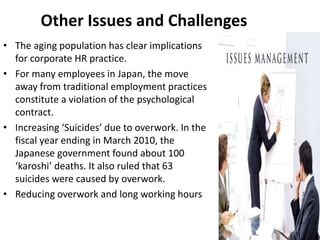
• The aging population has clear implications
for corporate HR practice.
• For many employees in Japan, the move
away from traditional employment practices
constitute a violation of the psychological
contract.
• Increasing ‘Suicides’ due to overwork. In the
fiscal year ending in March 2010, the
Japanese government found about 100
‘karoshi’ deaths. It also ruled that 63
suicides were caused by overwork.
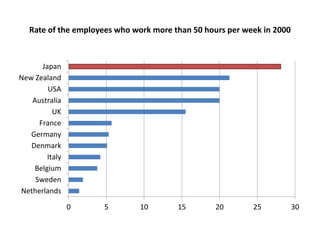
• Reducing overwork and long working hours
Rate of the employees who work more than 50 hours per week in 2000
0 5 10 15 20 25 30
Netherlands
Sweden
Belgium
Italy
Denmark
Germany
France
UK
Australia
USA
New Zealand
Japan
ReformingJapaneseHRM:
 Turning away from lifelong employment, flexibility of
recruitment, release of personnel and change of employer
 Managers-externally recruited and can be laid off again more
easily
 Increased formation of specialists and turning away from the
formation of generalists.
 Japanese managers - more concerned with the decline of the
seniority principle: “performance orientation”, “result and
objective orientation”, “performance and result oriented
remuneration” and “turning away from the seniority principle”.
New Japanese Model
NewValues Reasons
1) introducing flexible HR systems 1) economic recession & changing State
policy since 1992
2) more merit-based approach 2) mismatching HRM & business needs
3) emphasizing new HRD strategies 3) changing attitudes of young employees
Conclusion
Human Resource Management Practices in japan

Human Resource Management Practices in japan

  • 1.
  • 2.
  • 3.
    Quick Facts  Area:about 378,000 sq. Km.  Population: over 127 million people.  Language: Japanese spoken by 99% of population.  Religion: Buddhism and Shinto.  Longest overall life expectancy rate in the world.
  • 4.
    NationalCulture  collectivism  masculine endurance  indebtedness  absence of horizontal social groupings  observance of social status  harmony  high uncertainty avoidance
  • 5.
    HRMand otheremployee relatedvalues and practices • Enterprise-based trade unions, cooperative relationship between employees and company, avoidance of open conflict • Emotional and dependent relation between company and employees • The Japanese are experts at the "soft S's" of management: staff, skills, and style. • Ringi method: collective decision making • Implicit discrete performance appraisal • Teamwork: multi-skill work teams, team appraisal and reward
  • 6.
     nenko: life-time(or long-term) employment for regular core employees  seniority-based pay and promotion  process-oriented  discrimination against women  employee-oriented leadership style  job-rotation  job-flexibility  Kaizen- continuous improvement  Kanban or just-in-time production
  • 7.
    (1,000 persons,%) Source: United nations,world population prospects: the 2010 revision,OECD, labor force statistics, statistics bureau, ministry of internal affairs and communication,Japan, current population estimates 2009, labor force survey. Population,Laborforce,andnumberofunemployed(2010) Population 2008 Labor force Labor force participation rate No. of unemployed Unemployme nt rate Japan 126,536 62,210 81.6 3,320 5.0 USA 310,384 153,886 77.3 14,822 9.6 France 62,787 28,379 71.0 2,643 9.3 Germany 82,302 41,783 77.9 2,949 7.1 Italy 60,551 24,972 63.2 2,103 8.4 UK 62,036 31,365 78.4 2,432 7.8 Korea 48,184 24,749 70.3 921 3.7
  • 8.
    FourpillarsofJapaneseHRM  Long termemployment  Seniority based promotion and compensation  Company-driven employee training programs  Trade/labor unionism
  • 9.
    Japanesevs.westernHRM HR practices JapanWest Nature of employment •Long-term (if not lifetime) employment •Paternal approach •Strong long term talent pipeline •Employment- at-will •Individual responsibility •Short to mid term talent pipeline Compensation Pay for age or experience (seniority based pay) Pay-for-performance (value based) Training •Company responsibility •generalist focus •Personal responsibility •Specialist focus Union relations •Cooperative •Passive •Confrontational •Aggressive
  • 11.
    Recruitment and Selection Recruitment at entry level (Hiring from universities)  Lateral hires, independent contractors for special tasks, recruiting agencies, and temporary employees (currently)  Hiring time  Mid-career hiring
  • 12.
    • Advertisements in newspapers,through web sites, employment agencies and through special seminars and meetings • Hiring on the basis of reference • Internship system • Selection criteria
  • 13.
    Training and development Traditional Japanese training styles  On-the-job training  Off-the-job training  Job rotation/multitasking
  • 14.
    Training and development(cont’d)  Occupational skills are valued over firm- specific skills  Support employees to improve technical skills and to acquire qualifications.  Creates generalists than specialists
  • 15.
    Compensation and benefits •Wage system based on seniority • Automatic Pay rises and promotions • Monthly salary comprises of only base pay and allowance. • Frequency of Pay reviews • Annual salary for the lateral hires
  • 16.
    Compensation and benefits(cont’d)  Retirement benefit  Bonuses are tied to the broader performance of the organization.  Bonuses frequently comprise a significant portion of take home pay.  Many companies are now reviewing this system to prepare one based on performance.  Growing numbers of companies are explicitly weighting ability and performance over tenure and age in salary decision.
  • 17.
    Performance management:  Appraisaland evaluation policies  Based on an employee's performance  Interviews with superiors once or twice a year  Management By Objectives (MBO)  Companies make a team assessment by project.
  • 18.
    Career management • Promotionsystem distinct from that of the West. • No clear demarcation between the white collar and the blue collar. • The rise to the senior level managerial post. • Japanese follow the late selection criterion mixed with simultaneous and divergent promotion.
  • 19.
     Reasons forStaffing o factor for international staffing o more PCNs than HCNs and TCNs  Selection methods  Selections criteria  Training  Pre-mature return and failure
  • 20.
    Ethics: • Japanese businessethics are a direct product of Japanese culture and religion. • The Keidanren Charter-Charter for Good Corporate Behavior clarifies ten principles • Punctuality and work ethics
  • 21.
    CorporateSocial Responsibility May 2009,the CSR ranking in Japan • SHARP-ranked at the first place-supports more than 500 environmental education classes with nongovernmental organizations for elementary school students. • TOYOTA, the second highest ranking company is famous about hybrid car PRIUS. • “Ecology” is the most important key word for the CSR activities in Japan. • Panasonic follow it in a respective order • Other highly ranked companies are renowned manufactures, except NTT DOCOMO, the largest mobile phone carrier in Japan. • Kyoto Protocol and low emission vehicles such as hybrid cars and low-fuel consumption cars are the subjects of lowering tax rates which offers the 50-100% of car purchasing related taxes
  • 22.
  • 23.
    Workplace Diversity • GenderDiversity • Example of IBM Japan – ratio of female employees improved from 13 percent in 1998 to 20 percent in 2010 – the number of women in management increased from 1.8 percent to 11.6 percent by 2010 • Diversity in employment structures
  • 24.
    Equality • Equal EmploymentOpportunity Law (EEOL) • Women occupied no more than 10 percent of management positions in 2005 • A 2000 Labor Ministry survey showed women held only 1.6 percent of positions equal to director • Japan ranks as the most unequal of the world’s rich countries, according to the United Nations Development Program’s “gender empowerment measure”.
  • 25.
    Convergence towards WesternHRM practices • Convergence debate at the centre of Japanese management research. • Convergence toward Western HRM practices. • Convergence to the extreme i.e. end of Japanese-style HRM.
  • 26.
    Other Issues andChallenges • The aging population has clear implications for corporate HR practice. • For many employees in Japan, the move away from traditional employment practices constitute a violation of the psychological contract. • Increasing ‘Suicides’ due to overwork. In the fiscal year ending in March 2010, the Japanese government found about 100 ‘karoshi’ deaths. It also ruled that 63 suicides were caused by overwork. • Reducing overwork and long working hours
  • 27.
    Rate of theemployees who work more than 50 hours per week in 2000 0 5 10 15 20 25 30 Netherlands Sweden Belgium Italy Denmark Germany France UK Australia USA New Zealand Japan
  • 28.
    ReformingJapaneseHRM:  Turning awayfrom lifelong employment, flexibility of recruitment, release of personnel and change of employer  Managers-externally recruited and can be laid off again more easily  Increased formation of specialists and turning away from the formation of generalists.  Japanese managers - more concerned with the decline of the seniority principle: “performance orientation”, “result and objective orientation”, “performance and result oriented remuneration” and “turning away from the seniority principle”.
  • 29.
    New Japanese Model NewValuesReasons 1) introducing flexible HR systems 1) economic recession & changing State policy since 1992 2) more merit-based approach 2) mismatching HRM & business needs 3) emphasizing new HRD strategies 3) changing attitudes of young employees
  • 30.