Policy Analysis
“Policy Analysis is an applied social science discipline
which uses multiple methods of inquiry and argument
to produce and transform policy relevant information
that may be utilized in political settings to resolve
policy problems”
Public Policy Analysis by William N Dunn
Policy Analysis
“Policy Analysis is a Rational Decision
Making Approach to Social and
Economic problems”
Policy Analysis for Effective Development
Policy Analysis
“... Any type of analysis that generates and presents
information in such a way as to improve the basis for policy
makers to exercise their judgment… in policy analysis ,
word analysis implies the use of intuition and judgment ,
design and synthesis of new alternatives… some policy
analysis are informal involves nothing more than hard and
careful thinking whereas other require extensive data
gathering and elaborate calculations…”
E S Quade
Policy Analysis
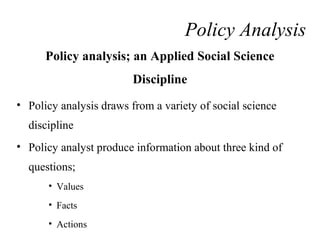
Policy analysis; an Applied Social Science
Discipline
• Policy analysis draws from a variety of social science
discipline
• Policy analyst produce information about three kind of
questions;
• Values
• Facts
• Actions
Policy Analysis
Approaches to Policy Analysis
Approach Primary Question Type of Information
Empirical Does it exist? (facts) Designative
Evaluative Of what worth is it?
(values)
Evaluative
Normative What should be done?
(action)
Advocative
Policy Analysis
in
Perspectives
Policy Analysis
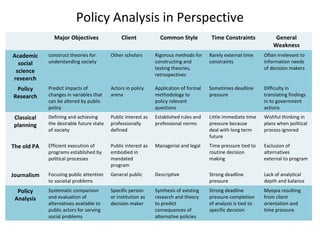
Policy Analysis in Perspective
Major Objectives Client Common Style Time Constraints General
Weakness
Academic
social
science
research
construct theories for
understanding society
Other scholars Rigorous methods for
constructing and
testing theories,
retrospectives
Rarely external time
constraints
Often irrelevant to
information needs
of decision makers
Policy
Research
Predict impacts of
changes in variables that
can be altered by public
policy
Actors in policy
arena
Application of formal
methodology to
policy relevant
questions
Sometimes deadline
pressure
Difficulty in
translating findings
in to government
actions
Classical
planning
Defining and achieving
the desirable future state
of society
Public interest as
professionally
defined
Established rules and
professional norms
Little immediate time
pressure because
deal with long term
future
Wishful thinking in
plans when political
process ignored
The old PA Efficient execution of
programs established by
political processes
Public interest as
embodied in
mandated
program
Managerial and legal Time pressure tied to
routine decision
making
Exclusion of
alternatives
external to program
Journalism Focusing public attention
to societal problems
General public Descriptive Strong deadline
pressure
Lack of analytical
depth and balance
Policy
Analysis
Systematic comparison
and evaluation of
alternatives available to
public actors for serving
social problems
Specific person
or institution as
decision maker
Synthesis of existing
research and theory
to predict
consequences of
alternative policies
Strong deadline
pressure-completion
of analysis is tied to
specific decision
Myopia resulting
from client
orientation and
time pressure
3 elements of Policy System
Policy Analysis
Policy
Stakeholders
Policy
Environment
Public
Policies
Basic Preparation for Policy Analysis
i. Know how to gather and organize information
ii. Putting perceived social problem in context
iii. Need for technical skills
iv. Understanding of political and organizational behavior
Policy Analysis
Ethical Code/ Ethos
• Protection of human rights and dignity
• Analytical integrity
• Misrepresentation of results
• Maintain confidentiality
• Honesty
Policy Analysis
Models for Policy Analysis
1.Process Model
2.Rational Model
Policy Analysis
Process Model
• Identification of a problem.
• Formulation of policy proposals by various parties.
• Selection and enactment of policy.
• Implementation.
• Evaluation.
Policy Analysis
“We can make public policymaking easier to
understand by breaking the system into parts
small enough to study. By understanding the
pieces, it is easier to understand the whole”
Jerri Cockrel --- “Public Policymaking in America”
Policy Analysis
Rational Model
1. Verify, define and detail the problem.
2. Establish evaluation criteria.
3. Identify alternative policies.
4. Evaluate and compare alternative policies.
5. Select the best policy among the alternatives considered.
6. Monitor and evaluate the proposed policy.
Policy Analysis
Rational Model
1.Verify, define and detail the problem.
“The uncreative mind can spot wrong answers, but
it takes a creative mind to spot wrong questions”
Antony Jay --- Management & Machiavelli
Policy Analysis
Rational Model
2. Establish evaluation criteria.
• Efficiency
• Cost
• Net benefit
• Equity
Policy Analysis
• Extent of uncertainty
• Political acceptability
• Administrative ease
• Legal issues
Rational Model
3. Identify alternative policies.
Policy Analysis
Rational Model
4. Evaluate and compare alternative policies.
• Scenario table
• Objective analysis
Policy Analysis
Rational Model
5. Select the best policy among the alternatives
considered.
Policy Analysis
Rational Model
6. Monitor and evaluate the proposed policy.
Policy Analysis
Rational Model
1. Verify, define and detail the problem.
2. Establish evaluation criteria.
3. Identify alternative policies.
4. Evaluate and compare alternative policies.
5. Select the best policy among the alternatives considered.
6. Monitor and evaluate the proposed policy.
Policy Analysis
HIGHER
EDUCATION
COMMISSION
Formation of HEC
• On 11th September 2002, the President of Pakistan
promulgated a Higher Education Ordinance
• The aim of HEC was that, it should be a central body that
would facilitate quality assurance of higher education in both
the public and private sectors
• Link funding by the federal government
Functions of HEC
• Evaluation of performance of institution
• Formulate policies, guiding principles and priorities for higher
education institutes
• Prescribe conditions under which educational institutions may
be opened and operated
• Determine the equivalence and recognition of degrees,
diplomas and certificates awarded by institutes with in and
outside the country
• Provide guidelines for the minimum criteria and qualification
for appointment, promotion and salary structure of teachers of
all institutions
• Curriculum revision
• Make and promote national and international linkages
Functions of HEC
Policy Analysis--- HEC Case
Study
Rational Model
1.Verify, define and detail the problem.
• HEC Devolution--- 18th
Amendment
• Education
• 4th
schedule --- Federal Legislative List
Policy Analysis--- HEC Case
Study
4th
schedule --- Federal Legislative List--- Part I
• Article 17 : Education as respects Pakistani students in
foreign countries and foreign students in Pakistan.
Policy Analysis--- HEC Case
Study
4th
schedule --- Federal Legislative List --- Part II
• Article 6 : All regulatory authorities established under a
Federal law.
• Article 7: National planning and national economic
coordination including planning and coordination of
scientific and technological research.
Policy Analysis--- HEC Case
Study
4th
schedule --- Federal Legislative List --- Part II
• Article 11:Legal, medical and other professions.
• Article 12:Standards in institutions for higher education
and research, scientific and technical institutions.
• Article 13: Inter-provincial matters and co-ordination.
Policy Analysis--- HEC Case
Study
Rational Model
1.Verify, define and detail the problem.
• Problem : “Extent of Devolution”
• Stakeholders' Analysis
Policy Analysis--- HEC Case
Study
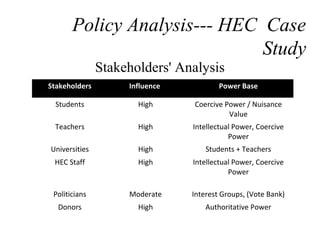
Stakeholders' Analysis
Policy Analysis--- HEC Case
Study
Stakeholders Influence Power Base
Students High Coercive Power / Nuisance
Value
Teachers High Intellectual Power, Coercive
Power
Universities High Students + Teachers
HEC Staff High Intellectual Power, Coercive
Power
Politicians Moderate Interest Groups, (Vote Bank)
Donors High Authoritative Power
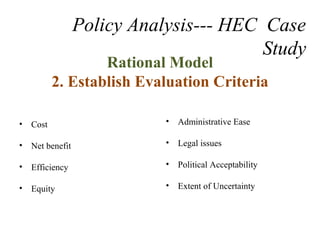
Rational Model
2. Establish Evaluation Criteria
• Cost
• Net benefit
• Efficiency
• Equity
• Administrative Ease
• Legal issues
• Political Acceptability
• Extent of Uncertainty
Policy Analysis--- HEC Case
Study
Rational Model
3. Identify Alternative policies
Policy Analysis--- HEC Case
Study
Policy Option 1 Policy Option 2 Policy Option 3
Do Not Devolve
(Status Quo)
Complete
Devolution
Shared
Function/Responsibilities
(Federal + Provincial)
HEC Ordinance 2002
Core Functions
Policy Analysis--- HEC Case
Study
 Evaluation Criteria (Teachers)
 Equivalence and recognition of
Degrees
 Regulation
 Linkages with foreign universities
 Standard in institutions for Higher
Education
 Funding
 Degree Attestation
 Curriculum
 Evaluation Criteria for Universities
• Standard in institutions for Higher Education
Article 12:Standards in institutions for higher education and research, scientific
and technical institutions.
• Regulation
Article 6 : All regulatory authorities established under a Federal law.
• Linkages with foreign universities
Article 17 : Education as respects Pakistani students in foreign countries and
foreign students in Pakistan.
Policy Analysis--- HEC Case
Study
Rational Model
4. Evaluate and Compare
Alternative Policies
Policy Analysis--- HEC Case
Study
Scenario Table
Policy Option
1
Policy Option
2
Policy Option
3
Status quo Completely devolve Share responsibilities
Attributes current status of HEC
continues
All functions of HEC
goes to the respective
province’s Commission
for Higher Standard
Education
Provinces
• Curriculum
• Syllabus
• Developing linkages
• Attestation of degrees
Criteria under which
institutions are opened
Federal
• Standards of higher
education
• Equivalence and
recognition of degrees
• funding
• Criteria for
appointment, promotion
and salary structure of
teachers
Evaluation Criteria
Policy Option 1
(Status quo )
Policy Option 2
(Completely devolve)
Policy Option 3
(Share responsibilities)
Cost The current cost remain the
same
Cost increases
(administrative expenses)
Cost increase but
comparatively less than
option 2
Net benefit Remain same Low as compared to sharing High
Efficiency Remain same High level of efficiency Moderate level of efficiency
Administrative
Ease
Remain same Not easy because entirely
new structure need to be
developed
Relatively easy to
implement
Policy Option 1
(Status quo )
Policy Option 2
(Completely devolve)
Policy Option 3
(Share responsibilities)
Legal Issues Have to made amendment
in constitution
None Face some legal issues
Political
Acceptability
High level of
acceptability
Low level of
acceptability
High
Extent of
Uncertainty
The policy option is
certain
Highest level of
uncertainty
Moderate level of
uncertainty
Rational Model
5. Select the best policy among the
alternatives considered.
Policy Analysis--- HEC Case
Study
Policy Option 1 Policy Option 2 Policy Option 3
Do Not Devolve
(Status Quo)
Complete
Devolution
Shared
Function/Responsibilities
(Federal + Provincial)
Rational Model
6. Monitor and evaluate the proposed policy.
Formal + Informal
Policy Analysis--- HEC Case
Study
Conclusion
“ All political parties and stakeholders should
be consulted to develop a consensus in the
devolution of the Higher Education
Commission (HEC)”
Dawn News reported

Hec policy analysis

  • 1.
  • 2.
    “Policy Analysis isan applied social science discipline which uses multiple methods of inquiry and argument to produce and transform policy relevant information that may be utilized in political settings to resolve policy problems” Public Policy Analysis by William N Dunn Policy Analysis
  • 3.
    “Policy Analysis isa Rational Decision Making Approach to Social and Economic problems” Policy Analysis for Effective Development Policy Analysis
  • 4.
    “... Any typeof analysis that generates and presents information in such a way as to improve the basis for policy makers to exercise their judgment… in policy analysis , word analysis implies the use of intuition and judgment , design and synthesis of new alternatives… some policy analysis are informal involves nothing more than hard and careful thinking whereas other require extensive data gathering and elaborate calculations…” E S Quade Policy Analysis
  • 5.
    Policy analysis; anApplied Social Science Discipline • Policy analysis draws from a variety of social science discipline • Policy analyst produce information about three kind of questions; • Values • Facts • Actions Policy Analysis
  • 6.
    Approaches to PolicyAnalysis Approach Primary Question Type of Information Empirical Does it exist? (facts) Designative Evaluative Of what worth is it? (values) Evaluative Normative What should be done? (action) Advocative
  • 7.
  • 8.
    Policy Analysis inPerspective Major Objectives Client Common Style Time Constraints General Weakness Academic social science research construct theories for understanding society Other scholars Rigorous methods for constructing and testing theories, retrospectives Rarely external time constraints Often irrelevant to information needs of decision makers Policy Research Predict impacts of changes in variables that can be altered by public policy Actors in policy arena Application of formal methodology to policy relevant questions Sometimes deadline pressure Difficulty in translating findings in to government actions Classical planning Defining and achieving the desirable future state of society Public interest as professionally defined Established rules and professional norms Little immediate time pressure because deal with long term future Wishful thinking in plans when political process ignored The old PA Efficient execution of programs established by political processes Public interest as embodied in mandated program Managerial and legal Time pressure tied to routine decision making Exclusion of alternatives external to program Journalism Focusing public attention to societal problems General public Descriptive Strong deadline pressure Lack of analytical depth and balance Policy Analysis Systematic comparison and evaluation of alternatives available to public actors for serving social problems Specific person or institution as decision maker Synthesis of existing research and theory to predict consequences of alternative policies Strong deadline pressure-completion of analysis is tied to specific decision Myopia resulting from client orientation and time pressure
  • 9.
    3 elements ofPolicy System Policy Analysis Policy Stakeholders Policy Environment Public Policies
  • 10.
    Basic Preparation forPolicy Analysis i. Know how to gather and organize information ii. Putting perceived social problem in context iii. Need for technical skills iv. Understanding of political and organizational behavior Policy Analysis
  • 11.
    Ethical Code/ Ethos •Protection of human rights and dignity • Analytical integrity • Misrepresentation of results • Maintain confidentiality • Honesty Policy Analysis
  • 12.
    Models for PolicyAnalysis 1.Process Model 2.Rational Model Policy Analysis
  • 13.
    Process Model • Identificationof a problem. • Formulation of policy proposals by various parties. • Selection and enactment of policy. • Implementation. • Evaluation. Policy Analysis
  • 14.
    “We can makepublic policymaking easier to understand by breaking the system into parts small enough to study. By understanding the pieces, it is easier to understand the whole” Jerri Cockrel --- “Public Policymaking in America” Policy Analysis
  • 15.
    Rational Model 1. Verify,define and detail the problem. 2. Establish evaluation criteria. 3. Identify alternative policies. 4. Evaluate and compare alternative policies. 5. Select the best policy among the alternatives considered. 6. Monitor and evaluate the proposed policy. Policy Analysis
  • 16.
    Rational Model 1.Verify, defineand detail the problem. “The uncreative mind can spot wrong answers, but it takes a creative mind to spot wrong questions” Antony Jay --- Management & Machiavelli Policy Analysis
  • 17.
    Rational Model 2. Establishevaluation criteria. • Efficiency • Cost • Net benefit • Equity Policy Analysis • Extent of uncertainty • Political acceptability • Administrative ease • Legal issues
  • 18.
    Rational Model 3. Identifyalternative policies. Policy Analysis
  • 19.
    Rational Model 4. Evaluateand compare alternative policies. • Scenario table • Objective analysis Policy Analysis
  • 20.
    Rational Model 5. Selectthe best policy among the alternatives considered. Policy Analysis
  • 21.
    Rational Model 6. Monitorand evaluate the proposed policy. Policy Analysis
  • 22.
    Rational Model 1. Verify,define and detail the problem. 2. Establish evaluation criteria. 3. Identify alternative policies. 4. Evaluate and compare alternative policies. 5. Select the best policy among the alternatives considered. 6. Monitor and evaluate the proposed policy. Policy Analysis
  • 23.
  • 24.
    Formation of HEC •On 11th September 2002, the President of Pakistan promulgated a Higher Education Ordinance • The aim of HEC was that, it should be a central body that would facilitate quality assurance of higher education in both the public and private sectors • Link funding by the federal government
  • 25.
    Functions of HEC •Evaluation of performance of institution • Formulate policies, guiding principles and priorities for higher education institutes • Prescribe conditions under which educational institutions may be opened and operated • Determine the equivalence and recognition of degrees, diplomas and certificates awarded by institutes with in and outside the country
  • 26.
    • Provide guidelinesfor the minimum criteria and qualification for appointment, promotion and salary structure of teachers of all institutions • Curriculum revision • Make and promote national and international linkages Functions of HEC
  • 27.
  • 28.
    Rational Model 1.Verify, defineand detail the problem. • HEC Devolution--- 18th Amendment • Education • 4th schedule --- Federal Legislative List Policy Analysis--- HEC Case Study
  • 29.
    4th schedule --- FederalLegislative List--- Part I • Article 17 : Education as respects Pakistani students in foreign countries and foreign students in Pakistan. Policy Analysis--- HEC Case Study
  • 30.
    4th schedule --- FederalLegislative List --- Part II • Article 6 : All regulatory authorities established under a Federal law. • Article 7: National planning and national economic coordination including planning and coordination of scientific and technological research. Policy Analysis--- HEC Case Study
  • 31.
    4th schedule --- FederalLegislative List --- Part II • Article 11:Legal, medical and other professions. • Article 12:Standards in institutions for higher education and research, scientific and technical institutions. • Article 13: Inter-provincial matters and co-ordination. Policy Analysis--- HEC Case Study
  • 32.
    Rational Model 1.Verify, defineand detail the problem. • Problem : “Extent of Devolution” • Stakeholders' Analysis Policy Analysis--- HEC Case Study
  • 33.
    Stakeholders' Analysis Policy Analysis---HEC Case Study Stakeholders Influence Power Base Students High Coercive Power / Nuisance Value Teachers High Intellectual Power, Coercive Power Universities High Students + Teachers HEC Staff High Intellectual Power, Coercive Power Politicians Moderate Interest Groups, (Vote Bank) Donors High Authoritative Power
  • 34.
    Rational Model 2. EstablishEvaluation Criteria • Cost • Net benefit • Efficiency • Equity • Administrative Ease • Legal issues • Political Acceptability • Extent of Uncertainty Policy Analysis--- HEC Case Study
  • 35.
    Rational Model 3. IdentifyAlternative policies Policy Analysis--- HEC Case Study Policy Option 1 Policy Option 2 Policy Option 3 Do Not Devolve (Status Quo) Complete Devolution Shared Function/Responsibilities (Federal + Provincial)
  • 36.
    HEC Ordinance 2002 CoreFunctions Policy Analysis--- HEC Case Study  Evaluation Criteria (Teachers)  Equivalence and recognition of Degrees  Regulation  Linkages with foreign universities  Standard in institutions for Higher Education  Funding  Degree Attestation  Curriculum  Evaluation Criteria for Universities
  • 37.
    • Standard ininstitutions for Higher Education Article 12:Standards in institutions for higher education and research, scientific and technical institutions. • Regulation Article 6 : All regulatory authorities established under a Federal law. • Linkages with foreign universities Article 17 : Education as respects Pakistani students in foreign countries and foreign students in Pakistan. Policy Analysis--- HEC Case Study
  • 38.
    Rational Model 4. Evaluateand Compare Alternative Policies Policy Analysis--- HEC Case Study
  • 39.
    Scenario Table Policy Option 1 PolicyOption 2 Policy Option 3 Status quo Completely devolve Share responsibilities Attributes current status of HEC continues All functions of HEC goes to the respective province’s Commission for Higher Standard Education Provinces • Curriculum • Syllabus • Developing linkages • Attestation of degrees Criteria under which institutions are opened Federal • Standards of higher education • Equivalence and recognition of degrees • funding • Criteria for appointment, promotion and salary structure of teachers
  • 40.
    Evaluation Criteria Policy Option1 (Status quo ) Policy Option 2 (Completely devolve) Policy Option 3 (Share responsibilities) Cost The current cost remain the same Cost increases (administrative expenses) Cost increase but comparatively less than option 2 Net benefit Remain same Low as compared to sharing High Efficiency Remain same High level of efficiency Moderate level of efficiency Administrative Ease Remain same Not easy because entirely new structure need to be developed Relatively easy to implement
  • 41.
    Policy Option 1 (Statusquo ) Policy Option 2 (Completely devolve) Policy Option 3 (Share responsibilities) Legal Issues Have to made amendment in constitution None Face some legal issues Political Acceptability High level of acceptability Low level of acceptability High Extent of Uncertainty The policy option is certain Highest level of uncertainty Moderate level of uncertainty
  • 42.
    Rational Model 5. Selectthe best policy among the alternatives considered. Policy Analysis--- HEC Case Study Policy Option 1 Policy Option 2 Policy Option 3 Do Not Devolve (Status Quo) Complete Devolution Shared Function/Responsibilities (Federal + Provincial)
  • 43.
    Rational Model 6. Monitorand evaluate the proposed policy. Formal + Informal Policy Analysis--- HEC Case Study
  • 44.
    Conclusion “ All politicalparties and stakeholders should be consulted to develop a consensus in the devolution of the Higher Education Commission (HEC)” Dawn News reported