Consumption Function
 Theory of consumption function explain relationship
between consumption & income
 As per J.M Keynes, consumption expenditure of household
depends mainly on their current income
 Other factors influence like interest rate, taxation, amount of
wealth etc.
 As per Keynes, when income increases, consumption
increases but in a lesser proportion due to savings factor
 Consumption Function is also known as Propensity to
consume
APC & MPC
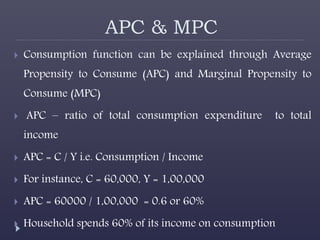
 Consumption function can be explained through Average
Propensity to Consume (APC) and Marginal Propensity to
Consume (MPC)
 APC – ratio of total consumption expenditure to total
income
 APC = C / Y i.e. Consumption / Income
 For instance, C = 60,000, Y = 1,00,000
 APC = 60000 / 1,00,000 = 0.6 or 60%
 Household spends 60% of its income on consumption
APC & MPC
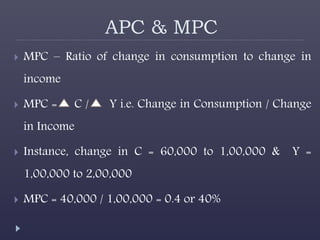
 MPC – Ratio of change in consumption to change in
income
 MPC = C / Y i.e. Change in Consumption / Change
in Income
 Instance, change in C = 60,000 to 1,00,000 & Y =
1,00,000 to 2,00,000
 MPC = 40,000 / 1,00,000 = 0.4 or 40%
APS & MPS
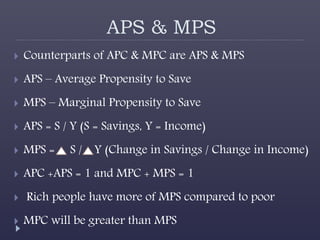
 Counterparts of APC & MPC are APS & MPS
 APS – Average Propensity to Save
 MPS – Marginal Propensity to Save
 APS = S / Y (S = Savings, Y = Income)
 MPS = S / Y (Change in Savings / Change in Income)
 APC +APS = 1 and MPC + MPS = 1
 Rich people have more of MPS compared to poor
 MPC will be greater than MPS
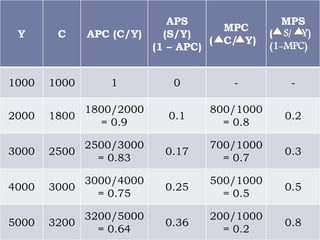
Y C APC (C/Y)
APS
(S/Y)
(1 – APC)
MPC
( C/ Y)
MPS
( S/ Y)
(1-MPC)
1000 1000 1 0 - -
2000 1800
1800/2000
= 0.9
0.1
800/1000
= 0.8
0.2
3000 2500
2500/3000
= 0.83
0.17
700/1000
= 0.7
0.3
4000 3000
3000/4000
= 0.75
0.25
500/1000
= 0.5
0.5
5000 3200
3200/5000
= 0.64
0.36
200/1000
= 0.2
0.8
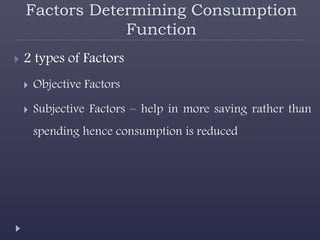
Factors Determining Consumption
Function
 2 types of Factors
 Objective Factors
 Subjective Factors – help in more saving rather than
spending hence consumption is reduced
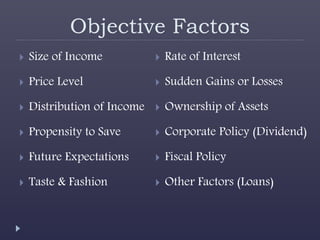
Objective Factors
 Size of Income
 Price Level
 Distribution of Income
 Propensity to Save
 Future Expectations
 Taste & Fashion
 Rate of Interest
 Sudden Gains or Losses
 Ownership of Assets
 Corporate Policy (Dividend)
 Fiscal Policy
 Other Factors (Loans)
Subjective Factors
 Precaution against illness, accident, unemployment etc.
 Future Expectations & Needs
 Accumulation of Wealth
 Independence
 Investment
 Speculation
Marginal Efficiency of Capital
Effective Demand
 J.M. Keynes emphasises on high level of effective
demand to maintain high level of employment
 Effective Dem = Consumption Dem + Investment Dem
 Consumption Demand
 Demand for final goods & services
 Depends upon level of income & propensity to spend
 In Short run, it remains stable
Effective Demand
 Investment Demand
 Demand for Capital Goods
 Depends upon rate of interest and marginal efficiency of
capital
 In short run, rate of interest is stable
 Marginal Efficiency of Capital is influential factor in
determining level of investment demand
 In short run, consumption demand remains stable hence,
level of employment is influenced by investment demand
Marginal Efficiency of Capital
(MEC)
 MEC is the expected rate of profitability from a capital asset
 Rate of Return expected over & above the cost of an
additional unit of capital asset
 Capital Asset is brand new asset & not existing one
 Similarly, “return” is expected returns & not existing returns
or actual returns
 MEC depend upon prospective yield from capital asset &
supply price of the asset
Marginal Efficiency of Capital
(MEC)
Prospective Yield From Capital
Asset
Supply Price of
Capital Asset
 Total net return expected
from asset over its lifetime
 Net income received by
selling its output
(products manufactured
by machinery)
 Net Income = Gross
Income – Cost
 Price of asset is considered
before purchasing
 Comparison is made
between supply price &
yield from the asset
 Investment is made when
yield is more than supply
price
MEC
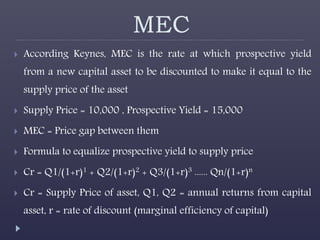
 According Keynes, MEC is the rate at which prospective yield
from a new capital asset to be discounted to make it equal to the
supply price of the asset
 Supply Price = 10,000 , Prospective Yield = 15,000
 MEC = Price gap between them
 Formula to equalize prospective yield to supply price
 Cr = Q1/(1+r)1 + Q2/(1+r)2 + Q3/(1+r)3 ...... Qn/(1+r)n
 Cr = Supply Price of asset, Q1, Q2 = annual returns from capital
asset, r = rate of discount (marginal efficiency of capital)
MEC
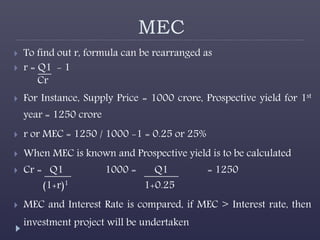
 To find out r, formula can be rearranged as
 r = Q1 - 1
Cr
 For Instance, Supply Price = 1000 crore, Prospective yield for 1st
year = 1250 crore
 r or MEC = 1250 / 1000 -1 = 0.25 or 25%
 When MEC is known and Prospective yield is to be calculated
 Cr = Q1 1000 = Q1 = 1250
(1+r)1 1+0.25
 MEC and Interest Rate is compared, if MEC > Interest rate, then
investment project will be undertaken
Investment Demand Curve
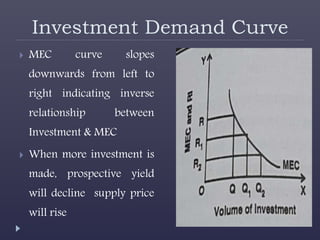
 MEC curve slopes
downwards from left to
right indicating inverse
relationship between
Investment & MEC
 When more investment is
made, prospective yield
will decline supply price
will rise
Questions
1. Explain the concept of consumption function
2. Differentiate between APC & MPC, APS & MPS
3. Throw light on the factors influencing consumption
function (Subjective or objective can come as short Note)
4. Sums to Calculate APC, MPC, APS, MPS will come
5. Discuss the concept of Effective Demand
6. Throw light on the concept of MEC with suitable diagram
7. Explain Investment Demand Curve
8. Sums to calculate MEC, Cr, Q will come

7. consumption function

  • 1.
  • 2.
    Consumption Function  Theoryof consumption function explain relationship between consumption & income  As per J.M Keynes, consumption expenditure of household depends mainly on their current income  Other factors influence like interest rate, taxation, amount of wealth etc.  As per Keynes, when income increases, consumption increases but in a lesser proportion due to savings factor  Consumption Function is also known as Propensity to consume
  • 3.
    APC & MPC Consumption function can be explained through Average Propensity to Consume (APC) and Marginal Propensity to Consume (MPC)  APC – ratio of total consumption expenditure to total income  APC = C / Y i.e. Consumption / Income  For instance, C = 60,000, Y = 1,00,000  APC = 60000 / 1,00,000 = 0.6 or 60%  Household spends 60% of its income on consumption
  • 4.
    APC & MPC MPC – Ratio of change in consumption to change in income  MPC = C / Y i.e. Change in Consumption / Change in Income  Instance, change in C = 60,000 to 1,00,000 & Y = 1,00,000 to 2,00,000  MPC = 40,000 / 1,00,000 = 0.4 or 40%
  • 5.
    APS & MPS Counterparts of APC & MPC are APS & MPS  APS – Average Propensity to Save  MPS – Marginal Propensity to Save  APS = S / Y (S = Savings, Y = Income)  MPS = S / Y (Change in Savings / Change in Income)  APC +APS = 1 and MPC + MPS = 1  Rich people have more of MPS compared to poor  MPC will be greater than MPS
  • 6.
    Y C APC(C/Y) APS (S/Y) (1 – APC) MPC ( C/ Y) MPS ( S/ Y) (1-MPC) 1000 1000 1 0 - - 2000 1800 1800/2000 = 0.9 0.1 800/1000 = 0.8 0.2 3000 2500 2500/3000 = 0.83 0.17 700/1000 = 0.7 0.3 4000 3000 3000/4000 = 0.75 0.25 500/1000 = 0.5 0.5 5000 3200 3200/5000 = 0.64 0.36 200/1000 = 0.2 0.8
  • 7.
    Factors Determining Consumption Function 2 types of Factors  Objective Factors  Subjective Factors – help in more saving rather than spending hence consumption is reduced
  • 8.
    Objective Factors  Sizeof Income  Price Level  Distribution of Income  Propensity to Save  Future Expectations  Taste & Fashion  Rate of Interest  Sudden Gains or Losses  Ownership of Assets  Corporate Policy (Dividend)  Fiscal Policy  Other Factors (Loans)
  • 9.
    Subjective Factors  Precautionagainst illness, accident, unemployment etc.  Future Expectations & Needs  Accumulation of Wealth  Independence  Investment  Speculation
  • 10.
  • 11.
    Effective Demand  J.M.Keynes emphasises on high level of effective demand to maintain high level of employment  Effective Dem = Consumption Dem + Investment Dem  Consumption Demand  Demand for final goods & services  Depends upon level of income & propensity to spend  In Short run, it remains stable
  • 12.
    Effective Demand  InvestmentDemand  Demand for Capital Goods  Depends upon rate of interest and marginal efficiency of capital  In short run, rate of interest is stable  Marginal Efficiency of Capital is influential factor in determining level of investment demand  In short run, consumption demand remains stable hence, level of employment is influenced by investment demand
  • 13.
    Marginal Efficiency ofCapital (MEC)  MEC is the expected rate of profitability from a capital asset  Rate of Return expected over & above the cost of an additional unit of capital asset  Capital Asset is brand new asset & not existing one  Similarly, “return” is expected returns & not existing returns or actual returns  MEC depend upon prospective yield from capital asset & supply price of the asset
  • 14.
    Marginal Efficiency ofCapital (MEC) Prospective Yield From Capital Asset Supply Price of Capital Asset  Total net return expected from asset over its lifetime  Net income received by selling its output (products manufactured by machinery)  Net Income = Gross Income – Cost  Price of asset is considered before purchasing  Comparison is made between supply price & yield from the asset  Investment is made when yield is more than supply price
  • 15.
    MEC  According Keynes,MEC is the rate at which prospective yield from a new capital asset to be discounted to make it equal to the supply price of the asset  Supply Price = 10,000 , Prospective Yield = 15,000  MEC = Price gap between them  Formula to equalize prospective yield to supply price  Cr = Q1/(1+r)1 + Q2/(1+r)2 + Q3/(1+r)3 ...... Qn/(1+r)n  Cr = Supply Price of asset, Q1, Q2 = annual returns from capital asset, r = rate of discount (marginal efficiency of capital)
  • 16.
    MEC  To findout r, formula can be rearranged as  r = Q1 - 1 Cr  For Instance, Supply Price = 1000 crore, Prospective yield for 1st year = 1250 crore  r or MEC = 1250 / 1000 -1 = 0.25 or 25%  When MEC is known and Prospective yield is to be calculated  Cr = Q1 1000 = Q1 = 1250 (1+r)1 1+0.25  MEC and Interest Rate is compared, if MEC > Interest rate, then investment project will be undertaken
  • 17.
    Investment Demand Curve MEC curve slopes downwards from left to right indicating inverse relationship between Investment & MEC  When more investment is made, prospective yield will decline supply price will rise
  • 18.
    Questions 1. Explain theconcept of consumption function 2. Differentiate between APC & MPC, APS & MPS 3. Throw light on the factors influencing consumption function (Subjective or objective can come as short Note) 4. Sums to Calculate APC, MPC, APS, MPS will come 5. Discuss the concept of Effective Demand 6. Throw light on the concept of MEC with suitable diagram 7. Explain Investment Demand Curve 8. Sums to calculate MEC, Cr, Q will come