PUBLIC ECONOMICS
UNIT:- 3
Public Expenditure
NISHALI B.
M.A. ECONOMICS
SEMESTER 1
Wagner's Hypothesis and
Peacock-Wiseman Hypothesis
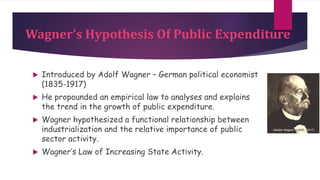
Wagner's Hypothesis Of Public Expenditure
 Introduced by Adolf Wagner – German political economist
(1835-1917)
 He propounded an empirical law to analyses and explains
the trend in the growth of public expenditure.
 Wagner hypothesized a functional relationship between
industrialization and the relative importance of public
sector activity.
 Wagner’s Law of Increasing State Activity.
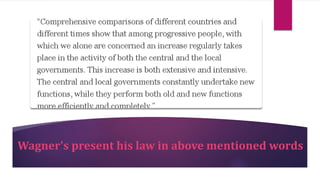
Wagner's present his law in above mentioned words
 Intensive increase means expansion of
traditional functions of the State on large
scale.
 Extensive increase means relates to
coverage of new welfare functions.
Public Expenditure Continuous Increases Due
To 3 Reasons
• Expansion of traditional functions
• Coverage of new functions
• Expanding sphere of public goods
Factors Affecting Public Expenditure Activities
 Both demand side and supply side of public expenditure activities.
 Demand side of public expenditure activities.
 Supply side of public expenditure activities.
Wagner believed that public expenditure will increase faster that
the increase in per capita income of people.
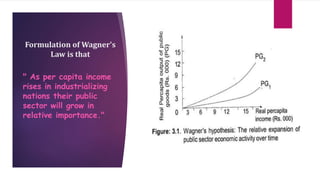
Formulation of Wagner's
Law is that
" As per capita income
rises in industrializing
nations their public
sector will grow in
relative importance."
Criticisms of Wagner's Hypothesis
 Lacks interdisciplinary approach
 Lacks comprehensiveness
 Ignores the influence of war
 Stresses a long term trend of public economic activity
Peacock and Wiseman Hypothesis
 This hypothesis regarding the growth of public
expenditure was put forth by Peacock and
Wiseman, in their empirical study of public
expenditure in U.K. for the period 1890-1955.
 Peacock and Wiseman emphasize the time
pattern of public spending trends rather than
striving for a genuine positive theory of public
sector growth.
 Their analysis involves three related elements.
 These are displacement, inspection and
concentration effects.
Displacement
Effect
The figure reveals
that as the social
disturbance cause a
relative expansion of
the public sector, the
displacement effect
which occurs helps to
explain the time
pattern by which the
government growth
takes place.
Inspection Effect
Inspection effect is the inadequacy of revenue in comparison with the
‘required’ public expenditure.
It refers to the apparent tendency for the central government
economic activity to become an increasing proportion of total public
sector economic activity, when a society is experiencing economic
growth.
Concentration Effect
THANK YOU

Wagner's hypothesis and peacock-wiseman hypothesis

  • 1.
    PUBLIC ECONOMICS UNIT:- 3 PublicExpenditure NISHALI B. M.A. ECONOMICS SEMESTER 1 Wagner's Hypothesis and Peacock-Wiseman Hypothesis
  • 2.
    Wagner's Hypothesis OfPublic Expenditure  Introduced by Adolf Wagner – German political economist (1835-1917)  He propounded an empirical law to analyses and explains the trend in the growth of public expenditure.  Wagner hypothesized a functional relationship between industrialization and the relative importance of public sector activity.  Wagner’s Law of Increasing State Activity.
  • 3.
    Wagner's present hislaw in above mentioned words
  • 4.
     Intensive increasemeans expansion of traditional functions of the State on large scale.  Extensive increase means relates to coverage of new welfare functions.
  • 5.
    Public Expenditure ContinuousIncreases Due To 3 Reasons • Expansion of traditional functions • Coverage of new functions • Expanding sphere of public goods
  • 6.
    Factors Affecting PublicExpenditure Activities  Both demand side and supply side of public expenditure activities.  Demand side of public expenditure activities.  Supply side of public expenditure activities. Wagner believed that public expenditure will increase faster that the increase in per capita income of people.
  • 7.
    Formulation of Wagner's Lawis that " As per capita income rises in industrializing nations their public sector will grow in relative importance."
  • 8.
    Criticisms of Wagner'sHypothesis  Lacks interdisciplinary approach  Lacks comprehensiveness  Ignores the influence of war  Stresses a long term trend of public economic activity
  • 9.
    Peacock and WisemanHypothesis  This hypothesis regarding the growth of public expenditure was put forth by Peacock and Wiseman, in their empirical study of public expenditure in U.K. for the period 1890-1955.  Peacock and Wiseman emphasize the time pattern of public spending trends rather than striving for a genuine positive theory of public sector growth.  Their analysis involves three related elements.  These are displacement, inspection and concentration effects.
  • 10.
    Displacement Effect The figure reveals thatas the social disturbance cause a relative expansion of the public sector, the displacement effect which occurs helps to explain the time pattern by which the government growth takes place.
  • 11.
    Inspection Effect Inspection effectis the inadequacy of revenue in comparison with the ‘required’ public expenditure. It refers to the apparent tendency for the central government economic activity to become an increasing proportion of total public sector economic activity, when a society is experiencing economic growth. Concentration Effect
  • 12.