Commons , Collective, and
Public Goods
May 29, 2013
Announcements
• New problem set due: Now!
• CAPE evaluation now online
– We’ll have time at end of class today in case you have
laptop / smart phone.
– Same thing Monday: I’ll email you this weekend to
remind you to bring laptop / smart phone.
Announcements
• Next week is last week of classes.
– Wed and Fri will be final review.
• Early next week, practice final questions will be
posted.
• If you can’t make my office hours but need to talk with
me: Please feel free to email for an appointment!
Last Time
• Finished talking about health care.
• Provision of “safety” supplied by firms
– Conditional on (MB to workers) > (MC to firm).
Learning Goals for Today
• Contrast the characteristics of
private, commons, collective, and public
goods.
• Collect intuition for how inefficiencies arise.
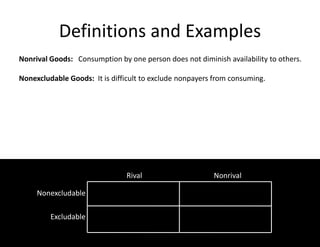
Definitions and Examples
Nonrival Goods: Consumption by one person does not diminish availability to others.
Nonexcludable Goods: It is difficult to exclude nonpayers from consuming.
Rival Nonrival
Nonexcludable
Excludable
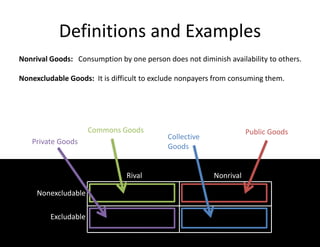
Definitions and Examples
Nonrival Goods: Consumption by one person does not diminish availability to others.
Nonexcludable Goods: It is difficult to exclude nonpayers from consuming them.
Rival Nonrival
Nonexcludable
Excludable
Public Goods
Collective
Goods
Commons Goods
Private Goods
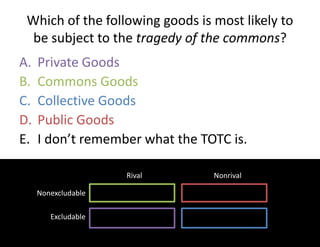
Which of the following goods is most likely to
be subject to the tragedy of the commons?
A. Private Goods
B. Commons Goods
C. Collective Goods
D. Public Goods
E. I don’t remember what the TOTC is.
Rival Nonrival
Nonexcludable
Excludable
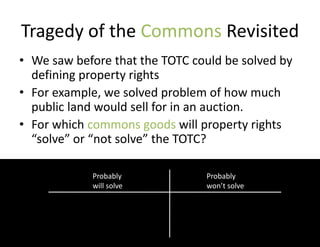
Tragedy of the Commons Revisited
• We saw before that the TOTC could be solved by
defining property rights
• For example, we solved problem of how much
public land would sell for in an auction.
• For which commons goods will property rights
“solve” or “not solve” the TOTC?
Probably
will solve
Probably
won’t solve
Free Riders
• Consumers of a good who do not pay
• Not “cheating” per se, they simply have no
incentive.
Free Riders
• Like commons goods, public goods are
nonexcludable, but unlike them, they’re also
nonrival.
• Both cause free riders.
• However, public goods don’t induce TOTC.
Public Goods: Which to Provide?
• Most are provided by the government
– Why? Everyone can benefit from them, but free rider
problem makes profit unlikely.
• However, the government should not provide all
public goods.
– Still need to follow benefits > costs principle.
Probably
should provide
Probably
shouldn’t provide
Public Goods: What Does Market
Demand Look Like?
• Recall: how do we generate a market
demand line for a private good?
• What is the key difference for public goods?

053113

  • 1.
    Commons , Collective,and Public Goods May 29, 2013
  • 2.
    Announcements • New problemset due: Now! • CAPE evaluation now online – We’ll have time at end of class today in case you have laptop / smart phone. – Same thing Monday: I’ll email you this weekend to remind you to bring laptop / smart phone.
  • 3.
    Announcements • Next weekis last week of classes. – Wed and Fri will be final review. • Early next week, practice final questions will be posted. • If you can’t make my office hours but need to talk with me: Please feel free to email for an appointment!
  • 4.
    Last Time • Finishedtalking about health care. • Provision of “safety” supplied by firms – Conditional on (MB to workers) > (MC to firm).
  • 5.
    Learning Goals forToday • Contrast the characteristics of private, commons, collective, and public goods. • Collect intuition for how inefficiencies arise.
  • 6.
    Definitions and Examples NonrivalGoods: Consumption by one person does not diminish availability to others. Nonexcludable Goods: It is difficult to exclude nonpayers from consuming. Rival Nonrival Nonexcludable Excludable
  • 7.
    Definitions and Examples NonrivalGoods: Consumption by one person does not diminish availability to others. Nonexcludable Goods: It is difficult to exclude nonpayers from consuming them. Rival Nonrival Nonexcludable Excludable Public Goods Collective Goods Commons Goods Private Goods
  • 8.
    Which of thefollowing goods is most likely to be subject to the tragedy of the commons? A. Private Goods B. Commons Goods C. Collective Goods D. Public Goods E. I don’t remember what the TOTC is. Rival Nonrival Nonexcludable Excludable
  • 9.
    Tragedy of theCommons Revisited • We saw before that the TOTC could be solved by defining property rights • For example, we solved problem of how much public land would sell for in an auction. • For which commons goods will property rights “solve” or “not solve” the TOTC? Probably will solve Probably won’t solve
  • 10.
    Free Riders • Consumersof a good who do not pay • Not “cheating” per se, they simply have no incentive.
  • 11.
    Free Riders • Likecommons goods, public goods are nonexcludable, but unlike them, they’re also nonrival. • Both cause free riders. • However, public goods don’t induce TOTC.
  • 12.
    Public Goods: Whichto Provide? • Most are provided by the government – Why? Everyone can benefit from them, but free rider problem makes profit unlikely. • However, the government should not provide all public goods. – Still need to follow benefits > costs principle. Probably should provide Probably shouldn’t provide
  • 13.
    Public Goods: WhatDoes Market Demand Look Like? • Recall: how do we generate a market demand line for a private good? • What is the key difference for public goods?