LESSON 1:
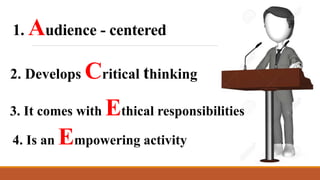
1. Audience - centered
3. It comes with Ethical responsibilities
4. Is an Empowering activity
2. Develops Critical thinking
Taking Points
1. Have you witnessed an
unsuccessful public speaker?
2. Where did he/she go wrong?
LESSON 2. Steps in
Speech
Preparation
(Brooks &Heath)
1. Selecting the topic
2. Scanning the audience
3. Speech purpose
4. Organizing and outlining the speech
5. Gathering of supporting materials
6. Giving the speech through language and
style
7. Giving the speech through audio – visual
aids
8. Preparing for audience feedback
A. Selecting the Topic
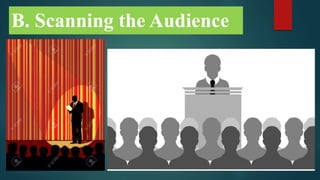
B. Scanning the Audience
C. Determining the Purpose
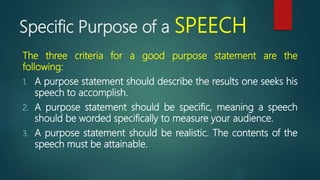
Specific Purpose of a SPEECH
The three criteria for a good purpose statement are the
following:
1. A purpose statement should describe the results one seeks his
speech to accomplish.
2. A purpose statement should be specific, meaning a speech
should be worded specifically to measure your audience.
3. A purpose statement should be realistic. The contents of the
speech must be attainable.
D. Organizing and Outlining the Speech
Three Major Parts of a Speech
1. Introduction
2. The Body
3. The conclusion
The INTRODUCTION
1. Referring to the Audience
2. Referring to the Occasion
3. Referring to the relationship between the
audience and the subject
4. Referring to something familiar to the
audience
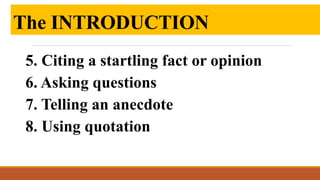
5. Citing a startling fact or opinion
6. Asking questions
7. Telling an anecdote
8. Using quotation
The INTRODUCTION
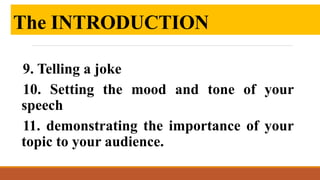
9. Telling a joke
10. Setting the mood and tone of your
speech
11. demonstrating the importance of your
topic to your audience.
The INTRODUCTION
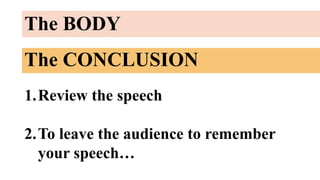
The BODY
The CONCLUSION
1.Review the speech
2.To leave the audience to remember
your speech…
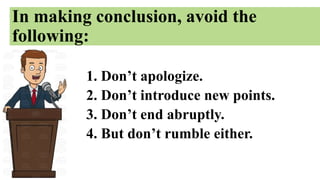
In making conclusion, avoid the
following:
1. Don’t apologize.
2. Don’t introduce new points.
3. Don’t end abruptly.
4. But don’t rumble either.
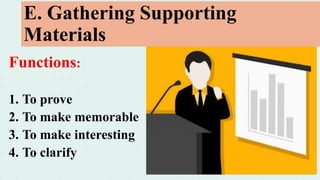
E. Gathering Supporting
Materials
Functions:
1. To prove
2. To make memorable
3. To make interesting
4. To clarify
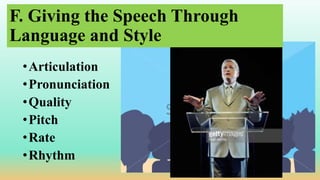
F. Giving the Speech Through
Language and Style
•Articulation
•Pronunciation
•Quality
•Pitch
•Rate
•Rhythm
F. Preparing for Audience
Feedback
The End!!!

Public Communication

  • 2.
  • 3.
    1. Audience -centered 3. It comes with Ethical responsibilities 4. Is an Empowering activity 2. Develops Critical thinking
  • 4.
    Taking Points 1. Haveyou witnessed an unsuccessful public speaker? 2. Where did he/she go wrong?
  • 5.
    LESSON 2. Stepsin Speech Preparation (Brooks &Heath)
  • 6.
    1. Selecting thetopic 2. Scanning the audience 3. Speech purpose 4. Organizing and outlining the speech
  • 7.
    5. Gathering ofsupporting materials 6. Giving the speech through language and style 7. Giving the speech through audio – visual aids 8. Preparing for audience feedback
  • 8.
  • 9.
  • 10.
  • 11.
    Specific Purpose ofa SPEECH The three criteria for a good purpose statement are the following: 1. A purpose statement should describe the results one seeks his speech to accomplish. 2. A purpose statement should be specific, meaning a speech should be worded specifically to measure your audience. 3. A purpose statement should be realistic. The contents of the speech must be attainable.
  • 12.
    D. Organizing andOutlining the Speech Three Major Parts of a Speech 1. Introduction 2. The Body 3. The conclusion
  • 13.
    The INTRODUCTION 1. Referringto the Audience 2. Referring to the Occasion 3. Referring to the relationship between the audience and the subject 4. Referring to something familiar to the audience
  • 14.
    5. Citing astartling fact or opinion 6. Asking questions 7. Telling an anecdote 8. Using quotation The INTRODUCTION
  • 15.
    9. Telling ajoke 10. Setting the mood and tone of your speech 11. demonstrating the importance of your topic to your audience. The INTRODUCTION
  • 16.
    The BODY The CONCLUSION 1.Reviewthe speech 2.To leave the audience to remember your speech…
  • 17.
    In making conclusion,avoid the following: 1. Don’t apologize. 2. Don’t introduce new points. 3. Don’t end abruptly. 4. But don’t rumble either.
  • 18.
    E. Gathering Supporting Materials Functions: 1.To prove 2. To make memorable 3. To make interesting 4. To clarify
  • 19.
    F. Giving theSpeech Through Language and Style •Articulation •Pronunciation •Quality •Pitch •Rate •Rhythm
  • 20.
    F. Preparing forAudience Feedback
  • 21.

Editor's Notes

  • #4 Ethical – following an accepted rules of behaviour, morally right and good Involving questions of right and wrong behaviour Empowering – to promote self – actualization or to influence
  • #9 Topic you are knowledgeable of Topic you are interested in Topic should also interest audience
  • #10 It is important to analyse the audience so the topic would have an impact on them and serve its purpose. ARISTOTLE = the audience would determine the end or objective of the speech
  • #11 General Purposes of speech To entertain – to relax audience by providing them pleasant listening experience 2. To inform – to inform enlightens your aideience by teaching them about the topic to be discussed 3. To persuade – to move ur audience toward a new attitude or behavior
  • #14 5. (10)Setting the mood or tone of your speech 3. (11) demonstrate importance of your topic to your audince
  • #17 By using final effective remarks