FUNCTIONS OF DYADIC COMMUNICATION
To express and receive interpersonal needs…
Functions of Dyadic CommunicationEstablish self-identity or personal discoveryGain informationEstablish meaningful relationshipsChange attitudes and behaviorBuilding a context of understanding
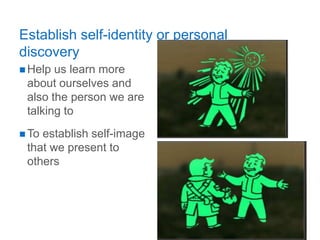
Establish self-identity or personal discoveryHelp us learn more about ourselves and also the person we are talking toTo establish self-image that we present to others
Gain informationTo gain information about things and events around usTo effectively interact with other people.
Establish meaningful relationshipsTo feel a sense of belongingness and love  To establish relationship with other people
Change attitudes and behavior To influence the attitudes and behaviors of othersTo transform individuals.“Interpersonal Persuasion”
Building a context of understandingTo help understand interpersonal relationships
END
Forms of Dyadic Communication
Forms of Dyadic Communication Conversation	DialogueInterview
CONVERSATION“… should flow, like waters after summer showers, not as if raised by mere mechanic powers” —William CowperSpoken exchange of thoughts, opinions, and feelingAn informalexchangeNo formal purposeLess intimate and less seriousCASUALExample: Talking to a taho vendor.
DIALOGUEFrom the Greek word dialogos (MEANING FLOWING THROUGH)Dia- “through” or “with each other”     Logos- “the meaning” or “the word”Type of communication in which the deepest, most personal and most intimate relationships are formeda discussion between two or more people or groups, esp. one directed toward exploration of a particular subject or resolution of a problemEx. Marital Communication and a Pep Talk with a friend/team mate
INTERVIEWMost purposiveStructure (opening, body and a closing)Various objectives/goals (gather information, persuade, solve a problem, help, learn about a job applicant etc.) to question, especially for the purpose of obtaining informationinvolves two persons interacting largely through a question-and-answer format to achieve specific goalsExample: Job interview and Final interviews in organizations
Tips for Interviewers:Prepare an interview "plan sheet"RelaxMinimize extraneous noisesAsk Open-ended questions (How, What, Why, Describe, Tell me, Explain and When)Avoid topics such as Arrest Records, Marital Status, Religion, Age, Disabilities etc.
Follow the 70/30 rule (listen 70%, 30% speak)Do not begin with controversial questionsInterrupt very rarelyBe sensitiveTake notes during or immediately after the interview.Thank the interviewee.
Tips for Interviewees:Arrive earlyDress appropriatelyTurn off your cellphoneStand up and greet your interviewerGive a firm  handshake (NVC)Maintain eye contactSmile. Be friendly but not too casual.
Speak in complete sentences, and use a formal vocabulary.Be concise.Weakness? Focus on things you can improve not character flaws and personality flaws.You don’t need to answer personal questions (ex. Marital status and age)Thank the interviewer.
Summary
Activity	Pick 2 representatives.Each representative will give the rest of the class a useful tip when conducting an interview, by acting it out.Each group will be given 30 seconds to guess what their groupmates’ tip is.CHARADES :D
SourcesHendricks, P.A. (1998). Targeting Life Skills Model. Ames, IA: Iowa State University Extension.(n.d.). Interviewing Tips for the Interviewer. Retrieved July 27, 2006, from http://www.olemiss.edu/depts/HR/employ/interview.html(n.d.). Tips for Interviewers. Retrieved July 26, 2006, from http://www.rscc.cc.tn.us/owl&writingcenter/OWL/Interview2.htmlCommunication 3 Book
Stages of InterpersonalCommunicationJan Wray A. AlcantaraComm 3
InterpersonalCommunication-concerning or involving relationships and conversations between people. Most probably two people. In every society, humans have developed spoken and written language as a means of sharing messages and meanings. The most common form of daily communication is interpersonal—that is, vis-a-vis, at the same time and in the same place.
OVERVIEW:Each stage is important and cannot  be removed from the process.
 Each stage compliments with each other making a wholesome communication.
 The stages are somehow difficult to perform.
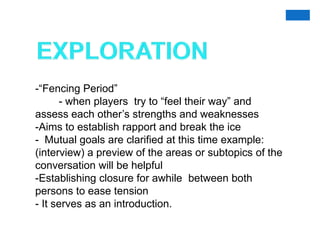
 It follows the normal sequence of a speech.EXPLORATION“Fencing Period”        - when players  try to “feel their way” and assess each other’s strengths and weaknesses Aims to establish rapport and break the ice
  Mutual goals are clarified at this time example: (interview) a preview of the areas or subtopics of the conversation will be helpful
Establishing closure for awhile  between both persons to ease tension
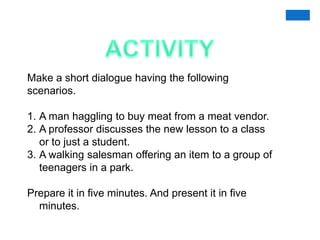
 It serves as an introduction.ACTIVITYMake a short dialogue having the following scenarios.A man haggling to buy meat from a meat vendor.A professor discusses the new lesson to a class or to just a student.A walking salesman offering an item to a group of teenagers in a park.Prepare it in five minutes. And present it in five minutes.
INTERACTIONsubstantive part
subject matter is explored by the participants

Interpersonal Communication

  • 1.
    FUNCTIONS OF DYADICCOMMUNICATION
  • 2.
    To express andreceive interpersonal needs…
  • 3.
    Functions of DyadicCommunicationEstablish self-identity or personal discoveryGain informationEstablish meaningful relationshipsChange attitudes and behaviorBuilding a context of understanding
  • 4.
    Establish self-identity orpersonal discoveryHelp us learn more about ourselves and also the person we are talking toTo establish self-image that we present to others
  • 5.
    Gain informationTo gaininformation about things and events around usTo effectively interact with other people.
  • 6.
    Establish meaningful relationshipsTofeel a sense of belongingness and love To establish relationship with other people
  • 7.
    Change attitudes andbehavior To influence the attitudes and behaviors of othersTo transform individuals.“Interpersonal Persuasion”
  • 8.
    Building a contextof understandingTo help understand interpersonal relationships
  • 9.
  • 10.
    Forms of DyadicCommunication
  • 11.
    Forms of DyadicCommunication Conversation DialogueInterview
  • 12.
    CONVERSATION“… should flow,like waters after summer showers, not as if raised by mere mechanic powers” —William CowperSpoken exchange of thoughts, opinions, and feelingAn informalexchangeNo formal purposeLess intimate and less seriousCASUALExample: Talking to a taho vendor.
  • 13.
    DIALOGUEFrom the Greekword dialogos (MEANING FLOWING THROUGH)Dia- “through” or “with each other” Logos- “the meaning” or “the word”Type of communication in which the deepest, most personal and most intimate relationships are formeda discussion between two or more people or groups, esp. one directed toward exploration of a particular subject or resolution of a problemEx. Marital Communication and a Pep Talk with a friend/team mate
  • 14.
    INTERVIEWMost purposiveStructure (opening,body and a closing)Various objectives/goals (gather information, persuade, solve a problem, help, learn about a job applicant etc.) to question, especially for the purpose of obtaining informationinvolves two persons interacting largely through a question-and-answer format to achieve specific goalsExample: Job interview and Final interviews in organizations
  • 15.
    Tips for Interviewers:Preparean interview "plan sheet"RelaxMinimize extraneous noisesAsk Open-ended questions (How, What, Why, Describe, Tell me, Explain and When)Avoid topics such as Arrest Records, Marital Status, Religion, Age, Disabilities etc.
  • 16.
    Follow the 70/30rule (listen 70%, 30% speak)Do not begin with controversial questionsInterrupt very rarelyBe sensitiveTake notes during or immediately after the interview.Thank the interviewee.
  • 17.
    Tips for Interviewees:ArriveearlyDress appropriatelyTurn off your cellphoneStand up and greet your interviewerGive a firm handshake (NVC)Maintain eye contactSmile. Be friendly but not too casual.
  • 18.
    Speak in completesentences, and use a formal vocabulary.Be concise.Weakness? Focus on things you can improve not character flaws and personality flaws.You don’t need to answer personal questions (ex. Marital status and age)Thank the interviewer.
  • 19.
  • 20.
    Activity Pick 2 representatives.Eachrepresentative will give the rest of the class a useful tip when conducting an interview, by acting it out.Each group will be given 30 seconds to guess what their groupmates’ tip is.CHARADES :D
  • 21.
    SourcesHendricks, P.A. (1998).Targeting Life Skills Model. Ames, IA: Iowa State University Extension.(n.d.). Interviewing Tips for the Interviewer. Retrieved July 27, 2006, from http://www.olemiss.edu/depts/HR/employ/interview.html(n.d.). Tips for Interviewers. Retrieved July 26, 2006, from http://www.rscc.cc.tn.us/owl&writingcenter/OWL/Interview2.htmlCommunication 3 Book
  • 22.
  • 23.
    InterpersonalCommunication-concerning or involvingrelationships and conversations between people. Most probably two people. In every society, humans have developed spoken and written language as a means of sharing messages and meanings. The most common form of daily communication is interpersonal—that is, vis-a-vis, at the same time and in the same place.
  • 24.
    OVERVIEW:Each stage isimportant and cannot be removed from the process.
  • 25.
    Each stagecompliments with each other making a wholesome communication.
  • 26.
    The stagesare somehow difficult to perform.
  • 27.
    It followsthe normal sequence of a speech.EXPLORATION“Fencing Period” - when players try to “feel their way” and assess each other’s strengths and weaknesses Aims to establish rapport and break the ice
  • 28.
    Mutualgoals are clarified at this time example: (interview) a preview of the areas or subtopics of the conversation will be helpful
  • 29.
    Establishing closure forawhile between both persons to ease tension
  • 30.
    It servesas an introduction.ACTIVITYMake a short dialogue having the following scenarios.A man haggling to buy meat from a meat vendor.A professor discusses the new lesson to a class or to just a student.A walking salesman offering an item to a group of teenagers in a park.Prepare it in five minutes. And present it in five minutes.
  • 31.
  • 32.
    subject matter isexplored by the participants

Editor's Notes

  • #19 “I’d rather keep the focus on the job not my personal life.”