Republic of the Philippines
University of Rizal System
Graduate School
Psycho-Socio Foundation
EDUC – 202
(12:00nn – 8:00 pm)
Presentedby:
SARAH JANE A. PACAMARA
ARWIN A. CORSABA
Presentedto:
GLORIA P. SARABIA Ph.D.
Emotions
Chapter5
1. Emotion and its physiological and
behavioral components (Theories of
Emotion)
2. Eradicating Undesirable emotions
3. Indirect adjustments to Frustration
Objectives:
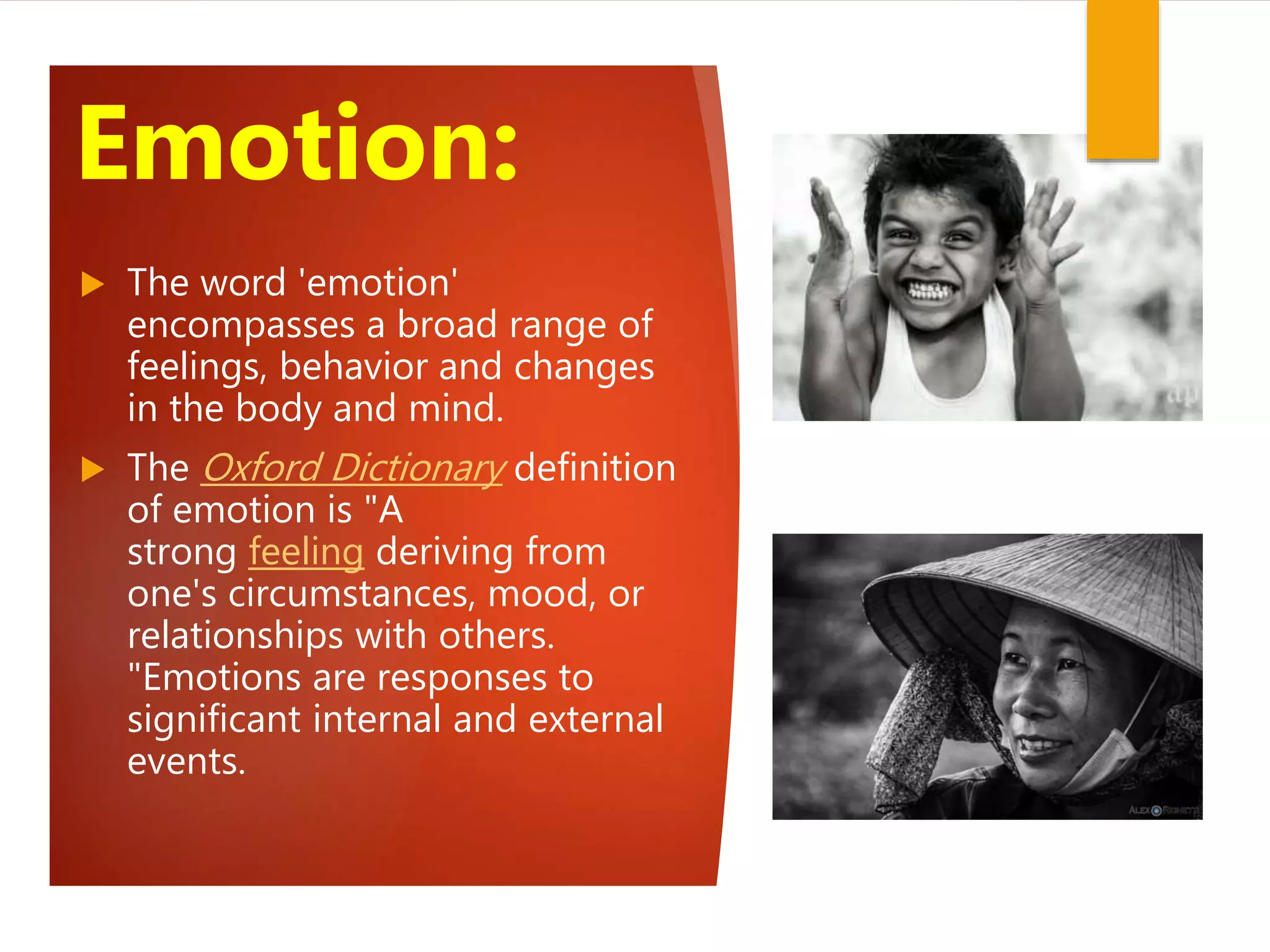
 Define emotion and its characteristics
 Identify the components and the categories of basic
human emotions
 Describe the factors affecting emotions
 Recognize the methods of eradicating undesirable
emotions and indirect adjustments to frustration
Introduction
 One characteristic of the
learner is temperament which
refers to certain emotional
predispositions of an
individual.
 Experience affects our
emotions to varying degrees
thereby rendering our
emotional state pleasant or
unpleasant.
Whatis
emotion?Definition:
 The term emotion is derived from
the Latin verb ‘movere’ means stir
up, agitate, disturb or move.
Woodworth has defined emotion as
“conscious stirred up state of the
organism”.
Emotion:
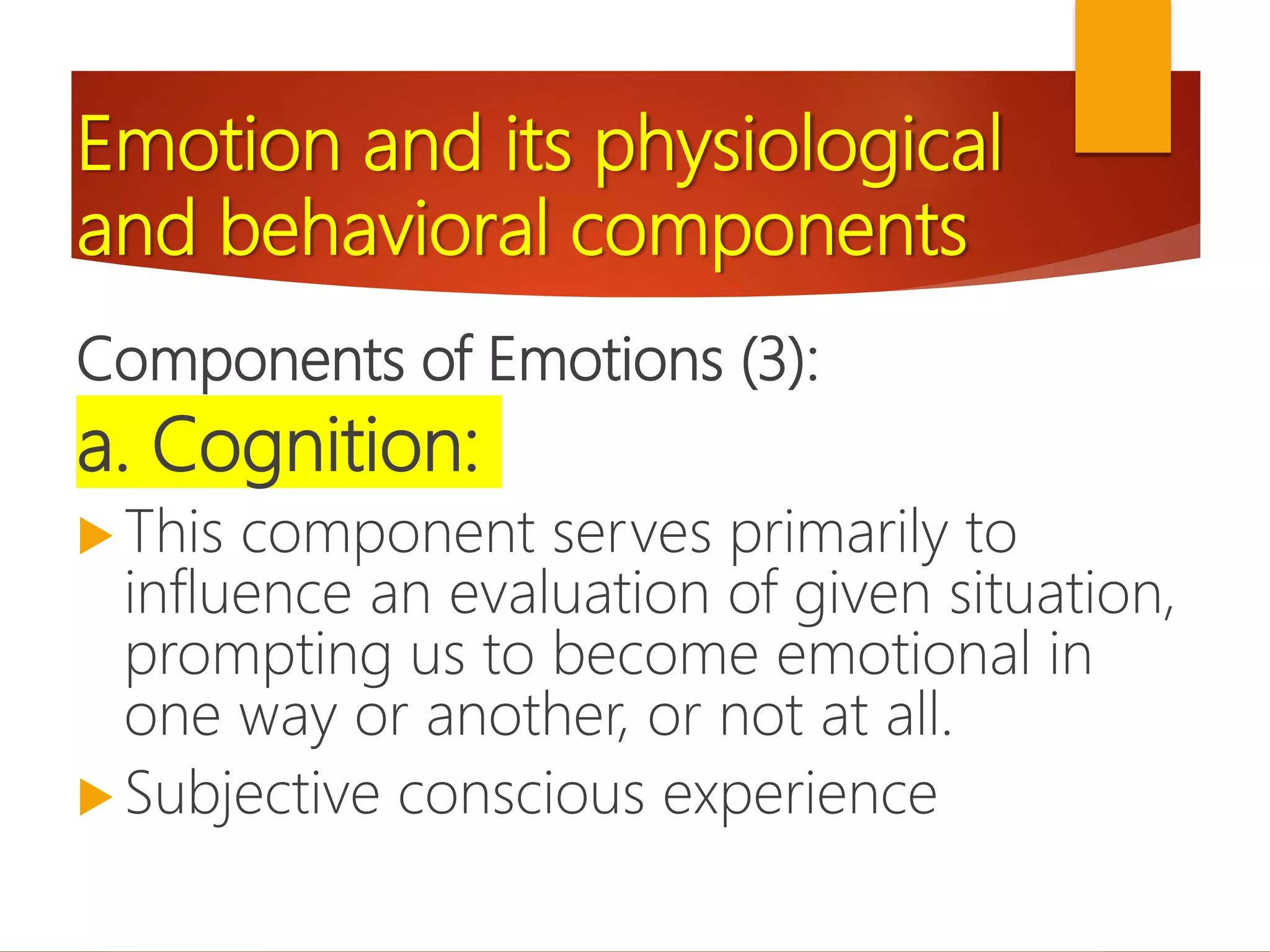
 The word 'emotion'
encompasses a broad range of
feelings, behavior and changes
in the body and mind.
 The Oxford Dictionary definition
of emotion is "A
strong feeling deriving from
one's circumstances, mood, or
relationships with others.
"Emotions are responses to
significant internal and external
events.
Emotion and its physiological
and behavioral components
Components of Emotions (3):
a. Cognition:
 This component serves primarily to
influence an evaluation of given situation,
prompting us to become emotional in
one way or another, or not at all.
 Subjective conscious experience
b. Feeling:
 In daily life we think of feelings. The feelings are
most readily evident changes in an aroused
person. Feelings have immediate motivational
significance.
 They give rise to many physiological processes in
the cardiovascular system and produce increased
blood pressure, changes in sexual urge. They
also stimulate nervous system and prompt
widespread electrochemical activities.
c. Behavior:
The behavioral component
involves facial, postural, gestures
and vocal responses.
Changes during Emotions:
Changes during emotions are
divided into external and
internal changes.
External changes:
 There are many external or observable changes during
emotion.
a. The voice changes according to the type of emotion.
Experiments have proved that emotions can be identified
on the basis of voice.
b. Facial expressions change. We can identify emotion
experienced by a person by looking at his face.
c. There will be changes in the body language like stiffness
of muscles, twisting of fingers, movements of hands and
legs.
External changes:
d. Sweating.
e. Wrinkles on forehead.
f. Redness of eyes.
g. Erection of hairs on the skin,
etc.
Internal changes:
 Many internal changes take place during
emotions. The ANS has 2 subdivisions.
Sympathetic division prepares the body for facing
emergency either by fight or by flight, i.e. fights if
possible, otherwise escapes from the situation. It
stimulates the adrenal glands and causes the
excess release of adrenaline and nor-adrenaline.
Adrenaline gets circulated all over the body and
stimulates vital organs leading to following internal
changes.
Internal changes:
a. Increase in heart rate thereby increase in
BP
b. Increase in rate of respiration
c. Increase in blood sugar level
d. Decrease in functioning of GI tract-that is
why we do not experience the feeling of
hunger during emotional states
Internal changes:
e. Changes in frequency of brain waves
f. Dilatation of pupils
g. Decreased secretion of saliva and
dryness of mouth.
CATEGORIES OF EMOTIONS
EMOTIONS ARE DIVIDED
INTO TWO CATEGORIES:
• PRIMARY EMOTIONS
• SECONDARY EMOTIONS
Primary emotion
 A primary human emotion types are the one
triggered in response to an event.
 PRIMARY EMOTIONS
 LOVE
 JOY
 ANGER
 SADNESS
 SURPRISE
 FEAR
Secondary emotion
 If we experience fear , the secondary emotions would be
: feel threatened or feel anger , depending on the
situation we are experiencing.
 SECONDARY EMOTIONS
 PASSION
 OPTIMISM
 IRRITATION
 DISGUST
 SHAME
 NERVOUSNESS
BASIC TYPES OF HUMAN EMOTIONS
VARIETY OF EMOTIONS
 Human emotion is innate in all of us; it’s
something we’re born with and something
we die with. Happiness, sadness, love,
hatred, worries, and indifference – these
are things that constantly occur in our
daily lives.
 Positive and Negative Human Emotion
POSITIVE HUMAN
EMOTIONS
 Positive emotions that lead
one to feel good about one’s
self will lead to an
emotionally happy and
satisfied result.
 SOME OF THE POSITIVE
EMOTIONS ARE :
 HOPEFUL
 CONFIDENT
 PEACEFUL
NEGATIVE HUMAN EMOTIONS
 Negative emotions sap your energy and
undermine your effectiveness. In the negative
emotional state, you find the lack of desire to do
anything
 SOME OF THE NEGATIVE EMOTIONS ARE :
 EXHAUSTED
 PANIC
 OBNOXIOUS
FACTORS AFFECTING EMOTIONS
PERSONALITY
CULTURE
WEATHER
STRESS
AGE
GENDER
ENVIRONMENT
IMPORTANCE OF EMOTIONS
1. Generally, emotion shapes up the personality
of a person.
2. Emotion either makes us strong to do action
or prevents us from doing any action during
emergencies
3. Emotion enables us to cope with conflicts
and emergencies
4. Emotion dominates our lives
METHODS OF
ERADICATING
UNDESIRABLE
EMOTIONAL BEHAVIOR
Disuse
Frequent application of the stimulus
Ridicule or Scorn
Social Imitation
Verbal appeal
Reconditioning
MEANS OF INDIRECT
ADJUSTMENT TO
FRUSTATION
MEANS OF INDIRECT
ADJUSTMENT TO FRUSTATION
 Adjustment
- Process by which living organism maintain a balance
between it’s need and the circumstances.
- Continual process by which a person varies his behavior
to produce a more harmonious relationship between himself
and environment.
- Psychological survival in much the same way as biologist
uses the term adaptation to describe physiological survival.
Frustration
In psychology, frustration is a
common emotional response to
opposition, related to anger, annoyance
and disappointment, frustration arises
from the perceived resistance to the
fulfillment of an individual's will or goal
MEANS OF INDIRECT
ADJUSTMENT TO FRUSTATION
MEANS OF INDIRECT
ADJUSTMENT TO FRUSTATION
Sublimation or Substitution
Is an indirect but socially acceptable expression
of emotion or drive.
When we transform our negative emotions or
instincts, mainly, to acceptable behavior and
positive actions. For example, a person
experiencing extreme anger might take up kick-
boxing as a means of venting frustration.
MEANS OF INDIRECT
ADJUSTMENT TO FRUSTATION
Displacement
Displacing or shifting of thought
from one person or situation to
another - Transferring emotion
from situation to other situation.
MEANS OF INDIRECT
ADJUSTMENT TO FRUSTATION
Intellectualization
 Thinking about events in a cold, clinical way.
 Allows us to avoid thinking about the
stressful, emotional aspect of the situation
and instead focus only on the intellectual
component
Intellectualization
 Example; a person who has just been diagnosed
with a terminal illness might focus on learning
everything about the disease in order to avoid
distress and remain distant from the reality of
the situation.
Psycho socio-emotion

Psycho socio-emotion

  • 1.
    Republic of thePhilippines University of Rizal System Graduate School Psycho-Socio Foundation EDUC – 202 (12:00nn – 8:00 pm) Presentedby: SARAH JANE A. PACAMARA ARWIN A. CORSABA Presentedto: GLORIA P. SARABIA Ph.D.
  • 2.
  • 3.
    Chapter5 1. Emotion andits physiological and behavioral components (Theories of Emotion) 2. Eradicating Undesirable emotions 3. Indirect adjustments to Frustration
  • 4.
    Objectives:  Define emotionand its characteristics  Identify the components and the categories of basic human emotions  Describe the factors affecting emotions  Recognize the methods of eradicating undesirable emotions and indirect adjustments to frustration
  • 5.
    Introduction  One characteristicof the learner is temperament which refers to certain emotional predispositions of an individual.  Experience affects our emotions to varying degrees thereby rendering our emotional state pleasant or unpleasant.
  • 6.
    Whatis emotion?Definition:  The termemotion is derived from the Latin verb ‘movere’ means stir up, agitate, disturb or move. Woodworth has defined emotion as “conscious stirred up state of the organism”.
  • 7.
    Emotion:  The word'emotion' encompasses a broad range of feelings, behavior and changes in the body and mind.  The Oxford Dictionary definition of emotion is "A strong feeling deriving from one's circumstances, mood, or relationships with others. "Emotions are responses to significant internal and external events.
  • 8.
    Emotion and itsphysiological and behavioral components Components of Emotions (3): a. Cognition:  This component serves primarily to influence an evaluation of given situation, prompting us to become emotional in one way or another, or not at all.  Subjective conscious experience
  • 9.
    b. Feeling:  Indaily life we think of feelings. The feelings are most readily evident changes in an aroused person. Feelings have immediate motivational significance.  They give rise to many physiological processes in the cardiovascular system and produce increased blood pressure, changes in sexual urge. They also stimulate nervous system and prompt widespread electrochemical activities.
  • 10.
    c. Behavior: The behavioralcomponent involves facial, postural, gestures and vocal responses.
  • 11.
    Changes during Emotions: Changesduring emotions are divided into external and internal changes.
  • 12.
    External changes:  Thereare many external or observable changes during emotion. a. The voice changes according to the type of emotion. Experiments have proved that emotions can be identified on the basis of voice. b. Facial expressions change. We can identify emotion experienced by a person by looking at his face. c. There will be changes in the body language like stiffness of muscles, twisting of fingers, movements of hands and legs.
  • 13.
    External changes: d. Sweating. e.Wrinkles on forehead. f. Redness of eyes. g. Erection of hairs on the skin, etc.
  • 14.
    Internal changes:  Manyinternal changes take place during emotions. The ANS has 2 subdivisions. Sympathetic division prepares the body for facing emergency either by fight or by flight, i.e. fights if possible, otherwise escapes from the situation. It stimulates the adrenal glands and causes the excess release of adrenaline and nor-adrenaline. Adrenaline gets circulated all over the body and stimulates vital organs leading to following internal changes.
  • 15.
    Internal changes: a. Increasein heart rate thereby increase in BP b. Increase in rate of respiration c. Increase in blood sugar level d. Decrease in functioning of GI tract-that is why we do not experience the feeling of hunger during emotional states
  • 16.
    Internal changes: e. Changesin frequency of brain waves f. Dilatation of pupils g. Decreased secretion of saliva and dryness of mouth.
  • 17.
    CATEGORIES OF EMOTIONS EMOTIONSARE DIVIDED INTO TWO CATEGORIES: • PRIMARY EMOTIONS • SECONDARY EMOTIONS
  • 18.
    Primary emotion  Aprimary human emotion types are the one triggered in response to an event.  PRIMARY EMOTIONS  LOVE  JOY  ANGER  SADNESS  SURPRISE  FEAR
  • 19.
    Secondary emotion  Ifwe experience fear , the secondary emotions would be : feel threatened or feel anger , depending on the situation we are experiencing.  SECONDARY EMOTIONS  PASSION  OPTIMISM  IRRITATION  DISGUST  SHAME  NERVOUSNESS
  • 20.
    BASIC TYPES OFHUMAN EMOTIONS
  • 21.
    VARIETY OF EMOTIONS Human emotion is innate in all of us; it’s something we’re born with and something we die with. Happiness, sadness, love, hatred, worries, and indifference – these are things that constantly occur in our daily lives.  Positive and Negative Human Emotion
  • 22.
    POSITIVE HUMAN EMOTIONS  Positiveemotions that lead one to feel good about one’s self will lead to an emotionally happy and satisfied result.  SOME OF THE POSITIVE EMOTIONS ARE :  HOPEFUL  CONFIDENT  PEACEFUL
  • 23.
    NEGATIVE HUMAN EMOTIONS Negative emotions sap your energy and undermine your effectiveness. In the negative emotional state, you find the lack of desire to do anything  SOME OF THE NEGATIVE EMOTIONS ARE :  EXHAUSTED  PANIC  OBNOXIOUS
  • 24.
  • 25.
    IMPORTANCE OF EMOTIONS 1.Generally, emotion shapes up the personality of a person. 2. Emotion either makes us strong to do action or prevents us from doing any action during emergencies 3. Emotion enables us to cope with conflicts and emergencies 4. Emotion dominates our lives
  • 26.
  • 27.
    Disuse Frequent application ofthe stimulus Ridicule or Scorn Social Imitation Verbal appeal Reconditioning
  • 28.
  • 29.
    MEANS OF INDIRECT ADJUSTMENTTO FRUSTATION  Adjustment - Process by which living organism maintain a balance between it’s need and the circumstances. - Continual process by which a person varies his behavior to produce a more harmonious relationship between himself and environment. - Psychological survival in much the same way as biologist uses the term adaptation to describe physiological survival.
  • 30.
    Frustration In psychology, frustrationis a common emotional response to opposition, related to anger, annoyance and disappointment, frustration arises from the perceived resistance to the fulfillment of an individual's will or goal MEANS OF INDIRECT ADJUSTMENT TO FRUSTATION
  • 31.
    MEANS OF INDIRECT ADJUSTMENTTO FRUSTATION Sublimation or Substitution Is an indirect but socially acceptable expression of emotion or drive. When we transform our negative emotions or instincts, mainly, to acceptable behavior and positive actions. For example, a person experiencing extreme anger might take up kick- boxing as a means of venting frustration.
  • 32.
    MEANS OF INDIRECT ADJUSTMENTTO FRUSTATION Displacement Displacing or shifting of thought from one person or situation to another - Transferring emotion from situation to other situation.
  • 33.
    MEANS OF INDIRECT ADJUSTMENTTO FRUSTATION Intellectualization  Thinking about events in a cold, clinical way.  Allows us to avoid thinking about the stressful, emotional aspect of the situation and instead focus only on the intellectual component
  • 34.
    Intellectualization  Example; aperson who has just been diagnosed with a terminal illness might focus on learning everything about the disease in order to avoid distress and remain distant from the reality of the situation.