Sociology
UNIT 9
Social disorganization and major social problems
(factors of social disorganisation)
Social disorganization
1. Social disorganization is the process opposed to
social organization.
2. Social organization -“ some fundamental concepts”
Characteristic of Social disorganization
1. Conflicts of mores and of institution
2. Transfer of functions from one group to another
3. Individuation
4. Change in the Role and Status of the Individuals
Causes of Social disorganization
1. Division of Labour
2. Violation of Social Rules
3. Industrialization
4. Cultural Lag
5. Natural Catastrophes
6. War
7. Maladaptation of Inherited Nature to Culture
Major Social Problems
1. Poverty
2. Unemployment
3. Beggary
4. Crime
5. War
6. Other social issues
Sociology
UNIT 10
case study
(sociological study of neighbourhood in an urban area)
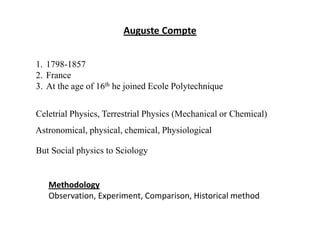
Auguste Compte
1. 1798-1857
2. France
3. At the age of 16th he joined Ecole Polytechnique
Celetrial Physics, Terrestrial Physics (Mechanical or Chemical)
Astronomical, physical, chemical, Physiological
But Social physics to Sciology
Methodology
Observation, Experiment, Comparison, Historical method
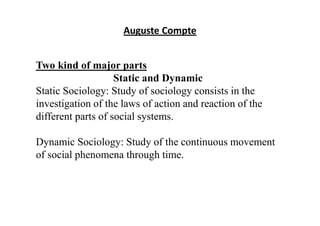
Auguste Compte
Two kind of major parts
Static and Dynamic
Static Sociology: Study of sociology consists in the
investigation of the laws of action and reaction of the
different parts of social systems.
Dynamic Sociology: Study of the continuous movement
of social phenomena through time.
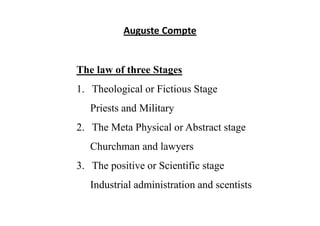
Auguste Compte
The law of three Stages
1. Theological or Fictious Stage
Priests and Military
2. The Meta Physical or Abstract stage
Churchman and lawyers
3. The positive or Scientific stage
Industrial administration and scentists
Max Weber
1.Born at 1864-1920
2.Germany
3.He studied Law, then he shifted to study of
social sciences.
4.His PhD thesis was on the “History of
Commercial Society in the Middle Ages”
5.In 1896, he became the professor of economics.
6.Social Action
7.Types of Authority
Max Weber
Social Action
1.Zweck rational Action
Relation to Goal (Engineering, Army)
2.Wert rational Action
Also rational Action but in-relation to
values
3.Affective Action
Action is emotional
4.Traditional Action
Action is directed by beliefs and customs
which become habituated.
Max Weber
Types of Authority
According to Weber Authority relations refer to those
relations of men whereby some men feel that they have a
legitimate right to expect willing obedience from other people
to their command.
1.Rational-Legal Authority
Based on laws, rules and regulations
2.Traditional Authority
Based on domination of past customs and traditions
3.Charismatic Authority
Based on extra-ordinary devotion to sacred quality or
exemplary character of a person
Karl Marx
1.Born at 1818-1883
2.He studied Law, then he shifted to study of
philosophy.
3.At the age of 23 he received doctorate degree.
4.Dialectical materialism
5.Economic infrastructure and socio-economic
superstructure.
6.Theory of class and class conflict.
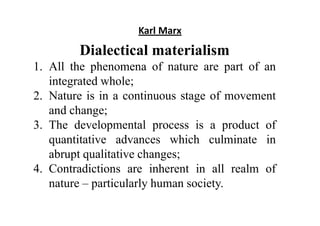
Dialectical materialism
1. All the phenomena of nature are part of an
integrated whole;
2. Nature is in a continuous stage of movement
and change;
3. The developmental process is a product of
quantitative advances which culminate in
abrupt qualitative changes;
4. Contradictions are inherent in all realm of
nature – particularly human society.
Karl Marx
Karl Marx
Economic infrastructure
and
socio-economic superstructure.
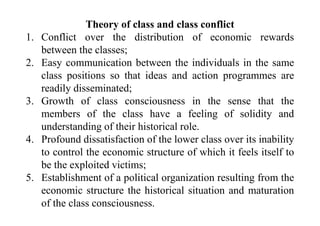
Theory of class and class conflict
1. Conflict over the distribution of economic rewards
between the classes;
2. Easy communication between the individuals in the same
class positions so that ideas and action programmes are
readily disseminated;
3. Growth of class consciousness in the sense that the
members of the class have a feeling of solidity and
understanding of their historical role.
4. Profound dissatisfaction of the lower class over its inability
to control the economic structure of which it feels itself to
be the exploited victims;
5. Establishment of a political organization resulting from the
economic structure the historical situation and maturation
of the class consciousness.
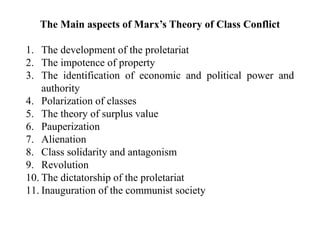
The Main aspects of Marx’s Theory of Class Conflict
1. The development of the proletariat
2. The impotence of property
3. The identification of economic and political power and
authority
4. Polarization of classes
5. The theory of surplus value
6. Pauperization
7. Alienation
8. Class solidarity and antagonism
9. Revolution
10. The dictatorship of the proletariat
11. Inauguration of the communist society
Sociology part 9 and 10

Sociology part 9 and 10

  • 1.
    Sociology UNIT 9 Social disorganizationand major social problems (factors of social disorganisation)
  • 2.
    Social disorganization 1. Socialdisorganization is the process opposed to social organization. 2. Social organization -“ some fundamental concepts”
  • 3.
    Characteristic of Socialdisorganization 1. Conflicts of mores and of institution 2. Transfer of functions from one group to another 3. Individuation 4. Change in the Role and Status of the Individuals
  • 4.
    Causes of Socialdisorganization 1. Division of Labour 2. Violation of Social Rules 3. Industrialization 4. Cultural Lag 5. Natural Catastrophes 6. War 7. Maladaptation of Inherited Nature to Culture
  • 5.
    Major Social Problems 1.Poverty 2. Unemployment 3. Beggary 4. Crime 5. War 6. Other social issues
  • 6.
    Sociology UNIT 10 case study (sociologicalstudy of neighbourhood in an urban area)
  • 7.
    Auguste Compte 1. 1798-1857 2.France 3. At the age of 16th he joined Ecole Polytechnique Celetrial Physics, Terrestrial Physics (Mechanical or Chemical) Astronomical, physical, chemical, Physiological But Social physics to Sciology Methodology Observation, Experiment, Comparison, Historical method
  • 8.
    Auguste Compte Two kindof major parts Static and Dynamic Static Sociology: Study of sociology consists in the investigation of the laws of action and reaction of the different parts of social systems. Dynamic Sociology: Study of the continuous movement of social phenomena through time.
  • 9.
    Auguste Compte The lawof three Stages 1. Theological or Fictious Stage Priests and Military 2. The Meta Physical or Abstract stage Churchman and lawyers 3. The positive or Scientific stage Industrial administration and scentists
  • 10.
    Max Weber 1.Born at1864-1920 2.Germany 3.He studied Law, then he shifted to study of social sciences. 4.His PhD thesis was on the “History of Commercial Society in the Middle Ages” 5.In 1896, he became the professor of economics. 6.Social Action 7.Types of Authority
  • 11.
    Max Weber Social Action 1.Zweckrational Action Relation to Goal (Engineering, Army) 2.Wert rational Action Also rational Action but in-relation to values 3.Affective Action Action is emotional 4.Traditional Action Action is directed by beliefs and customs which become habituated.
  • 12.
    Max Weber Types ofAuthority According to Weber Authority relations refer to those relations of men whereby some men feel that they have a legitimate right to expect willing obedience from other people to their command. 1.Rational-Legal Authority Based on laws, rules and regulations 2.Traditional Authority Based on domination of past customs and traditions 3.Charismatic Authority Based on extra-ordinary devotion to sacred quality or exemplary character of a person
  • 13.
    Karl Marx 1.Born at1818-1883 2.He studied Law, then he shifted to study of philosophy. 3.At the age of 23 he received doctorate degree. 4.Dialectical materialism 5.Economic infrastructure and socio-economic superstructure. 6.Theory of class and class conflict.
  • 14.
    Dialectical materialism 1. Allthe phenomena of nature are part of an integrated whole; 2. Nature is in a continuous stage of movement and change; 3. The developmental process is a product of quantitative advances which culminate in abrupt qualitative changes; 4. Contradictions are inherent in all realm of nature – particularly human society. Karl Marx
  • 15.
  • 16.
    Theory of classand class conflict 1. Conflict over the distribution of economic rewards between the classes; 2. Easy communication between the individuals in the same class positions so that ideas and action programmes are readily disseminated; 3. Growth of class consciousness in the sense that the members of the class have a feeling of solidity and understanding of their historical role. 4. Profound dissatisfaction of the lower class over its inability to control the economic structure of which it feels itself to be the exploited victims; 5. Establishment of a political organization resulting from the economic structure the historical situation and maturation of the class consciousness.
  • 17.
    The Main aspectsof Marx’s Theory of Class Conflict 1. The development of the proletariat 2. The impotence of property 3. The identification of economic and political power and authority 4. Polarization of classes 5. The theory of surplus value 6. Pauperization 7. Alienation 8. Class solidarity and antagonism 9. Revolution 10. The dictatorship of the proletariat 11. Inauguration of the communist society