





Republic of the Philippines
University of Rizal System
Graduate School
SPORTS PSYCHOLOGY AND COACHING
STRATEGIES
(P.E. 211)
2:00 – 5:00 pm
Reported by:
Sarah Jane A. Pacamara
Arwin A. Corsaba
Reported to:
Noel P. Aranda Ph.D
FOCUSING ON GROUP
PROCESSES
FOCUSING ON GROUP
PROCESSES
 LEADERSHIP
 GROUP COHESION
 COMMUNICATION
 GROUP AND TEAM DYNAMICS
 Tools for Measuring Cohesion
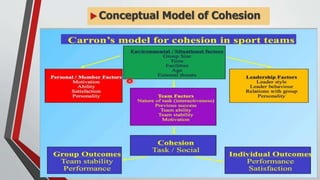
 Conceptual Model of Cohesion
 Definition of Cohesion
GROUP COHESION
 Relationship between
Cohesion and Performance
 Other Factors Associated with
Cohesion
Continuation…..
 Strategies for Enhancing
Cohesion
 Guidelines for Building Team
Cohesion
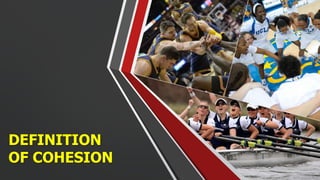
DEFINITION
OF COHESION
DEFINITION OF COHESION
“ A dynamic process that is
reflected in the tendency of a
group to stick together and remain
united in the pursuit of its
instrumental objectives and/or for
the satisfaction of member needs”.
DEFINITION OF COHESION
“According to Stephen Robbins,
group cohesiveness is the
degree to which members are
attracted to each other and
motivated to stay in the group”.
Clichés such as “Together We Stand,
Divided We Fall”, “There is no I in Team”,
“Players Play, Teams Win” are often used
to show individuals the importance of
Team Cohesion.
TYPES OF COHESION
Task Cohesion
Social Cohesion
Task Cohesion
The degree to which members of a
team work together to achieve a
specific and identifiable goal.
Social Cohesion
The degree to which the members of
a team like each other and enjoy
personal satisfaction from being
members of the team.
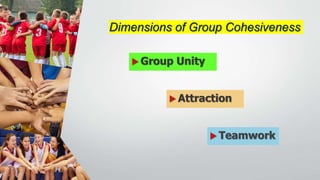
 Teamwork
 Attraction
 Group Unity
Dimensions of Group Cohesiveness
CONCEPTUAL
MODEL OF
COHESION
 Conceptual Model of Cohesion
Tools for
Measuring
Cohesion
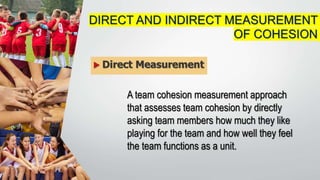
 Direct Measurement
DIRECT AND INDIRECT MEASUREMENT
OF COHESION
A team cohesion measurement approach
that assesses team cohesion by directly
asking team members how much they like
playing for the team and how well they feel
the team functions as a unit.
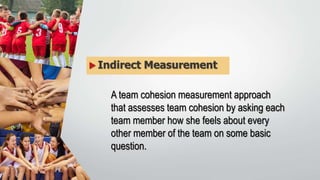
 Indirect Measurement
A team cohesion measurement approach
that assesses team cohesion by asking each
team member how she feels about every
other member of the team on some basic
question.
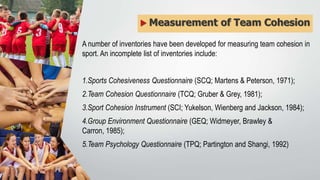
 Measurement of Team Cohesion
A number of inventories have been developed for measuring team cohesion in
sport. An incomplete list of inventories include:
1.Sports Cohesiveness Questionnaire (SCQ; Martens & Peterson, 1971);
2.Team Cohesion Questionnaire (TCQ; Gruber & Grey, 1981);
3.Sport Cohesion Instrument (SCI; Yukelson, Wienberg and Jackson, 1984);
4.Group Environment Questionnaire (GEQ; Widmeyer, Brawley &
Carron, 1985);
5.Team Psychology Questionnaire (TPQ; Partington and Shangi, 1992)
RELATIONSHIP
BETWEEN
COHESION AND
PERFORMANCE
OTHER FACTORS
ASSOCIATED
WITH COHESION
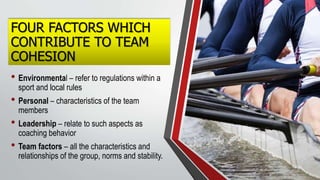
FOUR FACTORS WHICH
CONTRIBUTE TO TEAM
COHESION
• Environmental – refer to regulations within a
sport and local rules
• Personal – characteristics of the team
members
• Leadership – relate to such aspects as
coaching behavior
• Team factors – all the characteristics and
relationships of the group, norms and stability.
STRATEGIES
FOR ENHANCING
COHESION
Strategies for Enhancing
Cohesion
• Keep Communication Open
• Promote Trust
• Assist in Conflict Resolution
• Encourage Feedback
• Time for Fun
• Team building
GUIDELINES FOR
BUILDING TEAM
COHESION
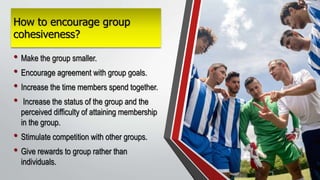
How to encourage group
cohesiveness?
• Make the group smaller.
• Encourage agreement with group goals.
• Increase the time members spend together.
• Increase the status of the group and the
perceived difficulty of attaining membership
in the group.
• Stimulate competition with other groups.
• Give rewards to group rather than
individuals.
Cohesion
Cohesion

Cohesion

  • 1.
    Republic of thePhilippines University of Rizal System Graduate School SPORTS PSYCHOLOGY AND COACHING STRATEGIES (P.E. 211) 2:00 – 5:00 pm Reported by: Sarah Jane A. Pacamara Arwin A. Corsaba Reported to: Noel P. Aranda Ph.D
  • 2.
  • 3.
    FOCUSING ON GROUP PROCESSES LEADERSHIP  GROUP COHESION  COMMUNICATION  GROUP AND TEAM DYNAMICS
  • 5.
     Tools forMeasuring Cohesion  Conceptual Model of Cohesion  Definition of Cohesion GROUP COHESION  Relationship between Cohesion and Performance
  • 6.
     Other FactorsAssociated with Cohesion Continuation…..  Strategies for Enhancing Cohesion  Guidelines for Building Team Cohesion
  • 7.
  • 8.
    DEFINITION OF COHESION “A dynamic process that is reflected in the tendency of a group to stick together and remain united in the pursuit of its instrumental objectives and/or for the satisfaction of member needs”.
  • 9.
    DEFINITION OF COHESION “Accordingto Stephen Robbins, group cohesiveness is the degree to which members are attracted to each other and motivated to stay in the group”.
  • 10.
    Clichés such as“Together We Stand, Divided We Fall”, “There is no I in Team”, “Players Play, Teams Win” are often used to show individuals the importance of Team Cohesion.
  • 11.
    TYPES OF COHESION TaskCohesion Social Cohesion
  • 12.
    Task Cohesion The degreeto which members of a team work together to achieve a specific and identifiable goal.
  • 13.
    Social Cohesion The degreeto which the members of a team like each other and enjoy personal satisfaction from being members of the team.
  • 14.
     Teamwork  Attraction Group Unity Dimensions of Group Cohesiveness
  • 15.
  • 16.
  • 17.
  • 18.
     Direct Measurement DIRECTAND INDIRECT MEASUREMENT OF COHESION A team cohesion measurement approach that assesses team cohesion by directly asking team members how much they like playing for the team and how well they feel the team functions as a unit.
  • 19.
     Indirect Measurement Ateam cohesion measurement approach that assesses team cohesion by asking each team member how she feels about every other member of the team on some basic question.
  • 20.
     Measurement ofTeam Cohesion A number of inventories have been developed for measuring team cohesion in sport. An incomplete list of inventories include: 1.Sports Cohesiveness Questionnaire (SCQ; Martens & Peterson, 1971); 2.Team Cohesion Questionnaire (TCQ; Gruber & Grey, 1981); 3.Sport Cohesion Instrument (SCI; Yukelson, Wienberg and Jackson, 1984); 4.Group Environment Questionnaire (GEQ; Widmeyer, Brawley & Carron, 1985); 5.Team Psychology Questionnaire (TPQ; Partington and Shangi, 1992)
  • 21.
  • 23.
  • 24.
    FOUR FACTORS WHICH CONTRIBUTETO TEAM COHESION • Environmental – refer to regulations within a sport and local rules • Personal – characteristics of the team members • Leadership – relate to such aspects as coaching behavior • Team factors – all the characteristics and relationships of the group, norms and stability.
  • 25.
  • 26.
    Strategies for Enhancing Cohesion •Keep Communication Open • Promote Trust • Assist in Conflict Resolution • Encourage Feedback • Time for Fun • Team building
  • 27.
  • 28.
    How to encouragegroup cohesiveness? • Make the group smaller. • Encourage agreement with group goals. • Increase the time members spend together. • Increase the status of the group and the perceived difficulty of attaining membership in the group. • Stimulate competition with other groups. • Give rewards to group rather than individuals.

Editor's Notes

  • #11 As a social psychological topic, team cohesion ranks as a very important factor for enhancing team performance and feelings of satisfaction among members.
  • #16 conceptual model of team cohesion  A model of team cohesion that is based on an interaction between an athlete’s group orientation and the athlete’s perception of the team.
  • #21 Of these five inventories, the Group Environment Questionnaire (GEQ) has been sport psychologists' primary inventory of choice over the last fifteen years. The GEQ has continued to be used extensively by researchers and practitioners The GEQ is composed of eighteen items that measure the four team cohesion dimensions