SOCIAL ORGANIZATION
Introduction :
Organization is an orderly arranging of parts
into a whole. Social organization is a pattern
of social relationship between and among
individuals and groups are interrelated
together to create a social organization. All
social institutions such as family, church,
collage, political party ,associations, clubs and
other formal groups are example of
organization
• The organization is a social system of social
relationships .Etymologically, the word
organization derived from the word organ. It
means a part of a man or animal. organization
implies a group of people with common aim,
objectives, cooperation and their productive
work. For instance-trade union, student union/
organization(students federation of India, all
India students association, Karla students union,
democratic students federation, all odisha
students union, etc.
CONTINUED…
Meaning
• Social organization is a state wherein various
institutions in the society are functioning in
accordance with their recognized or implied purposes.
• Organization is the system of relationships between
persons and among groups with the division of activity
and with regard to the division of activity and the
functional arrangement of mutual obligations within
the society.
• When there is an arrangement of persons or parts
which are interrelated or interdependent it is termed
as social organization.
• Institutions, associations and groups are the various
constituents of a social organization
DEFINITION
• According to Auguste comte “ social organization is
general social agreement or social consensus”.
• According to HM Johnson, “ organization refers to an
aspect of interaction system.
• According to Ogburn and Nimcolf “ an organization is
an articulation of different parts which perform
various functions, it is an active group device for
getting something done.”
• According to Herbert Spencer “social organization
refers to interactions of the economic, political, and
other division of society.”
Definition:
• According to Earnest Jones –social organization
is a system by which the parts of society are
related to each other and to the whole society in
a meaningful way.
• Eliot and Merrill-organization is a state of being a
condition in which the various institutions in a
society are functioning in accordance with their
recognized or implied purpose.
• Leonard Broom and Philip Selznick –Social
organization are pattern relations of individuals
and groups.
Elements of social organization
Within a social organization individuals hold various
positions and abide by the set rules to achieve common
goals or objectives. Basic elements of a social
organization areas follows
• GOAL-Members of an organization are interrelated to
each other and display unity of interest .All members
try to achieve `a common goal.
• ROLE STATUS AND POSITION - Within an
organization every member has an assigned role to
perform and position and status to occupy .Members
are prepare to accept ones role and status .
• NORMS AND MODES- Every organization has
its norms and modes which control its members
through discipline ,regularity and punctuality. if
its organization . An organization functions
smoothly if its members follow these modes and
norms.
• SANCTIONS –Every organization follows a
system of sanctions .If the member does not
follow the norms he is compelled to follow
them through sanction (conditions) which may
range from warning to physical punishment e.g.
expulsion or dismissal. Through which
organization achieve common goal
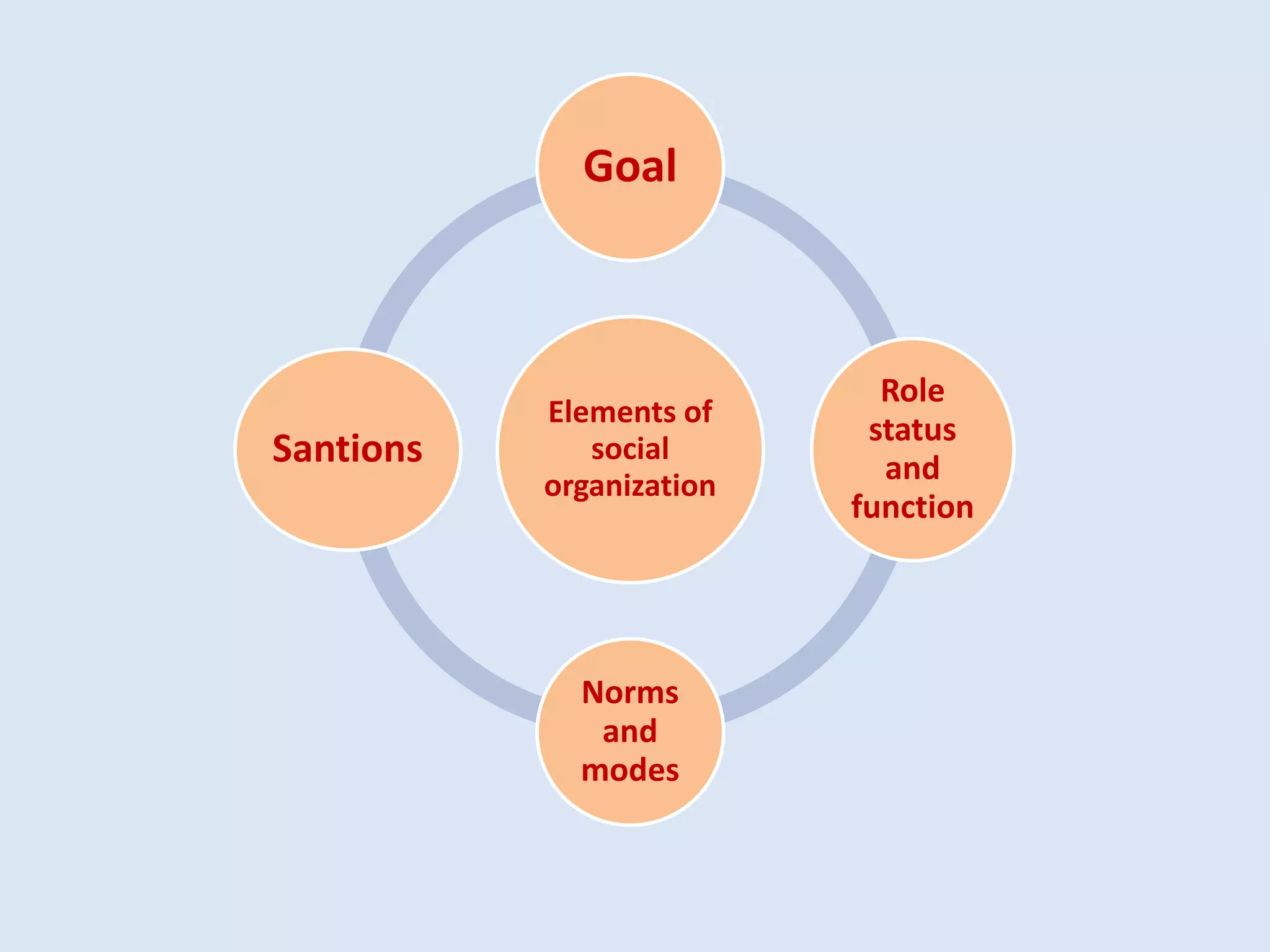
Elements of
social
organization
Goal
Role
status
and
function
Norms
and
modes
Santions
Types of social organization-
In social organization people work, co-
operation and co-ordination. Members are
related to each other on the basis of status in
order to accomplish a common goal social
organization classified as :-
Political organization:-This form of
organization is more concerned with political
matter e.g. state, nation, rural, urban etc.
Economic organization :- It is concerned
with the production and distribution of wealth
e.g. factory industry etc.
Religious organization :- It is a place where
people offers prayers carry out religious rituals . The
main purpose of religious organization is to meet
spiritual needs of the people e.g. Temple, Church
mosque etc.
Financial organization :- It is concerned
with money matter e.g. Bank , post office,
provident fund organization
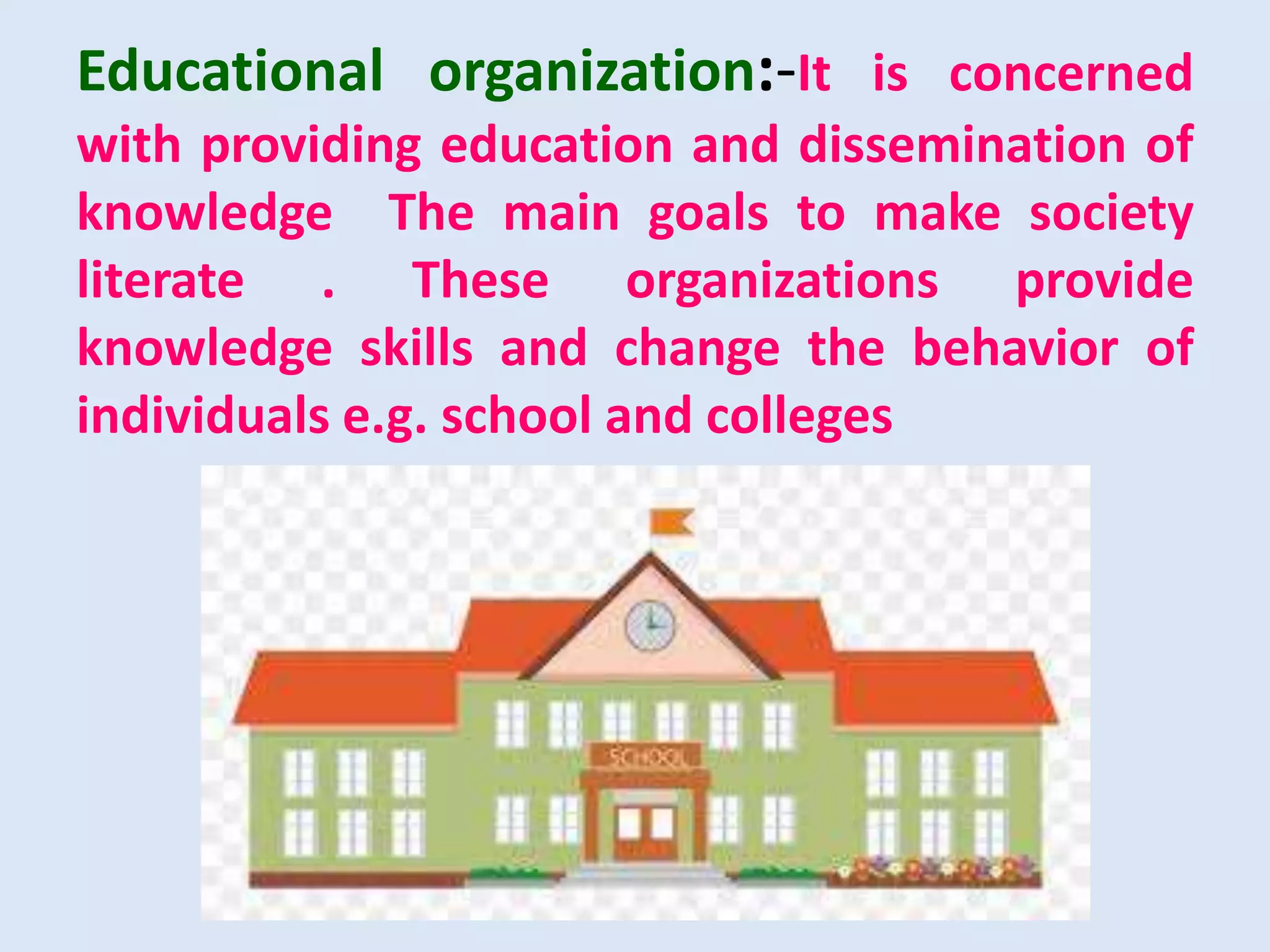
Educational organization:-It is concerned
with providing education and dissemination of
knowledge The main goals to make society
literate . These organizations provide
knowledge skills and change the behavior of
individuals e.g. school and colleges
Mode of Participation:
• There are two modes of participation in a social
organization viz. democratic and autocratic.
• Democratic : Mode of participation, members of
the society engaged themselves in the decision
process and group related matters.
• Authoritarian participation is based on the use of
coercive power /Threat or force.
• Autocratic- In autocratic or authoritarian
participation is based on the use of coercive
power . Authoritarian Leaders make decisions
independently with little or no input from the
group.

Social organization.pptx

  • 1.
  • 2.
    Introduction : Organization isan orderly arranging of parts into a whole. Social organization is a pattern of social relationship between and among individuals and groups are interrelated together to create a social organization. All social institutions such as family, church, collage, political party ,associations, clubs and other formal groups are example of organization
  • 3.
    • The organizationis a social system of social relationships .Etymologically, the word organization derived from the word organ. It means a part of a man or animal. organization implies a group of people with common aim, objectives, cooperation and their productive work. For instance-trade union, student union/ organization(students federation of India, all India students association, Karla students union, democratic students federation, all odisha students union, etc. CONTINUED…
  • 4.
    Meaning • Social organizationis a state wherein various institutions in the society are functioning in accordance with their recognized or implied purposes. • Organization is the system of relationships between persons and among groups with the division of activity and with regard to the division of activity and the functional arrangement of mutual obligations within the society. • When there is an arrangement of persons or parts which are interrelated or interdependent it is termed as social organization. • Institutions, associations and groups are the various constituents of a social organization
  • 5.
    DEFINITION • According toAuguste comte “ social organization is general social agreement or social consensus”. • According to HM Johnson, “ organization refers to an aspect of interaction system. • According to Ogburn and Nimcolf “ an organization is an articulation of different parts which perform various functions, it is an active group device for getting something done.” • According to Herbert Spencer “social organization refers to interactions of the economic, political, and other division of society.”
  • 6.
    Definition: • According toEarnest Jones –social organization is a system by which the parts of society are related to each other and to the whole society in a meaningful way. • Eliot and Merrill-organization is a state of being a condition in which the various institutions in a society are functioning in accordance with their recognized or implied purpose. • Leonard Broom and Philip Selznick –Social organization are pattern relations of individuals and groups.
  • 7.
    Elements of socialorganization Within a social organization individuals hold various positions and abide by the set rules to achieve common goals or objectives. Basic elements of a social organization areas follows • GOAL-Members of an organization are interrelated to each other and display unity of interest .All members try to achieve `a common goal. • ROLE STATUS AND POSITION - Within an organization every member has an assigned role to perform and position and status to occupy .Members are prepare to accept ones role and status .
  • 8.
    • NORMS ANDMODES- Every organization has its norms and modes which control its members through discipline ,regularity and punctuality. if its organization . An organization functions smoothly if its members follow these modes and norms. • SANCTIONS –Every organization follows a system of sanctions .If the member does not follow the norms he is compelled to follow them through sanction (conditions) which may range from warning to physical punishment e.g. expulsion or dismissal. Through which organization achieve common goal
  • 9.
  • 10.
    Types of socialorganization- In social organization people work, co- operation and co-ordination. Members are related to each other on the basis of status in order to accomplish a common goal social organization classified as :-
  • 11.
    Political organization:-This formof organization is more concerned with political matter e.g. state, nation, rural, urban etc.
  • 12.
    Economic organization :-It is concerned with the production and distribution of wealth e.g. factory industry etc.
  • 13.
    Religious organization :-It is a place where people offers prayers carry out religious rituals . The main purpose of religious organization is to meet spiritual needs of the people e.g. Temple, Church mosque etc.
  • 14.
    Financial organization :-It is concerned with money matter e.g. Bank , post office, provident fund organization
  • 15.
    Educational organization:-It isconcerned with providing education and dissemination of knowledge The main goals to make society literate . These organizations provide knowledge skills and change the behavior of individuals e.g. school and colleges
  • 16.
    Mode of Participation: •There are two modes of participation in a social organization viz. democratic and autocratic. • Democratic : Mode of participation, members of the society engaged themselves in the decision process and group related matters. • Authoritarian participation is based on the use of coercive power /Threat or force. • Autocratic- In autocratic or authoritarian participation is based on the use of coercive power . Authoritarian Leaders make decisions independently with little or no input from the group.