Perception
Mrs Agnes Mahima David
Associate Prof
OWhen our sense organs come in contact with
the world and are stimulated by external
stimuli and receive sensations, it results in
perception. Sensation precedes perception.
Sensation is the initial response of an
individual to a stimulus. Perception is the
interpretation of sensory stimuli, which
reaches the sense organs and the brain.
Interpretation gives meaning to sensation and
we become aware of objects.
Definitions
O Perception is the experience of objects,
events or relationships obtained by extracting
information from and interpreting sensations.
(JH Jackson, O Desiderato and DB
Howieson—1976)
O Perception is an individual’s awareness
aspect of behavior, for it is the way each
person processes the raw data he receives
from the environment, into meaningful
patterns.
(RE Silverman—1976)
Principles of Perception (Perceptual
Organization
OIndividuals tend to organize
environmental stimuli into some
meaningful patterns or whole
according to certain principles.
Some of the important
principles are:
O Principle of Figure-Ground
Relationship
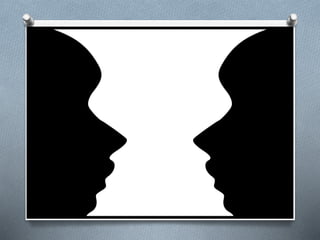
According to principle of figure-ground
relationship, a figure is perceived in
relationship to its background. The
perception of the object or figure in terms of
color, size, shape and intensity, etc.
depends upon the figure-ground relationship
O Principle of Closure
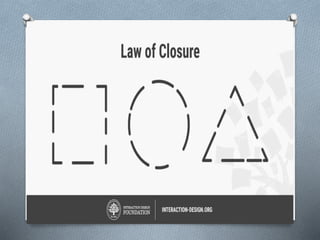
According to principle of closure, while
confronting an incomplete pattern one tends to
complete or close the pattern or fill in sensory
gaps and perceive it as a meaningful whole.
This type of organization is extremely helpful in
making valuable interpretation of various
incomplete objects, patterns or stimuli present in
our environment. For example, the lines in the
figure may be well perceived as letters W, M
and D
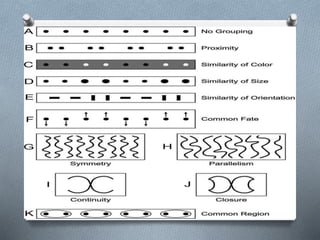
O Principle of Grouping
Principle of grouping refers to
a tendency to perceive
stimuli in some organized
meaningful patterns by
grouping them on some solid
basis like similarity, proximity
and continuity.
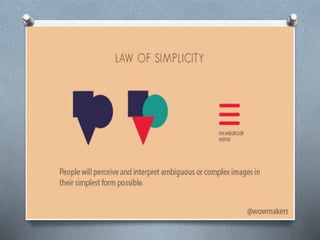
O Principle of Simplicity
We perceive the simplest
possible pattern because they
enable the perceiver to perceive
the whole from some of its parts.
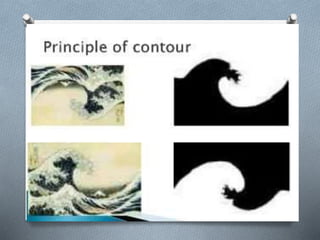
O Principle of Contour
A contour is said to be a boundary
between a figure and its ground. The
degree of the quality of this contour
separating the figure from the ground
is responsible for enabling us to
organize stimuli or objects into
meaningful patterns
O Principle of Context
Perceptual organization is also
governed by the principle of
context, i.e. an examiner may
award higher marks to the same
answer book in a pleasant
context than in an unpleasant
one.
Principle of Contrast
Perceptual organization is very much
affected through contrast effects as the
stimuli that are in sharp contrast to nearby
stimuli may draw our maximum attention
and carry different perceptual affects.
Principle of Adaptability
OThe perceptual organization for
some stimuli depends upon the
adaptability of the perceiver to
perceive similar stimuli. An
individual who adapts himself to
work before an intense bright light
will perceive normal sunlight as
quite dim.
Factors Affecting Perception
O Sense Organs
Perception depends upon the sense organs
or
receptors, on which the stimuli act and
sensory neurons, which transmit the nerve
current from the receptors to the sensory
area of the brain.
O Brain
Perception depends upon the functioning capacity of
sensory area and the association areas of the brain.
Memory Images of the Past Experience
Memory images help us in the comprehension of the
object or stimulus before us. Generally, perception
involves the integration of sensory experience in the
light of past experience and present psychological
conditions
O Personal Interests and Mind Set
We perceive those things quickly and clearly, which
are concerned with our interests and mind set.
O Acquired Interests
Our acquired interests also determine the object or
objects, which we perceive. A person, who has a
hobby of collecting stamps will quickly notice any
new stamp on a letter.
O Needs and Desires
Our needs or desires also modify our
perceptions. Besides these, our
beliefs, opinions and cultural ideals
also modify our perception of things,
situations and objects.
Errors in Perception
O Perceptual processes enable an individual
to perceive things accurately and facilitate
smooth functioning. However, some errors
creep into this process under certain
circumstances leading to impaired
perceptions, these are: illusions and
hallucination
O Illusion
Illusion is a misinterpretation of actual
perception. When the interpretation of a
particular stimulus goes wrong, it gives rise
to a wrong perception or illusion. For
example, a rope in the dark is perceived as
a snake
O Hallucination
Hallucination is identified as one
of the major errors of perception.
These are sensory perceptions,
in the absence of any
corresponding external sensory
stimuli
Causes for Inaccurate Perception
O Defective functioning of sense organs: For
example, myopia, deafness, anesthesia or other
sensory defects can cause inaccurate perception.
O Inadequate stimulus: Our receptors may not be
stimulated adequately, if stimuli were not strong
enough, vague or indefinite. A very weak light or
soft sound will make it difficult to perceive correctly.
O Too many stimuli at one time: When too many
stimuli are present at one given time, perceiving
one stimulus correctly is difficult.
O Poor health: Sense organs cannot function
adequately and correctly as a result of illness. For
this reason, the perceptions of patients may be
inaccurate.
O Limited attention: If we try to apprehend more
things than we can at a time, we are liable to have an
inaccurate perception
O Figure merges in the ground:
Sometimes objects are perceived with
difficulty because they resemble their
surroundings. For example, a white patch
is difficult to detect on a white wall. The
nurse learns to perceive sign of illness or
wellness in patients only, when she learns
what these signs are.
O Guidance: Perception is inaccurate,
when we do not know what should be
perceived.

Perception.pptx

  • 1.
    Perception Mrs Agnes MahimaDavid Associate Prof
  • 2.
    OWhen our senseorgans come in contact with the world and are stimulated by external stimuli and receive sensations, it results in perception. Sensation precedes perception. Sensation is the initial response of an individual to a stimulus. Perception is the interpretation of sensory stimuli, which reaches the sense organs and the brain. Interpretation gives meaning to sensation and we become aware of objects.
  • 3.
    Definitions O Perception isthe experience of objects, events or relationships obtained by extracting information from and interpreting sensations. (JH Jackson, O Desiderato and DB Howieson—1976) O Perception is an individual’s awareness aspect of behavior, for it is the way each person processes the raw data he receives from the environment, into meaningful patterns. (RE Silverman—1976)
  • 4.
    Principles of Perception(Perceptual Organization OIndividuals tend to organize environmental stimuli into some meaningful patterns or whole according to certain principles. Some of the important principles are:
  • 5.
    O Principle ofFigure-Ground Relationship According to principle of figure-ground relationship, a figure is perceived in relationship to its background. The perception of the object or figure in terms of color, size, shape and intensity, etc. depends upon the figure-ground relationship
  • 7.
    O Principle ofClosure According to principle of closure, while confronting an incomplete pattern one tends to complete or close the pattern or fill in sensory gaps and perceive it as a meaningful whole. This type of organization is extremely helpful in making valuable interpretation of various incomplete objects, patterns or stimuli present in our environment. For example, the lines in the figure may be well perceived as letters W, M and D
  • 9.
    O Principle ofGrouping Principle of grouping refers to a tendency to perceive stimuli in some organized meaningful patterns by grouping them on some solid basis like similarity, proximity and continuity.
  • 11.
    O Principle ofSimplicity We perceive the simplest possible pattern because they enable the perceiver to perceive the whole from some of its parts.
  • 13.
    O Principle ofContour A contour is said to be a boundary between a figure and its ground. The degree of the quality of this contour separating the figure from the ground is responsible for enabling us to organize stimuli or objects into meaningful patterns
  • 15.
    O Principle ofContext Perceptual organization is also governed by the principle of context, i.e. an examiner may award higher marks to the same answer book in a pleasant context than in an unpleasant one.
  • 16.
    Principle of Contrast Perceptualorganization is very much affected through contrast effects as the stimuli that are in sharp contrast to nearby stimuli may draw our maximum attention and carry different perceptual affects.
  • 17.
    Principle of Adaptability OTheperceptual organization for some stimuli depends upon the adaptability of the perceiver to perceive similar stimuli. An individual who adapts himself to work before an intense bright light will perceive normal sunlight as quite dim.
  • 18.
    Factors Affecting Perception OSense Organs Perception depends upon the sense organs or receptors, on which the stimuli act and sensory neurons, which transmit the nerve current from the receptors to the sensory area of the brain.
  • 19.
    O Brain Perception dependsupon the functioning capacity of sensory area and the association areas of the brain. Memory Images of the Past Experience Memory images help us in the comprehension of the object or stimulus before us. Generally, perception involves the integration of sensory experience in the light of past experience and present psychological conditions
  • 20.
    O Personal Interestsand Mind Set We perceive those things quickly and clearly, which are concerned with our interests and mind set. O Acquired Interests Our acquired interests also determine the object or objects, which we perceive. A person, who has a hobby of collecting stamps will quickly notice any new stamp on a letter.
  • 21.
    O Needs andDesires Our needs or desires also modify our perceptions. Besides these, our beliefs, opinions and cultural ideals also modify our perception of things, situations and objects.
  • 22.
    Errors in Perception OPerceptual processes enable an individual to perceive things accurately and facilitate smooth functioning. However, some errors creep into this process under certain circumstances leading to impaired perceptions, these are: illusions and hallucination
  • 23.
    O Illusion Illusion isa misinterpretation of actual perception. When the interpretation of a particular stimulus goes wrong, it gives rise to a wrong perception or illusion. For example, a rope in the dark is perceived as a snake
  • 24.
    O Hallucination Hallucination isidentified as one of the major errors of perception. These are sensory perceptions, in the absence of any corresponding external sensory stimuli
  • 25.
    Causes for InaccuratePerception O Defective functioning of sense organs: For example, myopia, deafness, anesthesia or other sensory defects can cause inaccurate perception. O Inadequate stimulus: Our receptors may not be stimulated adequately, if stimuli were not strong enough, vague or indefinite. A very weak light or soft sound will make it difficult to perceive correctly. O Too many stimuli at one time: When too many stimuli are present at one given time, perceiving one stimulus correctly is difficult.
  • 26.
    O Poor health:Sense organs cannot function adequately and correctly as a result of illness. For this reason, the perceptions of patients may be inaccurate. O Limited attention: If we try to apprehend more things than we can at a time, we are liable to have an inaccurate perception
  • 27.
    O Figure mergesin the ground: Sometimes objects are perceived with difficulty because they resemble their surroundings. For example, a white patch is difficult to detect on a white wall. The nurse learns to perceive sign of illness or wellness in patients only, when she learns what these signs are. O Guidance: Perception is inaccurate, when we do not know what should be perceived.