EMOTIONS:
 Emotionmeans “to excite,stiruporagitate”.
 It isderivedfroma Latinword“Emovere”.
A responsethatincludesfeelingssuch ashappiness,fear,sadness,grief,sorrow etc.it is the mixtureof :
i. Psychologicalarousal.
ii. Expression of conscious.
iii. The consciousexperienceof the situation thatinfluencebehavior.
 In psychology,emotionisconsideredaresponse tostimuli thatinvolvescharacteristics
psychological changessuchas:
 Increase inpulse rate.
 Rise inbodytemperature.
 Greateror lessactivityof glands.
 Change inrate f breathing.
It tendsitself tomotivate the individual towardfurtheractivities.
OUTCOMES OF EMOTION EXPERIENCES
Emotionsare feelings,highlysubjective personal tendenciestorespondtoexternalandinternal
variables.
Componentsof emotionexperiences:
Emotionshave cognitive thinking,psychological arousal andbehavioralcomponents.
 Our cognitive thinkingandevolutionof eventsinourlivesare keydeterminantstoour
emotional responses.
 Emotionsare accompaniedbypsychological arousal of the automaticnervoussystemthatleads
to physical symptomssuchas:increase inrespirationandheartrate.
 The behavioral componentof emotions isexpressedinournonverbal bodylanguageincluding
facial expressions.
Mc Dougall divisionofemotions:
Mc Dougall dividesemotionsintothree parts;
1. Primary:
It Include simpleemotionssuchas:fear,happiness,anger,disgust,etc.
2. Secondary:
It Include mixture of variousinstinctssuchas:curiosity,escape etc
3. Derived:
Learn throughexperiencessuchas:sadness,boredom.
Somebodily changesmay be manifestin differentemotionalexperiences.
ACCESSING EMOTIONS
To explainthe meaningof emotion,the importantthingsare;
o Acquaintance
o Association
o Derivingcluesfromownemotional experiences
Expressionsinemotions:
Vocal or verbal andfacial expressionsplayavital role indeterminingemotionsaswell asourinteraction
withthe physical world.
Facial expressions
Facial expressions clearlyreflectthe intensityof emotional experiencessuchas;happiness,sadness,
angeretc: all can be understoodfromemotional expressions. Howevertheyvaryfrompersontoperson.
Vocal expression
An adult’svoice patternclearlyreflectstheiremotions.Variationsinpitchorloudnessexpressdifferent
typesof emotions.
EMOTIONS AND COGNITIONS:
Understandingemotions:
Some psychologistsbelieve thatmemoryandcognitionsare entirelyseparate systemsthatfunctions
independently;
 Some arguesthat we emotionallyrespondtothe situation andthenunderstandit
cognitively.
 On the otherhand,otherbelievedthatwe firstcognitivelyunderstandthe situationand
thenrespondsit.
Both pointsof viewsare somehowsupportedbythe studiesandthe debate isstill unresolved.
Role of emotionin everydaylife:
Emotionsmake ourlife brightandenlightened,because withoutthe expressionof emotions,ourlife
wouldbe dull,uninteresting,andwithoutanypurpose.
Psychologistsidentified numberof functionsof emotionsthathavea vitalrole in our daily life. They are;
Stirred up for the fight or flightaction:
Afterseeingasnake or; the bodyispreparedto stirred upto face and deal the situation.
Modifyingthe future responsesandbehavior:
Learningtakesplace afteremotional state thatpreparesustomanifestappropriate behaviorsinfuture
i.e.strategiesshouldbe adoptedtominimize the aftermathtoface the snake.
Social interactionsare enhanced:
Emotionsare both verbal andnon-verbal sotheyhelppeopletobetterunderstandthe responses
whethertheyare beingexpressedornot.
COMMONEMOTIONS
Range of emotions:
There are numberof basicemotionsthathave beenidentifiedbypeople ininstance.Theyare;
 Happy
 Anger
 Fear
 Disgust
 Surprise
 Sadness
J.B.Watson:
He talkedaboutthree main emotions
 Anger
 Love
 Fear
He provedinhisexperimentsthatinfantsare capable of these three primaryemotions.
 Psychologistshave alsoidentifiedotheremotionsorrelatedexpressionssuchas;contempt,
shame,startle.
Robert Pultchik(1984):
RobertPultchik(1984) became able todetermine the basicemotionsandtheirrelationshipsthroughhis
studies.
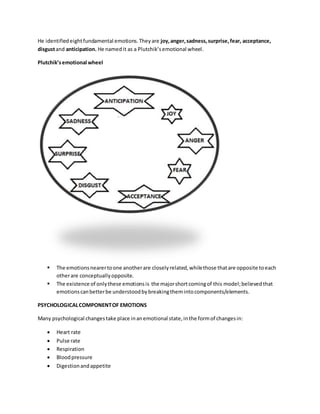
He identifiedeightfundamental emotions.Theyare joy,anger,sadness,surprise,fear, acceptance,
disgustand anticipation. He namedit as a Plutchik’semotional wheel.
Plutchik’semotional wheel
 The emotionsnearertoone anotherare closelyrelated,whilethose thatare opposite toeach
otherare conceptuallyopposite.
 The existence of onlythese emotionsis the majorshortcomingof this model;believedthat
emotionscanbetterbe understoodbybreakingthemintocomponents/elements.
PSYCHOLOGICALCOMPONENTOF EMOTIONS
Many psychological changestake place inanemotional state,inthe formof changesin:
 Heart rate
 Pulse rate
 Respiration
 Bloodpressure
 Digestionandappetite
 Muscular activity
 Bodytemperature
 Perspiration
 Endocrine andneurotransmittersecretions
 Bloodsugar
 Salivaryglandactivity
 Pupil dilation
ROLE OF NERVOUSSYSTEM IN EMOTIONS:
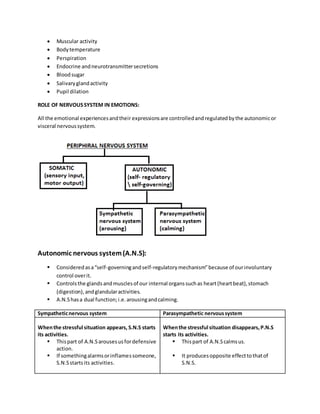
All the emotional experiencesandtheir expressionsare controlledandregulatedbythe autonomicor
visceral nervoussystem.
Autonomic nervous system(A.N.S):
 Consideredasa“self-governingandself-regulatorymechanism”because of ourinvoluntary
control overit.
 Controlsthe glandsandmusclesof our internal organssuchas heart(heartbeat),stomach
(digestion),andglandularactivities.
 A.N.Shasa dual function;i.e.arousingandcalming.
Sympatheticnervous system Parasympathetic nervoussystem
Whenthe stressful situation appears, S.N.S starts
its activities.
 Thispart of A.N.Sarousesusfordefensive
action.
 If somethingalarmsorinflamessomeone,
S.N.Sstartsits activities.
Whenthe stressful situation disappears,P.N.S
starts its activities.
 Thispart of A.N.Scalmsus.
 It producesopposite effecttothatof
S.N.S.
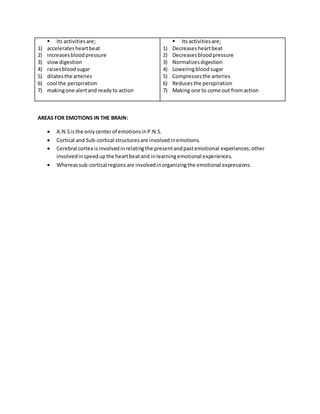
 Its activitiesare;
1) acceleratesheartbeat
2) increasesbloodpressure
3) slowdigestion
4) raisesbloodsugar
5) dilatesthe arteries
6) cool the perspiration
7) makingone alertand readyto action
 Its activitiesare;
1) Decreasesheartbeat
2) Decreasesbloodpressure
3) Normalizesdigestion
4) Loweringbloodsugar
5) Compressesthe arteries
6) Reducesthe perspiration
7) Making one to come out fromaction
AREAS FOR EMOTIONS IN THE BRAIN:
 A.N.Sisthe onlycenterof emotionsinP.N.S.
 Cortical and Sub-cortical structuresare involvedinemotions.
 Cerebral cortex isinvolvedinrelatingthe presentandpastemotional experiences;other
involvedinspeedupthe heartbeatand inlearningemotional experiences.
 Whereassub-cortical regions are involvedinorganizingthe emotional expressions.

Emotions

  • 1.
    EMOTIONS:  Emotionmeans “toexcite,stiruporagitate”.  It isderivedfroma Latinword“Emovere”. A responsethatincludesfeelingssuch ashappiness,fear,sadness,grief,sorrow etc.it is the mixtureof : i. Psychologicalarousal. ii. Expression of conscious. iii. The consciousexperienceof the situation thatinfluencebehavior.  In psychology,emotionisconsideredaresponse tostimuli thatinvolvescharacteristics psychological changessuchas:  Increase inpulse rate.  Rise inbodytemperature.  Greateror lessactivityof glands.  Change inrate f breathing. It tendsitself tomotivate the individual towardfurtheractivities. OUTCOMES OF EMOTION EXPERIENCES Emotionsare feelings,highlysubjective personal tendenciestorespondtoexternalandinternal variables. Componentsof emotionexperiences: Emotionshave cognitive thinking,psychological arousal andbehavioralcomponents.  Our cognitive thinkingandevolutionof eventsinourlivesare keydeterminantstoour emotional responses.  Emotionsare accompaniedbypsychological arousal of the automaticnervoussystemthatleads to physical symptomssuchas:increase inrespirationandheartrate.  The behavioral componentof emotions isexpressedinournonverbal bodylanguageincluding facial expressions. Mc Dougall divisionofemotions: Mc Dougall dividesemotionsintothree parts; 1. Primary: It Include simpleemotionssuchas:fear,happiness,anger,disgust,etc. 2. Secondary: It Include mixture of variousinstinctssuchas:curiosity,escape etc
  • 2.
    3. Derived: Learn throughexperiencessuchas:sadness,boredom. Somebodilychangesmay be manifestin differentemotionalexperiences. ACCESSING EMOTIONS To explainthe meaningof emotion,the importantthingsare; o Acquaintance o Association o Derivingcluesfromownemotional experiences Expressionsinemotions: Vocal or verbal andfacial expressionsplayavital role indeterminingemotionsaswell asourinteraction withthe physical world. Facial expressions Facial expressions clearlyreflectthe intensityof emotional experiencessuchas;happiness,sadness, angeretc: all can be understoodfromemotional expressions. Howevertheyvaryfrompersontoperson. Vocal expression An adult’svoice patternclearlyreflectstheiremotions.Variationsinpitchorloudnessexpressdifferent typesof emotions. EMOTIONS AND COGNITIONS: Understandingemotions: Some psychologistsbelieve thatmemoryandcognitionsare entirelyseparate systemsthatfunctions independently;  Some arguesthat we emotionallyrespondtothe situation andthenunderstandit cognitively.  On the otherhand,otherbelievedthatwe firstcognitivelyunderstandthe situationand thenrespondsit. Both pointsof viewsare somehowsupportedbythe studiesandthe debate isstill unresolved. Role of emotionin everydaylife: Emotionsmake ourlife brightandenlightened,because withoutthe expressionof emotions,ourlife wouldbe dull,uninteresting,andwithoutanypurpose.
  • 3.
    Psychologistsidentified numberof functionsofemotionsthathavea vitalrole in our daily life. They are; Stirred up for the fight or flightaction: Afterseeingasnake or; the bodyispreparedto stirred upto face and deal the situation. Modifyingthe future responsesandbehavior: Learningtakesplace afteremotional state thatpreparesustomanifestappropriate behaviorsinfuture i.e.strategiesshouldbe adoptedtominimize the aftermathtoface the snake. Social interactionsare enhanced: Emotionsare both verbal andnon-verbal sotheyhelppeopletobetterunderstandthe responses whethertheyare beingexpressedornot. COMMONEMOTIONS Range of emotions: There are numberof basicemotionsthathave beenidentifiedbypeople ininstance.Theyare;  Happy  Anger  Fear  Disgust  Surprise  Sadness J.B.Watson: He talkedaboutthree main emotions  Anger  Love  Fear He provedinhisexperimentsthatinfantsare capable of these three primaryemotions.  Psychologistshave alsoidentifiedotheremotionsorrelatedexpressionssuchas;contempt, shame,startle. Robert Pultchik(1984): RobertPultchik(1984) became able todetermine the basicemotionsandtheirrelationshipsthroughhis studies.
  • 4.
    He identifiedeightfundamental emotions.Theyarejoy,anger,sadness,surprise,fear, acceptance, disgustand anticipation. He namedit as a Plutchik’semotional wheel. Plutchik’semotional wheel  The emotionsnearertoone anotherare closelyrelated,whilethose thatare opposite toeach otherare conceptuallyopposite.  The existence of onlythese emotionsis the majorshortcomingof this model;believedthat emotionscanbetterbe understoodbybreakingthemintocomponents/elements. PSYCHOLOGICALCOMPONENTOF EMOTIONS Many psychological changestake place inanemotional state,inthe formof changesin:  Heart rate  Pulse rate  Respiration  Bloodpressure  Digestionandappetite
  • 5.
     Muscular activity Bodytemperature  Perspiration  Endocrine andneurotransmittersecretions  Bloodsugar  Salivaryglandactivity  Pupil dilation ROLE OF NERVOUSSYSTEM IN EMOTIONS: All the emotional experiencesandtheir expressionsare controlledandregulatedbythe autonomicor visceral nervoussystem. Autonomic nervous system(A.N.S):  Consideredasa“self-governingandself-regulatorymechanism”because of ourinvoluntary control overit.  Controlsthe glandsandmusclesof our internal organssuchas heart(heartbeat),stomach (digestion),andglandularactivities.  A.N.Shasa dual function;i.e.arousingandcalming. Sympatheticnervous system Parasympathetic nervoussystem Whenthe stressful situation appears, S.N.S starts its activities.  Thispart of A.N.Sarousesusfordefensive action.  If somethingalarmsorinflamessomeone, S.N.Sstartsits activities. Whenthe stressful situation disappears,P.N.S starts its activities.  Thispart of A.N.Scalmsus.  It producesopposite effecttothatof S.N.S.
  • 6.
     Its activitiesare; 1)acceleratesheartbeat 2) increasesbloodpressure 3) slowdigestion 4) raisesbloodsugar 5) dilatesthe arteries 6) cool the perspiration 7) makingone alertand readyto action  Its activitiesare; 1) Decreasesheartbeat 2) Decreasesbloodpressure 3) Normalizesdigestion 4) Loweringbloodsugar 5) Compressesthe arteries 6) Reducesthe perspiration 7) Making one to come out fromaction AREAS FOR EMOTIONS IN THE BRAIN:  A.N.Sisthe onlycenterof emotionsinP.N.S.  Cortical and Sub-cortical structuresare involvedinemotions.  Cerebral cortex isinvolvedinrelatingthe presentandpastemotional experiences;other involvedinspeedupthe heartbeatand inlearningemotional experiences.  Whereassub-cortical regions are involvedinorganizingthe emotional expressions.