
PARKINSONISM
4/4/2018KIRSHA,1
DEFINITION
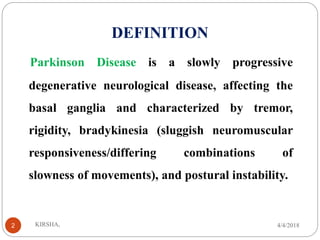
Parkinson Disease is a slowly progressive
degenerative neurological disease, affecting the
basal ganglia and characterized by tremor,
rigidity, bradykinesia (sluggish neuromuscular
responsiveness/differing combinations of
slowness of movements), and postural instability.
4/4/2018KIRSHA,2
TYPES
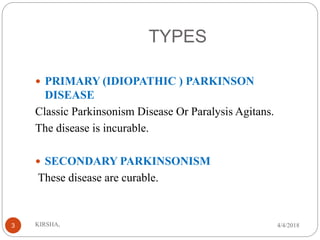
 PRIMARY (IDIOPATHIC ) PARKINSON
DISEASE
Classic Parkinsonism Disease Or Paralysis Agitans.
The disease is incurable.
 SECONDARY PARKINSONISM
These disease are curable.
4/4/2018KIRSHA,3
ETIOLOGY
Primary (Idiopathic)
Parkinson Disease
Neuronal Loss
Genetics
Factors
Secondary
Parkinsonism
Drugs
Poisoning by
chemicals or toxins
Infectious causes
Other factors- age, environmental factors
4/4/2018KIRSHA,4
PRIMARY PARKINSON DISEASE
NEURONAL LOSS IN IDIOPATHIC PARKINSON
(1) The normally high concentration in the basal ganglia of the brain is reduced
in Parkinsonism. The loss of the dopaminergic neuron in the substantia
nigra that normally inhibit the output of GABAergic cells in the corpus
striatum, which causes excitatory effect on cholinergic neurons and hence
symptoms like tremors.
(2) There is degeneration of cells with loss of pigmented neurons in the pars
compacta of substantia nigra. The degenerating pigmented neurons contain
eosinophilic inclusion bodies called Lewis bodies, which are characteristics
of this disease.
(3) Defects of mitochondrial respiration and xenobiotic- metabolizing enzymes
(eg: glutathione transferase, cytochrome P450 2D6, N-acetyl transferase)
may contribute to free radical generation and oxidant stress.
4/4/2018KIRSHA,5
(1) Exposure to the free radicals. Hydrogen peroxide and production of
free radicals—both toxic to cells— are products of catabolism.
Protective reductants (eg: glutathione), enzymes, and free radical
scavengers, such as vitamins E and C, protect cells from damage.
It is proposed that either a decrease in these protective
mechanisms or reduced dopamine concentration in the basal
ganglia causes a destruction of the neurons by free radicals.
GENETIC FACTORS
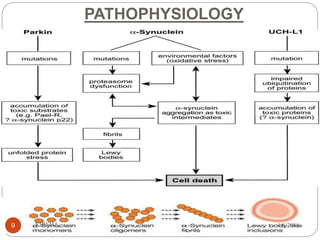
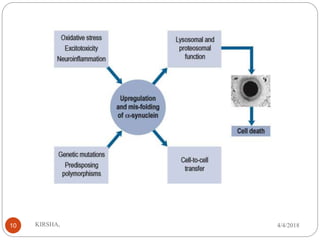
Genes that link to Parkinson disease- such as alpha-
synuclein and parkin
4/4/2018KIRSHA,6
SECONDARY PARKINSONISM
BY DRUGS, INCLUDING DOPAMINE ANTAGONISTS
 Phenothiazines (e.g., chlorpromazine, perphenazine)
 Butyrophenones (e.g., haloperidol)
 Reserpine
POISONING BY CHEMICALS OR TOXINS
 Carbon monoxide poisoning
 Heavy-metal poisoning, such as that by manganese or mercury
 MPTP (methyl-phenyl-tetrahydropyridine), a commercial compound used in organic
synthesis and found (as a side product) in an illegal meperidine analog
INFECTIOUS CAUSES
 Encephalitis (viral)
 Syphilis
4/4/2018KIRSHA,7
OTHER CAUSES
 Arteriosclerosis
 Degenerative diseases of the central nervous system (CNS), such as
progressive Supranuclear Palsy
 Metabolic disorders such as Wilson Disease
Pathophysiology
Absorption of highly potent neurotoxins (environmental), such as carbon
monoxide, manganese, solvents, and N-methyl-4-phenyl-1,2,3,6-
tetrahydropyridine (MPTP), which is a product of improper synthesis of a synthetic
heroin-like compound. Exposure to these agents, alone or in combination with
the neuronal loss of age, may be the cause of Parkinson disease.
4/4/2018KIRSHA,8
PATHOPHYSIOLOGY
4/4/2018KIRSHA,9
4/4/2018KIRSHA,10
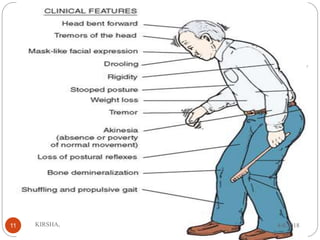
Cardinal
Features
Motor
Symptoms
Autonomic
Symptoms
Mental
Status
Changes
CLINICAL FEATURES
4/4/2018KIRSHA,11
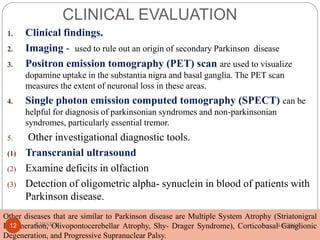
CLINICAL EVALUATION
1. Clinical findings.
2. Imaging - used to rule out an origin of secondary Parkinson disease
3. Positron emission tomography (PET) scan are used to visualize
dopamine uptake in the substantia nigra and basal ganglia. The PET scan
measures the extent of neuronal loss in these areas.
4. Single photon emission computed tomography (SPECT) can be
helpful for diagnosis of parkinsonian syndromes and non-parkinsonian
syndromes, particularly essential tremor.
5. Other investigational diagnostic tools.
(1) Transcranial ultrasound
(2) Examine deficits in olfaction
(3) Detection of oligometric alpha- synuclein in blood of patients with
Parkinson disease.
Other diseases that are similar to Parkinson disease are Multiple System Atrophy (Striatonigral
Degeneration, Olivopontocerebellar Atrophy, Shy- Drager Syndrome), Corticobasal Ganglionic
Degeneration, and Progressive Supranuclear Palsy.
4/4/2018KIRSHA,12
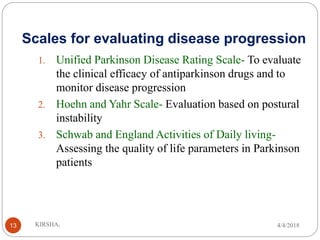
Scales for evaluating disease progression
1. Unified Parkinson Disease Rating Scale- To evaluate
the clinical efficacy of antiparkinson drugs and to
monitor disease progression
2. Hoehn and Yahr Scale- Evaluation based on postural
instability
3. Schwab and England Activities of Daily living-
Assessing the quality of life parameters in Parkinson
patients
4/4/2018KIRSHA,13
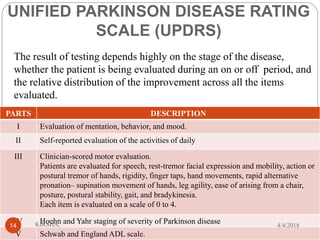
UNIFIED PARKINSON DISEASE RATING
SCALE (UPDRS)
The result of testing depends highly on the stage of the disease,
whether the patient is being evaluated during an on or off period, and
the relative distribution of the improvement across all the items
evaluated.
PARTS DESCRIPTION
I Evaluation of mentation, behavior, and mood.
II Self-reported evaluation of the activities of daily
III Clinician-scored motor evaluation.
Patients are evaluated for speech, rest-tremor facial expression and mobility, action or
postural tremor of hands, rigidity, finger taps, hand movements, rapid alternative
pronation– supination movement of hands, leg agility, ease of arising from a chair,
posture, postural stability, gait, and bradykinesia.
Each item is evaluated on a scale of 0 to 4.
IV Hoehn and Yahr staging of severity of Parkinson disease
V Schwab and England ADL scale.
4/4/2018KIRSHA,14
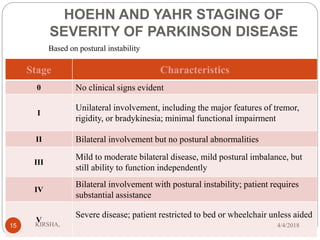
HOEHN AND YAHR STAGING OF
SEVERITY OF PARKINSON DISEASE
Stage Characteristics
0 No clinical signs evident
I
Unilateral involvement, including the major features of tremor,
rigidity, or bradykinesia; minimal functional impairment
II Bilateral involvement but no postural abnormalities
III
Mild to moderate bilateral disease, mild postural imbalance, but
still ability to function independently
IV
Bilateral involvement with postural instability; patient requires
substantial assistance
V
Severe disease; patient restricted to bed or wheelchair unless aided
Based on postural instability
4/4/2018KIRSHA,15
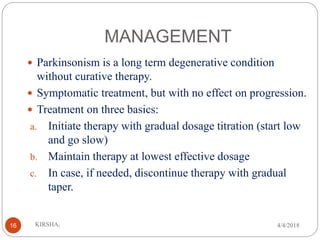
MANAGEMENT
 Parkinsonism is a long term degenerative condition
without curative therapy.
 Symptomatic treatment, but with no effect on progression.
 Treatment on three basics:
a. Initiate therapy with gradual dosage titration (start low
and go slow)
b. Maintain therapy at lowest effective dosage
c. In case, if needed, discontinue therapy with gradual
taper.
4/4/2018KIRSHA,16
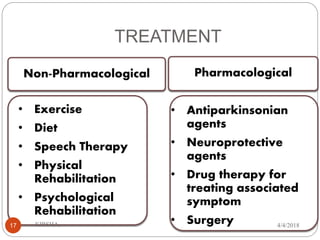
TREATMENT
PharmacologicalNon-Pharmacological
• Exercise
• Diet
• Speech Therapy
• Physical
Rehabilitation
• Psychological
Rehabilitation
• Antiparkinsonian
agents
• Neuroprotective
agents
• Drug therapy for
treating associated
symptom
• Surgery 4/4/2018KIRSHA,17
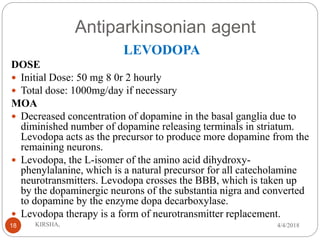
Antiparkinsonian agent
LEVODOPA
DOSE
 Initial Dose: 50 mg 8 0r 2 hourly
 Total dose: 1000mg/day if necessary
MOA
 Decreased concentration of dopamine in the basal ganglia due to
diminished number of dopamine releasing terminals in striatum.
Levodopa acts as the precursor to produce more dopamine from the
remaining neurons.
 Levodopa, the L-isomer of the amino acid dihydroxy-
phenylalanine, which is a natural precursor for all catecholamine
neurotransmitters. Levodopa crosses the BBB, which is taken up
by the dopaminergic neurons of the substantia nigra and converted
to dopamine by the enzyme dopa decarboxylase.
 Levodopa therapy is a form of neurotransmitter replacement.
4/4/2018KIRSHA,18
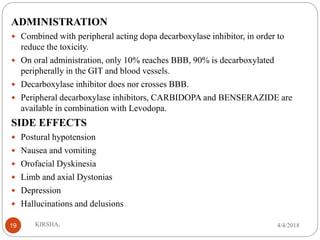
ADMINISTRATION
 Combined with peripheral acting dopa decarboxylase inhibitor, in order to
reduce the toxicity.
 On oral administration, only 10% reaches BBB, 90% is decarboxylated
peripherally in the GIT and blood vessels.
 Decarboxylase inhibitor does nor crosses BBB.
 Peripheral decarboxylase inhibitors, CARBIDOPA and BENSERAZIDE are
available in combination with Levodopa.
SIDE EFFECTS
 Postural hypotension
 Nausea and vomiting
 Orofacial Dyskinesia
 Limb and axial Dystonias
 Depression
 Hallucinations and delusions
4/4/2018KIRSHA,19
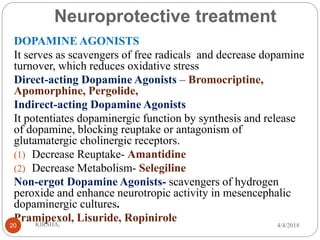
Neuroprotective treatment
DOPAMINE AGONISTS
It serves as scavengers of free radicals and decrease dopamine
turnover, which reduces oxidative stress
Direct-acting Dopamine Agonists – Bromocriptine,
Apomorphine, Pergolide,
Indirect-acting Dopamine Agonists
It potentiates dopaminergic function by synthesis and release
of dopamine, blocking reuptake or antagonism of
glutamatergic cholinergic receptors.
(1) Decrease Reuptake- Amantidine
(2) Decrease Metabolism- Selegiline
Non-ergot Dopamine Agonists- scavengers of hydrogen
peroxide and enhance neurotropic activity in mesencephalic
dopaminergic cultures.
Pramipexol, Lisuride, Ropinirole
4/4/2018KIRSHA,20
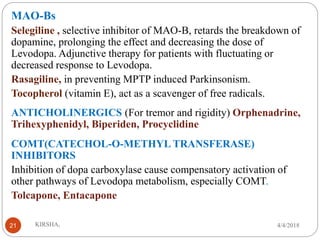
MAO-Bs
Selegiline , selective inhibitor of MAO-B, retards the breakdown of
dopamine, prolonging the effect and decreasing the dose of
Levodopa. Adjunctive therapy for patients with fluctuating or
decreased response to Levodopa.
Rasagiline, in preventing MPTP induced Parkinsonism.
Tocopherol (vitamin E), act as a scavenger of free radicals.
ANTICHOLINERGICS (For tremor and rigidity) Orphenadrine,
Trihexyphenidyl, Biperiden, Procyclidine
COMT(CATECHOL-O-METHYL TRANSFERASE)
INHIBITORS
Inhibition of dopa carboxylase cause compensatory activation of
other pathways of Levodopa metabolism, especially COMT.
Tolcapone, Entacapone
4/4/2018KIRSHA,21
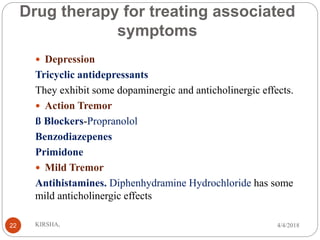
Drug therapy for treating associated
symptoms
 Depression
Tricyclic antidepressants
They exhibit some dopaminergic and anticholinergic effects.
 Action Tremor
ß Blockers-Propranolol
Benzodiazepenes
Primidone
 Mild Tremor
Antihistamines. Diphenhydramine Hydrochloride has some
mild anticholinergic effects
4/4/2018KIRSHA,22
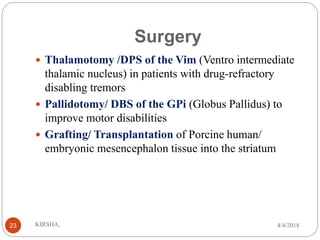
Surgery
 Thalamotomy /DPS of the Vim (Ventro intermediate
thalamic nucleus) in patients with drug-refractory
disabling tremors
 Pallidotomy/ DBS of the GPi (Globus Pallidus) to
improve motor disabilities
 Grafting/ Transplantation of Porcine human/
embryonic mesencephalon tissue into the striatum
4/4/2018KIRSHA,23
Secondary effects of Parkinson disease
Cardiovascular Effects
Orthostatic Hypotension
Arrhythmia
Gastrointestinal Effects
Constipation
Hypersalivation
Genitourinary Effects
Increased Urinary Frequency
Impotence
Central Nervous System Effects
Hallucinations
Depression
Psychosis
4/4/2018KIRSHA,24
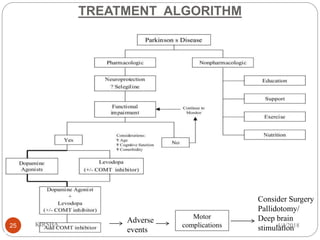
TREATMENT ALGORITHM
Motor
complications
Adverse
events
Consider Surgery
Pallidotomy/
Deep brain
stimulation4/4/2018KIRSHA,25
END
4/4/2018KIRSHA,26

Parkinsonism - management

  • 1.
  • 2.
    DEFINITION Parkinson Disease isa slowly progressive degenerative neurological disease, affecting the basal ganglia and characterized by tremor, rigidity, bradykinesia (sluggish neuromuscular responsiveness/differing combinations of slowness of movements), and postural instability. 4/4/2018KIRSHA,2
  • 3.
    TYPES  PRIMARY (IDIOPATHIC) PARKINSON DISEASE Classic Parkinsonism Disease Or Paralysis Agitans. The disease is incurable.  SECONDARY PARKINSONISM These disease are curable. 4/4/2018KIRSHA,3
  • 4.
    ETIOLOGY Primary (Idiopathic) Parkinson Disease NeuronalLoss Genetics Factors Secondary Parkinsonism Drugs Poisoning by chemicals or toxins Infectious causes Other factors- age, environmental factors 4/4/2018KIRSHA,4
  • 5.
    PRIMARY PARKINSON DISEASE NEURONALLOSS IN IDIOPATHIC PARKINSON (1) The normally high concentration in the basal ganglia of the brain is reduced in Parkinsonism. The loss of the dopaminergic neuron in the substantia nigra that normally inhibit the output of GABAergic cells in the corpus striatum, which causes excitatory effect on cholinergic neurons and hence symptoms like tremors. (2) There is degeneration of cells with loss of pigmented neurons in the pars compacta of substantia nigra. The degenerating pigmented neurons contain eosinophilic inclusion bodies called Lewis bodies, which are characteristics of this disease. (3) Defects of mitochondrial respiration and xenobiotic- metabolizing enzymes (eg: glutathione transferase, cytochrome P450 2D6, N-acetyl transferase) may contribute to free radical generation and oxidant stress. 4/4/2018KIRSHA,5
  • 6.
    (1) Exposure tothe free radicals. Hydrogen peroxide and production of free radicals—both toxic to cells— are products of catabolism. Protective reductants (eg: glutathione), enzymes, and free radical scavengers, such as vitamins E and C, protect cells from damage. It is proposed that either a decrease in these protective mechanisms or reduced dopamine concentration in the basal ganglia causes a destruction of the neurons by free radicals. GENETIC FACTORS Genes that link to Parkinson disease- such as alpha- synuclein and parkin 4/4/2018KIRSHA,6
  • 7.
    SECONDARY PARKINSONISM BY DRUGS,INCLUDING DOPAMINE ANTAGONISTS  Phenothiazines (e.g., chlorpromazine, perphenazine)  Butyrophenones (e.g., haloperidol)  Reserpine POISONING BY CHEMICALS OR TOXINS  Carbon monoxide poisoning  Heavy-metal poisoning, such as that by manganese or mercury  MPTP (methyl-phenyl-tetrahydropyridine), a commercial compound used in organic synthesis and found (as a side product) in an illegal meperidine analog INFECTIOUS CAUSES  Encephalitis (viral)  Syphilis 4/4/2018KIRSHA,7
  • 8.
    OTHER CAUSES  Arteriosclerosis Degenerative diseases of the central nervous system (CNS), such as progressive Supranuclear Palsy  Metabolic disorders such as Wilson Disease Pathophysiology Absorption of highly potent neurotoxins (environmental), such as carbon monoxide, manganese, solvents, and N-methyl-4-phenyl-1,2,3,6- tetrahydropyridine (MPTP), which is a product of improper synthesis of a synthetic heroin-like compound. Exposure to these agents, alone or in combination with the neuronal loss of age, may be the cause of Parkinson disease. 4/4/2018KIRSHA,8
  • 9.
  • 10.
  • 11.
  • 12.
    CLINICAL EVALUATION 1. Clinicalfindings. 2. Imaging - used to rule out an origin of secondary Parkinson disease 3. Positron emission tomography (PET) scan are used to visualize dopamine uptake in the substantia nigra and basal ganglia. The PET scan measures the extent of neuronal loss in these areas. 4. Single photon emission computed tomography (SPECT) can be helpful for diagnosis of parkinsonian syndromes and non-parkinsonian syndromes, particularly essential tremor. 5. Other investigational diagnostic tools. (1) Transcranial ultrasound (2) Examine deficits in olfaction (3) Detection of oligometric alpha- synuclein in blood of patients with Parkinson disease. Other diseases that are similar to Parkinson disease are Multiple System Atrophy (Striatonigral Degeneration, Olivopontocerebellar Atrophy, Shy- Drager Syndrome), Corticobasal Ganglionic Degeneration, and Progressive Supranuclear Palsy. 4/4/2018KIRSHA,12
  • 13.
    Scales for evaluatingdisease progression 1. Unified Parkinson Disease Rating Scale- To evaluate the clinical efficacy of antiparkinson drugs and to monitor disease progression 2. Hoehn and Yahr Scale- Evaluation based on postural instability 3. Schwab and England Activities of Daily living- Assessing the quality of life parameters in Parkinson patients 4/4/2018KIRSHA,13
  • 14.
    UNIFIED PARKINSON DISEASERATING SCALE (UPDRS) The result of testing depends highly on the stage of the disease, whether the patient is being evaluated during an on or off period, and the relative distribution of the improvement across all the items evaluated. PARTS DESCRIPTION I Evaluation of mentation, behavior, and mood. II Self-reported evaluation of the activities of daily III Clinician-scored motor evaluation. Patients are evaluated for speech, rest-tremor facial expression and mobility, action or postural tremor of hands, rigidity, finger taps, hand movements, rapid alternative pronation– supination movement of hands, leg agility, ease of arising from a chair, posture, postural stability, gait, and bradykinesia. Each item is evaluated on a scale of 0 to 4. IV Hoehn and Yahr staging of severity of Parkinson disease V Schwab and England ADL scale. 4/4/2018KIRSHA,14
  • 15.
    HOEHN AND YAHRSTAGING OF SEVERITY OF PARKINSON DISEASE Stage Characteristics 0 No clinical signs evident I Unilateral involvement, including the major features of tremor, rigidity, or bradykinesia; minimal functional impairment II Bilateral involvement but no postural abnormalities III Mild to moderate bilateral disease, mild postural imbalance, but still ability to function independently IV Bilateral involvement with postural instability; patient requires substantial assistance V Severe disease; patient restricted to bed or wheelchair unless aided Based on postural instability 4/4/2018KIRSHA,15
  • 16.
    MANAGEMENT  Parkinsonism isa long term degenerative condition without curative therapy.  Symptomatic treatment, but with no effect on progression.  Treatment on three basics: a. Initiate therapy with gradual dosage titration (start low and go slow) b. Maintain therapy at lowest effective dosage c. In case, if needed, discontinue therapy with gradual taper. 4/4/2018KIRSHA,16
  • 17.
    TREATMENT PharmacologicalNon-Pharmacological • Exercise • Diet •Speech Therapy • Physical Rehabilitation • Psychological Rehabilitation • Antiparkinsonian agents • Neuroprotective agents • Drug therapy for treating associated symptom • Surgery 4/4/2018KIRSHA,17
  • 18.
    Antiparkinsonian agent LEVODOPA DOSE  InitialDose: 50 mg 8 0r 2 hourly  Total dose: 1000mg/day if necessary MOA  Decreased concentration of dopamine in the basal ganglia due to diminished number of dopamine releasing terminals in striatum. Levodopa acts as the precursor to produce more dopamine from the remaining neurons.  Levodopa, the L-isomer of the amino acid dihydroxy- phenylalanine, which is a natural precursor for all catecholamine neurotransmitters. Levodopa crosses the BBB, which is taken up by the dopaminergic neurons of the substantia nigra and converted to dopamine by the enzyme dopa decarboxylase.  Levodopa therapy is a form of neurotransmitter replacement. 4/4/2018KIRSHA,18
  • 19.
    ADMINISTRATION  Combined withperipheral acting dopa decarboxylase inhibitor, in order to reduce the toxicity.  On oral administration, only 10% reaches BBB, 90% is decarboxylated peripherally in the GIT and blood vessels.  Decarboxylase inhibitor does nor crosses BBB.  Peripheral decarboxylase inhibitors, CARBIDOPA and BENSERAZIDE are available in combination with Levodopa. SIDE EFFECTS  Postural hypotension  Nausea and vomiting  Orofacial Dyskinesia  Limb and axial Dystonias  Depression  Hallucinations and delusions 4/4/2018KIRSHA,19
  • 20.
    Neuroprotective treatment DOPAMINE AGONISTS Itserves as scavengers of free radicals and decrease dopamine turnover, which reduces oxidative stress Direct-acting Dopamine Agonists – Bromocriptine, Apomorphine, Pergolide, Indirect-acting Dopamine Agonists It potentiates dopaminergic function by synthesis and release of dopamine, blocking reuptake or antagonism of glutamatergic cholinergic receptors. (1) Decrease Reuptake- Amantidine (2) Decrease Metabolism- Selegiline Non-ergot Dopamine Agonists- scavengers of hydrogen peroxide and enhance neurotropic activity in mesencephalic dopaminergic cultures. Pramipexol, Lisuride, Ropinirole 4/4/2018KIRSHA,20
  • 21.
    MAO-Bs Selegiline , selectiveinhibitor of MAO-B, retards the breakdown of dopamine, prolonging the effect and decreasing the dose of Levodopa. Adjunctive therapy for patients with fluctuating or decreased response to Levodopa. Rasagiline, in preventing MPTP induced Parkinsonism. Tocopherol (vitamin E), act as a scavenger of free radicals. ANTICHOLINERGICS (For tremor and rigidity) Orphenadrine, Trihexyphenidyl, Biperiden, Procyclidine COMT(CATECHOL-O-METHYL TRANSFERASE) INHIBITORS Inhibition of dopa carboxylase cause compensatory activation of other pathways of Levodopa metabolism, especially COMT. Tolcapone, Entacapone 4/4/2018KIRSHA,21
  • 22.
    Drug therapy fortreating associated symptoms  Depression Tricyclic antidepressants They exhibit some dopaminergic and anticholinergic effects.  Action Tremor ß Blockers-Propranolol Benzodiazepenes Primidone  Mild Tremor Antihistamines. Diphenhydramine Hydrochloride has some mild anticholinergic effects 4/4/2018KIRSHA,22
  • 23.
    Surgery  Thalamotomy /DPSof the Vim (Ventro intermediate thalamic nucleus) in patients with drug-refractory disabling tremors  Pallidotomy/ DBS of the GPi (Globus Pallidus) to improve motor disabilities  Grafting/ Transplantation of Porcine human/ embryonic mesencephalon tissue into the striatum 4/4/2018KIRSHA,23
  • 24.
    Secondary effects ofParkinson disease Cardiovascular Effects Orthostatic Hypotension Arrhythmia Gastrointestinal Effects Constipation Hypersalivation Genitourinary Effects Increased Urinary Frequency Impotence Central Nervous System Effects Hallucinations Depression Psychosis 4/4/2018KIRSHA,24
  • 25.
  • 26.