Prurigo
Dr Yugandar
• Group of skin diseases characterized by
intensely pruritic papules or nodules.
• Some authors have stressed the intense
pruritus
• visible excoriations
• No identifiable local cause for the
scratched lesions.
• chronic inflammatory skin disorder
characterized by severe pruritus and
papules and nodules with excoriations and
ulcerations due to scratching.
• Prurigo is derived from the Latin and
means “itch”, which simply refers to the
common feature shared by all pruriginous
diseases, a sometimes intractable pruritus.
• The term was originally introduced by
Hebra
• He denote papules induced by scratching.
Pruriginous dermatoses
• Nodular prurigo
• chronic prurigo
• prurigo pigmentosa
• prurigo of pregnancy
• actinic prurigo.
• Acute Prurigo:Urticarial erythema or wheals
appear and become exudative papules, usually
in small children k/a Strophulus infantum
• Subacute prurigo: urticarial papule
accompanied by intense itching occurs on
extensor surface of the extremities or the
trunk.when it is rubbed and scratched, erosion
or crust forms
• Chronic prurigo: prurigo chronica
multiformis,with aggregated individual
papules that tend to form a lichenoid
l e s i o n ;
• prurigo nodularis, with large nodular
p a pu les tha t f orm s pars ely a n d
Prurigo chronica multiformis:
• trunk and legs of the elderly
• Exudative or solid papules aggregate to
form invasive plaques. The lesions are
rubbed as a result of intense itching, and
exudate and crusts form to present
intermingled pruritic papules and lichenoid
lesions.
• often chronic, with recurrences and
Nodular prurigo
• Nodular prurigo is characterized clinically
by chronic, intensely itchy nodules and
histologically by marked hyperkeratosis
and acanthosis, with downward
projections of the epidermis.
• history of atopic dermatitis
• Aetiology : unknown, Hyde is credited
with being the first describe
• Hyde’s prurigo, prurigo simplex chronica,
and lichen obtusus corneus
• Woman > man
• No genetic factos
• Some authors suggested with atopic
eczemaearly-onset atopic Late-onset atopic
•Close a/w atopic D
•Initial manifeatation at
19
•a/w environmental
allergens
• Initial manifestation at 48
years
•No h/o atopic D
•No a/w allergens
Etiopathogenesis
• severe chronic pruritus leads to repetitive
mechanical trauma as a result of scratching, and
• chronic skin irritation then leads to a characteristic
tissue reaction
• marked by recruitment of a lymphocyte-rich
inflammatory infiltrate,
• activation of epidermal keratinocytes,
• a circumscribed increase in collagen tissue, and
• activation & proliferation of peripheral sensory
• Leukocyte recruitment and activation :after
mechanical trauma primary pro-inflammatory
cytokines such as interleukin(IL)-1 and tumor
necrosis factor alpha (TNF-α) induce chemokine
cascades in keratinocytes
• Recruitment of Lymphocytes, eosinophils, and
mast cells
• Keratinocyte and fibroblast activation:
acanthosis, parakeratosis,and
hyperkeratosis of the epidermis
• Thes changes are due to the chronic
stimulation of keratinocytes by scratching
• Activation of sensory neurons:marked
hyperplasia of peripheral cutaneous nerves
• peripheral nerves in prurigo nodularis lesions
have increased amounts of nerve growth factor
(NGF)-receptor p75.
• produce high levels of NGF, calcitonin gene
related peptide and substance P
• A further study has shown that the
vanilloid receptor, subtype 1
(VR1/TRPV1), an ion channel, binds to
capsaicin,
• found in much higher levels on cutaneous
nerves in lesional skin in prurigo nodularis
patients
• These results show that activation and
proliferation of cutaneous nerves in patients
with prurigo nodularis are associated with
increased production of
• the neuropeptides
• CGRP and
• substance P possibly intensifying the pruritus
via neurogenic inflammatory pathways.
CLINICAL FEATURES
• massive, and sometimes excruciating pruritus
• extensor aspects of the extremities, the
shoulders,and the chest and sacral regions
• The face, palms of the hands, and plantar
surfaces of the feet are usually not affected
• No involvement of the mucous membranes
• sharply demarcated,tough, mildly
erythematous nodule
• patients often scratch intensely leading to
gray or purple and sometimes verruciform
keratotic areas, excoriations, crater-like
ulcerations, and
hemorrhagic crusts
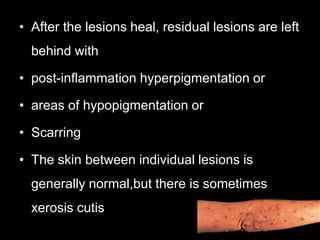
• After the lesions heal, residual lesions are left
behind with
• post-inflammation hyperpigmentation or
• areas of hypopigmentation or
• Scarring
• The skin between individual lesions is
generally normal,but there is sometimes
xerosis cutis
• The development of nodules first occurs
as a result of intense scratching.
• Typically there is an area of skin that is
unaffected which the patient cannot
reach, such as the middle of the back.
• This characteristic feature of prurigo
nodularis is referred to as the “butterfly
sign”
• significance of the mechanical trauma for
the development of lesions
• The development of areas of
keratosis, excoriation,and ulceration on
primary lesions is attributed to the constant
irritation caused by scratching
• “scratching” of a lesion produces only
temporary relief from pruritus, which quickly
starts again, leading to an “itch-scratch-
cycle”which causes the nodules to persist
and leads to secondary lesions
• Due to the simultaneous appearance of
recent and older lesions,patients usually
present with a
• Polymorphous appearance consisting of
recent
• nodules, excoriations
• crater-like ulcerations
• residual lesions such as hypopigmentation
or hyperpigmentation as well as scarring.
Histopathology
• Marked hyperkeratosis
• focal parakeratosis
• irregular acanthosis
• appearance of pseudocarcinomatous
or pseudoepitheliomatous hyperplasia
• arises from papillomatosis and an irregular,
• downward proliferation of epidermis and
epithelia of adnexal structures
• In the papillary dermis
• increased amounts of multinucleated fibroblasts as
well as thick collagen fiber bundles arranged
perpendicularly to the surface.
• Proliferation of nerve fibers and Schwann cells may be
observed.
• dilated, vertically-oriented capillaries.
• At the surface, around vessels and in interstitial
spaces dense infiltrate of lymphocytes, isolated
eosinophilic granulocytes,mast cells, macrophages,
• More no of Eosinophilic granulocytes with
degranulation in atopic diathesis.
• If there are erosions or
excoriations, crusting around the margin
with exudation
• It shows parakeratosis , plasma cells and
neutrophils
• gross accentuation of
the changes of
lichenifi cation.
• The epidermal
downgrowth is
pseudoepitheliomatou
s in extent.
• mixed inflammatory
cell infi ltrate in the
dermis
• sclerosis of the
dermal collagen
Differential Diagnosis
• antipruritic measures should be
undertaken to eliminate pruritus
• cutting the fingernails and
• wearing cotton gloves
• instruments such as brushes are used to
combat the itching.
• Topical corticosteroids
• mometasone furoate or
methylprednisolone aceponate
• application of topical corticosteroids
should be under occlusion
• Intralesional application of corticosteroids :
triamcinolone acetonide suspension 10-40
mg/ml
• Calcineurin inhibitors :
• topical tacrolimus
• antipruritic effect of calcineurin inhibitors
can possibly be explained by their anti-
inflammatory effect and direct effect on
nerve fibers
• Vitamin D3 analogues : topical therapy
calcipotriol, tacalcitol
• Menthol and polidocanol :
• menthol (0.5-2%)
• urea (2-10%)
• polidocanol (3-5%)
• Capsaicin : Topical capsaicin acts by
desensitizing sensory nerve fibers and
interrupting transmission of cutaneous
pruritus
• gradually increasing doses (0.025% -
0.05% - 0.075% - 0.1%).
• In prurigo nodularis, concentrations of up
to 0.3% may be necessary
• Cannabinoid agonists:
• Topical use of the cannabinoid agonists N-
palmitoylethanolamine (PEA)
• Phototherapy : broadband UVB, narrow
band UVB, narrow band UVB in
combination with thalidomide,UVA-1
phototherapy,bath PUVA
• induction of anti-inflammatory and
immunosuppressive factors as well as
antiproliferative effects
• UVB-induced apoptosis of mast cells
Systemic antipruritic therapies
• Antihistamines
• Cyclosporine : inhibits the function of
lymphocytes as well as mast cells
• Anticonvulsant agents : gabapentin also
has an antipruritic effect
• Antidepressants :
mirtazapine, paroxetine, ondansetron,
• Opioid receptor antagonist: Naltrexone
• Thalidomide:dosage between 100 mg/day
and a maximum of 400 mg/day
• Roxithromycin with tranilast: roxithromycin
at a dosage of 300 mg/day with tranilast
(N-(3,4-dimethoxycinnamoyl)) in a dosage
of
200 mg/day in patients with prurigo
nodularis
• Cryosurgery: use of liquid
nitrogen, depending on their size, vary from
10-30 seconds with two to four “freeze-thaw
cycles.”
• It can take up to four weeks until the treated
nodules heal.
• Residual scarring can occur.
• After cryosurgery, patients can be pruritus-
free for up to three months,
• Combination therapy with
cryosurgery, intralesional triamcinolone
acetonide 40 mg/ml
Parthenium dermatitis manifesting clinically
as polymorphic light eruption and prurigo
nodularis-
LATE ONSET NODULAR
PRURIGO – THE SOLE AND INITIAL
MANIFESTATION OF OCCULT
HODGKIN’S DISEASE

Prurigo

  • 1.
  • 2.
    • Group ofskin diseases characterized by intensely pruritic papules or nodules. • Some authors have stressed the intense pruritus • visible excoriations • No identifiable local cause for the scratched lesions.
  • 3.
    • chronic inflammatoryskin disorder characterized by severe pruritus and papules and nodules with excoriations and ulcerations due to scratching.
  • 4.
    • Prurigo isderived from the Latin and means “itch”, which simply refers to the common feature shared by all pruriginous diseases, a sometimes intractable pruritus. • The term was originally introduced by Hebra • He denote papules induced by scratching.
  • 5.
    Pruriginous dermatoses • Nodularprurigo • chronic prurigo • prurigo pigmentosa • prurigo of pregnancy • actinic prurigo.
  • 6.
    • Acute Prurigo:Urticarialerythema or wheals appear and become exudative papules, usually in small children k/a Strophulus infantum • Subacute prurigo: urticarial papule accompanied by intense itching occurs on extensor surface of the extremities or the trunk.when it is rubbed and scratched, erosion or crust forms
  • 7.
    • Chronic prurigo:prurigo chronica multiformis,with aggregated individual papules that tend to form a lichenoid l e s i o n ; • prurigo nodularis, with large nodular p a pu les tha t f orm s pars ely a n d
  • 8.
    Prurigo chronica multiformis: •trunk and legs of the elderly • Exudative or solid papules aggregate to form invasive plaques. The lesions are rubbed as a result of intense itching, and exudate and crusts form to present intermingled pruritic papules and lichenoid lesions. • often chronic, with recurrences and
  • 9.
    Nodular prurigo • Nodularprurigo is characterized clinically by chronic, intensely itchy nodules and histologically by marked hyperkeratosis and acanthosis, with downward projections of the epidermis.
  • 10.
    • history ofatopic dermatitis • Aetiology : unknown, Hyde is credited with being the first describe • Hyde’s prurigo, prurigo simplex chronica, and lichen obtusus corneus
  • 11.
    • Woman >man • No genetic factos • Some authors suggested with atopic eczemaearly-onset atopic Late-onset atopic •Close a/w atopic D •Initial manifeatation at 19 •a/w environmental allergens • Initial manifestation at 48 years •No h/o atopic D •No a/w allergens
  • 12.
    Etiopathogenesis • severe chronicpruritus leads to repetitive mechanical trauma as a result of scratching, and • chronic skin irritation then leads to a characteristic tissue reaction • marked by recruitment of a lymphocyte-rich inflammatory infiltrate, • activation of epidermal keratinocytes, • a circumscribed increase in collagen tissue, and • activation & proliferation of peripheral sensory
  • 15.
    • Leukocyte recruitmentand activation :after mechanical trauma primary pro-inflammatory cytokines such as interleukin(IL)-1 and tumor necrosis factor alpha (TNF-α) induce chemokine cascades in keratinocytes • Recruitment of Lymphocytes, eosinophils, and mast cells
  • 16.
    • Keratinocyte andfibroblast activation: acanthosis, parakeratosis,and hyperkeratosis of the epidermis • Thes changes are due to the chronic stimulation of keratinocytes by scratching
  • 17.
    • Activation ofsensory neurons:marked hyperplasia of peripheral cutaneous nerves • peripheral nerves in prurigo nodularis lesions have increased amounts of nerve growth factor (NGF)-receptor p75. • produce high levels of NGF, calcitonin gene related peptide and substance P
  • 18.
    • A furtherstudy has shown that the vanilloid receptor, subtype 1 (VR1/TRPV1), an ion channel, binds to capsaicin, • found in much higher levels on cutaneous nerves in lesional skin in prurigo nodularis patients
  • 19.
    • These resultsshow that activation and proliferation of cutaneous nerves in patients with prurigo nodularis are associated with increased production of • the neuropeptides • CGRP and • substance P possibly intensifying the pruritus via neurogenic inflammatory pathways.
  • 21.
    CLINICAL FEATURES • massive,and sometimes excruciating pruritus • extensor aspects of the extremities, the shoulders,and the chest and sacral regions • The face, palms of the hands, and plantar surfaces of the feet are usually not affected • No involvement of the mucous membranes
  • 23.
    • sharply demarcated,tough,mildly erythematous nodule • patients often scratch intensely leading to gray or purple and sometimes verruciform keratotic areas, excoriations, crater-like ulcerations, and hemorrhagic crusts
  • 24.
    • After thelesions heal, residual lesions are left behind with • post-inflammation hyperpigmentation or • areas of hypopigmentation or • Scarring • The skin between individual lesions is generally normal,but there is sometimes xerosis cutis
  • 25.
    • The developmentof nodules first occurs as a result of intense scratching. • Typically there is an area of skin that is unaffected which the patient cannot reach, such as the middle of the back. • This characteristic feature of prurigo nodularis is referred to as the “butterfly sign” • significance of the mechanical trauma for the development of lesions
  • 27.
    • The developmentof areas of keratosis, excoriation,and ulceration on primary lesions is attributed to the constant irritation caused by scratching • “scratching” of a lesion produces only temporary relief from pruritus, which quickly starts again, leading to an “itch-scratch- cycle”which causes the nodules to persist and leads to secondary lesions
  • 28.
    • Due tothe simultaneous appearance of recent and older lesions,patients usually present with a • Polymorphous appearance consisting of recent • nodules, excoriations • crater-like ulcerations • residual lesions such as hypopigmentation or hyperpigmentation as well as scarring.
  • 29.
    Histopathology • Marked hyperkeratosis •focal parakeratosis • irregular acanthosis • appearance of pseudocarcinomatous or pseudoepitheliomatous hyperplasia • arises from papillomatosis and an irregular, • downward proliferation of epidermis and epithelia of adnexal structures
  • 30.
    • In thepapillary dermis • increased amounts of multinucleated fibroblasts as well as thick collagen fiber bundles arranged perpendicularly to the surface. • Proliferation of nerve fibers and Schwann cells may be observed. • dilated, vertically-oriented capillaries. • At the surface, around vessels and in interstitial spaces dense infiltrate of lymphocytes, isolated eosinophilic granulocytes,mast cells, macrophages,
  • 31.
    • More noof Eosinophilic granulocytes with degranulation in atopic diathesis. • If there are erosions or excoriations, crusting around the margin with exudation • It shows parakeratosis , plasma cells and neutrophils
  • 32.
    • gross accentuationof the changes of lichenifi cation. • The epidermal downgrowth is pseudoepitheliomatou s in extent. • mixed inflammatory cell infi ltrate in the dermis • sclerosis of the dermal collagen
  • 35.
  • 36.
    • antipruritic measuresshould be undertaken to eliminate pruritus • cutting the fingernails and • wearing cotton gloves • instruments such as brushes are used to combat the itching.
  • 37.
    • Topical corticosteroids •mometasone furoate or methylprednisolone aceponate • application of topical corticosteroids should be under occlusion • Intralesional application of corticosteroids : triamcinolone acetonide suspension 10-40 mg/ml
  • 38.
    • Calcineurin inhibitors: • topical tacrolimus • antipruritic effect of calcineurin inhibitors can possibly be explained by their anti- inflammatory effect and direct effect on nerve fibers
  • 39.
    • Vitamin D3analogues : topical therapy calcipotriol, tacalcitol
  • 40.
    • Menthol andpolidocanol : • menthol (0.5-2%) • urea (2-10%) • polidocanol (3-5%)
  • 41.
    • Capsaicin :Topical capsaicin acts by desensitizing sensory nerve fibers and interrupting transmission of cutaneous pruritus • gradually increasing doses (0.025% - 0.05% - 0.075% - 0.1%). • In prurigo nodularis, concentrations of up to 0.3% may be necessary
  • 42.
    • Cannabinoid agonists: •Topical use of the cannabinoid agonists N- palmitoylethanolamine (PEA)
  • 43.
    • Phototherapy :broadband UVB, narrow band UVB, narrow band UVB in combination with thalidomide,UVA-1 phototherapy,bath PUVA • induction of anti-inflammatory and immunosuppressive factors as well as antiproliferative effects • UVB-induced apoptosis of mast cells
  • 44.
    Systemic antipruritic therapies •Antihistamines • Cyclosporine : inhibits the function of lymphocytes as well as mast cells • Anticonvulsant agents : gabapentin also has an antipruritic effect • Antidepressants : mirtazapine, paroxetine, ondansetron, • Opioid receptor antagonist: Naltrexone
  • 45.
    • Thalidomide:dosage between100 mg/day and a maximum of 400 mg/day • Roxithromycin with tranilast: roxithromycin at a dosage of 300 mg/day with tranilast (N-(3,4-dimethoxycinnamoyl)) in a dosage of 200 mg/day in patients with prurigo nodularis
  • 46.
    • Cryosurgery: useof liquid nitrogen, depending on their size, vary from 10-30 seconds with two to four “freeze-thaw cycles.” • It can take up to four weeks until the treated nodules heal. • Residual scarring can occur. • After cryosurgery, patients can be pruritus- free for up to three months, • Combination therapy with cryosurgery, intralesional triamcinolone acetonide 40 mg/ml
  • 48.
    Parthenium dermatitis manifestingclinically as polymorphic light eruption and prurigo nodularis-
  • 49.
    LATE ONSET NODULAR PRURIGO– THE SOLE AND INITIAL MANIFESTATION OF OCCULT HODGKIN’S DISEASE