Dr Yugandar
 The word ichthyosis comes from the Greek word for a
fish.
 ichthyosis : is a group of disorders that are characterized
by a persistent, non-inflammatory scaling disorder of the
skin surface.
 It is caused by abnormality in keratinization and
exfoliation of the horny cell layer.
 The ichthyoses are a clinically and genetically
heterogeneous group of skin disorders,
characterized by a diffuse, generally uniform and persistent
pattern of scaling without mucosal or extracutaneous
(except in ichthyosiform syndromes) involvement.
 Cutaneous features can be isolated (non syndromic ichthyosis),
or associated with extra-cutaneous (syndromic ichthyosis)
Types of Non syndromic ichthyosis
Congenital ichthyosis
Ichthyosis vulgaris
X-linked ichthyosis
Bullous congenital ichthyosiform erythroderma (BCIE)
Nonbullous congenital ichthyosiform erythroderma (NBCIE)
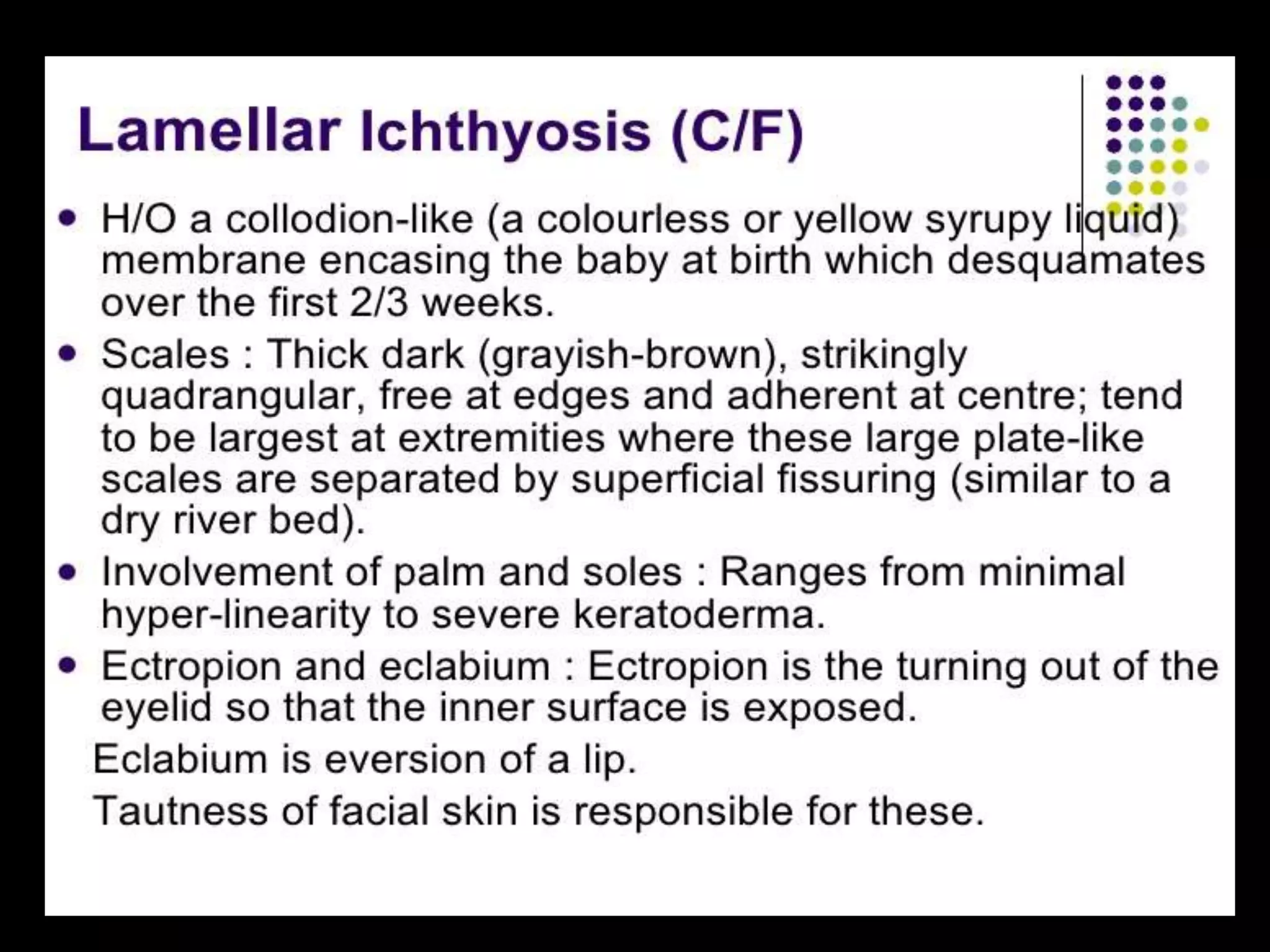
Lamellar ichthyosis
Acquired ichthyosis
Acquired ichthyosis
Types of syndromic ichthyosis
Sjögren-Larsson syndrome
Netherton syndrome
KID syndrome
Refsum syndrome
Rud syndrome
Congenital ichthyosis
Ichthyosis vulgaris
X-linked ichthyosis
Bullous congenital ichthyosiform erythroderma (BCIE)
Nonbullous congenital ichthyosiform erythroderma (NBCIE)
Lamellar ichthyosis
 It is the common inherited disorder.
 inheritance is autosomal dominant
Etiology :
 caused by mutation in the gene coding for
filaggrin, a key protein involved in skin barrier
function.
 Decreased convesrion of Profilaggrin to
Filaggrin.
Pathogenesis :
 decrease in the production of filaggrin,defective aggregation of
Keratin intermediate filaments,
 abnormal exfoliation and dryness and scaling
 Keratohyalin synthesis is affected because of the filaggrin
mutation.
 Filaggrin is an epidermal protein that normally functions as a
barrier molecule against environmental allergens, water loss,
and infection
Pathology :
There is thickening of the horny cell layer
reduction or loss of granular cell layer.
Histopathology:
 Mild hyperkeratosis
 diminished or absent granular layer in the epidermis.
 The dermis is normal.
 Electron microscopy reveals scanty and fragmented
keratohyaline granules in granular layer cells
 Diminished or absent
granular layer
 Absent of filaggrin with
immunostaining
 Age of Onset :
early 3 – 12 months of age
Clinical features :
 This is the mildest form of ichthyosis.
 main symptoms are dryness and scaling of the skin (fine
scale).
 Present, mostly on the extensor surfaces of extremities and
trunk.
 back > abdomen ,extensor surface > flexor surface
 Scaling is most prominent over the trunk, abdomen, buttocks
and legs.
 The flexural areas, such as the antecubital fossa, are spared.
 The symptoms subside during the summer and aggravate
during the winter
 scaling may be present on the eyelid skin,punctate
epithelial keratitis and recurrent corneal erosion
 Linkage analysis has identified an ichthyosis vulgaris
locus on band 1q22
 An association may be present between ichthyosis vulgaris
and atopic diseases
 Mutations in the coding of the filaggrin gene have been
identified in both ichthyosis vulgaris and atopic dermatitis.
 Treatment : symptomatic treatement
 Its uncommon type
 Etiology : It is caused by loss or marked reduction of steroid
sulfatase enzyme
 delayed exfoliation of the horny cell layer.
 inheritance : X-linked recessively inherited,male children
 Its k/a Ichthyosis nigra due to dark brown scales
Pathogenesis :
 the lack of steroid sulfatase causes accumulation of
cholesterol sulfate, leading to delayed exfoliation of horny
cells and hyperkeratosis
Histopathology :
 Thickening of the horny cell layer.
 normal or mildly thickened granular and suprabasal cell
layers.
 Compact
hyperkeratosis
 Accentuated granular
layer
Clinical features:
 ichthyosis manifests shortly after birth and does not improve
with age.
 The symptoms are severer than ichthyosis vulgaris,
 the scales are large and dark brown.
 The scalp also scaly.
 Eruptions also appear on the flexures of joints.
 The whole body of newborns may be encased in a translucent
covering (collodion baby) .
Scales : Large & DARK BROWN more
Prominent over flexural areas
Complication :
 Corneal opacification may occur.
 White opacities in slit lamp &
blue arc
D.D:
 ichthyosis vulgaris is differentiated from X-linked ichthyosis by
the decrease of steroid sulfatase in the case of the latter.
Treatment:
 symptomatic and the same as those for ichthyosis vulgaris
 The retinoids drugs may give good improvements, but the
side effects limit their use in infants and young children.
Etiology :
 Defect in Transglutaminase – 1 enzyme
 its a calcium-dependent enzyme that is necessary for the
formation of cornified cell envelopes in keratinocytes
Age of onset : begins usually at birth
Inheritance : as an autosomal recessive trait (AR).
K/a ARCI
 The transglutaminase 1 enzyme is involved in the
formation of the cornified cell envelope
 The formation of the cornified cell envelope is an essential
for normal intercellular lipid layer formation in the
stratum corneum.
 mutations cause defects in the intercellular lipid layers in
the stratum corneum, leading to defective barrier function
of the stratum corneum
6 genes for lamellar ichthyosis have been localized and 5 of them
 TGM1 (14q11)
 ABCA12 (2q34)
 19p12-q12
 19p13
 ALOXE3-ALOX12B (17p13)
 ichthyin (5q33)
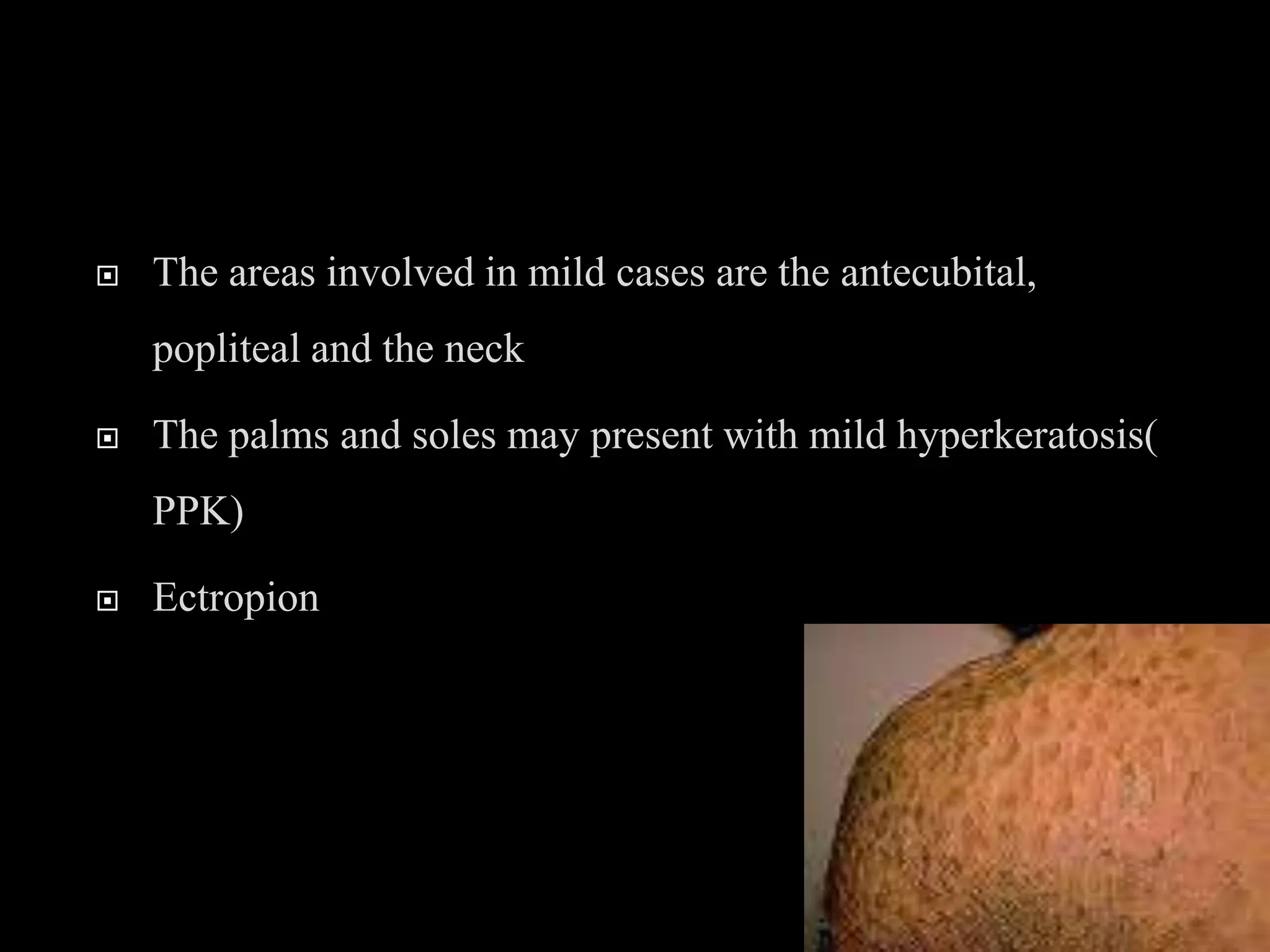
 The areas involved in mild cases are the antecubital,
popliteal and the neck
 The palms and soles may present with mild hyperkeratosis(
PPK)
 Ectropion
 Hyperkeratosis
,Hypergrannulosis
 Parakeratosis
 Prominent rete ridges
Mild perivascular
infiltrate in the upper
dermis and mitosis
 Skin biopsies can aid in the diagnosis of lamellar ichthyosis
and detection of transglutaminase-1 expression.
 At birth, electron microscopy can be used to differentiate a
severe collodion baby affected by lamellar ichthyosis from a
baby affected by harlequin ichthyosis by demonstrating the
absence of the marginal band
Bathing suit ichthyosis:
 unique clinical form of autosomal recessive congenital
ichthyosis
 characterized by marked scaling on the bathing suit
areas but sparing of the extremities and the central face.
 caused by transglutaminase-1 deficiency
 it is a temperature-sensitive phenotype
Shedding of membrane
Ichthyosiform
Erythroderms
 it is rare disorder
 autosomal dominantly inherited
 sometimes born as collodion babies
 Diffuse flushing and blistering recur for several weeks after
birth
 intermediate filament of suprabasal cells composed of keratin
1 and keratin 10.
 Because of mutation in the keratin 1 or keratin 10 gene
 abnormal keratin fiber formation & cytoskeleton distortion
 epidermal blistering occur, leading to secondary thickening
of the horny cell layer
 The horny and
suprabasal cell
layers thicken.
 Vacuolar
Degeneration of the
granular cell layer
 At birth child looks as Burned with widespread blisters &
erosions
 May have verrucous,dirty,firm, hyperkeratotic (hystrix)
spines over erythematous background often in flexural
creases
 blisters
 may have erythroderma
 palmar/plantar keratoderma
 Frequent skin infections
 characteristic pungent odor due to super infection
by mixed flora
D.D :
 epidermolysis bullosa
 incontinentia pigmenti
 impetigo contagiosa
 Treatment : oral retinoid and application of
moisturizer
 It is rare autosomal recessively inherited
 Most of the patients are born as collodion babies.
 The affected sites include the flexures of joints.
 Defects in enzymes Trans glutaminase ,Two
Lipoxygenases
 Six or more genes are thought to be associated with
occurrence of NBCIE.
 the mechanism of NBCIE is known to be a
marked decrease in physical and functional
strength of keratin
 Born as Collodion babes
 Covered by fine white scales, 2-3 days after birth, the
collodion covering exfoliates,
leaving the whole body surface
with diffuse flushing and scaling
 Scarring alopecia,short stature,
 Cardiac anomolies
 Erythroderma,
 ectropion
 NBCIE progresses until the age of 10,at which point it stops
and subsides.
 Oral retinoid (a vitamin A derivative) is effective.
 The skin should be kept clean to prevent secondary infection.
 very rare condition
 autosomal recessively inherited
 There is abnormality of the lamellar granules in harlequin
ichthyosis
 Abnormalities of Profilaggrin & K 6,K16
 Ichthyosis Congenita Gravis
 In Italy,Comic
servants characters
from Italian
commedia dell’arte
 In french ,Black faced
emissary of devil
,chasing damned
souls of evil people to
hell
 Baby skin affected in Utero
 patient is covered with an extremely thick stratum corneum
at birth causing thick, horny, armor-like plates that cover the
entire skin surface.
 Cracks in the skin
 ectropion of eyelids
 eclabium,Ears absent
 difficulty of opening the mouth are so severe
that most patients die within 2 weeks after
birth,still birth
Abnormal Lamellar Bodies
Under EM
Neonate after retinoid theraphy after 6 months
Ultrasound findings:
 Head: cracked skin; open eyes, due to severe eversion of the
eyelids (ectropion); wide lips, (eclabium)
 Skin: thickened with multiple fissures
 Extremities: deformation, hypoplasia of fingers and toes
 3D ultrasound helps to make the diagnosis.
thickened, Harlequin lips cracked skin on the fetal face
Transverse view of the fetal abdomen on
the image shows a thickened skin
with a crack indicated by arrow.
the foot with hypoplastic toes,
Differential diagnosis
 Sjögren-Larsson syndrome
 Netherton syndrome
 Gaucher disease
 Keratitis-ichthyosis-deafness syndrome
 Trichothiodystrophy ("sulfur-deficient hair")
 Chanarin-Dorfman syndrome
 Conradi-Hünermann syndrome (X-linked dominant
chondrodysplasia punctata)
 Hypohidrotic ectodermal dysplasia
 Bullous autosomal dominant ichthyoses
 In congenital ichthyosis syndromes, excessive intra-amniotic
debris and polyhydramnios on ultrasonography scanning in
utero may be the first indication of disease
 Using USG in utero, fetal foot length may be an important &
first marker, seen in the second trimester, for the diagnosis of
harlequin ichthyosis
 Other findings may include a persistently open mouth, dense
amniotic fluid, and fixed flexion of the extremities.
 low maternal serum unconjugated estriol during pregnancy
screening may be a good indication of placental STS deficiency
and X-linked recessive ichthyosis
 Microdeletion of STS gene can be confirmed by fluorescence in
situ hybridization (FISH) analysis of cultured amniotic fluid in X-
linked ichthyosis
 Prenatal diagnosis of lamellar Ichthyosis can be made by direct
mutational analysis of the keratinocyte transglutaminase gene
Congenital ichthyosis

Congenital ichthyosis

  • 1.
  • 2.
     The wordichthyosis comes from the Greek word for a fish.  ichthyosis : is a group of disorders that are characterized by a persistent, non-inflammatory scaling disorder of the skin surface.  It is caused by abnormality in keratinization and exfoliation of the horny cell layer.
  • 3.
     The ichthyosesare a clinically and genetically heterogeneous group of skin disorders, characterized by a diffuse, generally uniform and persistent pattern of scaling without mucosal or extracutaneous (except in ichthyosiform syndromes) involvement.
  • 7.
     Cutaneous featurescan be isolated (non syndromic ichthyosis), or associated with extra-cutaneous (syndromic ichthyosis)
  • 8.
    Types of Nonsyndromic ichthyosis Congenital ichthyosis Ichthyosis vulgaris X-linked ichthyosis Bullous congenital ichthyosiform erythroderma (BCIE) Nonbullous congenital ichthyosiform erythroderma (NBCIE) Lamellar ichthyosis Acquired ichthyosis Acquired ichthyosis Types of syndromic ichthyosis Sjögren-Larsson syndrome Netherton syndrome KID syndrome Refsum syndrome Rud syndrome
  • 9.
    Congenital ichthyosis Ichthyosis vulgaris X-linkedichthyosis Bullous congenital ichthyosiform erythroderma (BCIE) Nonbullous congenital ichthyosiform erythroderma (NBCIE) Lamellar ichthyosis
  • 10.
     It isthe common inherited disorder.  inheritance is autosomal dominant Etiology :  caused by mutation in the gene coding for filaggrin, a key protein involved in skin barrier function.  Decreased convesrion of Profilaggrin to Filaggrin.
  • 11.
    Pathogenesis :  decreasein the production of filaggrin,defective aggregation of Keratin intermediate filaments,  abnormal exfoliation and dryness and scaling  Keratohyalin synthesis is affected because of the filaggrin mutation.  Filaggrin is an epidermal protein that normally functions as a barrier molecule against environmental allergens, water loss, and infection Pathology : There is thickening of the horny cell layer reduction or loss of granular cell layer.
  • 12.
    Histopathology:  Mild hyperkeratosis diminished or absent granular layer in the epidermis.  The dermis is normal.  Electron microscopy reveals scanty and fragmented keratohyaline granules in granular layer cells
  • 13.
     Diminished orabsent granular layer  Absent of filaggrin with immunostaining
  • 14.
     Age ofOnset : early 3 – 12 months of age Clinical features :  This is the mildest form of ichthyosis.  main symptoms are dryness and scaling of the skin (fine scale).  Present, mostly on the extensor surfaces of extremities and trunk.  back > abdomen ,extensor surface > flexor surface
  • 15.
     Scaling ismost prominent over the trunk, abdomen, buttocks and legs.  The flexural areas, such as the antecubital fossa, are spared.
  • 16.
     The symptomssubside during the summer and aggravate during the winter  scaling may be present on the eyelid skin,punctate epithelial keratitis and recurrent corneal erosion  Linkage analysis has identified an ichthyosis vulgaris locus on band 1q22
  • 17.
     An associationmay be present between ichthyosis vulgaris and atopic diseases  Mutations in the coding of the filaggrin gene have been identified in both ichthyosis vulgaris and atopic dermatitis.  Treatment : symptomatic treatement
  • 20.
     Its uncommontype  Etiology : It is caused by loss or marked reduction of steroid sulfatase enzyme  delayed exfoliation of the horny cell layer.  inheritance : X-linked recessively inherited,male children  Its k/a Ichthyosis nigra due to dark brown scales
  • 22.
    Pathogenesis :  thelack of steroid sulfatase causes accumulation of cholesterol sulfate, leading to delayed exfoliation of horny cells and hyperkeratosis Histopathology :  Thickening of the horny cell layer.  normal or mildly thickened granular and suprabasal cell layers.
  • 23.
  • 24.
    Clinical features:  ichthyosismanifests shortly after birth and does not improve with age.  The symptoms are severer than ichthyosis vulgaris,  the scales are large and dark brown.  The scalp also scaly.  Eruptions also appear on the flexures of joints.  The whole body of newborns may be encased in a translucent covering (collodion baby) .
  • 25.
    Scales : Large& DARK BROWN more Prominent over flexural areas
  • 26.
    Complication :  Cornealopacification may occur.  White opacities in slit lamp & blue arc D.D:  ichthyosis vulgaris is differentiated from X-linked ichthyosis by the decrease of steroid sulfatase in the case of the latter.
  • 28.
    Treatment:  symptomatic andthe same as those for ichthyosis vulgaris  The retinoids drugs may give good improvements, but the side effects limit their use in infants and young children.
  • 30.
    Etiology :  Defectin Transglutaminase – 1 enzyme  its a calcium-dependent enzyme that is necessary for the formation of cornified cell envelopes in keratinocytes Age of onset : begins usually at birth Inheritance : as an autosomal recessive trait (AR). K/a ARCI
  • 31.
     The transglutaminase1 enzyme is involved in the formation of the cornified cell envelope  The formation of the cornified cell envelope is an essential for normal intercellular lipid layer formation in the stratum corneum.  mutations cause defects in the intercellular lipid layers in the stratum corneum, leading to defective barrier function of the stratum corneum
  • 32.
    6 genes forlamellar ichthyosis have been localized and 5 of them  TGM1 (14q11)  ABCA12 (2q34)  19p12-q12  19p13  ALOXE3-ALOX12B (17p13)  ichthyin (5q33)
  • 35.
     The areasinvolved in mild cases are the antecubital, popliteal and the neck  The palms and soles may present with mild hyperkeratosis( PPK)  Ectropion
  • 40.
     Hyperkeratosis ,Hypergrannulosis  Parakeratosis Prominent rete ridges Mild perivascular infiltrate in the upper dermis and mitosis
  • 41.
     Skin biopsiescan aid in the diagnosis of lamellar ichthyosis and detection of transglutaminase-1 expression.  At birth, electron microscopy can be used to differentiate a severe collodion baby affected by lamellar ichthyosis from a baby affected by harlequin ichthyosis by demonstrating the absence of the marginal band
  • 42.
    Bathing suit ichthyosis: unique clinical form of autosomal recessive congenital ichthyosis  characterized by marked scaling on the bathing suit areas but sparing of the extremities and the central face.  caused by transglutaminase-1 deficiency  it is a temperature-sensitive phenotype
  • 45.
  • 46.
     it israre disorder  autosomal dominantly inherited  sometimes born as collodion babies  Diffuse flushing and blistering recur for several weeks after birth
  • 47.
     intermediate filamentof suprabasal cells composed of keratin 1 and keratin 10.  Because of mutation in the keratin 1 or keratin 10 gene  abnormal keratin fiber formation & cytoskeleton distortion  epidermal blistering occur, leading to secondary thickening of the horny cell layer
  • 48.
     The hornyand suprabasal cell layers thicken.  Vacuolar Degeneration of the granular cell layer
  • 49.
     At birthchild looks as Burned with widespread blisters & erosions  May have verrucous,dirty,firm, hyperkeratotic (hystrix) spines over erythematous background often in flexural creases  blisters
  • 50.
     may haveerythroderma  palmar/plantar keratoderma  Frequent skin infections  characteristic pungent odor due to super infection by mixed flora
  • 51.
    D.D :  epidermolysisbullosa  incontinentia pigmenti  impetigo contagiosa  Treatment : oral retinoid and application of moisturizer
  • 52.
     It israre autosomal recessively inherited  Most of the patients are born as collodion babies.  The affected sites include the flexures of joints.  Defects in enzymes Trans glutaminase ,Two Lipoxygenases
  • 53.
     Six ormore genes are thought to be associated with occurrence of NBCIE.  the mechanism of NBCIE is known to be a marked decrease in physical and functional strength of keratin
  • 54.
     Born asCollodion babes  Covered by fine white scales, 2-3 days after birth, the collodion covering exfoliates, leaving the whole body surface with diffuse flushing and scaling
  • 55.
     Scarring alopecia,shortstature,  Cardiac anomolies  Erythroderma,  ectropion
  • 56.
     NBCIE progressesuntil the age of 10,at which point it stops and subsides.  Oral retinoid (a vitamin A derivative) is effective.  The skin should be kept clean to prevent secondary infection.
  • 57.
     very rarecondition  autosomal recessively inherited  There is abnormality of the lamellar granules in harlequin ichthyosis  Abnormalities of Profilaggrin & K 6,K16  Ichthyosis Congenita Gravis
  • 58.
     In Italy,Comic servantscharacters from Italian commedia dell’arte  In french ,Black faced emissary of devil ,chasing damned souls of evil people to hell
  • 59.
     Baby skinaffected in Utero  patient is covered with an extremely thick stratum corneum at birth causing thick, horny, armor-like plates that cover the entire skin surface.  Cracks in the skin  ectropion of eyelids  eclabium,Ears absent
  • 60.
     difficulty ofopening the mouth are so severe that most patients die within 2 weeks after birth,still birth Abnormal Lamellar Bodies Under EM
  • 62.
    Neonate after retinoidtheraphy after 6 months
  • 63.
    Ultrasound findings:  Head:cracked skin; open eyes, due to severe eversion of the eyelids (ectropion); wide lips, (eclabium)  Skin: thickened with multiple fissures  Extremities: deformation, hypoplasia of fingers and toes  3D ultrasound helps to make the diagnosis.
  • 64.
    thickened, Harlequin lipscracked skin on the fetal face
  • 65.
    Transverse view ofthe fetal abdomen on the image shows a thickened skin with a crack indicated by arrow. the foot with hypoplastic toes,
  • 66.
    Differential diagnosis  Sjögren-Larssonsyndrome  Netherton syndrome  Gaucher disease  Keratitis-ichthyosis-deafness syndrome  Trichothiodystrophy ("sulfur-deficient hair")  Chanarin-Dorfman syndrome  Conradi-Hünermann syndrome (X-linked dominant chondrodysplasia punctata)  Hypohidrotic ectodermal dysplasia  Bullous autosomal dominant ichthyoses
  • 71.
     In congenitalichthyosis syndromes, excessive intra-amniotic debris and polyhydramnios on ultrasonography scanning in utero may be the first indication of disease  Using USG in utero, fetal foot length may be an important & first marker, seen in the second trimester, for the diagnosis of harlequin ichthyosis  Other findings may include a persistently open mouth, dense amniotic fluid, and fixed flexion of the extremities.
  • 72.
     low maternalserum unconjugated estriol during pregnancy screening may be a good indication of placental STS deficiency and X-linked recessive ichthyosis  Microdeletion of STS gene can be confirmed by fluorescence in situ hybridization (FISH) analysis of cultured amniotic fluid in X- linked ichthyosis  Prenatal diagnosis of lamellar Ichthyosis can be made by direct mutational analysis of the keratinocyte transglutaminase gene