Eczema
Presented To
Department of Dermatology
Presented By
Dr.Muhammad Ilyas
LEARNING OBJECT
• Definition of Eczema
• Histology
• Classification
• Clinical manifestation
. Differential Diagnosis
• Complication
• Investigation
• Treatment
Definition of Eczema
It is a Distinctive reaction of the epidermis to a variety of agents,
both endogenous and exogenous , characterized clinically by
eruption of itchy, erythematous papules and vesicles leading to
weeping and/or lichenification, and histological evidence of
spongiosis.
.All eczema is dermatitis not all dermatitis is eczema
HISTOLOGY
• In the acute stage, oedema in the epidermis (spongiosis) progresses
to the formation of intraepidermal vesicles, which may coalesce
into larger blisters or rupture.
• The chronic stages of eczema show less spongiosis and vesication
but more thickening of the prickle cell layer (acanthosis) and horny
layers (hyperkeratosis and parakeratosis).
• variable degree of vasodilatation and infiltration with lymphocytes
THE SEQUENCE OF
HISTOLOGICAL
EVENTS IN ECZEMA
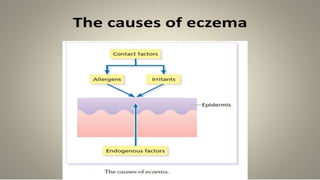
The causes of eczema
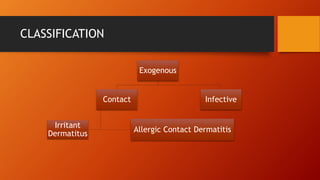
CLASSIFICATION
Exogenous
Contact
Allergic Contact Dermatitis
Irritant
Dermatitus
Infective
CLASSIFICATION
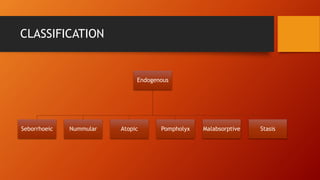
Endogenous
Seborrhoeic Nummular Atopic Pompholyx Malabsorptive Stasis
CLINICAL APPEARANCE
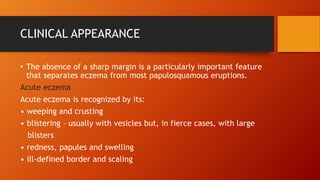
• The absence of a sharp margin is a particularly important feature
that separates eczema from most papulosquamous eruptions.
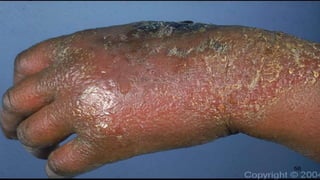
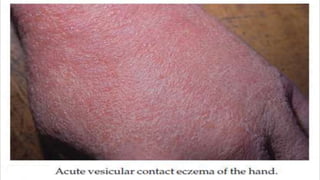
Acute eczema
Acute eczema is recognized by its:
• weeping and crusting
• blistering – usually with vesicles but, in fierce cases, with large
blisters
• redness, papules and swelling
• ill-defined border and scaling
Continue
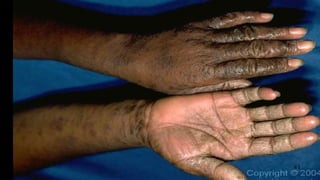
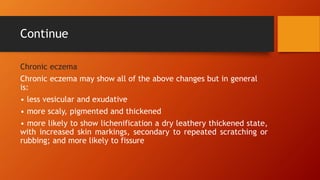
Chronic eczema
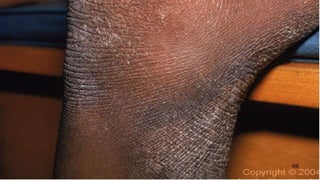
Chronic eczema may show all of the above changes but in general
is:
• less vesicular and exudative
• more scaly, pigmented and thickened
• more likely to show lichenification a dry leathery thickened state,
with increased skin markings, secondary to repeated scratching or
rubbing; and more likely to fissure
COMPLICATIONS
• Heavy bacterial colonization is common in all types of eczema ,
overt infection is most troublesome in the seborrhoeic, nummular
and atopic types.
• Local superimposed allergic reactions to medicaments can provoke
dissemination, especially in gravitational eczema.
• A huge effect on the quality of life.
• An itchy sleepless child can wreck family life.
• Eczema can interfere with work, sporting activities and sex lives.
Jobs can be lost through it
DIFFERENTIAL DIAGNOSIS
• Papulosquamous dermatoses, such as psoriasis or lichen planus, are
sharply defined and show no signs of epidermal disruption
• Always remember that eczemas are scaly, with poorly defined
margins.
• eczemas exhibit features of epidermal disruption such as weeping,
crust, excoriation, fissures and yellow scale (because of plasma
coating the scale).
INVESTIGATIONS
Exogenous eczema
Patch testing
to confirm allergic contact dermatitis and to identify the allergens
responsible for it
• In patch testing, standardized non-irritating concentrations of
common allergens are applied to the normal skin of the back. If the
patient is allergic to the allergen, eczema will develop at the site
of contact after 48–96 h.
• Patch testing with irritants is of no value in any type of eczema
CONTINUE
Photopatch testing
A chemical is applied to the skin for 24 h and then the site is
irradiated with a suberythemal dose of ultraviolet irradiation; the
patches are inspected for an eczematous reaction 48 h later.
Other types of eczema
• The only indication for patch testing here is when an added
contact allergic element is suspected. This is most common in
gravitational eczema
CONTINUE
• Prick testing in atopic eczema
• Total and specific IgE antibodies are measured by a radio
allergosorbent test RAST test as it carries no risk of anaphylaxis, is
easier to perform and is less time consuming
• Cultures for bacteria and Candida if the eczema is worsening
despite treatment, or if there is much crusting
ACUTE WEEPING ECZEMA TREATMENT
• rest and liquid applications
• Weeping eczema of the hands or feet is to use thrice daily 10-min soaks in a
cool 0.65% aluminium acetate solution saline or even tap water will do almost
as well
• Each soaking being followed by a smear of a corticosteroid cream or lotion and
the application of a non-stick dressing or cotton gloves
• One reason for dropping the dilute potassium permanganate solution that was
once so popular is because it stains the skin and nails brown
• Wider areas on the trunk respond well to corticosteroid creams and lotions or
traditional remedies such as calamine lotion, and the use of half-strength
magenta paint for the flexures are also effective
CONTINUE
Wet wrap dressings
• This is a labour-intensive but highly effective technique, of value in
the treatment of troublesome atopic eczema in children.
• After a bath, a corticosteroid is applied to the skin and then
covered with two layers of tubular dressing the inner layer already
soaked in warm water, the outer layer being applied dry and the
dressings can then be left in place for several hours
• • The evaporation of fluid from the bandages cools the skin and
provides rapid relief of itching
SUBACUTE ECZEMA TREATMENT
• Steroid lotions or creams are the mainstay of treatment
• bacitracin, fusidic acid,mupirocin or neomycin can be
incorporated into the application if an infective element is
present, but watch out for sensitization to neomycin, especially
when treating gravitational eczema
CHRONIC ECZEMA TREATMENT
• Calcineurin inhibitors such as tacrolimus and pimecrolimus work
well, although they lack the potency of strong topical
corticosteroids.
• Systemic antibiotics for bacterial superinfection or incorporation
of antibiotics (e.g. fusidic acid, mupirocin, neomycin or
chlortetracycline) or antiseptics (e.g. Vioform) into the steroid
formulation
• Salicylic acid (1–6% in emulsifying ointment) or stabilized urea
preparations for chronic localized hyperkeratotic eczema of the
palms or soles
CHRONIC ECZEMA TREATMENT
• Steroids in an ointment base, cause best responds, but is also
often helped by non-steroid applications such as ichthammol and
zinc cream or paste
• The strength of the steroid is important
• Nothing stronger than 0.5 or 1% hydrocortisone ointment should be
used on the face or in infancy.
• In adults one should be reluctant to prescribe more than 200g Per
week of a mildly potent steroid, 50 g/week of a moderately
potent or 30 g/week of a potent one for long periods
SYSTEMIC TREATMENT
• Short courses of systemic steroids may occasionally be justified in
extremely acute and severe eczema, particularly when the cause
is known and already eliminated (e.g. allergic contact dermatitis).
However, prolonged systemic steroid treatment should be avoided
in chronic cases, particularly in atopic eczema.
• Antihistamines may help at night.
• Systemic antibiotics may be needed in widespread bacterial
superinfection. Staphylococcus aureus routinely colonizes all
weeping eczemas, and most dry ones as well
ThankYou

Presentation eczema

  • 1.
    Eczema Presented To Department ofDermatology Presented By Dr.Muhammad Ilyas
  • 2.
    LEARNING OBJECT • Definitionof Eczema • Histology • Classification • Clinical manifestation . Differential Diagnosis • Complication • Investigation • Treatment
  • 3.
    Definition of Eczema Itis a Distinctive reaction of the epidermis to a variety of agents, both endogenous and exogenous , characterized clinically by eruption of itchy, erythematous papules and vesicles leading to weeping and/or lichenification, and histological evidence of spongiosis. .All eczema is dermatitis not all dermatitis is eczema
  • 7.
    HISTOLOGY • In theacute stage, oedema in the epidermis (spongiosis) progresses to the formation of intraepidermal vesicles, which may coalesce into larger blisters or rupture. • The chronic stages of eczema show less spongiosis and vesication but more thickening of the prickle cell layer (acanthosis) and horny layers (hyperkeratosis and parakeratosis). • variable degree of vasodilatation and infiltration with lymphocytes
  • 8.
  • 9.
  • 10.
  • 11.
  • 12.
    CLINICAL APPEARANCE • Theabsence of a sharp margin is a particularly important feature that separates eczema from most papulosquamous eruptions. Acute eczema Acute eczema is recognized by its: • weeping and crusting • blistering – usually with vesicles but, in fierce cases, with large blisters • redness, papules and swelling • ill-defined border and scaling
  • 13.
    Continue Chronic eczema Chronic eczemamay show all of the above changes but in general is: • less vesicular and exudative • more scaly, pigmented and thickened • more likely to show lichenification a dry leathery thickened state, with increased skin markings, secondary to repeated scratching or rubbing; and more likely to fissure
  • 15.
    COMPLICATIONS • Heavy bacterialcolonization is common in all types of eczema , overt infection is most troublesome in the seborrhoeic, nummular and atopic types. • Local superimposed allergic reactions to medicaments can provoke dissemination, especially in gravitational eczema. • A huge effect on the quality of life. • An itchy sleepless child can wreck family life. • Eczema can interfere with work, sporting activities and sex lives. Jobs can be lost through it
  • 16.
    DIFFERENTIAL DIAGNOSIS • Papulosquamousdermatoses, such as psoriasis or lichen planus, are sharply defined and show no signs of epidermal disruption • Always remember that eczemas are scaly, with poorly defined margins. • eczemas exhibit features of epidermal disruption such as weeping, crust, excoriation, fissures and yellow scale (because of plasma coating the scale).
  • 17.
    INVESTIGATIONS Exogenous eczema Patch testing toconfirm allergic contact dermatitis and to identify the allergens responsible for it • In patch testing, standardized non-irritating concentrations of common allergens are applied to the normal skin of the back. If the patient is allergic to the allergen, eczema will develop at the site of contact after 48–96 h. • Patch testing with irritants is of no value in any type of eczema
  • 18.
    CONTINUE Photopatch testing A chemicalis applied to the skin for 24 h and then the site is irradiated with a suberythemal dose of ultraviolet irradiation; the patches are inspected for an eczematous reaction 48 h later. Other types of eczema • The only indication for patch testing here is when an added contact allergic element is suspected. This is most common in gravitational eczema
  • 19.
    CONTINUE • Prick testingin atopic eczema • Total and specific IgE antibodies are measured by a radio allergosorbent test RAST test as it carries no risk of anaphylaxis, is easier to perform and is less time consuming • Cultures for bacteria and Candida if the eczema is worsening despite treatment, or if there is much crusting
  • 20.
    ACUTE WEEPING ECZEMATREATMENT • rest and liquid applications • Weeping eczema of the hands or feet is to use thrice daily 10-min soaks in a cool 0.65% aluminium acetate solution saline or even tap water will do almost as well • Each soaking being followed by a smear of a corticosteroid cream or lotion and the application of a non-stick dressing or cotton gloves • One reason for dropping the dilute potassium permanganate solution that was once so popular is because it stains the skin and nails brown • Wider areas on the trunk respond well to corticosteroid creams and lotions or traditional remedies such as calamine lotion, and the use of half-strength magenta paint for the flexures are also effective
  • 21.
    CONTINUE Wet wrap dressings •This is a labour-intensive but highly effective technique, of value in the treatment of troublesome atopic eczema in children. • After a bath, a corticosteroid is applied to the skin and then covered with two layers of tubular dressing the inner layer already soaked in warm water, the outer layer being applied dry and the dressings can then be left in place for several hours • • The evaporation of fluid from the bandages cools the skin and provides rapid relief of itching
  • 22.
    SUBACUTE ECZEMA TREATMENT •Steroid lotions or creams are the mainstay of treatment • bacitracin, fusidic acid,mupirocin or neomycin can be incorporated into the application if an infective element is present, but watch out for sensitization to neomycin, especially when treating gravitational eczema
  • 23.
    CHRONIC ECZEMA TREATMENT •Calcineurin inhibitors such as tacrolimus and pimecrolimus work well, although they lack the potency of strong topical corticosteroids. • Systemic antibiotics for bacterial superinfection or incorporation of antibiotics (e.g. fusidic acid, mupirocin, neomycin or chlortetracycline) or antiseptics (e.g. Vioform) into the steroid formulation • Salicylic acid (1–6% in emulsifying ointment) or stabilized urea preparations for chronic localized hyperkeratotic eczema of the palms or soles
  • 24.
    CHRONIC ECZEMA TREATMENT •Steroids in an ointment base, cause best responds, but is also often helped by non-steroid applications such as ichthammol and zinc cream or paste • The strength of the steroid is important • Nothing stronger than 0.5 or 1% hydrocortisone ointment should be used on the face or in infancy. • In adults one should be reluctant to prescribe more than 200g Per week of a mildly potent steroid, 50 g/week of a moderately potent or 30 g/week of a potent one for long periods
  • 25.
    SYSTEMIC TREATMENT • Shortcourses of systemic steroids may occasionally be justified in extremely acute and severe eczema, particularly when the cause is known and already eliminated (e.g. allergic contact dermatitis). However, prolonged systemic steroid treatment should be avoided in chronic cases, particularly in atopic eczema. • Antihistamines may help at night. • Systemic antibiotics may be needed in widespread bacterial superinfection. Staphylococcus aureus routinely colonizes all weeping eczemas, and most dry ones as well
  • 26.