GENU VULGUM
BY : DR ASAD ALI
ORTHOPAEDIC SURGEON
A 24 Yr old female presented to orthopedic OPD with
Bilateral Genu Vulgum more on Rt (25°) most
probably secondary to metabolic issues. There is
2cm shortening and 4cm wasting of quadriceps
muscles.
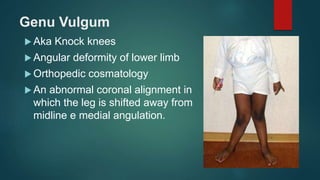
Genu Vulgum
 Aka Knock knees
 Angular deformity of lower limb
 Orthopedic cosmatology
 An abnormal coronal alignment in
which the leg is shifted away from
midline e medial angulation.
 In a normal person standing e heels/knees touching
each other, ASIS- centre of patella- centre of malleoli
and 2nd toe/web are in a straight line.
 Deviation of this line to inside of knees is VARUS
while outside is VARUS
 Upto 1 cm seperation allowed for soft tissues in
obese persons.
CAUSES
UNILATERAL
 PHYSEAL INJURY
 Trauma
 Infection (OM)
 Vascular
 PROX TIBIAL METAPHYSEAL
INJURY
 BENIGN TUMORS
 Fibrous Dysplasia
 Osteochondroma
 Olliers disease
 LATERAL LIGAMENT LAXITY
 Idiopathic
BILATERAL
 PHYSIOLOGICAL
 Vit. D Def RICKETS
 RENAL OSTEODYSTROPHY
 SKELETAL DYSPLASIAS
 Chondroctodermal Dysplasia
 SYNDROMES
 Morqio syndrome (MPS IV)
 Psuedoachondoplasia
 CP
 OI
 PAGETS DISEASE
PHYSIOLOGIC MALALIGNMENT
 Child is born Physiologically e Genu Varum which is corrected
upto 2 yrs of age.
 Persistance of Tight Post capsule of Hip (Ext Rotation) and
internal tibial torsion leads to overcorrection upto 2-3 yrs of
age
 Typically, developing children aged 3 to 4 years have up to 20°
of genu valgum.
 This physiologic vulgus should correct to adult level by 7 yr of
age.
 In females sometimes keep correcting upto 16 yrs
 After age 7 years, valgus should not exceed 12° with an
intermalleolar distance <8 cm.
 Pathoanatomy
 The deformity is usually in the distal femur but may also
arise in the proximal tibia.
 The degree of deformity necessary to lead to
degenerative changes in the knee is not known.
 Varus should be PATHOLOGICAL after 2-3 yr and Vulgus
after 11 yrs of age
Evaluation of patient : History
 Detailed History
 Birth history
 Family history
 Developmental milestones
 Nutritional history
 Previous percentile for height &
weight
 Family history
Evaluation of Patient : Exam
 Height & weight
 Percentile for age
 Shortening of extremity relative to trunk
 Appearance of lower limb during standing and gait
 Location of deformity
 Distance between medial femoral condyle [less than 6 cm]
 Distance between medial maleolus [less than 8 cm]
Evaluation of Patient : Exam
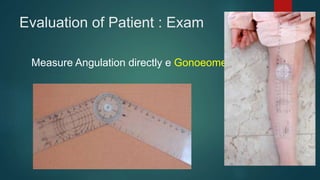
Measure Angulation directly e Gonoeometer
Evaluation of Patient : Exam
 Range Of Movemts (hip, knee,
ankle)
 Ligamentous laxity
 Rotational profile
 Compare with the normal limb
 Examination of the spine
Work Up
 RADIOLOGICAL
AP and Lateral Views of both lower limbs fully including
Femur abd Tibia in standing position
 Scannogram
 Computed Scannogram
 Metabolic Profile…. S. Ca++, P, ALP, Vit D level etc
 RFTs….. For ROD
Why Xrays ??
Confirmation of Dx
Site of disease
Degree of Disease
Associated diseases and assesment of physes
Signs of Rickets
MAL ALIGNMENT TESTS
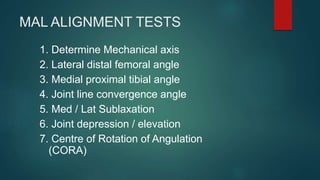
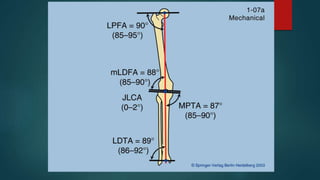
1. Determine Mechanical axis
2. Lateral distal femoral angle
3. Medial proximal tibial angle
4. Joint line convergence angle
5. Med / Lat Sublaxation
6. Joint depression / elevation
7. Centre of Rotation of Angulation
(CORA)
Signs of Rickets
 Refraction of Provisional zone of
calcification
 Irregularly frayed and Cupping
Metaphyses
 Deepened physis
 Thinning of cortex
 In healing Rickets … Zones of Provisional
calcification denser than diaphysis
How to Confirm location if Xrays Not
clear ??
Measure Centre of Rotation of Angulation (CORA)
This reveals
 Site apex of deformity… Femoral/ Tibial/ meataphyseal
 Magnitude
 Planning guide
 Addiotional deformities… bowing/ torsional deformities
TREATMENT
?
CONSERVATIVE Vs OPERATIVE
This depends upon
 Age
 Magnitude of deformity
 Site of deformity
 Underlying cause
NON OPERATIVE
 1. AGE:
Males< 12 yr females < 11 yrs
 2. Magnitude of deformity
< 15°
 3. Underlying cause
Active disease e.g Rickets
First treat the disease, only then operate
OPERATIVE TREATMENT
 OSTEOTOMY
• Wedge Osteotomy…. most oftenly… open or closed
• Dome Osteotomy
• Oblique Osteotomy
• Progressive lateral opening Osteotomy
 HEMI EPIPHYSIODESIS
 HEMI EPIPHYSEAL STAPLING
 ILLIZAROVE RING FIXATION
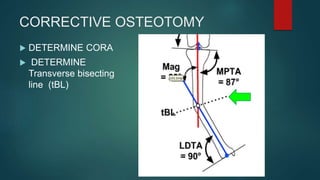
CORRECTIVE OSTEOTOMY
 DETERMINE CORA
 DETERMINE
Transverse bisecting
line (tBL)
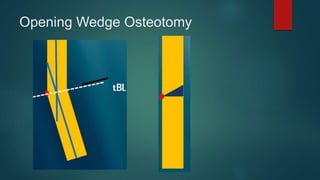
WEDGE OSTEOTOMY
OPENING WEDGE OSTEOTOMY
ADVANTAGES:
1.Avoids Shortening and hence
2nd procedure to correct limb
length
2.Avoids vascular complications
DISADVANTAGES:
1.Need for graft and graft
complications
2.Need for fixation
3.Collapse of graft and loosing
correction
4.Strech on NVB
5.Delayed Wt bearing
Opening Wedge Osteotomy
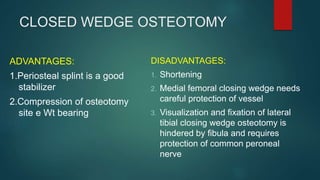
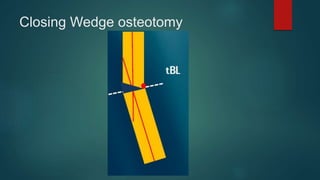
CLOSED WEDGE OSTEOTOMY
ADVANTAGES:
1.Periosteal splint is a good
stabilizer
2.Compression of osteotomy
site e Wt bearing
DISADVANTAGES:
1. Shortening
2. Medial femoral closing wedge needs
careful protection of vessel
3. Visualization and fixation of lateral
tibial closing wedge osteotomy is
hindered by fibula and requires
protection of common peroneal
nerve
Closing Wedge osteotomy
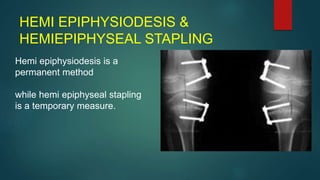
HEMI EPIPHYSIODESIS &
HEMIEPIPHYSEAL STAPLING
Hemi epiphysiodesis is a
permanent method
while hemi epiphyseal stapling
is a temporary measure.
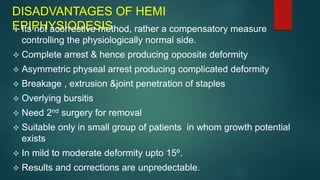
DISADVANTAGES OF HEMI
EPIPHYSIODESIS
 Its not acorrective method, rather a compensatory measure
controlling the physiologically normal side.
 Complete arrest & hence producing opoosite deformity
 Asymmetric physeal arrest producing complicated deformity
 Breakage , extrusion &joint penetration of staples
 Overlying bursitis
 Need 2nd surgery for removal
 Suitable only in small group of patients in whom growth potential
exists
 In mild to moderate deformity upto 15º.
 Results and corrections are unpredectable.
Thank you

Genu Valgum.pptx

  • 1.
    GENU VULGUM BY :DR ASAD ALI ORTHOPAEDIC SURGEON
  • 2.
    A 24 Yrold female presented to orthopedic OPD with Bilateral Genu Vulgum more on Rt (25°) most probably secondary to metabolic issues. There is 2cm shortening and 4cm wasting of quadriceps muscles.
  • 3.
    Genu Vulgum  AkaKnock knees  Angular deformity of lower limb  Orthopedic cosmatology  An abnormal coronal alignment in which the leg is shifted away from midline e medial angulation.
  • 4.
     In anormal person standing e heels/knees touching each other, ASIS- centre of patella- centre of malleoli and 2nd toe/web are in a straight line.  Deviation of this line to inside of knees is VARUS while outside is VARUS  Upto 1 cm seperation allowed for soft tissues in obese persons.
  • 5.
    CAUSES UNILATERAL  PHYSEAL INJURY Trauma  Infection (OM)  Vascular  PROX TIBIAL METAPHYSEAL INJURY  BENIGN TUMORS  Fibrous Dysplasia  Osteochondroma  Olliers disease  LATERAL LIGAMENT LAXITY  Idiopathic BILATERAL  PHYSIOLOGICAL  Vit. D Def RICKETS  RENAL OSTEODYSTROPHY  SKELETAL DYSPLASIAS  Chondroctodermal Dysplasia  SYNDROMES  Morqio syndrome (MPS IV)  Psuedoachondoplasia  CP  OI  PAGETS DISEASE
  • 6.
    PHYSIOLOGIC MALALIGNMENT  Childis born Physiologically e Genu Varum which is corrected upto 2 yrs of age.  Persistance of Tight Post capsule of Hip (Ext Rotation) and internal tibial torsion leads to overcorrection upto 2-3 yrs of age  Typically, developing children aged 3 to 4 years have up to 20° of genu valgum.  This physiologic vulgus should correct to adult level by 7 yr of age.  In females sometimes keep correcting upto 16 yrs
  • 7.
     After age7 years, valgus should not exceed 12° with an intermalleolar distance <8 cm.  Pathoanatomy  The deformity is usually in the distal femur but may also arise in the proximal tibia.  The degree of deformity necessary to lead to degenerative changes in the knee is not known.  Varus should be PATHOLOGICAL after 2-3 yr and Vulgus after 11 yrs of age
  • 8.
    Evaluation of patient: History  Detailed History  Birth history  Family history  Developmental milestones  Nutritional history  Previous percentile for height & weight  Family history
  • 9.
    Evaluation of Patient: Exam  Height & weight  Percentile for age  Shortening of extremity relative to trunk  Appearance of lower limb during standing and gait  Location of deformity  Distance between medial femoral condyle [less than 6 cm]  Distance between medial maleolus [less than 8 cm]
  • 10.
    Evaluation of Patient: Exam Measure Angulation directly e Gonoeometer
  • 11.
    Evaluation of Patient: Exam  Range Of Movemts (hip, knee, ankle)  Ligamentous laxity  Rotational profile  Compare with the normal limb  Examination of the spine
  • 12.
    Work Up  RADIOLOGICAL APand Lateral Views of both lower limbs fully including Femur abd Tibia in standing position  Scannogram  Computed Scannogram  Metabolic Profile…. S. Ca++, P, ALP, Vit D level etc  RFTs….. For ROD
  • 13.
    Why Xrays ?? Confirmationof Dx Site of disease Degree of Disease Associated diseases and assesment of physes Signs of Rickets
  • 14.
    MAL ALIGNMENT TESTS 1.Determine Mechanical axis 2. Lateral distal femoral angle 3. Medial proximal tibial angle 4. Joint line convergence angle 5. Med / Lat Sublaxation 6. Joint depression / elevation 7. Centre of Rotation of Angulation (CORA)
  • 16.
    Signs of Rickets Refraction of Provisional zone of calcification  Irregularly frayed and Cupping Metaphyses  Deepened physis  Thinning of cortex  In healing Rickets … Zones of Provisional calcification denser than diaphysis
  • 17.
    How to Confirmlocation if Xrays Not clear ?? Measure Centre of Rotation of Angulation (CORA) This reveals  Site apex of deformity… Femoral/ Tibial/ meataphyseal  Magnitude  Planning guide  Addiotional deformities… bowing/ torsional deformities
  • 18.
  • 19.
    CONSERVATIVE Vs OPERATIVE Thisdepends upon  Age  Magnitude of deformity  Site of deformity  Underlying cause
  • 20.
    NON OPERATIVE  1.AGE: Males< 12 yr females < 11 yrs  2. Magnitude of deformity < 15°  3. Underlying cause Active disease e.g Rickets First treat the disease, only then operate
  • 21.
    OPERATIVE TREATMENT  OSTEOTOMY •Wedge Osteotomy…. most oftenly… open or closed • Dome Osteotomy • Oblique Osteotomy • Progressive lateral opening Osteotomy  HEMI EPIPHYSIODESIS  HEMI EPIPHYSEAL STAPLING  ILLIZAROVE RING FIXATION
  • 22.
    CORRECTIVE OSTEOTOMY  DETERMINECORA  DETERMINE Transverse bisecting line (tBL)
  • 23.
    WEDGE OSTEOTOMY OPENING WEDGEOSTEOTOMY ADVANTAGES: 1.Avoids Shortening and hence 2nd procedure to correct limb length 2.Avoids vascular complications DISADVANTAGES: 1.Need for graft and graft complications 2.Need for fixation 3.Collapse of graft and loosing correction 4.Strech on NVB 5.Delayed Wt bearing
  • 24.
  • 25.
    CLOSED WEDGE OSTEOTOMY ADVANTAGES: 1.Periostealsplint is a good stabilizer 2.Compression of osteotomy site e Wt bearing DISADVANTAGES: 1. Shortening 2. Medial femoral closing wedge needs careful protection of vessel 3. Visualization and fixation of lateral tibial closing wedge osteotomy is hindered by fibula and requires protection of common peroneal nerve
  • 26.
  • 27.
    HEMI EPIPHYSIODESIS & HEMIEPIPHYSEALSTAPLING Hemi epiphysiodesis is a permanent method while hemi epiphyseal stapling is a temporary measure.
  • 28.
    DISADVANTAGES OF HEMI EPIPHYSIODESIS Its not acorrective method, rather a compensatory measure controlling the physiologically normal side.  Complete arrest & hence producing opoosite deformity  Asymmetric physeal arrest producing complicated deformity  Breakage , extrusion &joint penetration of staples  Overlying bursitis  Need 2nd surgery for removal  Suitable only in small group of patients in whom growth potential exists  In mild to moderate deformity upto 15º.  Results and corrections are unpredectable.
  • 29.