welcome

PROTOTYPING
RAISON SAM RAJU
Department of Commerce
University of kerala
raisonsamraju@yahoo.com

1
overview

PROTOTYPING
•
•
•
•
•
•

INTRODUCTION
MEANING
STEPS
ADVANTAGES
DISADVANTAGES
CONCLUSION
raisonsamraju@yahoo.com

2
INTRODUCTION
Information system is a system for accepting data as raw
material and through one or more transaction process
generating information as a product. as information system
has grown progressively more complex ,the development
cycle has lengthened. for solving complexities and attaining
objective system builders developed various methodologies
for system development. one such methodology is called
prototyping

raisonsamraju@yahoo.com

3
PROTOTYPING

Meaning

Prototyping is a system development method(SDM) in which a
prototype is built, tested and then reworked as necessary until an
acceptable prototype is finally achieved, from which the complete
system can be developed.
PROTOTYPE
Prototype is a preliminary working version of an information system for
demonstration and evaluation purpose.
Or
It is an early approximation of a final system.
ITERATION

Iteration means the act of repeating a process or steps to build a system with the
aim of approachingraisonsamraju@yahoo.com
a desired goal, target or result.
4
STEPS IN PROTYPING
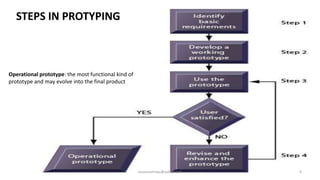
STEP 1:Identify the user’s basic information requirements
User articulates his or her basic needs in terms of output from the user. the designer responsibility is to establish realistic
user expectation and estimate the cost of developing an operational prototype.

STEP 2:develope the initial prototype system
Objective is to build a functional interactive system that meets user basic stated information requirements

STEP 3:use of prototype system to refine user requirements
The initially developed prototype is delivered to the user to identify further refinements/changes required in the prototype.

STEP 4:Revice and enhance the prototype
Designer makes necessary changes pointed out by user.step2 &3 are iterative.
raisonsamraju@yahoo.com

5
STEPS IN PROTYPING

Operational prototype: the most functional kind of
prototype and may evolve into the final product

raisonsamraju@yahoo.com

6
Advantages
Ability to ‘try out’ ideas without incurring large cost.

Lower overall development costs when requirement change frequently.
The ability to get functioning system into the hands of the user quickly.

Reduced application development time to achieve a functioning system.
Information system can be developed more efficiently and effectively.
Prototyping is especially valuable for the design of the end-user interface of
an information system.

Helps to determine technical feasibility
raisonsamraju@yahoo.com

7
Disadvantages
1.Iterative nature:
prototypes requires at least 2 iterations. It may become an unending process of refinement, which may take too much
time ,money and effort.
2.Prototypes are usually not complete system and there is a great temptations for most developers to create a
prototype and stick to it even though it has flaws.

3.Due to frequent changes ,management of the development process also becomes
difficult.
4.Time consuming model and slow process.

raisonsamraju@yahoo.com

8
CONCLUSION
Prototyping is the process of building an experimental system
that demonstrates the features of a proposed system for end
users to evaluvate.by interacting with the prototype user can
get better idea of their information requirements. the
prototype endorsed by the user can be used as a template to
create the final system. it is an iterative, trial-and-error
process that takes place between the developers and users.
there are 4 steps in the process of prototyping.
raisonsamraju@yahoo.com

9
Prototyping

Prototyping

  • 1.
    welcome PROTOTYPING RAISON SAM RAJU Departmentof Commerce University of kerala raisonsamraju@yahoo.com 1
  • 2.
  • 3.
    INTRODUCTION Information system isa system for accepting data as raw material and through one or more transaction process generating information as a product. as information system has grown progressively more complex ,the development cycle has lengthened. for solving complexities and attaining objective system builders developed various methodologies for system development. one such methodology is called prototyping raisonsamraju@yahoo.com 3
  • 4.
    PROTOTYPING Meaning Prototyping is asystem development method(SDM) in which a prototype is built, tested and then reworked as necessary until an acceptable prototype is finally achieved, from which the complete system can be developed. PROTOTYPE Prototype is a preliminary working version of an information system for demonstration and evaluation purpose. Or It is an early approximation of a final system. ITERATION Iteration means the act of repeating a process or steps to build a system with the aim of approachingraisonsamraju@yahoo.com a desired goal, target or result. 4
  • 5.
    STEPS IN PROTYPING STEP1:Identify the user’s basic information requirements User articulates his or her basic needs in terms of output from the user. the designer responsibility is to establish realistic user expectation and estimate the cost of developing an operational prototype. STEP 2:develope the initial prototype system Objective is to build a functional interactive system that meets user basic stated information requirements STEP 3:use of prototype system to refine user requirements The initially developed prototype is delivered to the user to identify further refinements/changes required in the prototype. STEP 4:Revice and enhance the prototype Designer makes necessary changes pointed out by user.step2 &3 are iterative. raisonsamraju@yahoo.com 5
  • 6.
    STEPS IN PROTYPING Operationalprototype: the most functional kind of prototype and may evolve into the final product raisonsamraju@yahoo.com 6
  • 7.
    Advantages Ability to ‘tryout’ ideas without incurring large cost. Lower overall development costs when requirement change frequently. The ability to get functioning system into the hands of the user quickly. Reduced application development time to achieve a functioning system. Information system can be developed more efficiently and effectively. Prototyping is especially valuable for the design of the end-user interface of an information system. Helps to determine technical feasibility raisonsamraju@yahoo.com 7
  • 8.
    Disadvantages 1.Iterative nature: prototypes requiresat least 2 iterations. It may become an unending process of refinement, which may take too much time ,money and effort. 2.Prototypes are usually not complete system and there is a great temptations for most developers to create a prototype and stick to it even though it has flaws. 3.Due to frequent changes ,management of the development process also becomes difficult. 4.Time consuming model and slow process. raisonsamraju@yahoo.com 8
  • 9.
    CONCLUSION Prototyping is theprocess of building an experimental system that demonstrates the features of a proposed system for end users to evaluvate.by interacting with the prototype user can get better idea of their information requirements. the prototype endorsed by the user can be used as a template to create the final system. it is an iterative, trial-and-error process that takes place between the developers and users. there are 4 steps in the process of prototyping. raisonsamraju@yahoo.com 9