proton density PD weighted mri image
PD weighted image
The proton density (PD) weighted image visualizes the number of
protons per volume.
Tissues with few protons have low signal intensity, tissues with
many protons have high signal intensity.
PD weighted image
Fat has a relatively high signal intensity, however, not as
high as in a T1 weighted image.
Fluid has an intermediate signal intensity rather than the
high signal intensity as in a T2 weighted image.
PD weighted image
A PD weighted image is used among other things to evaluate
meniscal tears in the knee
The distinction between CSF and pathology is difficult on a T2
weighted image; both have a high signal.
The contrast between CSF (intermediate signal intensity) and

pathology (high signal intensity) will be better on a PD weighted
image.
MRI image appearance
The easiest way to identify PD weighted images is to
compare the fluid against the fat signal.
Fluids normally appear as grayish white, almost similar
appearance as the fat in the body
https://mrimaster.com/characterise%20image%20pd.html
Tissues and their PD appearance
Bone marrow: - equal to or higher than that of muscle (fatty marrow is
usually bright)
Fat – bright (slightly darker than the fat signal in T1 images)
Fluids – bright (darker than the fluid signal in T2 images)
Moving blood- dark
Muscles-gray
Bone – dark
Air - dark
https://mrimaster.com/characterise%20image%20pd.html
Use
Useful for extremity imaging (e.g. ankle, knee, elbow
shoulder and hips)
Can be useful in thighs, lower legs, upper arms and
forearms imaging
https://mrimaster.com/characterise%20image%20pd.html
On spin-echo (SE) imaging, the repetition time (TR) and
the echo time (TE) are used to control image contrast
and the "weighting" of the MR image. There are many
misconceptions about what the term "weighting" actually
means, so a separate Q&A is devoted to that very
subject. For now we will not specifically define what we
mean by "T1-weighting", "T2-weighting", or "PD (proton-
density) weighting" other than to say that it implies that
image contrast is significantly affected by T1, T2 or [H].
http://mriquestions.com/image-contrast-trte.html
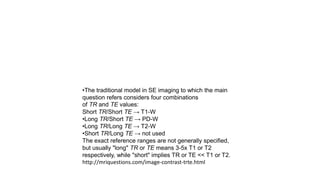
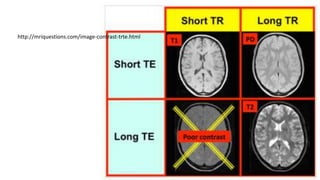
•The traditional model in SE imaging to which the main
question refers considers four combinations
of TR and TE values:
Short TR/Short TE → T1-W
•Long TR/Short TE → PD-W
•Long TR/Long TE → T2-W
•Short TR/Long TE → not used
The exact reference ranges are not generally specified,
but usually "long" TR or TE means 3-5x T1 or T2
respectively, while "short" implies TR or TE << T1 or T2.
http://mriquestions.com/image-contrast-trte.html
An MRI sequence in magnetic resonance imaging (MRI) is a
particular setting of pulse sequences and pulsed field gradients,
resulting in a particular image appearance.[1]
A multiparametric MRI is a combination of two or more sequences,
and/or including other specialized MRI configurations such
as spectroscopy.[2][3]
https://en.wikipedia.org/wiki/MRI_sequence#Spin_echo
Group Sequence Abbr. Physics Main clinical distinctions
E
x
a
m
p
l
e
Spin echo
T1 weighted T1
Measuring spin–lattice
relaxation by using a
short repetition time (TR)
and echo time (TE).
•Lower signal for more water content,[4] as
in edema, tumor, infarction, inflammation, i
nfection, hyperacute or
chronic hemorrhage.[5]
•High signal for fat[4][5]
•High signal for paramagnetic substances,
such as MRI contrast agents[5]
Standard foundation and comparison for
other sequences
T2 weighted T2
Measuring spin–spin
relaxation by using long TR and
TE times
•Higher signal for more water content[4]
•Low signal for fat[4] − Note that this only
applies to standard Spin Echo (SE)
sequences and not the more modern Fast
Spin Echo (FSE) sequence (also referred to
as Turbo Spin Echo, TSE), which is the most
commonly used technique today. In
FSE/TSE, fat will have a high signal.[6]
•Low signal for paramagnetic substances[5]
Standard foundation and comparison for
other sequences
Proton density
PD
Long TR (to reduce T1) and
[7]
•Joint disease and injury.[8]High signal
[9]
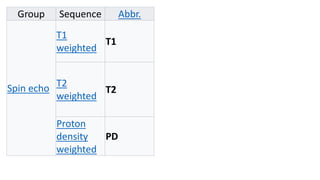
Group Sequence Abbr.
Spin echo
T1
weighted
T1
T2
weighted
T2
Proton
density
weighted
PD
Physics Main clinical distinctions
Measuring spin–lattice
relaxation by using a
short repetition
time (TR) and echo
time (TE).
•Lower signal for more water content,[4] as
in edema, tumor, infarction, inflammation, infection, hyperacute or
chronic hemorrhage.[5]
•High signal for fat[4][5]
•High signal for paramagnetic substances, such as MRI contrast agents[5]
Standard foundation and comparison for other sequences
Measuring spin–spin
relaxation by using
long TR and TE times
•Higher signal for more water content[4]
•Low signal for fat[4] − Note that this only applies to standard Spin Echo
(SE) sequences and not the more modern Fast Spin Echo (FSE) sequence
(also referred to as Turbo Spin Echo, TSE), which is the most commonly
used technique today. In FSE/TSE, fat will have a high signal.[6]
•Low signal for paramagnetic substances[5]
Standard foundation and comparison for other sequences
Long TR (to reduce T1)
and short TE (to
minimize T2).[7]
•Joint disease and injury.[8]High signal from meniscus tears.[9] (pictured)
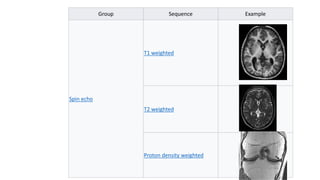
Group Sequence Example
Spin echo
T1 weighted
T2 weighted
Proton density weighted
Proton density (PD)- weighted images are created by
having a long repetition time (TR) and a short echo time
(TE).[36] On images of the brain, this sequence has a more
pronounced distinction between gray matter (bright)
and white matter (darker gray), but with little contrast
between brain and CSF.[36] It is very useful for the
detection of joint disease and injury.[37]
https://en.wikipedia.org/wiki/MRI_sequence#Spin_echo
proton density PD weighted mri image.pptx

proton density PD weighted mri image.pptx

  • 1.
    proton density PDweighted mri image
  • 2.
    PD weighted image Theproton density (PD) weighted image visualizes the number of protons per volume. Tissues with few protons have low signal intensity, tissues with many protons have high signal intensity.
  • 3.
    PD weighted image Fathas a relatively high signal intensity, however, not as high as in a T1 weighted image. Fluid has an intermediate signal intensity rather than the high signal intensity as in a T2 weighted image.
  • 4.
    PD weighted image APD weighted image is used among other things to evaluate meniscal tears in the knee The distinction between CSF and pathology is difficult on a T2 weighted image; both have a high signal. The contrast between CSF (intermediate signal intensity) and pathology (high signal intensity) will be better on a PD weighted image.
  • 5.
    MRI image appearance Theeasiest way to identify PD weighted images is to compare the fluid against the fat signal. Fluids normally appear as grayish white, almost similar appearance as the fat in the body https://mrimaster.com/characterise%20image%20pd.html
  • 6.
    Tissues and theirPD appearance Bone marrow: - equal to or higher than that of muscle (fatty marrow is usually bright) Fat – bright (slightly darker than the fat signal in T1 images) Fluids – bright (darker than the fluid signal in T2 images) Moving blood- dark Muscles-gray Bone – dark Air - dark https://mrimaster.com/characterise%20image%20pd.html
  • 7.
    Use Useful for extremityimaging (e.g. ankle, knee, elbow shoulder and hips) Can be useful in thighs, lower legs, upper arms and forearms imaging https://mrimaster.com/characterise%20image%20pd.html
  • 8.
    On spin-echo (SE)imaging, the repetition time (TR) and the echo time (TE) are used to control image contrast and the "weighting" of the MR image. There are many misconceptions about what the term "weighting" actually means, so a separate Q&A is devoted to that very subject. For now we will not specifically define what we mean by "T1-weighting", "T2-weighting", or "PD (proton- density) weighting" other than to say that it implies that image contrast is significantly affected by T1, T2 or [H]. http://mriquestions.com/image-contrast-trte.html
  • 9.
    •The traditional modelin SE imaging to which the main question refers considers four combinations of TR and TE values: Short TR/Short TE → T1-W •Long TR/Short TE → PD-W •Long TR/Long TE → T2-W •Short TR/Long TE → not used The exact reference ranges are not generally specified, but usually "long" TR or TE means 3-5x T1 or T2 respectively, while "short" implies TR or TE << T1 or T2. http://mriquestions.com/image-contrast-trte.html
  • 10.
  • 11.
    An MRI sequencein magnetic resonance imaging (MRI) is a particular setting of pulse sequences and pulsed field gradients, resulting in a particular image appearance.[1] A multiparametric MRI is a combination of two or more sequences, and/or including other specialized MRI configurations such as spectroscopy.[2][3] https://en.wikipedia.org/wiki/MRI_sequence#Spin_echo
  • 12.
    Group Sequence Abbr.Physics Main clinical distinctions E x a m p l e Spin echo T1 weighted T1 Measuring spin–lattice relaxation by using a short repetition time (TR) and echo time (TE). •Lower signal for more water content,[4] as in edema, tumor, infarction, inflammation, i nfection, hyperacute or chronic hemorrhage.[5] •High signal for fat[4][5] •High signal for paramagnetic substances, such as MRI contrast agents[5] Standard foundation and comparison for other sequences T2 weighted T2 Measuring spin–spin relaxation by using long TR and TE times •Higher signal for more water content[4] •Low signal for fat[4] − Note that this only applies to standard Spin Echo (SE) sequences and not the more modern Fast Spin Echo (FSE) sequence (also referred to as Turbo Spin Echo, TSE), which is the most commonly used technique today. In FSE/TSE, fat will have a high signal.[6] •Low signal for paramagnetic substances[5] Standard foundation and comparison for other sequences Proton density PD Long TR (to reduce T1) and [7] •Joint disease and injury.[8]High signal [9]
  • 13.
    Group Sequence Abbr. Spinecho T1 weighted T1 T2 weighted T2 Proton density weighted PD
  • 14.
    Physics Main clinicaldistinctions Measuring spin–lattice relaxation by using a short repetition time (TR) and echo time (TE). •Lower signal for more water content,[4] as in edema, tumor, infarction, inflammation, infection, hyperacute or chronic hemorrhage.[5] •High signal for fat[4][5] •High signal for paramagnetic substances, such as MRI contrast agents[5] Standard foundation and comparison for other sequences Measuring spin–spin relaxation by using long TR and TE times •Higher signal for more water content[4] •Low signal for fat[4] − Note that this only applies to standard Spin Echo (SE) sequences and not the more modern Fast Spin Echo (FSE) sequence (also referred to as Turbo Spin Echo, TSE), which is the most commonly used technique today. In FSE/TSE, fat will have a high signal.[6] •Low signal for paramagnetic substances[5] Standard foundation and comparison for other sequences Long TR (to reduce T1) and short TE (to minimize T2).[7] •Joint disease and injury.[8]High signal from meniscus tears.[9] (pictured)
  • 15.
    Group Sequence Example Spinecho T1 weighted T2 weighted Proton density weighted
  • 16.
    Proton density (PD)-weighted images are created by having a long repetition time (TR) and a short echo time (TE).[36] On images of the brain, this sequence has a more pronounced distinction between gray matter (bright) and white matter (darker gray), but with little contrast between brain and CSF.[36] It is very useful for the detection of joint disease and injury.[37] https://en.wikipedia.org/wiki/MRI_sequence#Spin_echo