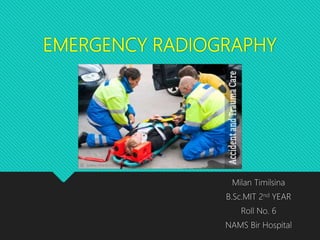
EMERGENCY RADIOGRAPHY
Milan Timilsina
B.Sc.MIT 2nd YEAR
Roll No. 6
NAMS Bir Hospital
Contents
 Introduction
 Patients condition and preparation
 Responsibilities of Radiographers
 Equipment
 Immobilization devices
 Grids
 Exposure factors
 Radiation protection
 Positioning & technique in Emergency/Trauma
 Summary
Emergency radiography is defined by
the imaging and imaging
management of patients who are
acutely ill and injured.
INTRODUCTION
Emergency radiography can be an exciting
,challenging as well as stressful environment for
the radiographer.
Depends on how prepared the radiographer is
to handle the situation.
Specialized trauma imaging systems reduce
the amount of time required to obtain
diagnostic images
EMERGENCY DEPARTMENT
 “Emergency
department” signifies a
specific level of
emergency medical
care.
 A medical emergency
is an injury or illness
that is acute and poses
an immediate risk to
a person's life or long
term health.
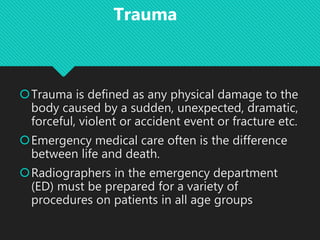
Trauma is defined as any physical damage to the
body caused by a sudden, unexpected, dramatic,
forceful, violent or accident event or fracture etc.
Emergency medical care often is the difference
between life and death.
Radiographers in the emergency department
(ED) must be prepared for a variety of
procedures on patients in all age groups
Trauma
ER at Bir Hospital
 DRGEM Company
 X-ray tube – Toshiba E7239X Model
 Manufactured – June 2014
 Maxm 120 kVp, minim 40 kVp
 Focal spot 2.0/1.0
 Grid ratio 10:1
 Target angle 16’
 X-ray coverage 354*354 mm at SID 750mm
ER at Trauma
Allengers company
Maxm kVp 150
mA 500
Rotating anode
Patient conditions and preparation
Closely supervise trauma patients at all times
A patient who requires examination of the
whole spine, chest & pelvis, lateral radiograph
should be performed before the anterior
posterior radiograph which avoids wasting
time in moving the tube back and forth
between exposure.
Patient preparation
To minimize risk of exacerbating the patient's
condition, the x-ray tube and lR should be
positioned, rather than the patient or the part.
Patient history must be taken into consideration
The items that might cause an artifact on the
images should be checked.
facility for proper storage of a patient's personal
belongings is required.
Responsibilities of Radiographers & RT
should develop an understanding of the
imaging equipment utilized in ER
Should know the role of the radiographer as a
vital part of the ER team,
 present the common radiographic procedures
performed on emergency patients.
Responsibilities of Radiographers & RT
Perform quality diagnostic imaging
procedures as requested
Practice ethical radiation protection
 Provide competent patient care
Equipment
To minimize the time required to acquire
diagnostic x-ray images, many ERs have
dedicated radiographic equipment
It provide greater flexibility with a minimal
patient movement. to minimize movement of
the injured patient while performing imaging
procedures
ER equipment
some ERs are equipped with specialized beds or
stretchers that have a moveable tray to hold the
l R.
This type of stretcher allows the use of a mobile
radiographic unit and eliminates the
requirement and risk of transferring an injured
patient to the radiographic table.
ER Equipment
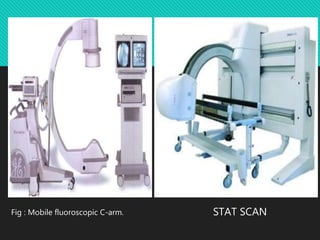
Mobile radiography is widely utilized in the ER. (
Battery Powered & Capacitor Discharge)
C-arms are utilized for fracture reduction
procedures, foreign body localization in limbs,
and for reducing joint dislocations
Celling suspended tube, vertical Bucky, floating
table top with Bucky
Skull Unit
Fig: A, Dedicated C-arm
type trauma radiographic
room with patient on the
table
Fig: B, Dedicated
conventional trauma
radiographic room with
vertical Bucky.
Fig : Mobile fluoroscopic C-arm. STAT SCAN
Immobilization devices
 To stabilize injured patients.
 To prevent involuntary and voluntary motion
 Once injuries have been diagnosed or ruled out, the
attending physician gives the order for immobilization to be
removed, changed, or continued.
 Radiolucent foam pads, Sponges, sandbags, and the creative
use of tape are often most useful tools.
 I R holders helps to perform cross-table lateral projections on
numerous body parts with minimal distortion.
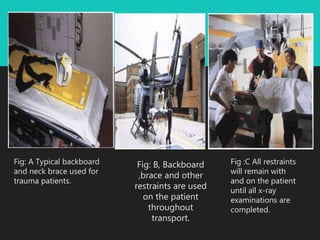
Fig: A Typical backboard
and neck brace used for
trauma patients.
Fig: B, Backboard
,brace and other
restraints are used
on the patient
throughout
transport.
Fig :C All restraints
will remain with
and on the patient
until all x-ray
examinations are
completed.
Grids
 Grids and IR holders are necessities since many projections
require the use of a horizontal central ray.
 Focused grid, lower grid ratio ( 6:1),12:1 bulky patient grids)
 Non-linear water type grid which have wider film range
and better tolerance of central ray angulation and
centering
 Correct FFD for the type of grid is used otherwise cutoff
artifact will result.
Exposure factors
 shortest possible exposure time that can be set should be
used in every procedure, except when a breathing technique
is desired.
 Radiographic exposure factor compensation may be required
when making exposures through immobilization devices, like
a spine board or backboard.
 Pathologic changes should also be considered when setting
technical factors. For instance, internal bleeding in the
abdominal cavity would absorb a greater amount of radiation
than a bowel obstruction.
Radiation Protection
 Collimation to the anatomy of interest to reduce scatter,
 Gonad shielding for the patients of child-bearing age
 Lead aprons for all personnel that remain in the room
during the procedure
 Exposure factors that minimize patient dose and scattered
radiation
 Announcement of impending exposure to allow unnecessary
personnel to exit the room
Best Practices in Trauma Patients
 Speed - Performing Quick or rapid diagnostic examination
is critical to saving the patients life.
 Accuracy - must provide an accurate images with a minimal
amount of distortion and the maximum amount of recorded
detail.
 Quality - The quality of a radiograph does not have to
sacrifice to produce an image quickly.
Gloves, mask, and gown must be properly worn.
Protect the IR and sponges and keep all equipment
and accessory devices clean
Wash hand frequently, especially between patients.
Adhere to Code of Ethics for Radiologic Technologist
and the Practice Standards of professionalism
Practice Standard Precautions
Positioning & technique in Trauma
Chest
Ribs & sternum
Abdomen
Upper extremities
Lower extremities
Spine
Skull
Chest
 AP
 Lateral
 Lateral decubitus AP
Chest AP
 Don’t elevate patient in erect position who have suspected
spinal injury
 Film is placed crosswise
 Head end of the bed can be elevated to achieve semi-erect
positon
 Cassettes is placed 2 inch above the shoulder
 Arms should be internally rotated to remove scapulae out of
lung field
 CR is directed 3-4 inches below the jugular notch with CR 3-5
inch caudally
 SID 72 inches or 48 inches if not possible
Multiple buckshot in
chest caused a
hemopneumothorax.
Arrows show the margin
of the collapsed lung
with free air laterally.
Arrowhead shows fluid
level at the costophrenic
angle,left lung
Patient and IR
positioned for a
trauma AP
projection of the
chest.
Open safety pin
lodged in
esophagus of a
1 3-month-old
baby.
Chest AP
 The lung fields entirety ,adequate aeration of the lungs, ribs
and lung parenchyma must be visualized with minimal rotation
and distortion.
 signs of respiratory distress or changes in level of
consciousness must be checked
 SID must be made max to minimize magnification of the
heart shadow
Sternum
 AP
 Left posterior oblique (LPO)
 Lateral Horizontal beam
Ribs
 AP
 Obliques
 Alternatives Oblique view
Abdomen
Supine AP
Left lateral decubitus
Dorsal decubitus ,
Lateral position
Upper extremities
 AP, Obliques, Lateral ( Fingers, Thumb, Hands, Wrist,
Forearm)
 Elbow PA & Lateral
 Humerus AP & Lateral
 Shoulder AP, Lateral, Y-view
 Scapula AP
 Clavicle AP & Axial
Lower extremities
 Toe and foot ( AP & Lateral)
 Ankle ( AP, Mortice, lateral, lateromedial)
 Leg (AP)
 Knee ( AP & Lateral, Oblique with lateromedial angulation
 Thigh and Hip region ( AP & Lateral )
 Pelvis and Hip joint ( AP, Inferiosuperior, Skiagram, Lateral)
Spine
Cervical Spine: - AP, AP
open mouth, Lateral,
Swimmer’s lateral,
Obliques)
Thoracolumbar: - AP,
Lateral
Swimmer’s
Lateral
Skull
Lateral, AP, Reverse
Caldwell view, Townes view
Facial bones ( Lateral, AP
Reverse waters view)
Mandible ( AP, AP Axial,
Axiolateral Oblique)
Reverse waters view
Other imaging modalities
 Computed tomography (MDCT, WBCT, CTPA for
active bleeding, ICH, hemoptysis & GI bleed, Dual
energy CT for cardiac imaging )
 Ultrasonography
 Magnetic Resonance Imaging (multiple vertebral
injuries)
Summary
 Emergency radiography has emerged as one of the newest
and fastest growing radiology subspecialties.
 Today, with the ready availability of cross-sectional imaging
with CT, MRI, and ultrasound, the emergency radiology
facility has become the acute diagnostic imaging center.
 Use of emergency cross-sectional imaging can expedite
patient care as well as prevent unnecessary hospital
admissions and unnecessary emergency surgery
References
 Clarks positioning 12th edition
 Text book of radiology for resident and technician,
5th edition
 www.radiologyinfo.org
 www.radiopedia.org


Emergency radiography

  • 1.
    EMERGENCY RADIOGRAPHY Milan Timilsina B.Sc.MIT2nd YEAR Roll No. 6 NAMS Bir Hospital
  • 2.
    Contents  Introduction  Patientscondition and preparation  Responsibilities of Radiographers  Equipment  Immobilization devices  Grids  Exposure factors  Radiation protection  Positioning & technique in Emergency/Trauma  Summary
  • 3.
    Emergency radiography isdefined by the imaging and imaging management of patients who are acutely ill and injured.
  • 4.
    INTRODUCTION Emergency radiography canbe an exciting ,challenging as well as stressful environment for the radiographer. Depends on how prepared the radiographer is to handle the situation. Specialized trauma imaging systems reduce the amount of time required to obtain diagnostic images
  • 5.
    EMERGENCY DEPARTMENT  “Emergency department”signifies a specific level of emergency medical care.  A medical emergency is an injury or illness that is acute and poses an immediate risk to a person's life or long term health.
  • 6.
    Trauma is definedas any physical damage to the body caused by a sudden, unexpected, dramatic, forceful, violent or accident event or fracture etc. Emergency medical care often is the difference between life and death. Radiographers in the emergency department (ED) must be prepared for a variety of procedures on patients in all age groups Trauma
  • 7.
    ER at BirHospital  DRGEM Company  X-ray tube – Toshiba E7239X Model  Manufactured – June 2014  Maxm 120 kVp, minim 40 kVp  Focal spot 2.0/1.0  Grid ratio 10:1  Target angle 16’  X-ray coverage 354*354 mm at SID 750mm
  • 8.
    ER at Trauma Allengerscompany Maxm kVp 150 mA 500 Rotating anode
  • 9.
    Patient conditions andpreparation Closely supervise trauma patients at all times A patient who requires examination of the whole spine, chest & pelvis, lateral radiograph should be performed before the anterior posterior radiograph which avoids wasting time in moving the tube back and forth between exposure.
  • 10.
    Patient preparation To minimizerisk of exacerbating the patient's condition, the x-ray tube and lR should be positioned, rather than the patient or the part. Patient history must be taken into consideration The items that might cause an artifact on the images should be checked. facility for proper storage of a patient's personal belongings is required.
  • 11.
    Responsibilities of Radiographers& RT should develop an understanding of the imaging equipment utilized in ER Should know the role of the radiographer as a vital part of the ER team,  present the common radiographic procedures performed on emergency patients.
  • 12.
    Responsibilities of Radiographers& RT Perform quality diagnostic imaging procedures as requested Practice ethical radiation protection  Provide competent patient care
  • 13.
    Equipment To minimize thetime required to acquire diagnostic x-ray images, many ERs have dedicated radiographic equipment It provide greater flexibility with a minimal patient movement. to minimize movement of the injured patient while performing imaging procedures
  • 14.
    ER equipment some ERsare equipped with specialized beds or stretchers that have a moveable tray to hold the l R. This type of stretcher allows the use of a mobile radiographic unit and eliminates the requirement and risk of transferring an injured patient to the radiographic table.
  • 15.
    ER Equipment Mobile radiographyis widely utilized in the ER. ( Battery Powered & Capacitor Discharge) C-arms are utilized for fracture reduction procedures, foreign body localization in limbs, and for reducing joint dislocations Celling suspended tube, vertical Bucky, floating table top with Bucky Skull Unit
  • 16.
    Fig: A, DedicatedC-arm type trauma radiographic room with patient on the table Fig: B, Dedicated conventional trauma radiographic room with vertical Bucky.
  • 17.
    Fig : Mobilefluoroscopic C-arm. STAT SCAN
  • 18.
    Immobilization devices  Tostabilize injured patients.  To prevent involuntary and voluntary motion  Once injuries have been diagnosed or ruled out, the attending physician gives the order for immobilization to be removed, changed, or continued.  Radiolucent foam pads, Sponges, sandbags, and the creative use of tape are often most useful tools.  I R holders helps to perform cross-table lateral projections on numerous body parts with minimal distortion.
  • 20.
    Fig: A Typicalbackboard and neck brace used for trauma patients. Fig: B, Backboard ,brace and other restraints are used on the patient throughout transport. Fig :C All restraints will remain with and on the patient until all x-ray examinations are completed.
  • 21.
    Grids  Grids andIR holders are necessities since many projections require the use of a horizontal central ray.  Focused grid, lower grid ratio ( 6:1),12:1 bulky patient grids)  Non-linear water type grid which have wider film range and better tolerance of central ray angulation and centering  Correct FFD for the type of grid is used otherwise cutoff artifact will result.
  • 22.
    Exposure factors  shortestpossible exposure time that can be set should be used in every procedure, except when a breathing technique is desired.  Radiographic exposure factor compensation may be required when making exposures through immobilization devices, like a spine board or backboard.  Pathologic changes should also be considered when setting technical factors. For instance, internal bleeding in the abdominal cavity would absorb a greater amount of radiation than a bowel obstruction.
  • 23.
    Radiation Protection  Collimationto the anatomy of interest to reduce scatter,  Gonad shielding for the patients of child-bearing age  Lead aprons for all personnel that remain in the room during the procedure  Exposure factors that minimize patient dose and scattered radiation  Announcement of impending exposure to allow unnecessary personnel to exit the room
  • 24.
    Best Practices inTrauma Patients  Speed - Performing Quick or rapid diagnostic examination is critical to saving the patients life.  Accuracy - must provide an accurate images with a minimal amount of distortion and the maximum amount of recorded detail.  Quality - The quality of a radiograph does not have to sacrifice to produce an image quickly.
  • 25.
    Gloves, mask, andgown must be properly worn. Protect the IR and sponges and keep all equipment and accessory devices clean Wash hand frequently, especially between patients. Adhere to Code of Ethics for Radiologic Technologist and the Practice Standards of professionalism Practice Standard Precautions
  • 26.
    Positioning & techniquein Trauma Chest Ribs & sternum Abdomen Upper extremities Lower extremities Spine Skull
  • 27.
    Chest  AP  Lateral Lateral decubitus AP
  • 28.
    Chest AP  Don’televate patient in erect position who have suspected spinal injury  Film is placed crosswise  Head end of the bed can be elevated to achieve semi-erect positon  Cassettes is placed 2 inch above the shoulder  Arms should be internally rotated to remove scapulae out of lung field  CR is directed 3-4 inches below the jugular notch with CR 3-5 inch caudally  SID 72 inches or 48 inches if not possible
  • 29.
    Multiple buckshot in chestcaused a hemopneumothorax. Arrows show the margin of the collapsed lung with free air laterally. Arrowhead shows fluid level at the costophrenic angle,left lung Patient and IR positioned for a trauma AP projection of the chest. Open safety pin lodged in esophagus of a 1 3-month-old baby.
  • 30.
    Chest AP  Thelung fields entirety ,adequate aeration of the lungs, ribs and lung parenchyma must be visualized with minimal rotation and distortion.  signs of respiratory distress or changes in level of consciousness must be checked  SID must be made max to minimize magnification of the heart shadow
  • 31.
    Sternum  AP  Leftposterior oblique (LPO)  Lateral Horizontal beam
  • 32.
    Ribs  AP  Obliques Alternatives Oblique view
  • 33.
    Abdomen Supine AP Left lateraldecubitus Dorsal decubitus , Lateral position
  • 34.
    Upper extremities  AP,Obliques, Lateral ( Fingers, Thumb, Hands, Wrist, Forearm)  Elbow PA & Lateral  Humerus AP & Lateral  Shoulder AP, Lateral, Y-view  Scapula AP  Clavicle AP & Axial
  • 35.
    Lower extremities  Toeand foot ( AP & Lateral)  Ankle ( AP, Mortice, lateral, lateromedial)  Leg (AP)  Knee ( AP & Lateral, Oblique with lateromedial angulation  Thigh and Hip region ( AP & Lateral )  Pelvis and Hip joint ( AP, Inferiosuperior, Skiagram, Lateral)
  • 37.
    Spine Cervical Spine: -AP, AP open mouth, Lateral, Swimmer’s lateral, Obliques) Thoracolumbar: - AP, Lateral
  • 38.
  • 39.
    Skull Lateral, AP, Reverse Caldwellview, Townes view Facial bones ( Lateral, AP Reverse waters view) Mandible ( AP, AP Axial, Axiolateral Oblique)
  • 40.
  • 41.
    Other imaging modalities Computed tomography (MDCT, WBCT, CTPA for active bleeding, ICH, hemoptysis & GI bleed, Dual energy CT for cardiac imaging )  Ultrasonography  Magnetic Resonance Imaging (multiple vertebral injuries)
  • 42.
    Summary  Emergency radiographyhas emerged as one of the newest and fastest growing radiology subspecialties.  Today, with the ready availability of cross-sectional imaging with CT, MRI, and ultrasound, the emergency radiology facility has become the acute diagnostic imaging center.  Use of emergency cross-sectional imaging can expedite patient care as well as prevent unnecessary hospital admissions and unnecessary emergency surgery
  • 43.
    References  Clarks positioning12th edition  Text book of radiology for resident and technician, 5th edition  www.radiologyinfo.org  www.radiopedia.org
  • 44.