Tutorial-2
1. Study of below given protocol:
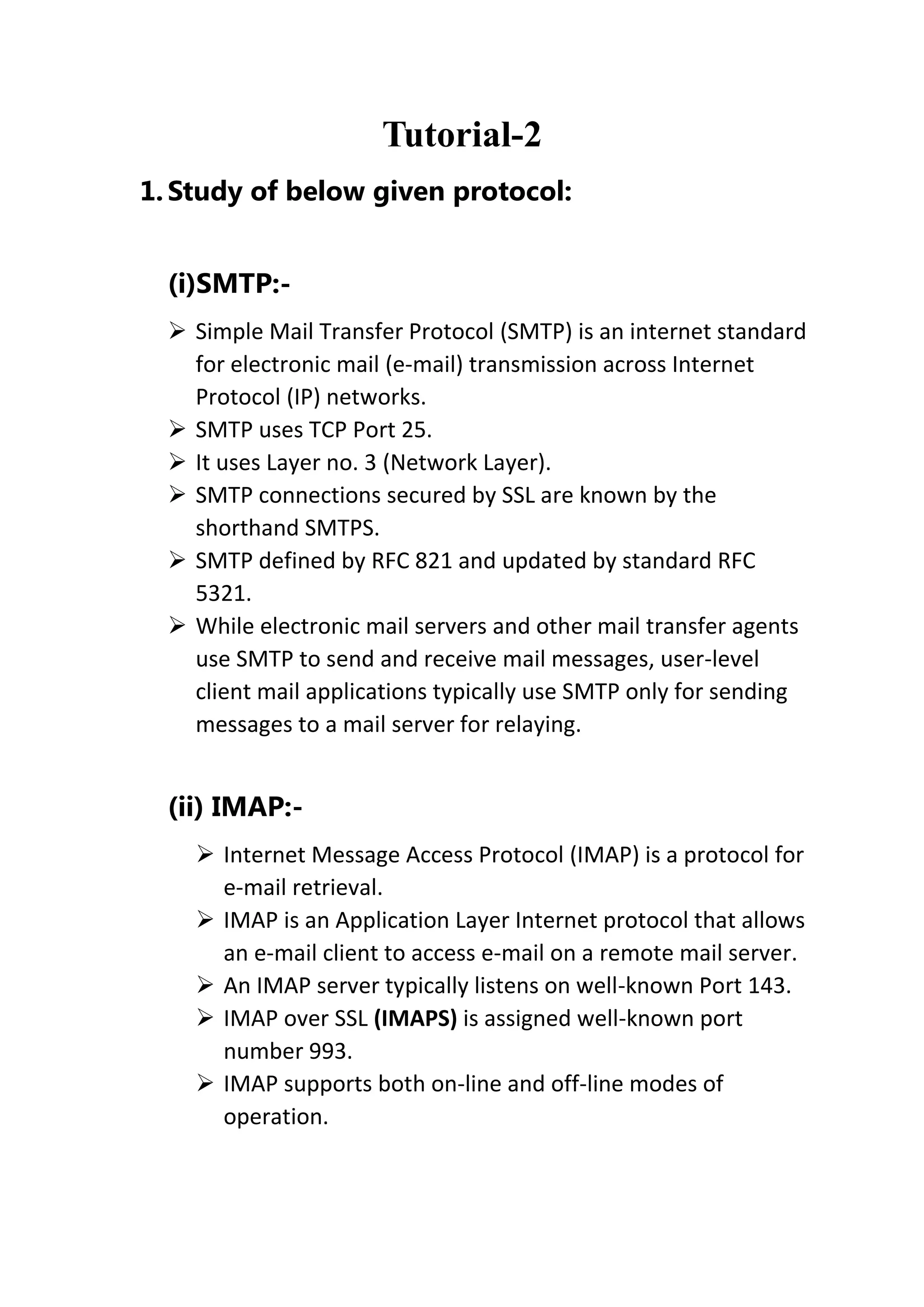
(i)SMTP: Simple Mail Transfer Protocol (SMTP) is an internet standard
for electronic mail (e-mail) transmission across Internet
Protocol (IP) networks.
 SMTP uses TCP Port 25.
 It uses Layer no. 3 (Network Layer).
 SMTP connections secured by SSL are known by the
shorthand SMTPS.
 SMTP defined by RFC 821 and updated by standard RFC
5321.
 While electronic mail servers and other mail transfer agents
use SMTP to send and receive mail messages, user-level
client mail applications typically use SMTP only for sending
messages to a mail server for relaying.

(ii) IMAP: Internet Message Access Protocol (IMAP) is a protocol for
e-mail retrieval.
 IMAP is an Application Layer Internet protocol that allows
an e-mail client to access e-mail on a remote mail server.
 An IMAP server typically listens on well-known Port 143.
 IMAP over SSL (IMAPS) is assigned well-known port
number 993.
 IMAP supports both on-line and off-line modes of
operation.
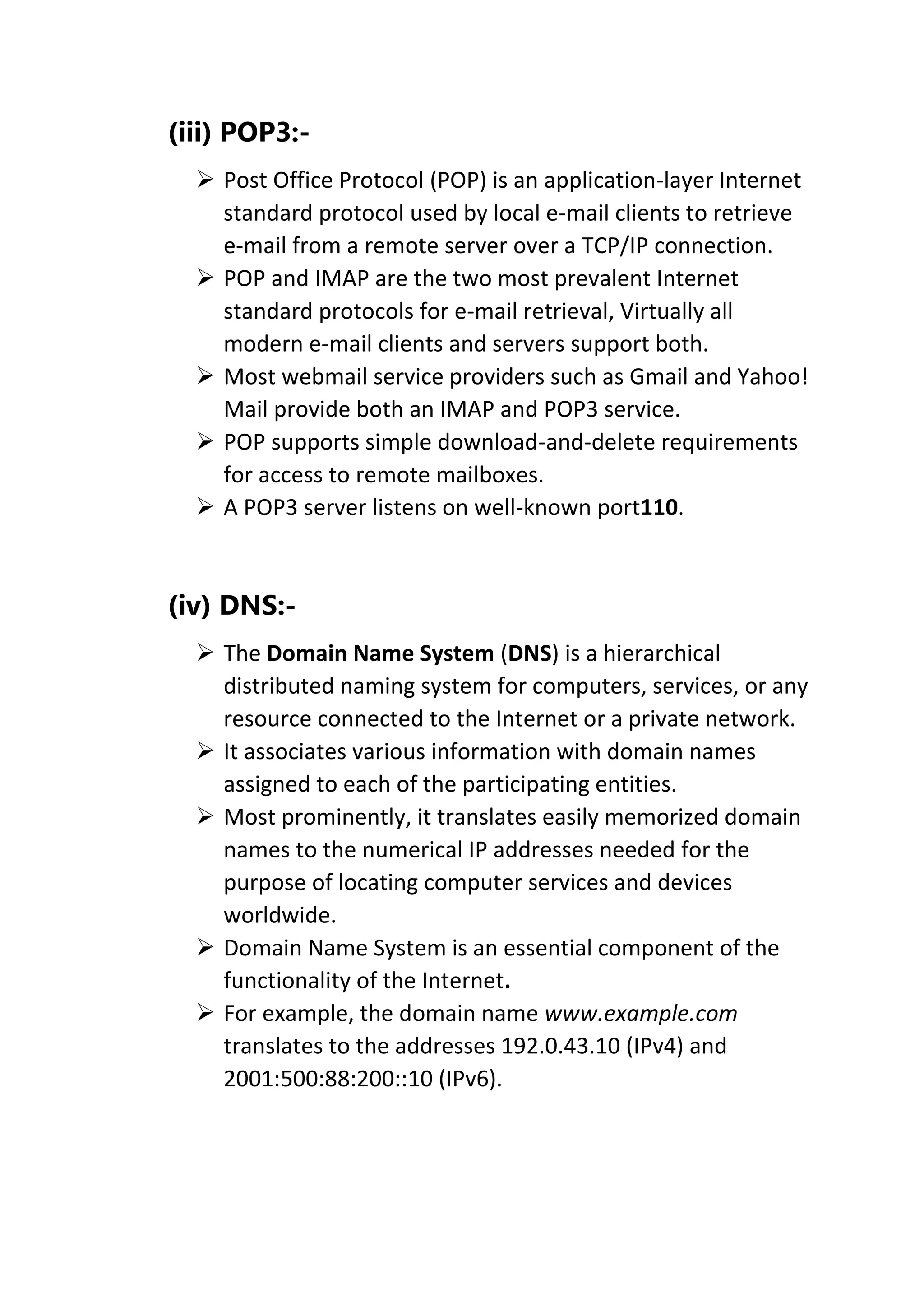
(iii) POP3: Post Office Protocol (POP) is an application-layer Internet
standard protocol used by local e-mail clients to retrieve
e-mail from a remote server over a TCP/IP connection.
 POP and IMAP are the two most prevalent Internet
standard protocols for e-mail retrieval, Virtually all
modern e-mail clients and servers support both.
 Most webmail service providers such as Gmail and Yahoo!
Mail provide both an IMAP and POP3 service.
 POP supports simple download-and-delete requirements
for access to remote mailboxes.
 A POP3 server listens on well-known port110.

(iv) DNS: The Domain Name System (DNS) is a hierarchical
distributed naming system for computers, services, or any
resource connected to the Internet or a private network.
 It associates various information with domain names
assigned to each of the participating entities.
 Most prominently, it translates easily memorized domain
names to the numerical IP addresses needed for the
purpose of locating computer services and devices
worldwide.
 Domain Name System is an essential component of the
functionality of the Internet.
 For example, the domain name www.example.com
translates to the addresses 192.0.43.10 (IPv4) and
2001:500:88:200::10 (IPv6).

Protocol

  • 1.
    Tutorial-2 1. Study ofbelow given protocol: (i)SMTP: Simple Mail Transfer Protocol (SMTP) is an internet standard for electronic mail (e-mail) transmission across Internet Protocol (IP) networks.  SMTP uses TCP Port 25.  It uses Layer no. 3 (Network Layer).  SMTP connections secured by SSL are known by the shorthand SMTPS.  SMTP defined by RFC 821 and updated by standard RFC 5321.  While electronic mail servers and other mail transfer agents use SMTP to send and receive mail messages, user-level client mail applications typically use SMTP only for sending messages to a mail server for relaying. (ii) IMAP: Internet Message Access Protocol (IMAP) is a protocol for e-mail retrieval.  IMAP is an Application Layer Internet protocol that allows an e-mail client to access e-mail on a remote mail server.  An IMAP server typically listens on well-known Port 143.  IMAP over SSL (IMAPS) is assigned well-known port number 993.  IMAP supports both on-line and off-line modes of operation.
  • 2.
    (iii) POP3: PostOffice Protocol (POP) is an application-layer Internet standard protocol used by local e-mail clients to retrieve e-mail from a remote server over a TCP/IP connection.  POP and IMAP are the two most prevalent Internet standard protocols for e-mail retrieval, Virtually all modern e-mail clients and servers support both.  Most webmail service providers such as Gmail and Yahoo! Mail provide both an IMAP and POP3 service.  POP supports simple download-and-delete requirements for access to remote mailboxes.  A POP3 server listens on well-known port110. (iv) DNS: The Domain Name System (DNS) is a hierarchical distributed naming system for computers, services, or any resource connected to the Internet or a private network.  It associates various information with domain names assigned to each of the participating entities.  Most prominently, it translates easily memorized domain names to the numerical IP addresses needed for the purpose of locating computer services and devices worldwide.  Domain Name System is an essential component of the functionality of the Internet.  For example, the domain name www.example.com translates to the addresses 192.0.43.10 (IPv4) and 2001:500:88:200::10 (IPv6).