Purification of lactate
dehydrogenase (LDH) from chicken
muscle


Gaurav Dutta Dwivedi
Hareesha Kakkera
Aim of the project

• The purpose of this experiment is
  to extract and purify LDH enzyme
  from chicken muscle using
  appropriate protein purification
  techniques.
Strategy applied for the
purification process
Techniques applied for achieving this:
• Centrifugation.
• Selective protein precipitation.
• Dialysis.
• Affinity chromatography.
Many different analytical methods were
employed to determine the presence, purity
and concentration of LDH such as activity
assays and SDS-PAGE.
The Protein:lactate dehydrogenase

In this course, we used lactate dehydrogenase
(LDH) as the subject of our studies.
It is an vital player in the anaerobic generation of
energy from glucose as well as in the synthesis of
glucose from lactate. It carry out the following
reaction:

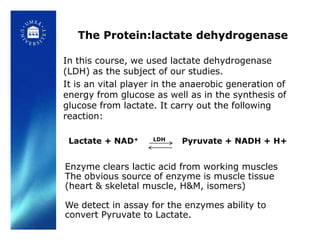
 Lactate + NAD+     LDH    Pyruvate + NADH + H+


Enzyme clears lactic acid from working muscles
The obvious source of enzyme is muscle tissue
(heart & skeletal muscle, H&M, isomers)

We detect in assay for the enzymes ability to
convert Pyruvate to Lactate.
Brief overview of the experiment
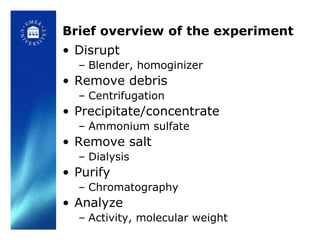
• Disrupt
  – Blender, homoginizer
• Remove debris
  – Centrifugation
• Precipitate/concentrate
  – Ammonium sulfate
• Remove salt
  – Dialysis
• Purify
  – Chromatography
• Analyze
  – Activity, molecular weight
Disrupt the cells
•We must start with a
tissue sample
containing the protein.

•Most proteins are
typically found within
a cell, so the tissue
must be subjected to a
homogenizing process
in order to break cell
walls and release
protein.
Remove debris
• Centrifugation of this extract
  at moderately high speeds
  sediments the nuclei,
  mitochondria, membranes
  and other insoluble material.
• The remainder of the
  purification is an attempt to
  separate the LDH contained in
  the clear supernatant from
  the other soluble proteins.
• The large centrifuge tube
  must then be balanced before
  it can be placed in the
  instrument; this is done using
  a separate tube filled with
  water and a pan balance.
Ammonium Sulfate ppt
• One of the most commonly used crude purification
  techniques involves the use of differential solubility.
• Proteins precipitate with increasing ammonium sulfate
  concentrations, with most proteins precipitating
  somewhere between 10% and 60% ammonium sulfate.
• This process depends on the physical or chemical
  interaction between the protein and the precipitating
  agent. In this lab, (NH4)2SO4 is used to precipitate out
  LDH.
Dialysis
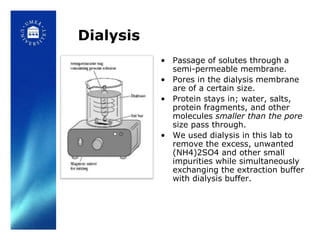
           • Passage of solutes through a
             semi-permeable membrane.
           • Pores in the dialysis membrane
             are of a certain size.
           • Protein stays in; water, salts,
             protein fragments, and other
             molecules smaller than the pore
             size pass through.
           • We used dialysis in this lab to
             remove the excess, unwanted
             (NH4)2SO4 and other small
             impurities while simultaneously
             exchanging the extraction buffer
             with dialysis buffer.
Affinity chromatography
• Most purification methods involve chromatography.
  Chromatographic methods involve a column of an
  insoluble material that can bind molecules based on
  specific properties common to proteins.
• The solution containing the mixture of proteins is
  then allowed to pass through the column; the
  protein of interest may bind (depending on its
  properties), while at least some impurities remain
  in solution and leave the column. The procedure is
  completed by eluting (i.e. “removing”) the proteins
  that have bound to the column.
• In this lab we used a Cibacron blue affinity column
  to purify LDH. This molecule mimics the shape and
  charge characteristics of pyridine nucleotides to
  which dehydrogenase proteins frequently bind to.
Analyzing the purity by SDS-
PAGE gel
• To determine which fractions from the
  chromatography contain the protein.
  SDS-PAGE gel electrophoresis is a good
  method to use for determining the purity
  of the protein.
• This method separates proteins according
  their molecular weight and length of
  polypeptide chain. Proteins all exhibit the
  same charge per unit mass due to the
  binding of SDS resulting in fractionation
  by size and mass.
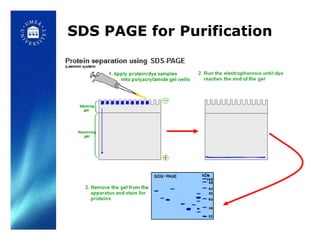
SDS PAGE for Purification
Result of the SDS-PAGE


          Purified protein band
Future strategies
• Performing a Western Blot analysis to
  confirm the presence of LDH in each
  sample and fraction.

• Expression of Lactate Dehydrogenase
  using recombinant DNA technology
  and use of various “tags”.

• Execute Colorimetric Assays for
  protein determination.

• Perform Gel filtration
  chromatography.
Long term objectives

• Recognize the interactions with its
  substrates by studying the enzyme
  kinetics.
• Perform protein crystallization to unravel
  the 3 D structure and relate its function
  and structure.
• Analyze the effects of an inhibitor, and
  studying the effects of chemical
  modification of the enzyme.
Application of lactate
dehydrogenase
• LDH is often used as a marker of
  tissue breakdown, therefore it can
  be used in detection of myocardial
  infarction, hemolysis.
• Variation in LDH isozymes profile
  might have a role in studying
  muscle response to training so its
  used in sports medicine.
Thank you !

Protein Purification

  • 2.
    Purification of lactate dehydrogenase(LDH) from chicken muscle Gaurav Dutta Dwivedi Hareesha Kakkera
  • 3.
    Aim of theproject • The purpose of this experiment is to extract and purify LDH enzyme from chicken muscle using appropriate protein purification techniques.
  • 4.
    Strategy applied forthe purification process Techniques applied for achieving this: • Centrifugation. • Selective protein precipitation. • Dialysis. • Affinity chromatography. Many different analytical methods were employed to determine the presence, purity and concentration of LDH such as activity assays and SDS-PAGE.
  • 5.
    The Protein:lactate dehydrogenase Inthis course, we used lactate dehydrogenase (LDH) as the subject of our studies. It is an vital player in the anaerobic generation of energy from glucose as well as in the synthesis of glucose from lactate. It carry out the following reaction: Lactate + NAD+ LDH Pyruvate + NADH + H+ Enzyme clears lactic acid from working muscles The obvious source of enzyme is muscle tissue (heart & skeletal muscle, H&M, isomers) We detect in assay for the enzymes ability to convert Pyruvate to Lactate.
  • 6.
    Brief overview ofthe experiment • Disrupt – Blender, homoginizer • Remove debris – Centrifugation • Precipitate/concentrate – Ammonium sulfate • Remove salt – Dialysis • Purify – Chromatography • Analyze – Activity, molecular weight
  • 7.
    Disrupt the cells •Wemust start with a tissue sample containing the protein. •Most proteins are typically found within a cell, so the tissue must be subjected to a homogenizing process in order to break cell walls and release protein.
  • 8.
    Remove debris • Centrifugationof this extract at moderately high speeds sediments the nuclei, mitochondria, membranes and other insoluble material. • The remainder of the purification is an attempt to separate the LDH contained in the clear supernatant from the other soluble proteins. • The large centrifuge tube must then be balanced before it can be placed in the instrument; this is done using a separate tube filled with water and a pan balance.
  • 9.
    Ammonium Sulfate ppt •One of the most commonly used crude purification techniques involves the use of differential solubility. • Proteins precipitate with increasing ammonium sulfate concentrations, with most proteins precipitating somewhere between 10% and 60% ammonium sulfate. • This process depends on the physical or chemical interaction between the protein and the precipitating agent. In this lab, (NH4)2SO4 is used to precipitate out LDH.
  • 10.
    Dialysis • Passage of solutes through a semi-permeable membrane. • Pores in the dialysis membrane are of a certain size. • Protein stays in; water, salts, protein fragments, and other molecules smaller than the pore size pass through. • We used dialysis in this lab to remove the excess, unwanted (NH4)2SO4 and other small impurities while simultaneously exchanging the extraction buffer with dialysis buffer.
  • 11.
    Affinity chromatography • Mostpurification methods involve chromatography. Chromatographic methods involve a column of an insoluble material that can bind molecules based on specific properties common to proteins. • The solution containing the mixture of proteins is then allowed to pass through the column; the protein of interest may bind (depending on its properties), while at least some impurities remain in solution and leave the column. The procedure is completed by eluting (i.e. “removing”) the proteins that have bound to the column. • In this lab we used a Cibacron blue affinity column to purify LDH. This molecule mimics the shape and charge characteristics of pyridine nucleotides to which dehydrogenase proteins frequently bind to.
  • 12.
    Analyzing the purityby SDS- PAGE gel • To determine which fractions from the chromatography contain the protein. SDS-PAGE gel electrophoresis is a good method to use for determining the purity of the protein. • This method separates proteins according their molecular weight and length of polypeptide chain. Proteins all exhibit the same charge per unit mass due to the binding of SDS resulting in fractionation by size and mass.
  • 13.
    SDS PAGE forPurification
  • 14.
    Result of theSDS-PAGE Purified protein band
  • 15.
    Future strategies • Performinga Western Blot analysis to confirm the presence of LDH in each sample and fraction. • Expression of Lactate Dehydrogenase using recombinant DNA technology and use of various “tags”. • Execute Colorimetric Assays for protein determination. • Perform Gel filtration chromatography.
  • 16.
    Long term objectives •Recognize the interactions with its substrates by studying the enzyme kinetics. • Perform protein crystallization to unravel the 3 D structure and relate its function and structure. • Analyze the effects of an inhibitor, and studying the effects of chemical modification of the enzyme.
  • 17.
    Application of lactate dehydrogenase •LDH is often used as a marker of tissue breakdown, therefore it can be used in detection of myocardial infarction, hemolysis. • Variation in LDH isozymes profile might have a role in studying muscle response to training so its used in sports medicine.
  • 18.